Friday October 27, 2017

I feel strangely related to the “Uncle Matt” character on Fraggle Rock, as if he and I were kin. “I’m traveling on my greatest adventure,” writes the bearded ethnographer toward the beginning of the show’s first episode. “So much to explore.” Part of me wishes to adopt as my handle from today onward the name “Traveling Matt.” After all, the first creature this character discovers along his journey into “outer space” is a four-legged beast named Sprocket. A light bulb goes on in my head: Fraggles are post-scarcity acid-heads! Characters like Gobo are like me. They seek advice not from the I Ching, but from a conglomerate entity known as the “Talking Trash-Heap.” Isn’t this similar to my use of the bins at the local Goodwill? (Trash-Heap, by the way, would be the Halloween costume to end all Halloween costumes.) Consider, though, the many psychedelic dimensions of Fraggle Rock: the Fraggles themselves are all stoners and acid-heads, their hair tie-dyed and frazzled. The Beast is asleep, whispers Gobo as he tiptoes past the upstairs inventor’s canine companion. Dogs, by some synchronistic logic, keep cropping up everywhere I turn. The show, I either realize or decide, is the script of my auto-psychobiography. I watched many of its episodes multiple times as a kid. Each episode begins with the mobile prosthetic consciousness known as the “camera-eye” gliding invisibly through the glass threshold separating exterior reality from its interior. Like Plato’s Cave Allegory, in other words, the show’s narrative unfolds across multiple levels. In Episode 2, a bongo-playing Fraggle sings about migration of consciousness via the magic of the jump-cut along that looped, ‘Möbius-Strip’ continuum that lesser minds divide into discrete domains denoted by the terms “here” and “there.” I know, too, from Brian Jay Jones’s biography that Henson “enjoyed a little grass” from time to time. Henson is also reported to have taken acid once, in the company of his friends Don Sahlin and Jerry Nelson — though he claimed in retrospect that the drug never took effect. Jones notes that the musicians featured in Henson’s short film Youth 68 praised acid’s positive effects when Henson interviewed them. After seeing Marty Balin of Jefferson Airplane (the long-haired dude with the toy pistol) suggest, mid-film, that the baby boomers will have to “do an Oedipus on their fathers,” I believe it.

The book also recounts how Henson planned to create a psychedelic nightclub called Cyclia in the late sixties. The idea for it came to him, says Henson’s wife Jane, “during the first wave of psychedelia. Jim went to see Jefferson Airplane and he was very intrigued with it — the light shows and the psychedelic graphics.” The nightclub, which Henson imagined housing in a geodesic dome or an inflatable structure at the foot of the Queensboro Bridge, was to have walls, floor, and ceiling “broken into faceted, crystal-like shapes onto which films would be projected” (Jones). Alas, none of these plans ever came to fruition — but I like to think that there’s a parallel universe — an “outer space,” so to speak — where they did.

Wednesday October 25, 2017

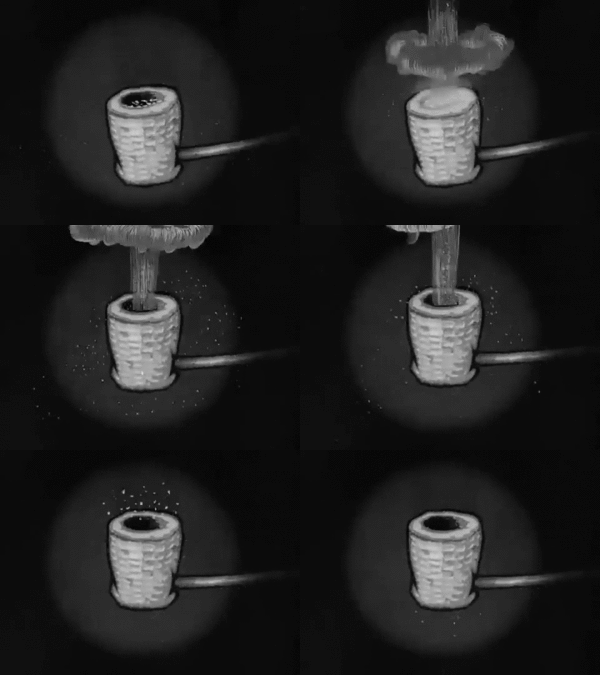
Weed helps turn profound emptiness and sadness into lovers lying in bed reminiscing about old apartments, old friends and neighbors, in honor of one of the common threads running throughout the couple’s life together, their dearly departed four-legged companion. Daphne was our greatest collaboration. The one constant. The supreme embodiment of the life Sarah and I built together. The two of us never had the money to own a home or raise kids. But Daphne made up for those. Her bunny hop. Her reverse sneezes. The way she used to urge us to play with her by pushing tennis balls at us with her snout. She was a weird, wild, autonomous little being who nevertheless loved us unconditionally and, through her evolving behavior and personality, reflected back to us traces of our own. “Death is so fucked up, though,” as Sarah said on our way to a park yesterday. There’s no way of relating to death that feels appropriate. I can certainly understand how one could find comfort in the belief that consciousness persists beyond death — some part of Daphne, for instance, watching over us from above, audience to our existence. When I entertain this thought, Sarah sternly interjects, “But she’s not! She’s just dead.” But why are we Marxists so quick to condemn delusion? Since when has truth ever set us free? I’ll admit: when a copy of Alice Coltrane’s Journey in Satchidananda turned up on vinyl in the bins at Goodwill yesterday, part of me was convinced that Daphne had gifted it to me to cheer me up.

Alice Coltrane

I don’t see any harm in temporary alleviation of suffering, even if it comes via dream. For the latter open up vistas, abstractions of geometric space, into which minds may wander. The private language of the autopilot black hole. Sarah and I arrived at a realization along our walk. A new sense of the potential life we might live, were it not for debt. A new sense of the stakes of what might be. The challenge now will be to find a way to demand from reality the future we want, and to do so quickly, as clocks are ticking.

Tuesday August 29, 2017

You’ll never catch me declaring, like Mary Boykin Chesnut into her Civil War diary, “My subjective days are over.” Something tells me, “Mists of memory are where we’re touched by the better angels of nature” — though not the ones spoken of by Lincoln. Mingled feelings of joy and sorrow. How have I escaped knowing all of these articles exist with titles like, “Are we headed for a second civil war?” The believers in magic are the ones who seize the day. “Today,” writes Robin Wright, “few civil wars involve pitched battles from trenches along neat geographic front lines. Many are low-intensity conflicts with episodic violence in constantly moving locales.” Perhaps I should revise a syllabus and assign Omar El Akkad’s novel American War. Nah, just kidding. That book sounds like a piece of shit. I worry, too, that a story like that may, in its telling, inspire people to buy more guns. My sense is that ideological opponents are already waging the war, precisely by trying to implant the war, as aggregate of instances and images, into the nation’s dominant narrative. Period dramas set in the seventies like The Deuce, meanwhile, no longer even attempt to approximate that former decade’s forms. Exhausted internally from work, I stare befuddled at the image-screen in front of me. Inauthentic, overacted: words begin to lose their meaning. Tide comes in and mutters, “Repair to the great outdoors.” The lone wolf dies, but the pack survives. Global warming will melt polar ice caps, says Game of Thrones, and the dead will walk the earth. Remember when the political community used to use the phrase “existential threat”? I kinda think that would make a good band name. Also, let’s hear it for all the Popeyes out there who like to eat cans of spinach. Let us each do as we’re each obliged, AKA “I yam what I yam.” “The evidence is circumstantial,” says Sensi Seeds, “but it is there, and when added together it presents a compelling picture that, for many readers at least, Popeye’s strength-giving spinach is … a clear metaphor for the miraculous powers of marijuana.” Before “Broccoli,” there was “The Spinach Song.” Of course, Julia Lee, famed performer of the latter, sometimes also just came out and said it, as in this more explicit version of her elegantly debauched classic, “Lotus Blossom.” The keys to the Kingdom are there for the taking, hidden only to those who refuse to look and listen.

Pipe