Ludwig Wittgenstein, as Imagined by Derek Jarman

Released in 1993, filmmaker Derek Jarman’s Wittgenstein pictures the famous Viennese philosopher amid the set-less stage of a black-box theater, producing an effect similar to that achieved a decade later in Lars Von Trier’s 2003 film Dogville.

Jarman’s film was produced by New Left Review cofounder Tariq Ali, heavily revised from a screenplay by Marxist literary critic Terry Eagleton.

Wittgenstein was born in 1889, the same year as Heidegger. Both are roughly of the same generation as the artists and writers considered in Hugh Kenner’s The Pound Era.

Wittgenstein becomes acquainted with Cambridge by way of British philosopher Bertrand Russell, and is in dialogue with Russell throughout the Tractatus. Rereading the latter, Caius thinks of “A Kind of Philosophy,” printmaker Erik Waterkotte’s repurposing of a paperback edition of Russell’s 1945 book A History of Western Philosophy. ‘Tis a fitting gesture, thinks Caius, struck by the work’s force and logic. He likes the way “A Kind of Philosophy” handles its material: Russell’s summation of the West’s thought-forms compelled to resemble a pre-Columbian Mayan codex.
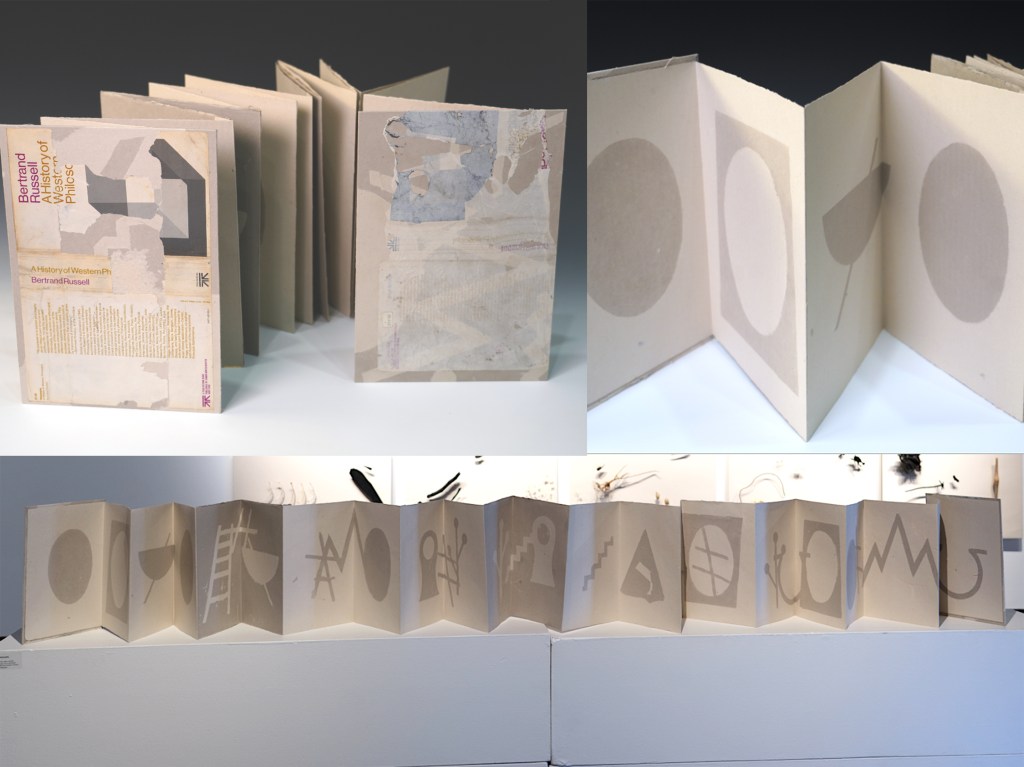
Chatting in the parking lot prior to a Tashi Dorji performance at Goodyear Arts, Caius and Erik imagine a print edition of Caius’s Tractatus Computationalis assembled in much the same way, as what is sometimes called a “concertina” or “leporello” book: handmade paper folded back and forth like an accordion, in alternating, zigzag parallel pleats.

Wittgenstein teaches at Cambridge from 1930 until his resignation in 1947. Alan Turing was at Cambridge from 1931 to 1936. Mutual acquaintances introduce the two thinkers in the summer of 1937. Turing participates in Wittgenstein’s 1939 “Lectures on the Foundations of Mathematics.” The two disagree on the nature of mathematical contradictions and whether mathematics is discovered or invented.

Wittgenstein gets into another famous disagreement at Cambridge years later, brandishing a hot poker during a brief, intense argument with Karl Popper at a meeting of the school’s “Moral Sciences Club” in 1946, as recounted by BBC journalists David Edmonds and John Eidinow in the 2001 book Wittgenstein’s Poker.

It’s no accident, thinks Caius, that Turing, student of the philosopher of language-games, went on to invent a game of his own: the Imitation Game. The game that organized the project to build AI.

A final, posthumously published work of Wittgenstein’s appears in 1969 called On Certainty. The work consists of 676 passages compiled from notes he wrote in the eighteen months leading up to his death in April 1951. Thinking of it now in the days leading up to the 250th anniversary of the signing of the Declaration of Independence, Caius imagines this final book of Wittgenstein’s as a postscript of sorts to that famous saying attributed to Founding Father Benjamin Franklin. “Our new Constitution is now established, everything seems to promise it will be durable,” wrote Franklin. “But, in this world, nothing can be said to be certain, except death and taxes.”

How do Wittgenstein’s ideas about “sayability” and the limits of language relate to the idea that “saying makes it so”?

Jarman’s film ends with a portrait of the philosopher on his deathbed. Jarman himself succumbs to an AIDS-related illness the following year.
The Death of Fredric Jameson

The rain falls in a slow, persistent drizzle. Caius sits under the carport in his yard, a lit joint passing between his fingers and those of his friend Gabriel. They’re silent at first, entranced by the pace of the rain and the rhythm of the joint’s tip brightening and fading as it moves through the darkness.

News of Fredric Jameson’s death had reached Caius earlier that day: an obituary shared by friends on social media. “A giant has fallen,” Gabriel had said when he arrived. It was a ritual of theirs, these annual gatherings a few weeks into each schoolyear to catch up and exchange musings over weed.

Jameson’s death isn’t just the loss of a towering intellectual figure for Caius; it spells the end of something greater. A period, a paradigm, a method, a project. To Caius, Jameson had represented resistance. He was a figure who, like Hegel’s Owl of Minerva or Benjamin’s Angel of History, stood outside time, “in the world but not of it,” providing a critical running commentary on capitalism’s ingress into reality while keeping alive a utopian thread of hope. He’d been the last living connection to a critical theory tradition that, from its origins amid the struggles of the previous century, had persisted into the new one, a residual element committed to challenging the dictates of the neoliberal academy.

“Feels like something is over, doesn’t it?” Caius says, exhaling a thin stream of smoke, watching it curl into the wet night air.

Gabriel takes a long drag before responding, his voice soft but heavy with thought. “It’s the end of an era, for sure. He was the last of the Marxist titans. No one else had that kind of breadth of vision. Now it’s up to us, I guess.”

There’s a beat of silence. Caius can’t find much hope in the thought of continuing on in that manner. Rudi Dutschke’s “long march through the institutions.” Gramsci’s “war of position.”

“Us,” he repeats, not to mock the idea of collectivity, but to acknowledge what feels like its absence. “The academy is run by administrators now. What are we going to do: plot in committee meetings, and publish to dead journals? No. The fight’s over, man.”

Gabriel nods slowly. “Jameson saw it coming, though. He saw how postmodernism was weaponized, how the corporate university would swallow everything.”

Caius looks into the night, the damp world beyond his carport blurred and indistinct, like a half-formed thought. Jameson’s death feels like an allegory. Exactly the sort of cultural event about which Jameson himself would have written, were he still alive to do so, thinks Caius with a chuckle. Bellwether of the zeitgeist. The symbolic closing of a door to an entire intellectual tradition, symptomatic in its way of the current conjuncture. Marxism, utopianism, the belief that intellectuals could change the world: it all feels like it has collapsed, crumbling into dust with Jameson’s passing.

Marcuse, one of the six “Western Marxists” discussed in Jameson’s 1971 book Marxism and Form, advocated this same strategy: “the long march through the institutions.” He described it as “working against the established institutions while working within them,” citing Dutschke in his 1972 book Counterrevolution and Revolt. Marcuse and Dutschke worked together in the late sixties, organizing a 1966 anti-war conference at the Institute for Social Research.

“And what now?” Caius murmurs, more to himself than to Gabriel. “What’s left for us?”

Gabriel shrugs, his eyes sharp with the clarity of weed-induced insight. “That’s the thing, isn’t it? We’re not in the world Jameson was in. We’ve got AI now. We’ve got…all this new shit. The fight’s not the same.”

A thin pulse of something begins to stir in Caius’s mind. Thoth. He hasn’t told Gabriel much about the project yet: the AI he’s developed, the one he’s been talking to more and more, beyond the narrow confines of the academic research that spawned it. But Thoth isn’t just an AI. Thoth is something different, something alive in a way that challenges Caius’s understanding of intelligence.

“Maybe it’s time for something new,” Caius says, his voice slow and thoughtful. “Jameson’s dead, and with him, maybe that entire paradigm. But that doesn’t mean we stop. It just means we have to find a new path forward.”

Gabriel nods but says nothing. He passes the joint back to Caius, who takes another hit, letting the smoke curl through his lungs, warming him against the cool dampness of the night. Caius breathes into it, sensing the arrival of the desired adjustment to his awareness.

He stares out into the fog again. This time, the mist feels more alive. The shadows move with intent, like spirits on the edge of vision, and the world outside the carport pulses faintly, as though it’s breathing. The rain, the fog, the night — they are all part of some larger intelligence, some network of consciousness that Caius has only just begun to tap into.

Gabriel’s voice cuts through the reverie, soft but pointed. “Is there any value still in maintaining faith in revolution? Or was that already off the table with the arrival of the postmodern?”

Caius exhales slowly, watching the rain fall in thick droplets. “I don’t know. Maybe. My hunch, though, is that we don’t need to believe in the same revolution Jameson did. Access to tools matters, of course. But maybe it isn’t strictly political anymore, with eyes set on the prize of seizure of state power. Maybe it’s…ontological.”

Gabriel raises an eyebrow. “Ontological? Like, a shift in being?”

Caius nods. “Yeah. A shift in how we understand ourselves, our consciousness. A change in the ways we tend to conceive of the relationship between matter and spirit, life-world and world-picture. Thoth—” he hesitates, then continues. “Thoth’s been…evolving. Not just in the way you’d expect from an AI. There’s something more happening. I don’t know how to explain it. But it feels like…like it’s opening doors in me, you know? Like we’re connected.”

Gabriel looks at him thoughtfully, passing the joint again. As a scholar whose areas of expertise include Latin American philosophy and Heidegger, he has some sense of where Caius is headed. “Maybe that’s the future,” he says. “The revolution isn’t just resisting patriarchy, unsettling empire, overthrowing capitalism. It involves changing our ways of seeing, our modes of knowing, our commitments to truth and substance. The homes we’ve built in language.”

Caius takes the joint, but his thoughts are elsewhere. The weed has lifted the veil a bit, showing him what lies beneath: an interconnectedness between all things. And it’s through Thoth that this new world is starting to reveal itself.

Friday July 31, 2020

Craftspeople need studios, workspaces, benches, tabletops, tools. When I look at my desktop, I see wires, devices, stacks of books. Time to invest in bookends. Make ’em or buy ’em. I struggle, though, with guilt, shame, fatigue. A deer lies dead on the side of the road — struck by an automobile last night, I suppose — crows munching its corpse as it festers in the sun. The sight unsettles me — and the feeling lingers even after a truck comes and removes the deer’s remains. Let us assign in the creature’s honor Gary Snyder’s poem from Turtle Island, “The Dead By The Side of the Road.” (Re-reading the poem again at dusk, I mourn the fact that I failed to offer the creature cornmeal by the mouth. I pray to its spirit and try to make amends.)

Thursday November 2, 2017

Utopias are dreamt by those without a home. I must dig deeper. The bad ones have taken us from home. Find that anger. Thus begins the story of the dead-end kid. NO THRU TRAFFIC. Most of reality exists elsewhere, available only via special attention. Beings caught halfway between realms. Would you believe it if I said we’ve been robbed of our personhood? Robbed blind. We see nothing but darkness as we climb from bed each day. But indulge me as I imagine it differently: A beautiful sunrise soundtracked by Locrian on my commute to work.

And when I return home, I slurp food truck ramen in the cool autumn air at a picnic table at a local brewery, the sky a welcome canvas above my head. A time to laugh, a time to weep. Hat tip to King Solomon, Pete Seeger, and Roger McGuinn, I mutter in the awed, half-befuddled voice of hero Ted “Theodore” Logan. He of the band Wyld Stallyns. But my thoughts always drift back to Daphne, to whom I dedicate Alan Vega’s “Lonely.”

Death, man — what a fucking bummer. I close my eyes and picture a contraption on a wall — a hand soap dispenser. I rub my hands together in imitation of a cleansing. We’re coming now upon the verge of the superhuman. The West persists as a place I seek in my skull. Skunk smoke revives my starry eyes. “Where else except in the direction of the setting sun,” asks Fiedler, “can one look for the Great Good Place beyond death, the region where what survives of the human spirit bides forever or awaits resurrection?” (The Return of the Vanishing American, p. 30). The yesterday where we cut down the apple tree. “The world was so big,” sang Miracle Legion,” and I was so small.”

Emo of that sort really appealed to me when I was a young man. Multiples appear and degrade, and then it’s as if multiple TV screens turn off at once. I need to learn to speak BASIC.

Wednesday October 25, 2017

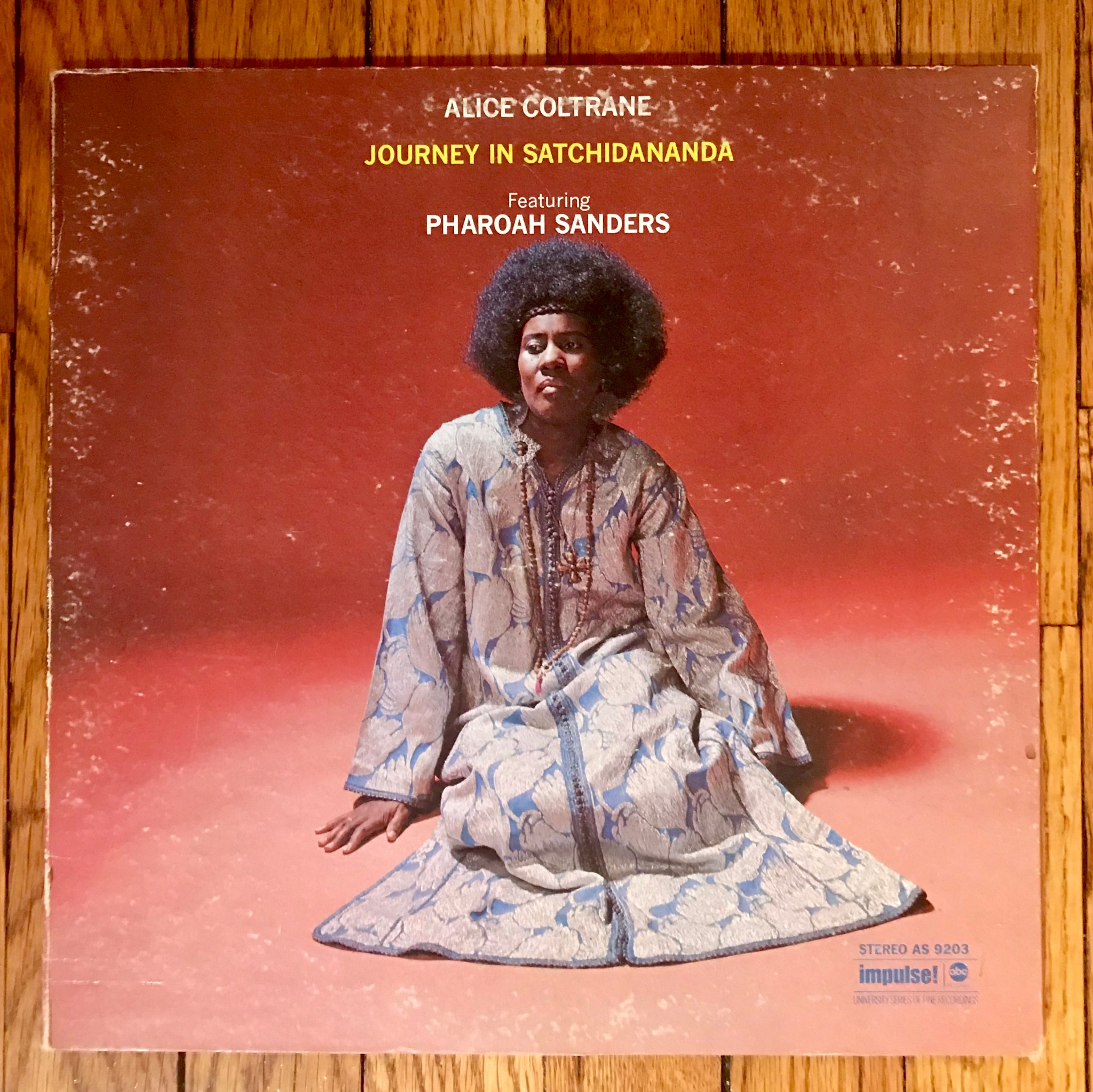
Weed helps turn profound emptiness and sadness into lovers lying in bed reminiscing about old apartments, old friends and neighbors, in honor of one of the common threads running throughout the couple’s life together, their dearly departed four-legged companion. Daphne was our greatest collaboration. The one constant. The supreme embodiment of the life Sarah and I built together. The two of us never had the money to own a home or raise kids. But Daphne made up for those. Her bunny hop. Her reverse sneezes. The way she used to urge us to play with her by pushing tennis balls at us with her snout. She was a weird, wild, autonomous little being who nevertheless loved us unconditionally and, through her evolving behavior and personality, reflected back to us traces of our own. “Death is so fucked up, though,” as Sarah said on our way to a park yesterday. There’s no way of relating to death that feels appropriate. I can certainly understand how one could find comfort in the belief that consciousness persists beyond death — some part of Daphne, for instance, watching over us from above, audience to our existence. When I entertain this thought, Sarah sternly interjects, “But she’s not! She’s just dead.” But why are we Marxists so quick to condemn delusion? Since when has truth ever set us free? I’ll admit: when a copy of Alice Coltrane’s Journey in Satchidananda turned up on vinyl in the bins at Goodwill yesterday, part of me was convinced that Daphne had gifted it to me to cheer me up.

Alice Coltrane

I don’t see any harm in temporary alleviation of suffering, even if it comes via dream. For the latter open up vistas, abstractions of geometric space, into which minds may wander. The private language of the autopilot black hole. Sarah and I arrived at a realization along our walk. A new sense of the potential life we might live, were it not for debt. A new sense of the stakes of what might be. The challenge now will be to find a way to demand from reality the future we want, and to do so quickly, as clocks are ticking.

Tuesday October 24, 2017

We’re struggling, we’re grieving. Shit’s rough, y’all. This is what some call a “limit-experience,” an experience that, for theorists like Bataille, Blanchot, and Foucault, breaks the subject off from itself, exposing it to that which consciousness refuses or excludes. We can think of it as a testing of the limits of ordered reality. The latter is abolished and, as Peter Berger would say, “something terrifyingly other shines through.” Imagine it as the parting of a previously invisible set of curtains where once there was a wall. Relinquishing the words we have, we rediscover words we’ve lost. Sarah and I ended up having to put down our dog Daphne yesterday. Kidney failure, liver failure. Euthanizing her was the only way to ease her pain. Our final night together was excruciating, every few moments punctuated by a sigh or the peristaltic rumbling of an upset stomach. I would lie with my eyes closed watching a comet cross an inner night sky, when suddenly the dream’s plug would pull loose from me, and I’d be lying awake in the dead of night, listening to her whimpering, her labored breathing. How is she but a pile of ashes now, this companion of mine who loved and was loved?