Tao Lin floats an interesting alternative history in his new book Trip—one that begins with worship of goddesses among our hunter-gatherer ancestors approximately 7,000 years ago. He relies for this account on controversial works like Riane Eisler’s The Chalice and the Blade, where historical societies are of two primary kinds: those organized according to principles of either domination or partnership. Upon my return from Los Angeles, I plan to make regular use of my new employer’s library. Along with Eisler’s book, I plan to grab Gary Lachman’s new book Dark Star Rising, a collection from Pluto Press called Voices of 1968: Documents from the Global North, and Marshall Sahlins’s Stone-Age Economics. I’m interested in the Pluto Press collection for its section on ‘60s Dutch “provo” Ole Grünbaum. Teenage boys sitting across from me at the airport brag about “roasting” some “random person” who has logged more than 5,000 hours in a single online video game. Together they resemble the cast of Stranger Things. The chaperoning mom rouses to deliver a “parenting” speech, the gist of which is to remind the boys to make smart choices; otherwise, she warns, she will “bring out the whip and bring down the hammer.” The boys chuckle at this, aware already of sexual innuendo, but still discomforted enough by it as to feel the need to mock it. “Wait, ‘the whip’? What’s ‘the whip’?” “Don’t cross me,” the mom fires back, “or I’ll be your worst nightmare.” “Ask this guy,” she ends, pointing to her son. On the plane afterwards, thousands of feet above the earth, my thoughts collect around the history of Enochian Magic. “Check out Sex and Rockets,” I remind myself, by which I mean a recently updated book on occult rocket scientist Jack Parsons. Make sure as well to read Kathleen Harrison’s essay in Sisters of the Extreme. Following Harrison’s ex-husband Terence McKenna, Lin posits fractal geometry as an important feature, an important characteristic, complement, or component, of psychedelic experience. Several hours later, I sigh deeply and the plane begins its descent. Back to the rainy, grey, fallen reality of the East Coast.
Friday June 8, 2018
Alien sirens heard from the depths of a hypnagogic state. The clock reads 10:04, like the Ben Lerner novel, as Sarah and I discuss our plans for the day. “Reviewing the itinerary,” copiloting with Google Maps: these activities bore me, but the structure of Los Angeles demands them. Upon exiting the Westin Bonaventure, Sarah says offhandedly, over her shoulder, “seems like a death trap.” We agree that, in many respects, Jameson’s discussion of the Bonaventure in his famous “Postmodernism” essay captures the phenomenological reality of the building perfectly: the ride in the elevator especially, rising up on the exterior skin of the building to a height above the city, followed by the delirious descent down again, the elevator plunging through the glass roof of the building’s atrium before coming to a stop atop a glimmering pool of water at the base of the building’s depths. Athanasius Kircher enters our thoughts as we continue our journey through the city. We encounter accounts of his accomplishments at the Museum of Jurassic Technology on our final afternoon in LA. Afterwards, at our Airbnb, I observe that our tiny home has been enlivened, made beautiful by play of sunlight, flower- and leaf-patterned pillowcases stacked casually at the head of the futon by the floor, windows beside the entrance to the home opened vertically to allow in vast, multi-sourced birdsong, the music of the host couple’s garden.
Tuesday June 5, 2018
Leaves rustle under the furtive gestures of shadow-hidden animal neighbors. I sit and smoke beneath Christmas lights strung through the low-lying branches of a bottlebrush tree the evening after my arrival at my second Airbnb in LA: a stucco-walled proto-“tiny home” / poolside cabana in the hills above Silver Lake. This vacation has been wonderful. Sarah and I wake each morning as we usually do, excited to embark on new adventures, only more so. Days allow for unanticipated surprises, course corrections, getaways from routine—and with these, learning and growth: insightful conversations with fellow psychonauts, one an ayahuascsa user, another a mushroom enthusiast; breakthroughs on the research end; delicious meals at restaurants like Joy and Dune; time to swim, time to drip dry while lounging in the sun; cool discoveries in the occult sections of bookstores. If our careers can be made to allow it, I think, we should move here. Demand the impossible. Grow toward the light.
Saturday June 2, 2018
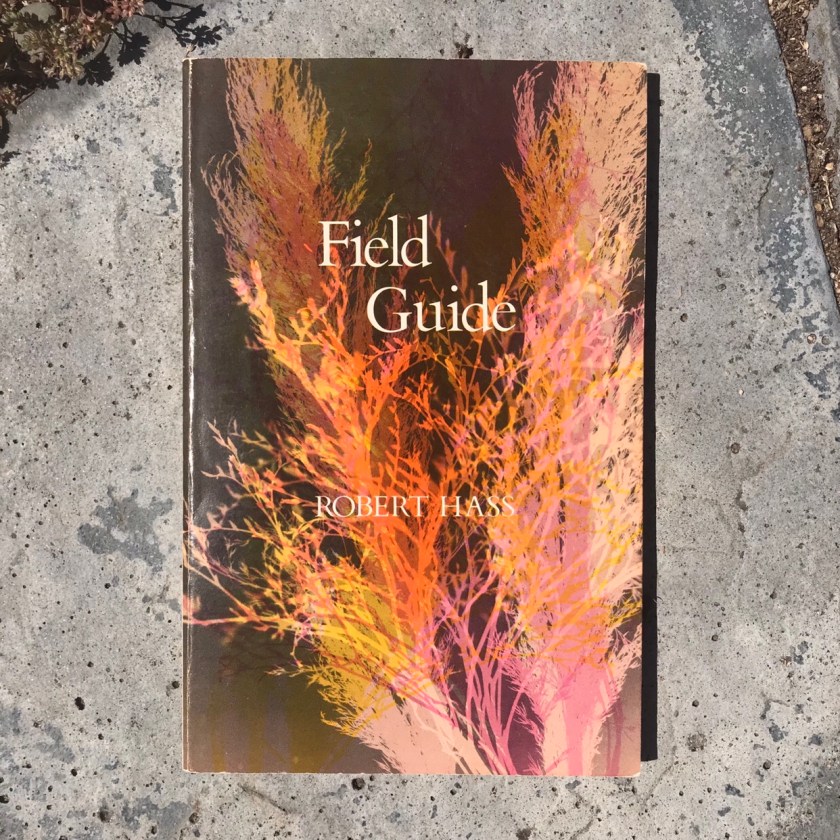
Pods unzip and out burst bundles of sealed lavender flower heads. Introducing Robert Hass’s Field Guide, I would tell students, “It matters where you read this,” the slim volume of poems held up for demonstration purposes, waved lightly between thumb and forefinger in front of me. “Read properly, these poems cast spells. What do I mean by that, you ask? I mean, used deliberately, in the sun, after walks through Australian and jungle gardens, after swimming and breathing exercises, beneath a bleached California sky, these poems are tools for the alteration of consciousness.”
Friday June 1, 2018
An old friend and I smoked together a few evenings ago in his beautiful downtown LA penthouse. As the weed kicked in, the friend mentioned Milton Rokeach’s The Three Christs of Ypsilanti: a book-length psychiatric study of an experiment of dubious ethicality involving a group of men suffering from paranoid schizophrenia. As the title indicates, Rokeach’s experiment brought together three patients with seemingly incompatible belief systems, each man convinced he was Christ, in the hope that these confrontations would cure them of their delusions. In the minutes and hours that followed in this friend’s penthouse, some sort of spiritual-metaphysical mythos or meaning-system crystallized for me around that detail. Next thing I knew, I had tumbled down a rabbit hole into a paranoid fantasy: a weird, apocalyptic tale woven around my soul, and thus discernible only by me, with plot points borrowed from The Stand and Miracle Mile — stories this friend and I encountered together and bonded over as teenagers. Milton’s Paradise Lost figured in there as well. Sarah was present through all of this, pleading my case with me, but I couldn’t shake the intuition that I was in the presence of some high-stakes decision tree. There I was like Adam, lacking the knowledge of good and evil needed to discern friend from foe, but convinced (because of what? the weed? my economic condition? my Catholic upbringing? my fear of dying?) that someone must be a foe, someone must be scheming to steal my happiness. Given this conviction, it seemed inevitable that I was damned either way, buckling under the strain of an impossible choice, an impossible demand. Perhaps, though, I’ve tried to tell myself afterwards, it is by this conviction and it alone that Satan is hypothesized and granted being. Or as Sartre once said, “Evil is making abstract that which is concrete.” Once we choose, of course, the paranoid condition evaporates. We become whole again, the psyche no mere compromise-formation Jerry-rigged by characters installed through socialization, the ones Freud called the Superego and the Id. The Real in which these characters are nested needn’t be defined as a tragic one. Behave lovingly and one is saved.
Wednesday May 30, 2018
Before arriving to the thing itself, I instruct myself to regard the 9-acre suite of Japanese gardens on the grounds of the Huntington not only in cynical terms, as a tourist site and a marker of social status, but also in more hopeful terms, as a site for encounter and self-actualization: manifestations, in other words, of Amida Buddha’s Western Paradise, enabling rebirth on a path toward enlightenment. Our observations, these gardens teach us, are always contingent, based on changing points of view. In the library itself, I request access to the “Aldous Huxley Oral History Papers, 1985-1990” and several rare books by Huxley’s friend and fellow mystic Gerald Heard. I also browse old issues of a journal called Aldous Huxley Annual. Consciousness airdrops into an altogether different Earth, however, some postindustrial world, an Earth of a different geological period, once the Subject exits the library and actually enters, sets foot into, the desert garden. Curvilinear profusion, flesh of the Earth thorny, prickly, and hairy. Morning doves and amber-bellied fox squirrels in the trees, lizards scurrying up the torsos of cacti. This is my Utopia, my garden at the end of time: this hot, wet, earthy, noisy, citrusy, fruit-bearing, sun-absorbing, multi-scented surround. I’m swept with the conviction in this moment that, whatever the details of this Utopia (apart from “full communism now”), our presence in it should be airy, minimal — an attentiveness to life’s formal richness that nonetheless remains light in its imprint. Let us be great lovers, tending only to our role as gardeners, nurturers, machines of loving grace, I’s who preside over the self-presentation of being. In these gardens and their surrounding bungalow heavens, this gift, this experience my love has given to me, LA prefigures its nickname “City of Angels.”
Tuesday May 29, 2018
After landing and grabbing a quick lunch at an In-N-Out Burger near LAX, we drop off our bags at our Airbnb, a pretty little poolside cottage a short walk from the Huntington, and begin to tour the city. Everything near and far looks amazing here in Pasadena: the trees, the hills, the restaurants, the architecture. We spend our first evening admiring the flora while walking the grounds beside the Griffith Park Observatory, and peeking in at Skylight Books, where my eye lands upon a new book in the 33 1/3 series on Fugazi’s In on the Kill Taker and Rob Chapman’s Psychedelia and Other Colours. Most of this West Coast ground of being hasn’t yet been “languaged” for me, so it’s a bit like “seeing what Adam had seen on the morning of his creation” (as Huxley says of his experience with mescaline). On the morning of day two, we drive to Santa Monica, landing for brunch at a somewhat mediocre, overpriced crêperie. After just a few short hours here, one detects firsthand the city’s monstrous antinomies, ones Mike Davis evoked so powerfully more than a quarter of a century ago in his book City of Quartz. Walking through Tongva Park, for instance, I observe homeless men and women sleeping on benches beside lush beds of what I soon learn to identify thanks to an app on my cellphone as Lindheimer’s Beeblossom, American Century Plant, Birds-of-Paradise, Tree Aeonium. Out along the Santa Monica Pier, a middle-aged topless man with glistening skin performs a rendition of “People Are Strange” while photographing himself with a selfie stick. Upon our return to Pasadena, we allow ourselves time to swim in a pool and lay in the sun. The day concludes with a dusky stroll through Bungalow Heaven, our wandering met by twin cosmic giggles: an ostentation of peafowl and an outdoor performance by Top 40 rapper Bryce Vine.
Monday May 28, 2018
I am fully alert and fully capable, I remind myself as I pass through security and board my flight. It isn’t long before I’ve achieved a speed of 520 MPH and an altitude of 37573 ft. Squares of land etched with the roots and branches of rivers and streams pass below me as I chew bits of a caramel-flavored Stroopwafel and read a chapter on Terence McKenna in Tao Lin’s new book Trip: Psychedelics, Alienation and Change. All that I normally encounter—what I on other days might call the “dimension of lived experience”—appears from this height abstracted into patterns that are at once simple, geometrical, and marvelously complex. I inhale deeply; clouds part to reveal circles cut into rectangles and squares of farmland. Further cuts into several of these circles reveal Land-Art Pacmans in tan and lavender and green. Up rise the Rockies, clouds casting shadows onto snow-covered peaks. Beyond that lie patches of brown desert, landscapes of a kind that, prior to this journey, I’ve never seen before. Ancient, intricate ridges and plateaus, like the surface of a rocky brain. Clouds again—and then before I know it, we descend, and holy asphalt, there they are: the gridded blocks of Los Angeles.
Sunday May 27, 2018
A midmorning conversation with a friend helps to enliven me. Magic seems to be in the air these days. When I mention to this friend of mine my upcoming trip to Los Angeles, he in no uncertain terms recommends I visit the Center for Land Use Interpretation (CLUI) and the Museum of Jurassic Technology. Along with research at major West Coast libraries and visits with old friends, several of whom we haven’t seen in more than a decade, Sarah and I hope to tour a number of locations of significance to us throughout the LA basin. This reminds me: I should track down a copy of David King Dunaway’s book, Huxley in Hollywood. Huxley has been on my mind of late. In preparation for my encounter with his papers, currently stored in special collections at UCLA, I’ve been reading his masterpiece on mysticism, The Perennial Philosophy—a book written, in fact, during WWII, when Huxley and his wife Maria were living at Pearblossom Ranch, a five-acre plot in the desert, overlooking the cemetery of LA’s short-lived socialist utopia, the Llano del Rio colony. This, too, is one of the locations I hope to visit in the next two weeks. Onward and upward!
Saturday May 26, 2018
Let us begin like Homer with an invocation of the totality. “Sing in me, Muse, and through me tell the story of the man of many ways.” A kit of pigeons crosses a sky of blue and grey on a warm afternoon. I prefer to sing of these nonhuman organisms, since A) I object to the above translation’s movement from the many to the singular-universal under the gendered sign of “man”; B) my own life continues to trouble me, particularly in its isolation from its Utopia, its beloved community; and C) to the extent that the personal under capitalism can still aspire to the scope of the political and the form of the epic, its universal human of many ways would unfortunately be a tragic figure, in many ways unfree. Stripped of ease, most especially, by its society’s demands upon its labor. “How can one self-actualize,” we might imagine this figure of subjection thinking to itself, “when one is separated from one’s fruits, the matter into which one bestows one’s energy?” Why would there be any surprise, in fact, if this figure, the human under these conditions, the subject with whom we identify, prefers to sing not of itself but of the nonhuman, multiple and singular, the paradoxical ever-changing presences that have thus far accompanied each day of the subject’s lived experience? The answer, of course, is Love, as this latter is the means by which that which we are—the subject, the “human of many ways”—finds in this world a companion. History may yet wish to make of me a casualty of the class war, I tell myself, but in the meantime I prefer to walk outdoors with Sarah, the two of us stopping over at a friend’s screened-in porch for wine and Goldfish, talk revolving around movies and TV shows we’ve been watching, punk-rock twentysomethings with bleached hair passing us on our way.
 Trance-Scripts