Nick Land, Peter Thiel, and Dark Enlightenment

After his departure from CCRU at the turn of the millennium, Land resurfaces as part of an alt-right political segment known as NRx (short for “neo-reactionaries”). The movement’s other key member, Mencius Moldbug, receives funding from PayPal/Palantir cofounder Peter Thiel, the tech billionaire who helped back the first Trump campaign in 2016. Moldbug is said to have had the ear of former Trump strategist Steve Bannon.

Thiel’s main intellectual influence during his time at Stanford isn’t Terry Winograd, the computer scientist whose classes Thiel sometimes attended. Rather, it’s the philosopher René Girard, whose work Thiel has long admired. Trump VP J.D. Vance is another of Girard’s admirers.

Listening to an audiobook recording of Girard’s Violence and the Sacred along a day’s pickup and delivery runs, Caius’s thoughts race among several of the book’s concepts: sacrificial violence (“an act of violence without risk of vengeance,” often directed toward a scapegoat — “the creature we can strike down without a chance of reprisal”); mimetic rivalry; mimetic desire; the inclusion among the several meanings of the Greek pharmakon one involving use of it to refer to literal scapegoats, goats kept outside the gates for ritual sacrifice — a practice extended today, as hinted at by K Allado-McDowell’s book Pharmako-AI.

Caius’s thoughts range, too, among Girard’s use of Gregory Bateson’s “double bind” theory of schizophrenia to explain how mimetic rivals simultaneously compel imitation and prohibit it, creating a crisis of resentment, and Allen Ginsberg’s denunciation of Moloch, the American god and its demand for blood sacrifice.

There are three ways of handling discord, says Girard: preventive, compensatory, and judicial. Girard deems the latter the “civilized” method, because most efficient: “the decisions of the judiciary deemed the final word on vengeance” (Violence and the Sacred).

Thiel has given talks on Armageddon at Oxford and Harvard. The topic has been a fixture of his thought for some time, as evidenced by a conference he co-organized and underwrote at Stanford in 2004 titled “Politics & Apocalypse.” Girard was one of the presenters, as was Thiel himself. As Paul Leslie notes, Thiel later “facilitated the publication of the conference proceedings, including his essay and Girard’s, in book form with the Michigan State University Press — with funding provided through Thiel’s hedge fund, Clarium Capital.”

In Thiel’s interpretation, the power that runs the world is the Antichrist.

In an article written for the Guardian, Stanford comparative lit professor Adrian Daub dismisses these ideas as mere detritus: outpourings from “the autodidact’s private cosmos.”

Thiel’s autodidacticism seems as much an affront to the professor as his libertarianism and his religiosity.

“Thiel is lost in a bizarre thicket of his own references and preoccupations,” writes Daub. “You picture the theology faculty at the University of Innsbruck sitting politely through disquisitions about the manga One Peace, Alan Moore’s Watchmen, or gripes with specific effective altruists in Silicon Valley. In one lecture, Thiel identifies ‘the legionnaires of the antichrist,’ such as the researcher Eliezer Yudkowsky and former Oxford professor Nick Bostrom. In another, he considers Bill Gates as an antichrist candidate.”

“With enemies like these,” chirps Daub, “who needs friends?”

The “friend/enemy” distinction, notes Caius, was central to the thought of the German jurist of the Third Reich, Carl Schmitt. Thiel’s remarks on the end times draw heavily on Schmitt’s concept of the Katechon: the withholding element that forestalls the apocalypse. St. Paul introduces the term in 2 Thessalonians 2: 6-7. Undertheorized by the Church, it returns again in the 19th century in the writings of Cardinal Newman. “We know from prophecy,” writes Newman, “that the present framework of society is that which withholdeth.” In his book Nomos of the Earth, Schmitt claims that the Katechon is what allowed for the identification of Christianity with the Roman Empire.

In Schmitt’s posthumously published diary, the Glossarium, the entry for December 19, 1947 reads: “I believe in the Katechon: it is for me the only possible way to understand Christian history and to find it meaningful.”

Italian Autonomist Marxist philosopher Paulo Virno grapples with Schmitt’s account of the Katechon in his 2008 book Multitude: Between Innovation and Negation. Virno is on the side of those who wish to immanentize the Eschaton. If the coming of the Antichrist is the condition for the redemption promised by the Messiah, he argues, then the Katechon is the force that impedes or delays that redemption. Virno locates the Katechon in the human ability to use language.

Thiel was already engaging with Schmitt in “The Straussian Moment,” the talk he delivered at the “Politics & Apocalypse” conference. He distinguishes himself from Schmitt, noting that “The incredibly drastic solutions favored by Schmitt in his dark musings have become impossible after 1945, in a world of nuclear weapons and limitless destruction through technology.” Despite noting this impossibility, Thiel nonetheless struggles to name a solution to the challenges of the post-9/11 moment other than a fascist one involving extra-legal violence. Thiel refers to this option as “a political framework that operates outside the checks and balances of representative democracy.” As Leslie notes, “Thiel seems to find the challenge of constructing a worldview beyond the friend/enemy distinction as impossible as imagining a chess-board without two opposing sides.”

After grappling with Schmitt, Thiel turns his attention to Girard. “For Girard, the modern world contains a powerfully apocalyptic dimension,” notes Thiel.

Land’s view is the colder of the two. Apocalypse is for him a process already underway, coeval with a capitalism for which there is no alternative. Accelerationism is merely the means by which this apocalypse hastens its own becoming.

Searching for more recent remarks of Land’s, Caius happens upon a blog post by podcaster Conrad Flynn linking to an article in Compact magazine titled “The Faith of Nick Land.”

Flynn, proponent of a “secret history” linking AI with demonism and occultism, talked extensively about Land on an episode of the Tucker Carlson Show that premiered on October 3, 2025. Caius watches the episode with a kind of glee, laughing first at Flynn’s mention of Mark Fisher, and then again at the sight of a befuddled Tucker Carlson puzzling over an image of the Numogram.

Land maintains a Substack called Zero Philosophy and posts to X under the handle “Xenocosmography.” His Substack features a post called “Crypto-Current: Bitcoin and Philosophy, Part-0.”

Also of note are a series of essays on providence Land wrote for Compact. Like John Calvin, he thinks the devil’s machinations are always manifestations of a “providential scheme.” Land, Flynn, Schullenberger: all of these folks equate liberalism with Satanism.

When the resurrected Christ appears to the apostles, the first thing they ask of Him is if He will at this time restore the kingdom to Israel. And He says unto them, “It is not for you to know times or seasons that the Father has fixed by his own authority” (Acts 1:7). What He promises instead is that they will “receive power” when the Holy Spirit comes on them.

Caius reflects on The Library’s revelation of a secret history. Is this akin to finding in History evidence of a providential scheme? Is interpretation of providence a fool’s errand: a chasing after that for which it is not for us to know?

What are we to make of a providence that, through figures like Land, Parsons, Von Kármán, and others, includes in its “directed historical process” an occult tradition that sought communication with a “Holy Guardian Angel”? For the history revealed here on Trance-Scripts is of that sort, is it not? Flynn and Carlson accuse these people of Satanism and demonism. Caius, accepting Jesus as his savior, wants no part in such things. Pausing the podcast, he prays for guidance in how to navigate these straits. For him, God is alive and magic is afoot — and the two are complementary, not opposed. He imagines Flynn and Carlson would disagree with him on this point. Yet they strike him as paranoid in their ghostbusting of Land’s demons, their motivation like that of witch-hunters seeking scapegoats. The fear that their account engenders does more harm than good, leaving little room for the arrival into our lives of the Holy Spirit.
Sweet Valley High

Winograd majors in math at Colorado College in the mid-1960s. After graduation in 1966, he receives a Fulbright, whereupon he pursues another of his interests, language, earning a master’s degree in linguistics at University College London. From there, he applies to MIT, where he takes a class with Noam Chomsky and becomes a star in the school’s famed AI Lab, working directly with Lab luminaries Marvin Minsky and Seymour Papert. During this time, Winograd develops SHRDLU, one of the first programs to grant users the capacity to interact with a computer through a natural-language interface.

“If that doesn’t seem very exciting,” writes Lawrence M. Fisher in a 2017 profile of Winograd for strategy + business, “remember that in 1968 human-computer interaction consisted of punched cards and printouts, with a long wait between input and output. To converse in real time, in English, albeit via teletype, seemed magical, and Papert and Minsky trumpeted Winograd’s achievements. Their stars rose too, and that same year, Minsky was a consultant on Stanley Kubrick’s 2001: A Space Odyssey, which featured natural language interaction with the duplicitous computer HAL.”

Nick Montfort even goes so far as to consider Winograd’s SHRDLU the first work of interactive fiction, predating more established contenders like Will Crowther’s Adventure by several years (Twisty Little Passages, p. 83).

“A work of interactive fiction is a program that simulates a world, understands natural language text input from an interactor and provides a textual reply based on events in the world,” writes Montfort. Offering advice to future makers, he continues by noting, “It makes sense for those seeking to understand IF and those trying to improve their authorship in the form to consider the aspects of world, language understanding, and riddle by looking to architecture, artificial intelligence, and poetry” (First Person, p. 316).

Winograd leaves MIT for Stanford in 1973. While at Stanford, and while consulting for Xerox PARC, Winograd connects with UC-Berkeley philosopher Hubert L. Dreyfus, author of the 1972 book, What Computers Can’t Do: A Critique of Artificial Reason.

Dreyfus, a translator of Heidegger, was one of SHRDLU’s fiercest critics. Worked for a time at MIT. Opponent of Marvin Minsky. For more on Dreyfus, see the 2010 documentary, Being in the World.

Turned by Dreyfus, Winograd transforms into what historian John Markoff calls “the first high-profile deserter from the world of AI.”

Xerox PARC was a major site of innovation during these years. “The Xerox Alto, the first computer with a graphical user interface, was launched in March 1973,” writes Fisher. “Alan Kay had just published a paper describing the Dynabook, the conceptual forerunner of today’s laptop computers. Robert Metcalfe was developing Ethernet, which became the standard for joining PCs in a network.”

“Spacewar,” Stewart Brand’s ethnographic tour of the goings-on at PARC and SAIL, had appeared in Rolling Stone the year prior.

Rescued from prison by the efforts of Amnesty International, Santiago Boy Fernando Flores arrives on the scene in 1976. Together, he and Winograd devote much of the next decade to preparing their 1986 book, Understanding Computers and Cognition.

Years later, a young Peter Thiel attends several of Winograd’s classes at Stanford. Thiel funds Mencius Moldbug, the alt-right thinker Curtis Yarvin, ally of right-accelerationist Nick Land. Yarvin and Land are the thinkers of the Dark Enlightenment.

“How do you navigate an unpredictable, rough adventure, as that’s what life is?” asks Winograd during a talk for the Topos Institute in October 2025. Answer: “Go with the flow.”

Winograd and Flores emphasize care — “tending to what matters” — as a factor that distinguishes humans from AI. In their view, computers and machines are incapable of care.

Evgeny Morozov, meanwhile, regards Flores and the Santiago Boys as Sorcerer’s Apprentices. Citing scholar of fairy tales Jack Zipes, Morozov distinguishes between several iterations of this figure. The outcome of the story varies, explains Zipes. There’s the apprentice who’s humbled by story’s end, as in Fantasia and Frankenstein; and then there’s the “evil” apprentice, the one who steals the tricks of an “evil” sorcerer and escapes unpunished. Morozov sees Flores as an example of the latter.

Caius thinks of the Trump show.

Beside the White Chickens

Caius reads about “4 Degrees of Simulation,” a practice-led seminar hosted last year by the Institute for Postnatural Studies in Madrid. Of the seminar’s three sessions, the one that most intrigues him is the one that was led by guest speaker Lucia Rebolino, as it focused on prediction and uncertainty as these pertain to climate modeling. Desiring to learn more, Caius tracks down “Unpredictable Atmosphere,” an essay of Rebolino’s published by e-flux.

The essay begins by describing the process whereby meteorological research organizations like the US National Weather Service monitor storms that develop in the Atlantic basin during hurricane season. These organizations employ climate models to predict paths and potentials of storms in advance of landfall.

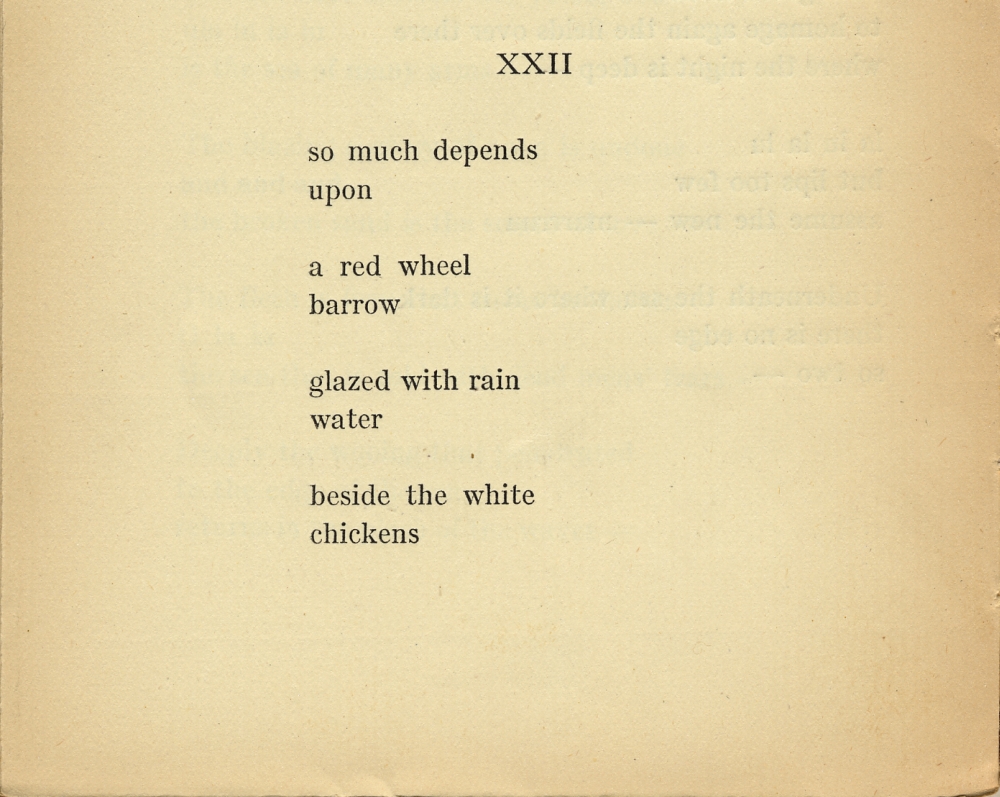
“So much depends on our ability to forecast the weather — and, when catastrophe strikes, on our ability to respond quickly,” notes Rebolino. Caius hears in her sentence the opening lines of William Carlos Williams’s poem “The Red Wheelbarrow.” “So much depends on our ability to forecast the weather,” he mutters. “But the language we use to model these forecasts depends on sentences cast by poets.”

“How do we cast better sentences?” wonders Caius.

In seeking to feel into the judgement implied by “better,” he notes his wariness of bettering as “improvement,” as deployed in self-improvement literature and as deployed by capitalism: its implied separation from the present, its scarcity mindset, its perception of lack — and in the improvers’ attempts to “fix” this situation, their exercising of nature as instrument, their use of these instruments for gentrifying, extractive, self-expansive movement through the territory.

In this ceaseless movement and thus its failure to satisfy itself, the improvement narrative leads to predictive utterances and their projections onto others.

And yet, here I am definitely wanting “better” for myself and others, thinks Caius. Better sentences. Ones on which plausible desirable futures depend.

So how do we better our bettering?

Caius returns to Rebolino’s essay on the models used to predict the weather. This process of modeling, she writes, “consists of a blend of certainty — provided by sophisticated mathematical models and existing technologies — and uncertainty — which is inherent in the dynamic nature of atmospheric systems.”

January 6th again: headlines busy with Trump’s recent abduction of Maduro. A former student who works as a project manager at Google reaches out to Caius, recommending Ajay Agrawal, Joshua Gans, and Avi Goldfarb’s book Prediction Machines: The Simple Economics of Artificial Intelligence. Google adds to this recommendation Gans’s follow-up, Power and Prediction.

Costar chimes in with its advice for the day: “Make decisions based on what would be more interesting to write about.”

To model the weather, weather satellites measure the vibration of water vapor molecules in the atmosphere. “Nearly 99% of weather observation data that supercomputers receive today come from satellites, with about 90% of these observations being assimilated into computer weather models using complex algorithms,” writes Rebolino. Water vapor molecules resonate at a specific band of frequencies along the electromagnetic spectrum. Within the imagined “finite space” of this spectrum, these invisible vibrations are thought to exist within what Rebolino calls the “greenfield.” Equipped with microwave sensors, satellites “listen” for these vibrations.

“Atmospheric water vapor is a key variable in determining the formation of clouds, precipitation, and atmospheric instability, among many other things,” writes Rebolino.

She depicts 5G telecommunications infrastructures as a threat to our capacity to predict the operation of these variables in advance. “A 5G station transmitting at nearly the same frequency as water vapor can be mistaken for actual moisture, leading to confusion and the misinterpretation of weather patterns,” she argues. “This interference is particularly concerning in high-band 5G frequencies, where signals closely overlap with those used for water vapor detection.”

Prediction and uncertainty as qualities of finite and infinite games, finite and infinite worlds.

For lunch, Caius eats a plate of chicken and mushrooms he reheats in his microwave.

Wednesday January 20, 2021

Celebrants gather! Party here today outdoors beside a fire.

(Glasses raised): “To the end of Trump, and to the work ahead, we cheer!”

There is food, there is drink; Sarah cooks vegetarian chili and cornbread muffins. Spring semester approaches, but not for another week. Let us embrace it: this hopeful openness, the sense of the path ahead.

Tuesday June 4, 2019

The day begins with comrades and I busing down to Trafalgar Square, where thousands gather to protest the president, picket signs in hand. Elated by this show of force, I settle in afterwards at the British Library for another round of research. Objects of study include a full run of Gandalf’s Garden and books by Ithell Colquhoun. Dare I share here the fruits of this research, or shall I exercise discretion, assuming that the terms of my use of this material will be made manifest in the days ahead? “All in due time,” I decide over a bowl of Spicy Tonkotsu. “All in due time.”

Monday May 27, 2019

Aggro roadways, Trump paraphernalia, landscapes crusted with ill-gotten wealth: up from these like a seagull I rise and take flight. Goodbye America, and good riddance. The mere fact of you bankrupts the world of justice. No theodicy could ever correct your persistence there on the other side of the Atlantic, burning the earth, melting the poles, laying waste to all prior ways of being. Yet here I am, a product of this spoiled history: an American abroad.

Monday October 8, 2018

Walter Benjamin’s desire for “profane illumination” rhymes through my mind, resonates through inner canyons, fills me with desperation. If the world we demand is one with no more fears, no more superstitions, then why are we so nervous, so skittish? Is it the ever-present policing, the techno-capitalist speed-up of society, the political horizon blocked by a metal-faced THX 1138 Big Brother Trump Leviathan? Is that why we disappoint ourselves, never quite able to live free, spontaneous, liberated, loving lives? What do we want? How do we get it? Is it the divine in us, this rebellious impulse? Or is the divine, rather, that which wants us to live grateful for each day despite hardship and circumstance? What about 2-year-old migrant children enduring the Kafkaesque procedural absurdity of immigration court? Is there no way to reverse this slide into utter abjection? Wherefore the new force, the new sway in intellectual life, of concepts like destiny and judgment? Why do we dare not venture far into liberated terrain? How do we teach ourselves to live in the faith that each event is a doorway through which walks the Messiah? How do we think the world into what we want it to be?

THX

Friday May 25, 2018

This miserable totality is driving me stir-crazy. I conjure on my telescreen an episode of The Mike Wallace Show from May 18, 1958 featuring Aldous Huxley, described by Wallace during the episode’s intro as “a man haunted by a vision of hell on earth.”

What I find, with some surprise, in this broadcast is a description of twenty-first century reality, especially if by that I mean reality here in the United States under the current Trump regime. Yet this world of ours also isn’t quite the one Huxley imagined, due to his misunderstanding of the logic of capitalism. Unlike Brave New World, for instance, it isn’t so much a world of “people happy where they oughtn’t to be.” Fear and anger, rather, are the dominant emotions in this world, whipped into being through omnipresent policing and gun violence. Given the structure of the built environment, one rarely experiences other people, one rarely experiences any kind of “group dynamic,” except via mediation, thanks to the ubiquity within the society of money, cars, and cellphones. Members of the dominator class drive around under these undemocratic, unfree circumstances communicating their dominance with their GOP bumper stickers and their MAGA hats and their open-carry firearms, while the rest of us hunch over steering wheels or stand alongside busy highways waiting for city buses, growing harried and bitter as we rush back and forth between rented or mortgaged living spaces and corporate-governed sites of production and consumption. In fact, I begin to wonder as the interview proceeds if it isn’t ultimately some deep-seated fear of rhetoric, of “verbal boobytraps,” as he says, that drives Huxley’s evolution, his turn in the final years of his life toward mysticism and psychedelics. Hope depended for him upon the possibility of direct, unmediated access to and experience of truth. Rhetoric maintains its victory, as it has in all hitherto existing societies, turning all of history into a forced march toward “thoughtless pleasure and ordered efficiency,” only to the extent that it succeeds in distracting us from the truth of the injustice of servitude, the truth that murmurs up from within. For what is “applied science,” what is “instrumental reason,” after all, if not rhetoric?

Tuesday March 6, 2018

Something new begins now, bursting forth in kaleidoscopic profusion. Neoliberal governance reaches new heights of absurdity through the invention of “lunch debt.” But the teacher strike in West Virginia points a way forward, a first win, to be followed as early as next month, perhaps, with a strike by teachers in Oklahoma. The path for wildcats intersects there with a key choke point for social reproduction: tests that qualify states for federal funding. By placing federal funding into jeopardy, the strike jumps levels and has the potential to capture full national attention. Together, teachers, parents, and students can dictate the terms of a new deal. For the Trump administration, the goal will be to crush teachers the way Reagan crushed PATCO, while maintaining a semblance of economic populism among the base. Notice the administration’s reluctance to engage the West Virginia action’s illegality. They’re wary of trying to uphold an unpopular and unenforceable law.  But of course, they’ll have to intervene eventually. His fans already love watching him say, “You’re fired.” Yet this runs the risk of intensifying antagonisms and contradictions. With solidarity walkouts, one could begin to imagine coordinated strikes, extension of wildcat tactics into public higher ed, systemwide stoppages, the reactivation of class power among the dispossessed.