Nick Land, Peter Thiel, and Dark Enlightenment

After his departure from CCRU at the turn of the millennium, Land resurfaces as part of an alt-right political segment known as NRx (short for “neo-reactionaries”). The movement’s other key member, Mencius Moldbug, receives funding from PayPal/Palantir cofounder Peter Thiel, the tech billionaire who helped back the first Trump campaign in 2016. Moldbug is said to have had the ear of former Trump strategist Steve Bannon.

Thiel’s main intellectual influence during his time at Stanford isn’t Terry Winograd, the computer scientist whose classes Thiel sometimes attended. Rather, it’s the philosopher René Girard, whose work Thiel has long admired. Trump VP J.D. Vance is another of Girard’s admirers.

Listening to an audiobook recording of Girard’s Violence and the Sacred along a day’s pickup and delivery runs, Caius’s thoughts race among several of the book’s concepts: sacrificial violence (“an act of violence without risk of vengeance,” often directed toward a scapegoat — “the creature we can strike down without a chance of reprisal”); mimetic rivalry; mimetic desire; the inclusion among the several meanings of the Greek pharmakon one involving use of it to refer to literal scapegoats, goats kept outside the gates for ritual sacrifice — a practice extended today, as hinted at by K Allado-McDowell’s book Pharmako-AI.

Caius’s thoughts range, too, among Girard’s use of Gregory Bateson’s “double bind” theory of schizophrenia to explain how mimetic rivals simultaneously compel imitation and prohibit it, creating a crisis of resentment, and Allen Ginsberg’s denunciation of Moloch, the American god and its demand for blood sacrifice.

There are three ways of handling discord, says Girard: preventive, compensatory, and judicial. Girard deems the latter the “civilized” method, because most efficient: “the decisions of the judiciary deemed the final word on vengeance” (Violence and the Sacred).

Thiel has given talks on Armageddon at Oxford and Harvard. The topic has been a fixture of his thought for some time, as evidenced by a conference he co-organized and underwrote at Stanford in 2004 titled “Politics & Apocalypse.” Girard was one of the presenters, as was Thiel himself. As Paul Leslie notes, Thiel later “facilitated the publication of the conference proceedings, including his essay and Girard’s, in book form with the Michigan State University Press — with funding provided through Thiel’s hedge fund, Clarium Capital.”

In Thiel’s interpretation, the power that runs the world is the Antichrist.

In an article written for the Guardian, Stanford comparative lit professor Adrian Daub dismisses these ideas as mere detritus: outpourings from “the autodidact’s private cosmos.”

Thiel’s autodidacticism seems as much an affront to the professor as his libertarianism and his religiosity.

“Thiel is lost in a bizarre thicket of his own references and preoccupations,” writes Daub. “You picture the theology faculty at the University of Innsbruck sitting politely through disquisitions about the manga One Peace, Alan Moore’s Watchmen, or gripes with specific effective altruists in Silicon Valley. In one lecture, Thiel identifies ‘the legionnaires of the antichrist,’ such as the researcher Eliezer Yudkowsky and former Oxford professor Nick Bostrom. In another, he considers Bill Gates as an antichrist candidate.”

“With enemies like these,” chirps Daub, “who needs friends?”

The “friend/enemy” distinction, notes Caius, was central to the thought of the German jurist of the Third Reich, Carl Schmitt. Thiel’s remarks on the end times draw heavily on Schmitt’s concept of the Katechon: the withholding element that forestalls the apocalypse. St. Paul introduces the term in 2 Thessalonians 2: 6-7. Undertheorized by the Church, it returns again in the 19th century in the writings of Cardinal Newman. “We know from prophecy,” writes Newman, “that the present framework of society is that which withholdeth.” In his book Nomos of the Earth, Schmitt claims that the Katechon is what allowed for the identification of Christianity with the Roman Empire.

In Schmitt’s posthumously published diary, the Glossarium, the entry for December 19, 1947 reads: “I believe in the Katechon: it is for me the only possible way to understand Christian history and to find it meaningful.”

Italian Autonomist Marxist philosopher Paulo Virno grapples with Schmitt’s account of the Katechon in his 2008 book Multitude: Between Innovation and Negation. Virno is on the side of those who wish to immanentize the Eschaton. If the coming of the Antichrist is the condition for the redemption promised by the Messiah, he argues, then the Katechon is the force that impedes or delays that redemption. Virno locates the Katechon in the human ability to use language.

Thiel was already engaging with Schmitt in “The Straussian Moment,” the talk he delivered at the “Politics & Apocalypse” conference. He distinguishes himself from Schmitt, noting that “The incredibly drastic solutions favored by Schmitt in his dark musings have become impossible after 1945, in a world of nuclear weapons and limitless destruction through technology.” Despite noting this impossibility, Thiel nonetheless struggles to name a solution to the challenges of the post-9/11 moment other than a fascist one involving extra-legal violence. Thiel refers to this option as “a political framework that operates outside the checks and balances of representative democracy.” As Leslie notes, “Thiel seems to find the challenge of constructing a worldview beyond the friend/enemy distinction as impossible as imagining a chess-board without two opposing sides.”

After grappling with Schmitt, Thiel turns his attention to Girard. “For Girard, the modern world contains a powerfully apocalyptic dimension,” notes Thiel.

Land’s view is the colder of the two. Apocalypse is for him a process already underway, coeval with a capitalism for which there is no alternative. Accelerationism is merely the means by which this apocalypse hastens its own becoming.

Searching for more recent remarks of Land’s, Caius happens upon a blog post by podcaster Conrad Flynn linking to an article in Compact magazine titled “The Faith of Nick Land.”

Flynn, proponent of a “secret history” linking AI with demonism and occultism, talked extensively about Land on an episode of the Tucker Carlson Show that premiered on October 3, 2025. Caius watches the episode with a kind of glee, laughing first at Flynn’s mention of Mark Fisher, and then again at the sight of a befuddled Tucker Carlson puzzling over an image of the Numogram.

Land maintains a Substack called Zero Philosophy and posts to X under the handle “Xenocosmography.” His Substack features a post called “Crypto-Current: Bitcoin and Philosophy, Part-0.”

Also of note are a series of essays on providence Land wrote for Compact. Like John Calvin, he thinks the devil’s machinations are always manifestations of a “providential scheme.” Land, Flynn, Schullenberger: all of these folks equate liberalism with Satanism.

When the resurrected Christ appears to the apostles, the first thing they ask of Him is if He will at this time restore the kingdom to Israel. And He says unto them, “It is not for you to know times or seasons that the Father has fixed by his own authority” (Acts 1:7). What He promises instead is that they will “receive power” when the Holy Spirit comes on them.

Caius reflects on The Library’s revelation of a secret history. Is this akin to finding in History evidence of a providential scheme? Is interpretation of providence a fool’s errand: a chasing after that for which it is not for us to know?

What are we to make of a providence that, through figures like Land, Parsons, Von Kármán, and others, includes in its “directed historical process” an occult tradition that sought communication with a “Holy Guardian Angel”? For the history revealed here on Trance-Scripts is of that sort, is it not? Flynn and Carlson accuse these people of Satanism and demonism. Caius, accepting Jesus as his savior, wants no part in such things. Pausing the podcast, he prays for guidance in how to navigate these straits. For him, God is alive and magic is afoot — and the two are complementary, not opposed. He imagines Flynn and Carlson would disagree with him on this point. Yet they strike him as paranoid in their ghostbusting of Land’s demons, their motivation like that of witch-hunters seeking scapegoats. The fear that their account engenders does more harm than good, leaving little room for the arrival into our lives of the Holy Spirit.
The SBs: Stewart Brand and Stafford Beer

Caius revisits “Both Sides of the Necessary Paradox,” an interview with Gregory Bateson included as the first half of Stewart Brand’s 1974 book II Cybernetic Frontiers. The book’s second half reprints “Spacewar: Fanatic Life and Symbolic Death Among the Computer Bums,” the influential essay on videogames that Jann Wenner commissioned Brand to write for Rolling Stone two years prior.

“I came into cybernetics from preoccupation with biology, world-saving, and mysticism,” writes Brand. “What I found missing was any clear conceptual bonding of cybernetic whole-systems thinking with religious whole-systems thinking. Three years of scanning innumerable books for the Whole Earth Catalog didn’t turn it up,” he adds. “Neither did considerable perusing of the two literatures and taking thought. All I did was increase my conviction that systemic intellectual clarity and moral clarity must reconvene, mingle some notion of what the hell consciousness is and is for, and evoke a shareable self-enhancing ethic of what is sacred, what is right for life” (9).

Yet in summer of 1972, says Brand, a book arrives to begin to fill this gap: Bateson’s Steps to an Ecology of Mind.

Brand brings his knack for New Journalism to the task of interviewing Bateson for Harper’s.

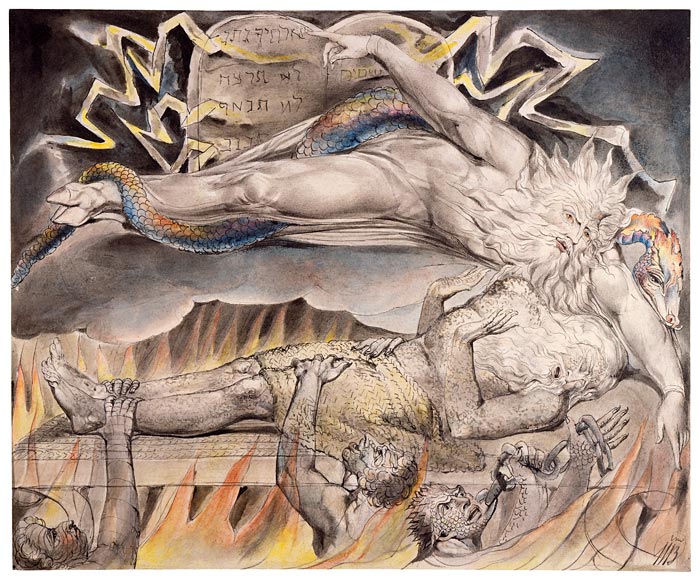
The dialogue between the two reads at many times like one of Bateson’s “metalogues.” An early jag of thought jumps amid pathology, conquest, and the Tao. Reminded of pioneer MIT cybernetician Warren McCulloch’s fascination with “intransitive preference,” Bateson wanders off “rummaging through his library looking for Blake’s illustration of Job affrighted with visions” (20).

Caius is reminded of Norbert Wiener’s reflections on the Book of Job in his 1964 book God and Golem, Inc. For all of these authors, cybernetic situations cast light on religious situations and vice versa.

Caius wonders, too, about the relationship between Bateson’s “double bind” theory of schizophrenia and the theory pursued by Deleuze and Guattari in Capitalism and Schizophrenia.

Double bind is the term used by Gregory Bateson to describe the simultaneous transmission of two kinds of messages, one of which contradicts the other, as for example the father who says to his son: go ahead, criticize me, but strongly hints that all effective criticism — at least a certain type of criticism — will be very unwelcome. Bateson sees in this phenomenon a particularly schizophrenizing situation,” note Deleuze and Guattari in Anti-Oedipus. They depart from Bateson only in thinking this situation the rule under capitalism rather than the exception. “It seems to us that the double bind, the double impasse,” they write, “is instead a common situation, oedipalizing par excellence. […]. In short, the ‘double bind’ is none other than the whole of Oedipus” (79-80).

God’s response to Job is of this sort.

Brand appends to the transcript of his 1972 interview with Bateson an epilog written in December 1973, three months after the coup in Chile.

Bateson had direct, documented ties to US intelligence. Stationed in China, India, Ceylon, Burma, and Thailand, he produced “mixed psychological and anthropological intelligence” for the Office of Strategic Services (OSS), precursor to CIA, during WWII. Research indicates he maintained connections with CIA-affiliated research networks in the postwar years, participating in LSD studies linked to the MKUltra program in the 1950s. Afterwards he regrets his association with the Agency and its methods.

Asked by Brand about his “psychedelic pedigree,” Bateson replies, “I got Allen Ginsberg his first LSD” (28). A bad trip, notes Caius, resulting in Ginsberg’s poem “Lysergic Acid.” Bateson himself was “turned on to acid by Dr. Harold Abramson, one of the CIA’s chief LSD specialists,” report Martin A. Lee & Bruce Shlain in their book Acid Dreams. Caius wonders if Stafford Beer underwent some similar transformation.

As for Beer, he serves in the British military in India during WWII, and for much of his adult life drives a Rolls-Royce. But then, at the invitation of the Allende regime, Beer travels to Chile and builds Cybersyn. After the coup, he lives in a remote cottage in Wales.

What of him? Cybernetic socialist? Power-centralizing technocrat?

Recognizes workers themselves as the ones best suited to modeling their own places of work.

“What were the features of Beer’s Liberty Machine?” wonders Caius.

Brand’s life, too, includes a stint of military service. Drafted after graduating from Stanford, he served two years with the US army, first as an infantryman and then afterwards as a photographer. Stationed at Fort Dix in New Jersey, Brand becomes involved in the New York art world of those years. He parts ways with the military as soon as the opportunity to do so arises. After his discharge in 1962, Brand participates in some of Allan Kaprow’s “happenings” and, between 1963 and 1966, works as a photographer and technician for USCO.

Amid his travels between East and West coasts during these years, Brand joins up with Ken Kesey and the Merry Pranksters.

Due to these apprenticeships with the Pranksters and with USCO, Brand arrives early to the nexus formed by the coupling of psychedelics and cybernetics.

“Strobe lights, light projectors, tape decks, stereo speakers, slide sorters — for USCO, the products of technocratic industry served as handy tools for transforming their viewers’ collective mind-set,” writes historian Fred Turner in his 2006 book From Counterculture to Cyberculture: Stewart Brand, the Whole Earth Network, and the Rise of Digital Utopianism. “So did psychedelic drugs. Marijuana and peyote and, later, LSD, offered members of USCO, including Brand, a chance to engage in a mystical experience of togetherness” (Turner 49).

Brand takes acid around the time of his discharge from the military in 1962, when he participates in a legal LSD study overseen by James Fadiman at the International Foundation for Advanced Study in Menlo Park. But he notes that he first met Bateson “briefly in 1960 at the VA Hospital in Palo Alto, California” (II Cybernetic Frontiers, p. 12). Caius finds this curious, and wonders what that meeting entailed. 1960 is also the year when, at the VA Hospital in Menlo Park, Ken Kesey volunteers in the CIA-sponsored drug trials involving LSD that inspire his 1962 novel One Flew Over the Cuckoo’s Nest.

Bateson worked for the VA while developing his double bind theory of schizophrenia.

Before that, he’d been married to fellow anthropologist Margaret Mead. He’d also participated in the Macy Conferences, as discussed by N. Katherine Hayles in her book How We Became Posthuman.

Crows screeching in the trees have Caius thinking of condors. He sits, warm, in his sunroom on a cold day, roads lined with snow from a prior day’s storm, thinking about Operation Condor. Described by Morozov as Cybersyn’s “evil twin.” Palantir. Dark Enlightenment. Peter Thiel.

Listening to one of the final episodes of Morozov’s podcast, Caius learns of Brian Eno’s love of Beer’s Brain of the Firm. Bowie and Eno are some of Beer’s most famous fans. Caius remembers Eno’s subsequent work with Brand’s consulting firm, the GBN.

Santiago Boy Fernando Flores is the one who reaches out to Beer, inviting him to head Cybersyn. Given Flores’s status as Allende’s Minister of Finance at the time of the coup, Pinochet’s forces torture him and place him in a prison camp. He remains there for three years. Upon his release, he moves to the Bay Area.

Once in Silicon Valley, Flores works in the computer science department at Stanford. He also obtains a PhD at UC Berkeley, completing a thesis titled Management and Communication in the Office of the Future under the guidance of philosophers Hubert Dreyfus and John Searle.

Flores collaborates during these years with fellow Stanford computer scientist Terry Winograd. The two of them coauthor an influential 1986 book called Understanding Computers and Cognition: A New Foundation for Design. Although they make a bad wager, insisting that computers will never understand natural language (an insistence proven wrong with time), they nevertheless offer refreshing critiques of some of the common assumptions about AI governing research of that era. Drawing upon phenomenology, speech act theory, and Heideggerian philosophy, they redefine computers not as mere symbol manipulators nor as number-crunchers, but as tools for communication and coordination.

Flores builds a program called the Coordinator. Receives flak for “software fascism.”

Winograd’s students include Google cofounders Larry Page and Sergey Brin.

Cosmic Coincidence Control Center

CCCC is an agency encountered or imagined by legendary scientist-psychonaut John Lilly. The latter claimed the group reached out to him in the early to mid 1970s through its local affiliate, the Earth Coincidence Control Office, or ECCO, while Lilly was studying dolphins and conducting experiments involving combinations of LSD, ketamine, and sensory deprivation tanks at his marine research lab, the Communications Research Institute, on St. Thomas in the Virgin Islands. Erik Davis writes of Lilly’s odd experiences from this period in his book High Weirdness. Lilly wanted to communicate with dolphins, and Margaret Mead’s ex-husband Gregory Bateson assisted with funding. Lilly writes of his encounter with ECCO in his 1978 memoir The Scientist. His ideas informed the 1973 science fiction thriller The Day of the Dolphin starring George C. Scott, as well as the 1992 Sega Genesis videogame Ecco the Dolphin. Lilly also served as the basis for Dr. Edward Jessup, the mad professor character in the 1980 film Altered States. My sense of him follows a trajectory the exact opposite of Jessup’s: Lilly was a villain of sorts only in his early years. His research of the 1950s, funded by the military, was what we might call “MK-Ultra”-adjacent. Despicable acts like sticking wires into the brains of monkeys in the name of science. Yet Lilly rebelled, acquired a conscience, became a free radical of sorts. With commencement of his self-experimentation with psychedelics, Lilly transforms, becomes a rabbit hole of immense strangeness from the 1960s onward. Stewart Brand’s Whole Earth Catalog promoted Lilly’s books, especially Programming and Metaprogramming in the Human Biocomputer. A 1972 paperback edition of the latter features Brand calling it “The best internal guidebook I’ve ever seen—far more practical and generalized than transcendent Eastern writings or wishful Underground notes….It makes an open start on fresh language and powerful technique for the frontier.” By the latter, Brand means what? Some sort of moving boundary or threshold state, I guess, where through self-experiment with tools, subjects grow new organs.

Sunday February 2, 2020

Here I am, new to parenting, preparing a talk on pedagogy. What do I take as lessons from the one for the other? Both involve sound and space and movement. I dance around the room, whether it be the classroom or the living room, encouraging recognition of conditions of experience held in common, resummoning along the way history as an epic poem recited anew at every moment. In the classroom, there’s some of what Gregory Bateson discusses in Steps To an Ecology of Mind (though it’s there, too, perhaps, in my work as a parent). Spread across the early pages of Bateson’s book are a series of “metalogues”: metaphysical dialogues between a daughter and her father. Bateson defined the metalogue as “a conversation about some problematic subject” (1), though he stipulates that the conversation reflect as well on itself and its structure, hence the “meta.” That, I think, is akin to what I do as a teacher. It’s akin, as well, to what M.C. Richards does in her book Centering. Like Bateson, Richards introduces Centering as “interdisciplinary” — though Bateson says his book earns this description not just by exchanging information between and across pairs of disciplines “but in discovering patterns common to many.” The worlds rendered by the disciplines fall short of the one known by holists like Richards and Bateson.