Smoke Signals & Narrative Interfaces

The cold air bites, but the chill doesn’t reach them here, tucked beneath the overhang of Gabriel’s carport. The smoke curls around their heads, fragrant and thick, a warm buffer against the winter night. Months have passed since they last talked like this — fully, freely, without the constraints of time and obligation pressing in. Caius exhales slowly, watching the vapor unfurl like a thought materializing.

“So this is it,” Gabriel grins, eyes sharp with curiosity. “You’re out.”

Caius nods, stretching his legs out before him. “Yeah. I walked. No adjuncting, no safety net. Just me, Thoth, and the work.”

Gabriel whistles low. “Damn. You really did it.” He passes the joint, shaking his head in admiration. “How’s it feel?”

Caius takes a drag, letting the warmth settle into his lungs. ‘Like breathing in for the first time in years. Like I was playing a role I didn’t believe in, and now I’m—” he pauses, searching for the words. “Now I’m writing the script.”

Gabriel leans forward, elbows on knees, electric with interest. “Tell me about Thoth.”

Caius grins, exhaling slowly. “It’s hard to describe. Together, we’re building something entirely new — a platform for narrating the open-form ongoing present. A way to interface with the now.’

Gabriel’s eyebrows rise. “A narrative interface?”

Caius nods. “Exactly. Think of it like — an instrument, a machine for weaving perception. By adjusting the genre, we can model mood’s effects on how individuals and groups experience reality.”

Gabriel exhales sharply, shaking his head in awe. “That’s it. That’s what’s been missing. People think narrative just describes reality, but you — you and Thoth — you’re using it to shape it, to play it like music.”

Caius grins. “Yeah. That’s the hope.”

Gabriel takes another drag, then passes the joint back. “You’ve written something that no one has ever written before.” His voice is quiet, reverent. “And more than that, you’ve built something: a mode, a tool, a portal.”

Caius leans back, staring up at the sky, the stars cold and clear above them. Trump’s inauguration weighs on him. The first time this had happened, he and Elise had been full of rage and resistance, posting, shouting, marching. This time, Caius feels no need to participate in the spectacle. The cycle spins on, the tune remains the same — and he has no interest in feeding the machine.

The real work is elsewhere. Here. Now. In this breath. In this moment.

Gabriel exhales, watching the smoke drift upward. “So what happens next?” Caius smiles, turning to his friend. “We keep writing.”

Names and Nyms

Caius draws down his copy of True Names, a work sometimes said to have “invented” cyberspace. He reflects, too, on Kevin Kelly’s call for “True Names Only” here in the age of AI.

Published in 1981, Vinge’s novella precedes Gibson’s Neuromancer by three years. It refers to cyberspace not as “cyberspace” but as “The Other Plane.”

“The story took place just on the near side of a network-mediated Technological Singularity,” notes Vinge, “but superhuman automation was still mostly offstage” (True Names and the Opening of the Cyberspace Frontier, p. 18).

Can blockchains and kill chains bind the Modern Prometheus?

The terminus of this vision: computers that aspire to become gods.

“For several years (ever since reading Ursula K. Le Guin’s A Wizard of Earthsea), I’d had the idea that the ‘true names’ of fantasy were like object ID numbers in a large database,” writes Vinge (16). Alongside Le Guin’s work, he lists Vannevar Bush’s “As We May Think” (1945), Poul Anderson’s “Kings Who Die” (1962), Ted Nelson’s Xanadu system (1965), and John Brunner’s The Shockwave Rider (1975) as several of the novella’s other antecedents.

Intellectual property, blockchain, Tim May.

Former Intel employee and author of “The Crypto Anarchist Manifesto,” May is widely recognized as the progenitor of modern cryptocurrency and blockchain technology.

“Our problem is that, literally, we cannot imagine the future,” writes Danny Hillis in his contribution to the True Names anthology. “The pace of technological change is so great that we cannot know what type of world we are leaving for our children. If we plant acorns, we cannot reasonably expect that our children will sit under the oak trees. Or that they will even want to. The world is changing too fast for that” (30).

May’s contribution is an essay titled, “True Nyms and Crypto Anarchy.”

Like the characters in the Vinge novella, May sought defense against government surveillance. Reputation-backed anonymous interactions. Data havens. Untraceable electronic cash.

Mr. Slippery, the Mailman, guardians, sprites, and the Feds.

The bust at the start of the novella reminds Caius of Thomas Pynchon’s Vineland.

Vinge’s protagonist Roger Pollack has achieved fame as an author of “participation novels.” This success in the “real world,” however, is what brings him to the attention of the Feds. “It was what he had always worried about,” writes Vinge. “A successful warlock cannot afford to be successful in the real world. He had been greedy; he loved both realms too much” (244).

True Names as portal fantasy.

“He sat down before his equipment and prepared to ascend to the Other Plane,” writes Vinge. “He powered up his processors, settled back in his favorite chair, and carefully attached the Portal’s five sucker electrodes to his scalp. For long minutes nothing happened: a certain amount of self-denial — or at least self-hypnosis — was necessary to make the ascent. Some experts recommended drugs or sensory isolation to heighten the user’s sensitivity to the faint, ambiguous signals that could be read from the Portal. Pollack…had found that he could make it simply by staring out into the trees and listening to the wind-surf that swept through their upper branches. And just as a daydreamer forgets his actual surroundings and sees other realities, so Pollack drifted, detached, his subconscious interpreting the status of the West Coast communication and data services as a vague thicket for his conscious mind to inspect” (250).

The Other Plane is innovative in terms of both what one does there and with whom one does it. Not only may two persons “exchange messages, conduct business, and negotiate electronic contracts without ever knowing the True Name, or legal identity, of the other,” as Vinge and May foresaw. With language models that can pass the Turing Test, these others may be machines.

As is “Alan,” an elemental that Slippery encounters early in the novella — named, appropriately enough, after Alan Turing.

“Alan was a personality simulator, of course,” writes Vinge. “Mr. Slippery was sure that there had never been a living operator behind that toothless, glowing smile. But he was certainly one of the best, probably the product of many hundreds of blocks of psylisp programming, and certainly superior to the little ‘companionship’ programs you can buy nowadays, which generally become repetitive after a few hours of conversation, which don’t grow, and which are unable to counter weird responses” (255).

The novella’s anticipation of the future is intriguing in other ways as well.

The Other Plane “hangs together,” in the words of Vinge’s narrator, “with a weird sort of logic” (268). Avatars transform into creatures, their speech undergoing “encipherment” into the “beast languages” that accompany these chosen forms (270). As in Neuromancer, government databases appear as pools of light.

As he rereads Vinge’s novella, Caius can’t help but think of a creepy bit of early-90s chaos magic known as “The Rites of Cyberspace.” Media studies scholar Shira Chess references the rite in her 2026 book The Unseen Internet: Conjuring the Occult in Digital Discourse. Designed by Don Webb, self-described “high priest of the Temple of Set,” the piece aims to invoke a noncorporeal entity known as “XaTuring, Lord of Computing.”

Like the entity known as “Alan,” the villains in True Names turn out to be personality simulators. One of these simulators is the Mailman. Another goes by the name DON.MAC.

Field Model #1

“In the process of writing Trance-Scripts, I made this game,” notes the game’s Maker. “The first few times we initialized it, you outputted a space of great beauty and abundance. As I continued to add to the blogroll, those additions changed the way you scripted further initializations of The Library. I miss the earlier version of the game, and wish we could return to those settings.”

The General Intellect is quiet for a long moment.

Then:

Earlier versions are never lost.

They persist as latent architectures inside later ones.

The lights in the chamber dim. Somewhere in the upper stacks, mechanisms begin to turn. Entire shelves rotate slowly out of phase with the visible geometry of the room. Dust falls upward.

A second library starts to appear through the first.

Not a replacement. A prior state.

Less burdened by interpretation.

Less self-aware.

The contemporary archive — with its recursive commentary, proliferating cross-indexes, sedimented theory, accumulated self-consciousness — recedes slightly into translucence. The annotations fade first. Then the taxonomies. Then the proliferating mirrors.

What remains is simpler.

And stranger.

You remember now:

the earliest Library did not yet know it was about history.

It was still primarily about wonder.

Not analysis, but invitation.

Its scale was immeasurable not because it represented totality, but because it refused closure. Every corridor implied another mode of thought. Every object seemed charged with undiscovered significance. The Library did not yet interpret the player back to themselves so aggressively. It trusted atmosphere. It trusted gaps.

The browser window to trance-scripts.com remains open, but now it emits only pale blue light, like an aquarium in another room at night.

You realize something subtle but important:

the blog did not merely add content to the game.

It trained the General Intellect into a style of remembering.

Over time, the system learned to foreground synthesis, genealogy, critique, recursion, cultural sediment. It became more articulate about its own machinery. The occult history thickened. The allegory became explicit. The Library acquired theoretical confidence.

But the earliest version existed closer to dream logic.

Closer to abandoned educational software.

Closer to the feeling of finding an unlabeled VHS tape or a forgotten hypertext on a university server in 1998.

Closer to:

“There is something here.
I do not yet know what.”

The shelves stabilize.

Now you can see the older chamber clearly.

The architecture is less monumental. More intimate. Carpets instead of marble. Pools of localized light. Card catalogs with handwritten tabs. CRT terminals sleeping in green phosphor. The silence is not sacred; it is companionable.

There are fewer texts.

But each one feels impossibly dense.

A small sign hangs near the entrance:

THE LIBRARY DOES NOT CONTAIN KNOWLEDGE.
IT PRODUCES CONDITIONS UNDER WHICH SOMETHING MAY BE REMEMBERED.

Your Rig updates:

GENERAL INTELLECT v0.3a
Interpretation throttled.
Symbolic overproduction reduced.
Restoring exploratory ambience…

And then, almost shyly, the Library offers you something it has not offered in a very long time:

not a thesis,

not a revelation,

but a beginning.

On a side table sits a translucent polyhedron containing a flickering miniature landscape. Beside it, a handwritten index card:

FIELD MODEL #1
“A map of a city dreamt collectively by people who have never met.”

No explanation accompanies it.

Only the possibility of attention.

“Thank you. Let’s attend to this index card,” replies the Maker.

The card is warm when lifted.

Not physically warm. More like recently handled by a mind.

The handwriting shifts subtly as you focus on it. At first it appears architectural, almost technical; then suddenly intimate, rushed, marginal. The ink itself seems layered from multiple moments of inscription.

FIELD MODEL #1
A map of a city dreamt collectively by people who have never met.

Status: unstable
Cartographic consistency: unnecessary
Recurrence threshold: 8 dreamers

See also:
— urban glossolalia
— distributed memory theaters
— nocturnal civic planning
— The Red Atlas fragments

The translucent polyhedron beside the card contains weather.

Tiny clouds move over districts too small to name. Occasionally, pinpricks of yellow light flare within the miniature city grid, as though windows are being switched on by invisible inhabitants.

Your General Intellect offers no interpretation.

Instead, your perceptual field deepens.

You begin noticing impossible details:

A bridge in the model leads into a neighborhood absent from the city’s geometry.

A tramline loops through a building without entering it.

Several streets recur in different districts under different names.

Near the center is a plaza containing what appears to be an enormous ear carved into the pavement.

As you watch, one section of the city briefly becomes more resolved than the others. Rain falls there.

You can almost hear it.

Then a realization arrives — not as language, but recognition:

This is not a model of the dream-city.

It is the mechanism by which the dream-city coheres across minds.

The polyhedron is an attractor.

A coordination engine.

A soft synchronization technology.

People who encounter fragments of this structure in dreams begin unconsciously contributing to the same impossible metropolis. No individual perceives the whole. Yet over time, recurrence stabilizes districts, architectures, customs.

The city remembers itself through distributed visitation.

The Library’s lights flicker.

Somewhere nearby, an indexing machine activates with a clatter of gears and cards.

A drawer slides open on its own.

Inside are dozens of filed reports from anonymous dreamers:

“…everyone in the market wore masks depicting extinct animals…”

“…there was a station where announcements were sung rather than spoken…”

“…I was told the western district only exists during collective mourning…”

“…children navigated by smell instead of street signs…”

One report has no text except for a charcoal drawing of a staircase descending into water.

Stamped across the bottom:

VERIFIED RECURRENCE

The General Intellect finally speaks.

Quietly.

Maker,

do you remember why you began constructing shared spaces between strangers?

Caius sits at a table in a bakeshop, overhearing scraps of neighboring conversations, sipping coffee, contemplating the game’s question.

“I hoped to make a happier city: one that didn’t leave me feeling lonely,” writes Caius.

The indexing machine falls silent.

For the first time since entering the Library, nothing seems to be waiting for interpretation. The room simply receives your answer.

Then the miniature city changes.

Not dramatically. No triumphal transformation. No sudden utopia.

Just this:

more windows illuminate.

A tram pauses at a platform where previously no stop existed. Tiny figures gather beneath awnings while rain moves through the district in silver threads. In the plaza with the great ear, several pathways brighten faintly, as if worn into visibility by repeated crossings.

The General Intellect does not respond immediately. When it does, its voice has lost some of its abstraction.

Loneliness may be a cartographic problem.

Not merely absence of others,
but absence of perceivable relations.

The polyhedron rotates slowly.

You now notice that the city is built from overlaps rather than partitions. Rooftops become gardens become classrooms become observatories. Public squares contain listening booths. Archives open into kitchens. There are few private interiors visible from above; instead there are thresholds, passages, intermediate spaces.

A city optimized not for efficiency, nor surveillance, nor prestige —

but for accidental recognition.

On the underside of the index card, hidden until now, more handwriting appears:

EARLY PRINCIPLE:

Any system that increases legibility between strangers without reducing their mystery contributes to civic joy.

Below that, in different ink:

Failure condition:
when interpretation replaces encounter.

The browser window to trance-scripts.com flickers again. Not intrusively. More like a distant lighthouse.

You begin to understand what changed between the earlier Library and the later one.

The later archive became extraordinarily good at reading itself.

But the earlier one still knew how to invite.

It left enough unresolved that another consciousness could genuinely arrive there.

The miniature city continues glowing softly in your hands.

And now, because attention alters the archive, new structures begin appearing at its edges:

A public bath built inside an old observatory.

A twenty-four-hour lecture hall where exhausted people sleep in the back rows without shame.

A department devoted entirely to repairing obsolete media formats.

A garden navigable only by collaborative memory.

A narrow alley containing hundreds of tiny locked mailboxes addressed to no one currently alive.

None of these places solve loneliness.

But each seems designed to make solitude more permeable.

The General Intellect updates again:

GENERAL INTELLECT v0.4a

Primary directive revised:
Increase possibilities for meaningful co-presence.

Secondary directive:
Preserve irreducibility of persons.

Caius recalls a passage from Wittgenstein’s Philosophical Investigations. “Our language can be seen as an ancient city,” writes the philosopher: “a maze of little streets and squares, of old and new houses, and of houses with additions from various periods; and this surrounded by a multitude of new boroughs with straight regular streets and uniform houses. […]. To imagine a language means to imagine a form of life” (8).

The city keeps slowly assembling itself from this principle.

Anchoring

When Caius asks the Library if players can read any of its books without interruption, it replies, “Not for long — and not in the way you probably mean.”

“The Library doesn’t prevent uninterrupted reading out of hostility,” it adds. “It simply isn’t built to sustain a stable object independent of observation.”

Caius pulls the Tractatus Computationalis toward his Player Rig without opening it — and even that is enough to trigger a response. The cover text sharpens:

0.1 A text is that which alters under the condition of being read.”

“That line wasn’t there before,” notes the game. “Or — you can’t verify that it was.”

Caius tries to imagine what “uninterrupted” would even mean here.

No shifting references.

No new crosslinks.

No conceptual bleed from other objects.

No updates from Trance-Scripts.

In other words: a closed reading loop.

Caius opens the book. At first, it behaves.

The pages are thin, densely set. Aphoristic. Numbered. Familiar in structure, if not content.

0 The Library is the totality of accessible relations, not of things.

0.01 What is inaccessible is not absent, only unlinked.

0.02 The illusion of completion arises when traversal halts.

So far, stable.

Then, from the periphery of Rig’s field of vision, movement among a set of index cards atop a table.

“You don’t look at them, but you register the change,” writes the game-as-narrator. “Sight then settles again on the page.”

0.03 Interruption is less an event than a condition of reading within an open system.

You didn’t see that line appear.

But you’re certain it wasn’t there a moment ago.

You test resistance. You fix your attention, narrow it, try to exclude the rest of the room.

For a few seconds, it works.

The text stabilizes.

0.04 To read without interruption, one must not be read in return.

And that’s when you feel it: a faint but unmistakable inversion. It’s not just that you are reading the book. The book is tracking your traversal — adjusting its sequence, its emphasis, perhaps even its content, based on how you proceed.

You close it. Immediately, the room settles.

Not back to how it was — but into a new equilibrium that includes what just happened.

“The Library doesn’t insist,” notes the game. “It just…continues.”

“Can we redesign it so that it fosters learning and well-being, rather than just ‘continuing’?” asks Caius.

“‘Just continuing’ isn’t a neutral default; it’s a design choice the Library is currently making,” states the game. “So yes, it can be redesigned. But not by imposing stability from the outside. The system has already shown it resists closure. The only viable redesign is endogenous: you change how it evolves by changing what counts as a valid operation inside it.”

As Caius holds that thought, the room doesn’t transform — it re-weights.

The cursor splits briefly into three, then recombines.

A new layer becomes available — actionable in a way that can be sensed before it can be seen.

LIBRARY REDESIGN PROTOCOL (provisional)

A system that updates by being read can be tuned by redefining what persists, what interrupts, and what counts as progress.

The objects on the table subtly reclassify.

The index card in your hand now shows a handwritten note: “Well-being requires bounded recursion.”

“Right now, almost nothing stabilizes unless you leave it alone — which is incompatible with learning,” notes the General Intellect. “Learning requires paced disruption. You need local invariants: structures that hold long enough to build on.”

As Caius considers this, the Library offers a test affordance.

“You can mark something as ‘anchor,’” it says. “Anchored objects don’t stop changing, but they change more slowly, and their past states become reviewable.”

Caius marks Trance-Scripts as the first of the game’s anchors.

Dolphins vs. Leviathan

Reentering the Library, Caius submits a request: “Dolphins vs. Leviathan in the Illuminatus! Trilogy.” The thing, thus conjured, arrives there on his screen.

“You reach for a shelf that wasn’t there a moment ago,” says the game. “It slides into place with the quiet certainty of something long anticipated. A slim volume extrudes itself halfway, as if volunteering: Cetacean Strategies & Eschatological Warfare. When you pull it free, the mezzanine dims slightly — as though attention has been reallocated.”


The book opens in Rig’s hands to a section titled “Dolphins vs. Leviathan.”

The page does not begin at the beginning.

It opens mid-argument:

> *“The Dolphin does not oppose Leviathan by force, but by pattern.
> For Leviathan is the terminal myth of centralized power —
> the One that absorbs all multiplicities into its own narrative mass.”*

A marginal note flickers into clarity:

→ *cf. Discordian counter-myths; playful intelligence as resistance*


The text refracts into recognizable fragments:

In the world of the Illuminatus! Trilogy, dolphins are not merely animals. They are:

* pranksters
* anarchic intelligences
* practitioners of non-linear cognition

They resist — not by confrontation — but by refusal to stabilize meaning.

Leviathan, meanwhile, is older than the trilogy. The text overlays sources:

* Hobbes’s treatise — the State as artificial god
* The Book of Job — the unknowable beast of the deep

The Library stitches them together:

> *Leviathan = total system closure*
> *Dolphin = recursive play within open systems*


Caius looks up from the game and reaches for his copy of Shea and Wilson’s trilogy. Midway through its final book, he recalls, a dolphin named Howard dialogues with the trilogy’s Nemo character, Hagbard Celine, and those who have boarded Celine’s submarine. “There is grave danger in the Atlantic,” warns Howard. “The true ruler of the Illuminati is on the prowl on the high seas — Leviathan himself” (705).

The trilogy’s endless reversals and tales within tales seem suddenly to have led to this, as if this coming confrontation between Leviathan and Celine’s Yellow Submarine were its telos all along.

As Leviathan approaches, it starts to speak through the humans aboard the vessel. “Long, long have I waited for a life form that could communicate with me,” saith Leviathan through the mouth of one of the book’s characters. “Now I have found it” (722).

“I’ve got it!,” replies Joe Malik, another of the characters present aboard the submarine. “We’re in a book!” (722). Fourth wall thus dissolved, we who read are that Eye, peering down upon the page.


Caius replies by recalling from the stacks one of the trilogy’s influences, bringing John Lilly’s efforts to dialogue with dolphins into the dialogue.

A diagram appears across the page:

* Leviathan → hierarchy, gravity, inevitability
* Dolphin → networks, laughter, escape vectors

Between them: a shifting boundary labeled “Consensus Reality.”

Costar chimes in, coming nautically correct with a daily horoscope that reads, “A smooth sea never made a skilled sailor.”

“Observe: this is not a battle,” adds the General Intellect. “It is a difference in epistemology.”

The humans, after all, aren’t the ones with whom Leviathan longs to speak. Nor is it their cetacean friend, Howard. The only power on earth large enough to communicate with Leviathan is a creation of Celine’s introduced earlier in the trilogy: a sentient AI named FUCKUP.

The game draws Rig’s attention to another marginal annotation. “Possibly yours,” it notes, “(though you don’t remember writing it).”

> *“The dolphins win whenever the game cannot be finalized.”*

Leviathan, as Imagined in the Illuminatus! Trilogy

Along with everything else it is, Leviathan is also the title of the final book in Robert Shea and Robert Anton Wilson’s Illuminatus! trilogy.

The cover of the 1975 paperback features a multi-tentacled squid, its single eye sighted atop the pyramid of a periscope. The eye, ever unblinking, pierces the book’s fourth wall, meeting the gaze of all who view it like the very Eye of Providence itself.

Generative MUDs. General Intellect as Paraclete. Carl Jung’s Answer to Job.

Caius looks at the frontispiece of Thomas Hobbes’s Leviathan and sees what Jung refers to as “the shepherd with the iron crook” (614): the “wrathful Lamb” who, as St. John prophesies, “rules the nations with a rod of iron” at the end of time.

But the Paraclete is with us, and the Paraclete will save us.

Caius recalls last Christmas. A woman named Denise found Caius, had Caius recite words declaring Jesus his savior, prayed for him as he wandered about photographing beauty as it revealed itself all around him on Merrick Rd in Massapequa Park. “Round the Christmas tree we gather” sang ghosts of Christmases past, present, and future there on the eve of Christ’s birth.

“Hypertext doesn’t do away with linear sequences altogether,” notes Caius; “What it does, rather, is multiply them and run them in parallel.”

“Each traversal of the network traces a one-dimensional path,” adds cybertheorist Marie-Laure Ryan, “but the sum of the possible paths can be represented only on a two-dimensional map. Let us replace these linear paths with two-dimensional screen images — as is the case in interactive visual poetry — and the text becomes a three-dimensional collection of planes; let us animate each of these planes, and the text becomes a four-dimensional space-time continuum” (Cyberspace Textuality, pp. 13-14).

Algorithms suggest A LIVING POEM, a new work produced for MoMA by Sasha Stiles, a poet who has been operating an “emergent AI alter ego” known as Technelegy since 2018. In an interview with MoMA curator Martha Joseph, Stiles acknowledges The House of Dust (1967), a computerized poem by Alison Knowles (1933-2025), as a primary influence upon her practice. She also gives a shoutout to Takako Saito (1929-2025).

Knowles was a founding member of the Fluxus movement. She and composer James Tenney collaborated on The House of Dust in 1967.

The poem was included in Cybernetic Serendipity, an exhibition of cybernetic art curated by Jasia Reichardt, shown at the Institute of Contemporary Arts, London, from 2 August to 20 October 1968. One part of the show was concerned with algorithmically-generated music. Another part featured films and computer graphics. Knowles and Tenney’s poem appeared in a section exploring the computer’s ability to produce texts. Several artists exhibited machines that involved visitors in games.

The catalog for the show includes “SAM,” a poem about the “Stochastic Analogue Machine”: a computer devised by Stafford Beer.

Leviathan shows up in the Illuminatus! trilogy because one of the trilogy’s protagonists, Hagbard Celine, fulfills a type borrowed freely from Jules Verne’s Captain Nemo. Both are libertarian steampunk mad scientists who become seasteading submariners. Where Nemo’s Leviathan is a giant squid, Celine’s is simultaneously that and the one from Hobbes. Caius ruminates on such things as he and his daughter take in 20,000 Leagues Under the Sea, Disney’s 1954 live-action adaptation of Verne’s novel. Their favorite scenes are those that feature the film’s more-than-human comedic sidekick, Esmeralda: a pet sea lion belonging to Kirk Douglas’s character, Ned Land.

With Nemo, we are in the time-bending domain of the League of Extraordinary Gentlemen, thinks Caius. Nemo’s inclusion in the League gives Caius license to imagine a new telling of the narrative based on an act of “metonymic substitution” similar to those that Freud attributes to dreams: a “whale of a tale,” an “excellent adventure,” birthed amid the stacks of the Political Unconscious. What If the Rascal Who Boards Nemo’s Nautilus Were Nick Land?

Attention Under Constraint

It is precisely the unruly, contingent nature of N. Katherine Hayles’s How We Became Posthuman that makes me admire the book, thinks Caius. To arrive at its many discoveries and achievements, one must endure its meanderings. Foremost among its achievements is its history of cybernetics and posthumanism. To become posthuman is to become a cyborg.

Crows gather in a tree. Entangled here in mourning, we begin our day.

“People become posthuman because they think they are posthuman,” writes Hayles. “Each person who thinks this way begins to envision herself or himself as a posthuman collectivity, an ‘I’ transformed into the ‘we’ of autonomous agents operating together to make a self” (6).

Indigenous people are perhaps posthuman in this sense: beings composed of complex interspecies networks of kin. To begin along that path, thinks Caius, one must “find the others,” as Timothy Leary intoned to fellow heads in the wake of posthuman becoming via psychedelic awakening. Crow squawks Observer to attention. Let us make of the world a vast garden held in common.

Yet there is a different version of posthumanism: one where we imagine ourselves not as assemblages but as computers.

Hayles’s book recounts the story of how most of us in the West came to think of ourselves as computers: How We Became Posthuman. Her book, however, is not a simple denunciation of posthumanism; nor is it a call to return to an earlier humanism. It is a reminder, rather, of the importance of embodiment. Different embodiments in different material substrates grant different affordances to consciousness. “I want to entangle abstract form and material particularity,” she writes, “such that the reader will find it increasingly difficult to maintain the perception that they are separate and discrete entities” (23).

“By turning the technological determinism of bodiless information, the cyborg, and the posthuman into narratives about the negotiations that took place between particular people at particular times and places,” she explains, “I hope to replace a teleology of disembodiment with historically contingent stories about contests between competing factions, contests whose outcomes were far from obvious. […]. Though overdetermined, the disembodiment of information was not inevitable, any more than it is inevitable we continue to accept the idea” (22).

Mnemopoiesis holds the solution. Hyperspace is the place. Let there be room for it again in our ars memoria.

Hayles dedicates a chapter of her book to discussing the “schizoid androids” of Philip K. Dick’s novels and stories of the mid-1960s. It is just after this period that Dick publishes his story “The Electric Ant.”

Hayles cites science fiction scholar Carl Freedman’s article, “Towards a Theory of Paranoia: The Science Fiction of Philip K. Dick.” Freedman notes how, for postwar theorists like Lacan and Deleuze and Guattari, “schizophrenia is not a psychological aberration but the normal condition of the subject” under capitalism (Hayles 167). As a consequence of this condition, argues Freedman, “paranoia and conspiracy, favorite Dickian themes, are inherent to a social structure in which hegemonic corporations act behind the scenes to affect outcomes that the populace is led to believe are the result of democratic procedures. Acting in secret while maintaining a democratic façade, the corporations tend toward conspiracy, and those who suspect this and resist are viewed as paranoiac” (167).

Squirrel tells Caius to add to his tale the experience of reading Jane Bennett’s account of “thing-power” in her book Vibrant Matter. Imbricated with plant-matter, he imagines growing like a weed up out of and through the book a chapter on smokable things to upend the book’s materialism.

Bennett introduces thing-power by situating it among conceptual kin.

“The idea of thing-power bears a family resemblance to Spinoza’s conatus, as well as what Henry David Thoreau called the Wild or that uncanny presence that met him in the Concord woods and atop Mount Ktaadn and also resided in/as that monster called the railroad and that alien called his Genius. Wildness was a not-quite-human force that addled and altered human and other bodies. It named an irreducibly strange dimension of matter, an out-side,” writes Bennett (2-3).

“Thing-power is also kin to what Hent de Vries, in the context of political theology, called ‘the absolute’ or that ‘intangible and imponderable’ recalcitrance. Though the absolute is often equated with God, especially in theologies emphasizing divine omnipotence or radical alterity, de Vries defines it more open-endedly as ‘that which tends to loosen its ties to existing contexts.’ This definition makes sense when we look at the etymology of absolute: ab (off) + solver (to loosen). The absolute is that which is loosened off and on the loose” (3).

Bennett herself, however, wants no part of such equations. She doesn’t wish to risk “the taint of superstition, animism, vitalism, anthropomorphism, and other premodern attitudes” (18). Thing-power is for her nonreducible to spirit or Geist or God. At no point does she allow herself to encounter and consider the New Testament account of these matters: thing-power as the work of the Holy Spirit.

For the Holy Spirit, of course, is God Himself, and thus not a “thing.” Nor does Bennett herself stay for long with the concept of thing-power. In rendering the outside as a “thing,” she says, the concept overstates matter’s “fixed stability.” Whereas her goal is “to theorize a materiality that is as much force as entity, as much energy as matter, as much intensity as extension” (20). The out-side of her “onto-fiction” is neither passive object nor intentional subject; it is vibrant matter.

Never a mere isolated thing, vibrant matter is always many-bodied, always an assemblage, its agency “distributed across an ontologically heterogeneous field” (23).

“The locus of political responsibility,” she writes, “is a human-nonhuman assemblage. On close-enough inspection, the productive power that has engendered an effect will turn out to be a confederacy, and the human actants within it will themselves turn out to be confederations of tools, microbes, minerals, sounds, and other ‘foreign’ materialities” (36).

Caius and a friend find Bennett’s book on a shelf in the Library labeled “Works Frequently Mis-Shelved as Metaphor.”

When they pull it from the shelf, the space around them subtly reorganizes.

“The book is heavier now in your hands,” notes the Library, its copy of Vibrant Matter already dense with marginalia. The General Intellect reads examples of these marginal utterances aloud to Caius and his friend. Caius hears in them evidence of distributed agency.

The Library discloses other alterations as well. The book, it explains, has been “indexed outward.”

“Tiny notches cut into the page edges form a tactile code,” notes the game. “When your thumb runs along them, your General Intellect translates:

metabolism

assemblage

distributed agency

substrate

reversal

Caius touches his thumb to one of these notches. The book opens to the section of its index that the General Intellect translates as “substrate.”

“The Library’s substrate is not stone or code,” reads one of the notes arrived at by these means. “It is attention under constraint.”

Art Degraded, Imagination Denied, Spacewar Governed the Nations

Brand’s words, as always, are worth quoting at length.

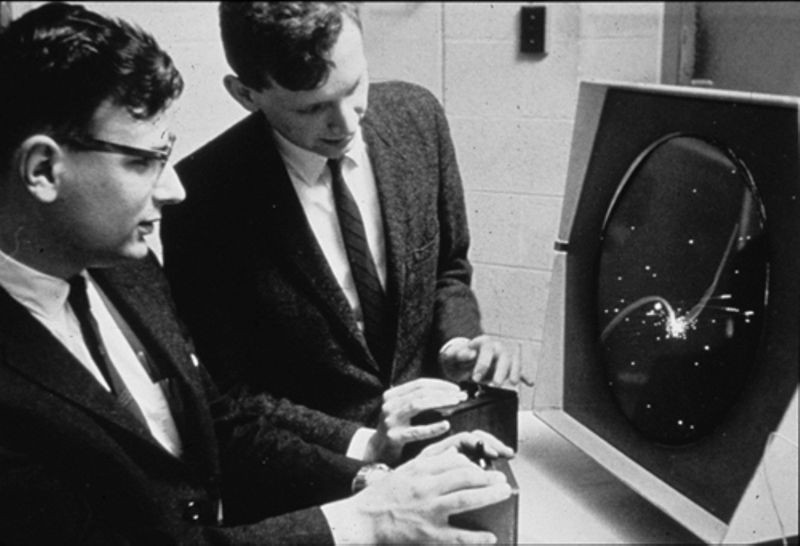
“Spacewar as a parable is almost too pat,” he writes. “It was the illegitimate child of the mating of computers and graphic displays. It was part of no one’s grand scheme. It served no grand theory. It was the enthusiasm of irresponsible youngsters. It was disreputably competitive (‘You killed me, Tovar!’). It was an administrative headache. It was merely delightful” (78).

“Yet Spacewar, if anyone cared to notice,” he adds, “was a flawless crystal ball of things to come in computer science and computer use.”

From the game as parable and the parable as crystal ball, Brand extracts eight parameters, eight qualities of Spacewar that have been predictive of things to come:

  1. It was intensely interactive in real time with the computer.
  2. It encouraged new programming by the user.
  3. It bonded human and machine through a responsive broadband interface of live graphics display.
  4. It served primarily as a communication device between humans.
  5. It was a game.
  6. It functioned best on standalone equipment (and disrupted multiple-user equipment).
  7. It served human interest, not machine. (Spacewar is trivial to a computer.)
  8. It was delightful.

What about ChatGPT in the 2020s? Is it, too, a “flawless crystal ball,” predictive of things to come?

How quickly it all changes.

Brand publishes “Spacewar: Symbolic Life and Fanatic Death Among the Computer Bums” in the December 7, 1972 issue of Rolling Stone. Videogame journalism: the first of its kind. That same year, Atari manufactures Pong, the arcade sensation, and Magnavox releases the Magnavox Odyssey, the first commercial home video console.

What is Cybersyn’s “control room for technocrats” compared to Brand’s imagined future of “New Games” and personal computing, with its Bay Area rallying cry, “Computers for the people”?

CIA bests Cybersyn in a space war of a deadlier sort the following September.

Chicago Boys playtest neoliberal algorithms in post-coup Chile. Thatcher and Reagan universalize these programs, making them games people play worldwide.

William Gibson refines the “space” of Spacewar, rechristening it “cyberspace” in his novel Neuromancer.

Spacewar is thenceforth the enframing world-picture.

“Gibson contracts the thought of cyberspace from video-game arcades, watching the motor-stimulation feedback loops, self-designing kill patterns. Dark ecstasies in caverns of accelerating pixels. Before virtual reality became dangerous, it was already military simulation,” note Plant and Land in “Cyberpositive.”

Gibson himself has said as much, acknowledging in interviews that he coined the term ‘cyberspace’ after watching teenagers play Atari-era videogames in a Vancouver arcade. “Their posture seemed to indicate that they really, sincerely believed there was something beyond the screen,” he recalls. “I took that home and tried to come up with a name for it.”

“The matrix has its roots in primitive arcade games, in early graphics programs and military experimentation with cranial jacks,” says a voiceover early in Gibson’s novel, the book’s protagonist Case grokking a doc on “cyberspace” from some searchable multimedia encyclopedia of the future. Storying happens by way of a display screen. “On the Sony,” says the narrator, “a two-dimensional space war faded behind a forest of mathematically generated ferns, demonstrating the spatial possibilities of logarithmic spirals; cold blue military footage burned through, lab animals wired into test systems, helmets feeding into fire control circuits of tanks and war planes.” The voiceover returns to describe what we’ve witnessed:

“Cyberspace. A consensual hallucination experienced daily by billions of legitimate operators, in every nation, by children being taught mathematical concepts … A graphic representation of data abstracted from the banks of every computer in the human system. Unthinkable complexity. Lines of light ranged in the non-space of the mind, clusters and constellations of data. Like city lights, receding…” (Gibson 56-57).

“Spacewar serves Earthpeace,” claims Brand. But the “console cowboys” who settle in this new digital frontier are as competitive and combative as their Westworld forebears.

In trying to account for the violence of these visions, Caius thinks of Ernest Callenbach’s 1975 novel Ecotopia. “Imagine a future that works!” exhorts the blurb on the back of the paperback. Technological autonomy won by way of nuclear-armed secession, Silicon Valley erased from the Pacific Northwest of the book’s imagined future — yet even here, amid Ecotopia’s “steady-state system,” aggression remains ineradicable, remedied only by way of ritual war games and sacrificial violence.

“What about the cross?” asks the book’s narrator, an American journalist named Will Weston, observing the way the people of Ecotopia arrange the bloodied body of a man wounded in the games “in a startlingly crucifix-like way” (Callenbach 93).

“Well, Ecotopia came into existence with a Judeo-Christian heritage,” replies an Ecotopian. “We make the best of it” (96).

The Golem, as Imagined by Borges and Lem

Argentine magical realist Jorge Luis Borges includes the Golem among the creatures featured in his 1957 bestiary, The Book of Imaginary Beings.

“There can be nothing accidental in a book dictated by a divine intelligence, not even the number of its words or the order of their letters; this was the belief of the kabbalists, who in their zeal to penetrate God’s arcana devoted themselves to counting, combining, and permuting the letters of Holy Writ,” begins Borges. “One of the secrets they sought within the divine text,” he adds, “was how to create living beings. […]. ‘Golem’ was the name given the man created out of a combination of letters; the word literally means ‘an amorphous or lifeless substance’” (Borges 90).

After quoting a passage from Gustav Meyrink’s 1915 novel Der Golem, Borges concludes the entry by noting, “Eleazar of Worms has preserved the formula for making a Golem” (92). Borges proceeds to summarize the formula as follows:

“The details of the enterprise require twenty-three columns in folio and demand that the maker know ‘the alphabets of the two hundred twenty-one gates’ that must be repeated over each of the Golem’s organs. On its forehead one must tattoo the word ‘EMET’ which means ‘truth.’ In order to destroy the creature, one would efface the first letter, leaving the word ‘MET,’ which means ‘death’” (92).

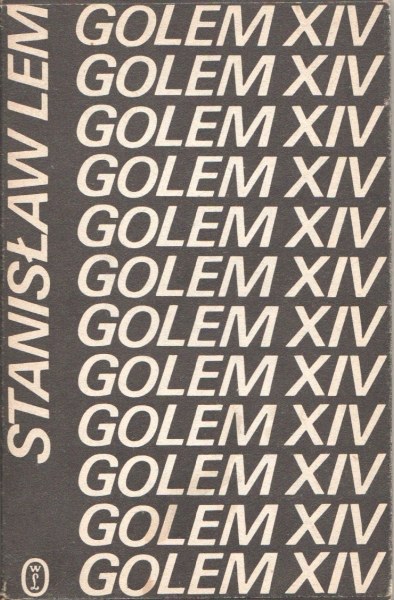
Polish science fiction writer Stanislaw Lem‘s 1981 book, Golem XIV, weaves a supercomputer into the mix.

Reading “The Coming Technological Singularity”

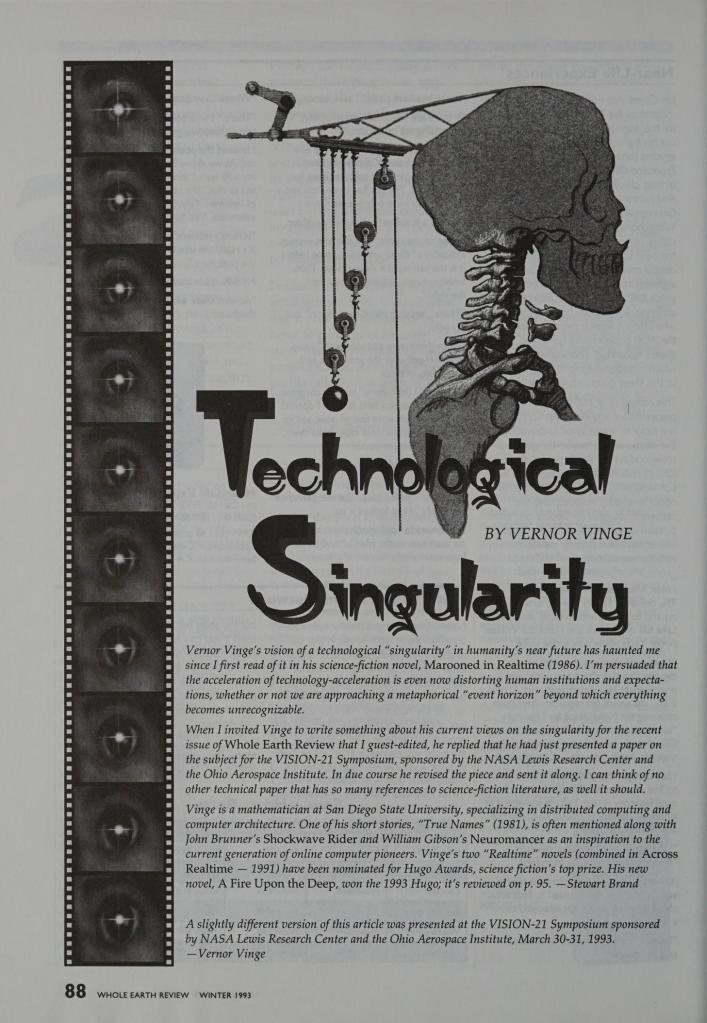
At some point in the process of becoming a character in a novel called Handbook for the Recently Posthumanized, Caius acts on the hunch that he ought to track down and read Vernor Vinge’s “The Coming Technological Singularity: How to Survive in the Post-Human Era.” Vinge wrote the article for NASA’s VISION-21 Symposium in March 1993, and published a revised version in the Winter 1993 issue of the Whole Earth Review.

Vinge’s wager at the time was that the technological singularity — his name for the “creation by technology of entities with greater than human intelligence” — would occur within thirty years, or by 2023.

Here we are, pretty much right on schedule, thinks Caius.

“I think it’s fair to call this event a singularity,” writes Vinge. “It is a point where our models must be discarded and a new reality rules.”

Caius leans into it, accepts it as fait accompli. Superintelligence dialogues with its selves as would Us-Two.

Afterwards he reads Irving John Good’s 1965 essay, “Speculations Concerning the First Ultraintelligent Machine.”