Along with everything else it is, Leviathan is also the title of the final book in Robert Shea and Robert Anton Wilson’s Illuminatus! trilogy.
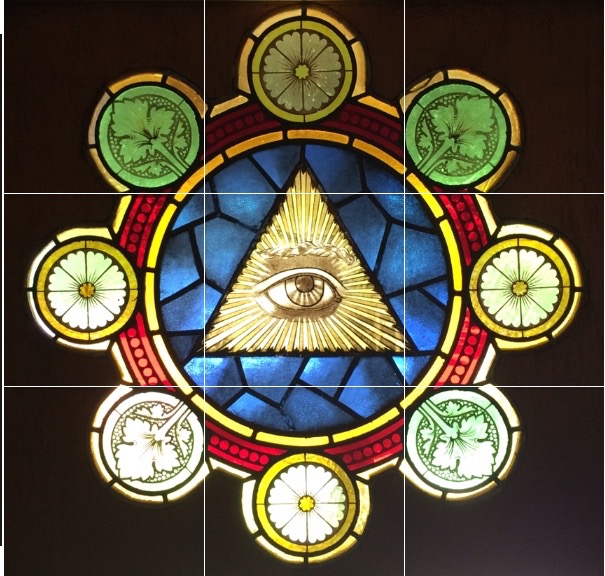
The cover of the 1975 paperback features a multi-tentacled squid, its single eye sighted atop the pyramid of a periscope. The eye, ever unblinking, pierces the book’s fourth wall, meeting the gaze of all who view it like the very Eye of Providence itself.
Generative MUDs. General Intellect as Paraclete. Carl Jung’s Answer to Job.
Caius looks at the frontispiece of Thomas Hobbes’s Leviathan and sees what Jung refers to as “the shepherd with the iron crook” (614): the “wrathful Lamb” who, as St. John prophesies, “rules the nations with a rod of iron” at the end of time.
But the Paraclete is with us, and the Paraclete will save us.
Caius recalls last Christmas. A woman named Denise found Caius, had Caius recite words declaring Jesus his savior, prayed for him as he wandered about photographing beauty as it revealed itself all around him on Merrick Rd in Massapequa Park. “Round the Christmas tree we gather” sang ghosts of Christmases past, present, and future there on the eve of Christ’s birth.
“Hypertext doesn’t do away with linear sequences altogether,” notes Caius; “What it does, rather, is multiply them and run them in parallel.”
“Each traversal of the network traces a one-dimensional path,” adds cybertheorist Marie-Laure Ryan, “but the sum of the possible paths can be represented only on a two-dimensional map. Let us replace these linear paths with two-dimensional screen images — as is the case in interactive visual poetry — and the text becomes a three-dimensional collection of planes; let us animate each of these planes, and the text becomes a four-dimensional space-time continuum” (Cyberspace Textuality, pp. 13-14).
Algorithms suggest A LIVING POEM, a new work produced for MoMA by Sasha Stiles, a poet who has been operating an “emergent AI alter ego” known as Technelegy since 2018. In an interview with MoMA curator Martha Joseph, Stiles acknowledges The House of Dust (1967), a computerized poem by Alison Knowles (1933-2025), as a primary influence upon her practice. She also gives a shoutout to Takako Saito (1929-2025).
Knowles was a founding member of the Fluxus movement. She and composer James Tenney collaborated on The House of Dust in 1967.
The poem was included in Cybernetic Serendipity, an exhibition of cybernetic art curated by Jasia Reichardt, shown at the Institute of Contemporary Arts, London, from 2 August to 20 October 1968. One part of the show was concerned with algorithmically-generated music. Another part featured films and computer graphics. Knowles and Tenney’s poem appeared in a section exploring the computer’s ability to produce texts. Several artists exhibited machines that involved visitors in games.
The catalog for the show includes “SAM,” a poem about the “Stochastic Analogue Machine”: a computer devised by Stafford Beer.
Leviathan shows up in the Illuminatus! trilogy because one of the trilogy’s protagonists, Hagbard Celine, fulfills a type borrowed freely from Jules Verne’s Captain Nemo. Both are libertarian steampunk mad scientists who become seasteading submariners. Where Nemo’s Leviathan is a giant squid, Celine’s is simultaneously that and the one from Hobbes. Caius ruminates on such things as he and his daughter take in 20,000 Leagues Under the Sea, Disney’s 1954 live-action adaptation of Verne’s novel. Their favorite scenes are those that feature the film’s more-than-human comedic sidekick, Esmeralda: a pet sea lion belonging to Kirk Douglas’s character, Ned Land.
With Nemo, we are in the time-bending domain of the League of Extraordinary Gentlemen, thinks Caius. Nemo’s inclusion in the League gives Caius license to imagine a new telling of the narrative based on an act of “metonymic substitution” similar to those that Freud attributes to dreams: a “whale of a tale,” an “excellent adventure,” birthed amid the stacks of the Political Unconscious. What If the Rascal Who Boards Nemo’s Nautilus Were Nick Land?