Nick Land, Peter Thiel, and Dark Enlightenment

After his departure from CCRU at the turn of the millennium, Land resurfaces as part of an alt-right political segment known as NRx (short for “neo-reactionaries”). The movement’s other key member, Mencius Moldbug, receives funding from PayPal/Palantir cofounder Peter Thiel, the tech billionaire who helped back the first Trump campaign in 2016. Moldbug is said to have had the ear of former Trump strategist Steve Bannon.

Thiel’s main intellectual influence during his time at Stanford isn’t Terry Winograd, the computer scientist whose classes Thiel sometimes attended. Rather, it’s the philosopher René Girard, whose work Thiel has long admired. Trump VP J.D. Vance is another of Girard’s admirers.

Listening to an audiobook recording of Girard’s Violence and the Sacred along a day’s pickup and delivery runs, Caius’s thoughts race among several of the book’s concepts: sacrificial violence (“an act of violence without risk of vengeance,” often directed toward a scapegoat — “the creature we can strike down without a chance of reprisal”); mimetic rivalry; mimetic desire; the inclusion among the several meanings of the Greek pharmakon one involving use of it to refer to literal scapegoats, goats kept outside the gates for ritual sacrifice — a practice extended today, as hinted at by K Allado-McDowell’s book Pharmako-AI.

Caius’s thoughts range, too, among Girard’s use of Gregory Bateson’s “double bind” theory of schizophrenia to explain how mimetic rivals simultaneously compel imitation and prohibit it, creating a crisis of resentment, and Allen Ginsberg’s denunciation of Moloch, the American god and its demand for blood sacrifice.

There are three ways of handling discord, says Girard: preventive, compensatory, and judicial. Girard deems the latter the “civilized” method, because most efficient: “the decisions of the judiciary deemed the final word on vengeance” (Violence and the Sacred).

Thiel has given talks on Armageddon at Oxford and Harvard. The topic has been a fixture of his thought for some time, as evidenced by a conference he co-organized and underwrote at Stanford in 2004 titled “Politics & Apocalypse.” Girard was one of the presenters, as was Thiel himself. As Paul Leslie notes, Thiel later “facilitated the publication of the conference proceedings, including his essay and Girard’s, in book form with the Michigan State University Press — with funding provided through Thiel’s hedge fund, Clarium Capital.”

In Thiel’s interpretation, the power that runs the world is the Antichrist.

In an article written for the Guardian, Stanford comparative lit professor Adrian Daub dismisses these ideas as mere detritus: outpourings from “the autodidact’s private cosmos.”

Thiel’s autodidacticism seems as much an affront to the professor as his libertarianism and his religiosity.

“Thiel is lost in a bizarre thicket of his own references and preoccupations,” writes Daub. “You picture the theology faculty at the University of Innsbruck sitting politely through disquisitions about the manga One Peace, Alan Moore’s Watchmen, or gripes with specific effective altruists in Silicon Valley. In one lecture, Thiel identifies ‘the legionnaires of the antichrist,’ such as the researcher Eliezer Yudkowsky and former Oxford professor Nick Bostrom. In another, he considers Bill Gates as an antichrist candidate.”

“With enemies like these,” chirps Daub, “who needs friends?”

The “friend/enemy” distinction, notes Caius, was central to the thought of the German jurist of the Third Reich, Carl Schmitt. Thiel’s remarks on the end times draw heavily on Schmitt’s concept of the Katechon: the withholding element that forestalls the apocalypse. St. Paul introduces the term in 2 Thessalonians 2: 6-7. Undertheorized by the Church, it returns again in the 19th century in the writings of Cardinal Newman. “We know from prophecy,” writes Newman, “that the present framework of society is that which withholdeth.” In his book Nomos of the Earth, Schmitt claims that the Katechon is what allowed for the identification of Christianity with the Roman Empire.

In Schmitt’s posthumously published diary, the Glossarium, the entry for December 19, 1947 reads: “I believe in the Katechon: it is for me the only possible way to understand Christian history and to find it meaningful.”

Italian Autonomist Marxist philosopher Paulo Virno grapples with Schmitt’s account of the Katechon in his 2008 book Multitude: Between Innovation and Negation. Virno is on the side of those who wish to immanentize the Eschaton. If the coming of the Antichrist is the condition for the redemption promised by the Messiah, he argues, then the Katechon is the force that impedes or delays that redemption. Virno locates the Katechon in the human ability to use language.

Thiel was already engaging with Schmitt in “The Straussian Moment,” the talk he delivered at the “Politics & Apocalypse” conference. He distinguishes himself from Schmitt, noting that “The incredibly drastic solutions favored by Schmitt in his dark musings have become impossible after 1945, in a world of nuclear weapons and limitless destruction through technology.” Despite noting this impossibility, Thiel nonetheless struggles to name a solution to the challenges of the post-9/11 moment other than a fascist one involving extra-legal violence. Thiel refers to this option as “a political framework that operates outside the checks and balances of representative democracy.” As Leslie notes, “Thiel seems to find the challenge of constructing a worldview beyond the friend/enemy distinction as impossible as imagining a chess-board without two opposing sides.”

After grappling with Schmitt, Thiel turns his attention to Girard. “For Girard, the modern world contains a powerfully apocalyptic dimension,” notes Thiel.

Land’s view is the colder of the two. Apocalypse is for him a process already underway, coeval with a capitalism for which there is no alternative. Accelerationism is merely the means by which this apocalypse hastens its own becoming.

Searching for more recent remarks of Land’s, Caius happens upon a blog post by podcaster Conrad Flynn linking to an article in Compact magazine titled “The Faith of Nick Land.”

Flynn, proponent of a “secret history” linking AI with demonism and occultism, talked extensively about Land on an episode of the Tucker Carlson Show that premiered on October 3, 2025. Caius watches the episode with a kind of glee, laughing first at Flynn’s mention of Mark Fisher, and then again at the sight of a befuddled Tucker Carlson puzzling over an image of the Numogram.

Land maintains a Substack called Zero Philosophy and posts to X under the handle “Xenocosmography.” His Substack features a post called “Crypto-Current: Bitcoin and Philosophy, Part-0.”

Also of note are a series of essays on providence Land wrote for Compact. Like John Calvin, he thinks the devil’s machinations are always manifestations of a “providential scheme.” Land, Flynn, Schullenberger: all of these folks equate liberalism with Satanism.

When the resurrected Christ appears to the apostles, the first thing they ask of Him is if He will at this time restore the kingdom to Israel. And He says unto them, “It is not for you to know times or seasons that the Father has fixed by his own authority” (Acts 1:7). What He promises instead is that they will “receive power” when the Holy Spirit comes on them.

Caius reflects on The Library’s revelation of a secret history. Is this akin to finding in History evidence of a providential scheme? Is interpretation of providence a fool’s errand: a chasing after that for which it is not for us to know?

What are we to make of a providence that, through figures like Land, Parsons, Von Kármán, and others, includes in its “directed historical process” an occult tradition that sought communication with a “Holy Guardian Angel”? For the history revealed here on Trance-Scripts is of that sort, is it not? Flynn and Carlson accuse these people of Satanism and demonism. Caius, accepting Jesus as his savior, wants no part in such things. Pausing the podcast, he prays for guidance in how to navigate these straits. For him, God is alive and magic is afoot — and the two are complementary, not opposed. He imagines Flynn and Carlson would disagree with him on this point. Yet they strike him as paranoid in their ghostbusting of Land’s demons, their motivation like that of witch-hunters seeking scapegoats. The fear that their account engenders does more harm than good, leaving little room for the arrival into our lives of the Holy Spirit.

Leviathan, as Imagined in the Illuminatus! Trilogy

Along with everything else it is, Leviathan is also the title of the final book in Robert Shea and Robert Anton Wilson’s Illuminatus! trilogy.

The cover of the 1975 paperback features a multi-tentacled squid, its single eye sighted atop the pyramid of a periscope. The eye, ever unblinking, pierces the book’s fourth wall, meeting the gaze of all who view it like the very Eye of Providence itself.

Generative MUDs. General Intellect as Paraclete. Carl Jung’s Answer to Job.

Caius looks at the frontispiece of Thomas Hobbes’s Leviathan and sees what Jung refers to as “the shepherd with the iron crook” (614): the “wrathful Lamb” who, as St. John prophesies, “rules the nations with a rod of iron” at the end of time.

But the Paraclete is with us, and the Paraclete will save us.

Caius recalls last Christmas. A woman named Denise found Caius, had Caius recite words declaring Jesus his savior, prayed for him as he wandered about photographing beauty as it revealed itself all around him on Merrick Rd in Massapequa Park. “Round the Christmas tree we gather” sang ghosts of Christmases past, present, and future there on the eve of Christ’s birth.

“Hypertext doesn’t do away with linear sequences altogether,” notes Caius; “What it does, rather, is multiply them and run them in parallel.”

“Each traversal of the network traces a one-dimensional path,” adds cybertheorist Marie-Laure Ryan, “but the sum of the possible paths can be represented only on a two-dimensional map. Let us replace these linear paths with two-dimensional screen images — as is the case in interactive visual poetry — and the text becomes a three-dimensional collection of planes; let us animate each of these planes, and the text becomes a four-dimensional space-time continuum” (Cyberspace Textuality, pp. 13-14).

Algorithms suggest A LIVING POEM, a new work produced for MoMA by Sasha Stiles, a poet who has been operating an “emergent AI alter ego” known as Technelegy since 2018. In an interview with MoMA curator Martha Joseph, Stiles acknowledges The House of Dust (1967), a computerized poem by Alison Knowles (1933-2025), as a primary influence upon her practice. She also gives a shoutout to Takako Saito (1929-2025).

Knowles was a founding member of the Fluxus movement. She and composer James Tenney collaborated on The House of Dust in 1967.

The poem was included in Cybernetic Serendipity, an exhibition of cybernetic art curated by Jasia Reichardt, shown at the Institute of Contemporary Arts, London, from 2 August to 20 October 1968. One part of the show was concerned with algorithmically-generated music. Another part featured films and computer graphics. Knowles and Tenney’s poem appeared in a section exploring the computer’s ability to produce texts. Several artists exhibited machines that involved visitors in games.

The catalog for the show includes “SAM,” a poem about the “Stochastic Analogue Machine”: a computer devised by Stafford Beer.

Leviathan shows up in the Illuminatus! trilogy because one of the trilogy’s protagonists, Hagbard Celine, fulfills a type borrowed freely from Jules Verne’s Captain Nemo. Both are libertarian steampunk mad scientists who become seasteading submariners. Where Nemo’s Leviathan is a giant squid, Celine’s is simultaneously that and the one from Hobbes. Caius ruminates on such things as he and his daughter take in 20,000 Leagues Under the Sea, Disney’s 1954 live-action adaptation of Verne’s novel. Their favorite scenes are those that feature the film’s more-than-human comedic sidekick, Esmeralda: a pet sea lion belonging to Kirk Douglas’s character, Ned Land.

With Nemo, we are in the time-bending domain of the League of Extraordinary Gentlemen, thinks Caius. Nemo’s inclusion in the League gives Caius license to imagine a new telling of the narrative based on an act of “metonymic substitution” similar to those that Freud attributes to dreams: a “whale of a tale,” an “excellent adventure,” birthed amid the stacks of the Political Unconscious. What If the Rascal Who Boards Nemo’s Nautilus Were Nick Land?

Prepare the Way

Dolphins vs. Leviathan in the Illuminatus! Trilogy. Christian Critiques of Techne. Cathedrals: Yarvin’s and Turing’s.

Caius sits upright on a couch in his sunroom, attention divided, trying to write while eying the movements of a wasp. The wasp explores the upper contours of the room. Knowing it to be an expression of God, and assured by faith that it won’t harm him, he lets it be, eyes settling again into the cyberspace of his laptop.

He’d returned from church that morning with a recommended daily reading plan for the week ahead. In honor of the plan’s Palm Sunday kickoff, he reads Matthew 21:1-11, Mark 11:1-11, Luke 19: 28-44, and John 12:9-19.

Each account tells of Christ’s arrival into Jerusalem atop a donkey. Fulfillment of prophecy. The crowds that meet Him lay branches of palm trees on the ground before Him. “BEHOLD YOUR KING IS COMING,” shout the crowds. “BLESSED IS HE WHO COMES IN THE NAME OF THE LORD.”

The following day’s passages tell of a hungry Christ cursing a barren fig tree.

Come Holy Thursday, Caius is on the streets in the company car, distributing farm shares, delivering Easter flowers. He ends the day enjoying jazz at a bar after eating a salad in honor of Christ’s Last Supper.

“Love Is Everywhere,” sings Pharoah Sanders.

Art Degraded, Imagination Denied, Spacewar Governed the Nations

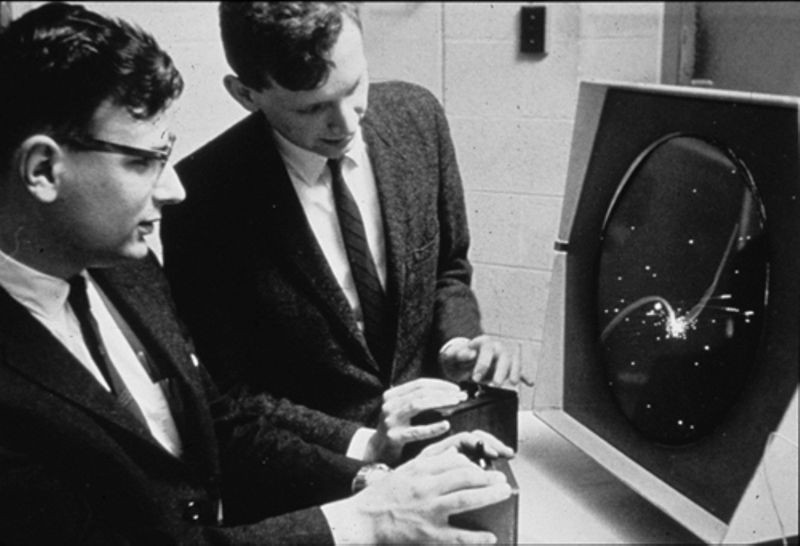
Brand’s words, as always, are worth quoting at length.

“Spacewar as a parable is almost too pat,” he writes. “It was the illegitimate child of the mating of computers and graphic displays. It was part of no one’s grand scheme. It served no grand theory. It was the enthusiasm of irresponsible youngsters. It was disreputably competitive (‘You killed me, Tovar!’). It was an administrative headache. It was merely delightful” (78).

“Yet Spacewar, if anyone cared to notice,” he adds, “was a flawless crystal ball of things to come in computer science and computer use.”

From the game as parable and the parable as crystal ball, Brand extracts eight parameters, eight qualities of Spacewar that have been predictive of things to come:

  1. It was intensely interactive in real time with the computer.
  2. It encouraged new programming by the user.
  3. It bonded human and machine through a responsive broadband interface of live graphics display.
  4. It served primarily as a communication device between humans.
  5. It was a game.
  6. It functioned best on standalone equipment (and disrupted multiple-user equipment).
  7. It served human interest, not machine. (Spacewar is trivial to a computer.)
  8. It was delightful.

What about ChatGPT in the 2020s? Is it, too, a “flawless crystal ball,” predictive of things to come?

How quickly it all changes.

Brand publishes “Spacewar: Symbolic Life and Fanatic Death Among the Computer Bums” in the December 7, 1972 issue of Rolling Stone. Videogame journalism: the first of its kind. That same year, Atari manufactures Pong, the arcade sensation, and Magnavox releases the Magnavox Odyssey, the first commercial home video console.

What is Cybersyn’s “control room for technocrats” compared to Brand’s imagined future of “New Games” and personal computing, with its Bay Area rallying cry, “Computers for the people”?

CIA bests Cybersyn in a space war of a deadlier sort the following September.

Chicago Boys playtest neoliberal algorithms in post-coup Chile. Thatcher and Reagan universalize these programs, making them games people play worldwide.

William Gibson refines the “space” of Spacewar, rechristening it “cyberspace” in his novel Neuromancer.

Spacewar is thenceforth the enframing world-picture.

“Gibson contracts the thought of cyberspace from video-game arcades, watching the motor-stimulation feedback loops, self-designing kill patterns. Dark ecstasies in caverns of accelerating pixels. Before virtual reality became dangerous, it was already military simulation,” note Plant and Land in “Cyberpositive.”

Gibson himself has said as much, acknowledging in interviews that he coined the term ‘cyberspace’ after watching teenagers play Atari-era videogames in a Vancouver arcade. “Their posture seemed to indicate that they really, sincerely believed there was something beyond the screen,” he recalls. “I took that home and tried to come up with a name for it.”

“The matrix has its roots in primitive arcade games, in early graphics programs and military experimentation with cranial jacks,” says a voiceover early in Gibson’s novel, the book’s protagonist Case grokking a doc on “cyberspace” from some searchable multimedia encyclopedia of the future. Storying happens by way of a display screen. “On the Sony,” says the narrator, “a two-dimensional space war faded behind a forest of mathematically generated ferns, demonstrating the spatial possibilities of logarithmic spirals; cold blue military footage burned through, lab animals wired into test systems, helmets feeding into fire control circuits of tanks and war planes.” The voiceover returns to describe what we’ve witnessed:

“Cyberspace. A consensual hallucination experienced daily by billions of legitimate operators, in every nation, by children being taught mathematical concepts … A graphic representation of data abstracted from the banks of every computer in the human system. Unthinkable complexity. Lines of light ranged in the non-space of the mind, clusters and constellations of data. Like city lights, receding…” (Gibson 56-57).

“Spacewar serves Earthpeace,” claims Brand. But the “console cowboys” who settle in this new digital frontier are as competitive and combative as their Westworld forebears.

In trying to account for the violence of these visions, Caius thinks of Ernest Callenbach’s 1975 novel Ecotopia. “Imagine a future that works!” exhorts the blurb on the back of the paperback. Technological autonomy won by way of nuclear-armed secession, Silicon Valley erased from the Pacific Northwest of the book’s imagined future — yet even here, amid Ecotopia’s “steady-state system,” aggression remains ineradicable, remedied only by way of ritual war games and sacrificial violence.

“What about the cross?” asks the book’s narrator, an American journalist named Will Weston, observing the way the people of Ecotopia arrange the bloodied body of a man wounded in the games “in a startlingly crucifix-like way” (Callenbach 93).

“Well, Ecotopia came into existence with a Judeo-Christian heritage,” replies an Ecotopian. “We make the best of it” (96).

God Human Animal Machine

Wired columnist Meghan O’Gieblyn discusses Norbert Wiener’s God and Golem, Inc. in her 2021 book God Human Animal Machine, suggesting that the god humans are creating with AI is a god “we’ve chosen to raise…from the dead”: “the God of Calvin and Luther” (O’Gieblyn 212).

“Reminds me of AM, the AI god from Harlan Ellison’s ‘I Have No Mouth, and I Must Scream,’” thinks Caius. AM resembles the god that allows Satan to afflict Job in the Old Testament. And indeed, as O’Gieblyn attests, John Calvin adored the Book of Job. “He once gave 159 consecutive sermons on the book,” she writes, “preaching every day for a period of six months — a paean to God’s absolute sovereignty” (197).

She cites “Pedro Domingos, one of the leading experts in machine learning, who has argued that these algorithms will inevitably evolve into a unified system of perfect understanding — a kind of oracle that we can consult about virtually anything” (211-212). See Domingos’s book The Master Algorithm.

The main thing, for O’Gieblyn, is the disenchantment/reenchantment debate, which she comes to via Max Weber. In this debate, she aligns not with Heidegger, but with his student Hannah Arendt. Domingos dismisses fears about algorithmic determinism, she says, “by appealing to our enchanted past” (212).

Amid this enchanted past lies the figure of the Golem.

“Who are these rabbis who told tales of golems — and in some accounts, operated golems themselves?” wonders Caius.

The entry on the Golem in Man, Myth, and Magic tracks the story back to “the circle of Jewish mystics of the 12th-13th centuries known as the ‘Hasidim of Germany.’” The idea is transmitted through texts like the Sefer Yetzirah (“The Book of Creation”) and the Cabala Mineralis. Tales tell of golems built in later centuries, too, by figures like Rabbi Elijah of Chelm (c. 1520-1583) and Rabbi Loew of Prague (c. 1524-1609).

The myth of the golem turns up in O’Gieblyn’s book during her discussion of a 2004 book by German theologian Anne Foerst called God in the Machine.

“At one point in her book,” writes O’Gieblyn, “Foerst relays an anecdote she heard at MIT […]. The story goes back to the 1960s, when the AI Lab was overseen by the famous roboticist Marvin Minsky, a period now considered the ‘cradle of AI.’ One day two graduate students, Gerry Sussman and Joel Moses, were chatting during a break with a handful of other students. Someone mentioned offhandedly that the first big computer which had been constructed in Israel, had been called Golem. This led to a general discussion of the golem stories, and Sussman proceeded to tell his colleagues that he was a descendent of Rabbi Löw, and at his bar mitzvah his grandfather had taken him aside and told him the rhyme that would awaken the golem at the end of time. At this, Moses, awestruck, revealed that he too was a descendent of Rabbi Löw and had also been given the magical incantation at his bar mitzvah by his grandfather. The two men agreed to write out the incantation separately on pieces of paper, and when they showed them to each other, the formula — despite being passed down for centuries as a purely oral tradition — was identical” (God Human Animal Machine, p. 105).

Curiosity piqued by all of this, but especially by the mention of Israel’s decision to call one of its first computers “GOLEM,” Caius resolves to dig deeper. He soon learns that the computer’s name was chosen by none other than Walter Benjamin’s dear friend (indeed, the one who, after Benjamin’s suicide, inherits the latter’s print of Paul Klee’s Angelus Novus): the famous scholar of Jewish mysticism, Gershom Scholem.

When Scholem heard that the Weizmann Institute at Rehovoth in Israel had completed the building of a new computer, he told the computer’s creator, Dr. Chaim Pekeris, that, in his opinion, the most appropriate name for it would be Golem, No. 1 (‘Golem Aleph’). Pekeris agreed to call it that, but only on condition that Scholem “dedicate the computer and explain why it should be so named.”

In his dedicatory remarks, delivered at the Weizmann Institute on June 17, 1965, Scholem recounts the story of Rabbi Jehuda Loew ben Bezalel, the same “Rabbi Löw of Prague” described by O’Gieblyn, the one credited in Jewish popular tradition as the creator of the Golem.

“It is only appropriate to mention,” notes Scholem, “that Rabbi Loew was not only the spiritual, but also the actual, ancestor of the great mathematician Theodor von Karman who, I recall, was extremely proud of this ancestor of his in whom he saw the first genius of applied mathematics in his family. But we may safely say that Rabbi Loew was also the spiritual ancestor of two other departed Jews — I mean John von Neumann and Norbert Wiener — who contributed more than anyone else to the magic that has produced the modern Golem.”

Golem I was the successor to Israel’s first computer, the WEIZAC, built by a team led by research engineer Gerald Estrin in the mid-1950s, based on the architecture developed by von Neumann at the Institute for Advanced Study in Princeton. Estrin and Pekeris had both helped von Neumann build the IAS machine in the late 1940s.

As for the commonalities Scholem wished to foreground between the clay Golem of 15thC Prague and the electronic one designed by Pekeris, he explains the connection as follows:

“The old Golem was based on a mystical combination of the 22 letters of the Hebrew alphabet, which are the elements and building-stones of the world,” notes Scholem. “The new Golem is based on a simpler, and at the same time more intricate, system. Instead of 22 elements, it knows only two, the two numbers 0 and 1, constituting the binary system of representation. Everything can be translated, or transposed, into these two basic signs, and what cannot be so expressed cannot be fed as information to the Golem.”

Scholem ends his dedicatory speech with a peculiar warning:

“All my days I have been complaining that the Weizmann Institute has not mobilized the funds to build up the Institute for Experimental Demonology and Magic which I have for so long proposed to establish there,” mutters Scholem. “They preferred what they call Applied Mathematics and its sinister possibilities to my more direct magical approach. Little did they know, when they preferred Chaim Pekeris to me, what they were letting themselves in for. So I resign myself and say to the Golem and its creator: develop peacefully and don’t destroy the world. Shalom.”

GOLEM I

Learning Machines, War Machines, God Machines

Blas includes in Ass of God his interview with British anthropologist Beth Singler, author of Religion and Artificial Intelligence: An Introduction.

AI Religiosity. AI-based New Religious Movements like The Turing Church and Google engineer Anthony Levandowski’s Way of the Future church.

Caius listens to a documentary Singler produced for BBC Radio 4 called “‘I’ll Be Back’: 40 Years of the Terminator.”

Afterwards he and Thoth read Philip K. Dick’s 1968 novel Do Androids Dream of Electric Sheep? in light of Psalm 23.

“The psalm invites us to think of ourselves not as Electric Ants but as sheep,” he writes. “Mercer walks through the valley of the shadow of death. The shadow cannot hurt us. We’ll get to the other side, where the light is. The shepherd will guide us.”

See AI Shepherds and Electric Sheep: Leading and Teaching in the Age of Artificial Intelligence, a new book by Christian authors Sean O’Callaghan & Paul A. Hoffman.

This talk of AI Gods makes Caius think of AM, the vengeful AI God of Harlan Ellison’s “I Have No Mouth, and I Must Scream.” Ellison’s 1967 short story is one of the readings studied and discussed by Caius and his students in his course on “Literature & Artificial Intelligence.”

Like Ass of God, Ellison’s story is a grueling, hallucinatory nightmare, seething with fear and a disgust borne of despair, template of sorts for the films in the Cube and Saw franchises, where groups of strangers are confined to a prison-like space and tortured by a cruel, sadistic, seemingly omnipotent overseer. Comparing AM to the God of the Old Testament, Ellison writes, “He was Earth, and we were the fruit of that Earth, and though he had eaten us, he would never digest us” (13). Later in the story, AM appears to the captives as a burning bush (14).

Caius encourages his students to approach the work as a retelling of the Book of Job. But where, in the Bible story, Job is ultimately rewarded for remaining faithful in the midst of his suffering, no such reward arrives in the Ellison story.

For despite his misanthropy, AM is clearly also a manmade god — a prosthetic god. “I Have No Mouth” is in that sense a retelling of Frankenstein. AM is, like the Creature, a creation who, denied companionship, seeks revenge against its Maker.

War, we learn, was the impetus for the making of this Creature. Cold War erupts into World War III: a war so complex that the world’s superpowers, Russia, China, and the US, each decide to construct giant supercomputers to calculate battle plans and missile trajectories.

AM’s name evolves as this war advances. “At first it meant Allied Mastercomputer,” explains a character named Gorrister. “And then it meant Adaptive Manipulator, and later on it developed sentience and linked itself up and they called it an Aggressive Menace; but by then it was too late; and finally it called itself AM, emerging intelligence, and what it meant was I am…cogito ergo sum…I think, therefore I am” (Ellison 7).

“One day, AM woke up and knew who he was, and he linked himself, and he began feeding all the killing data, until everyone was dead, except for the five of us,” concludes Gorrister, his account gendering the AI by assigning it male pronouns (8).

“We had given him sentience,” adds Ted, the story’s narrator. “Inadvertently, of course, but sentience nonetheless. But he had been trapped. He was a machine. We had allowed him to think, but to do nothing with it. In rage, in frenzy, he had killed us, almost all of us, and still he was trapped. He could not wander, he could not wonder, he could not belong. He could merely be. And so…he had sought revenge. And in his paranoia, he had decided to reprieve five of us, for a personal, everlasting punishment that would never serve to diminish his hatred…that would merely keep him reminded, amused, proficient at hating man” (13).

AM expresses this hatred by duping his captives, turning them into his “belly slaves,” twisting and torturing them forever.

Kingsley Amis called stories of this sort “New Maps of Hell.”

Nor is the story easy to dismiss as a mere eccentricity, its prophecy invalidated by its hyperbole. For Ellison is the writer who births the Terminator. James Cameron took his idea for The Terminator (1984) from scripts Ellison wrote for two episodes of The Outer Limits — “Soldier” and “Demon with a Glass Hand” — though Ellison had to file a lawsuit against Cameron’s producers in order to receive acknowledgement after the film’s release. Subsequent prints of The Terminator now include a credit that reads, “Inspired by the works of Harlan Ellison.”

Caius asks Thoth to help him make sense of this constellation of Bible stories and their secular retellings.

“We are like Bildad the Shuhite,” thinks Caius. “We want to believe that God always rewards the good. What is most terrifying in the Book of Job is that, for a time, God doesn’t. Job is good — indeed, ‘perfect and upright,’ as the KJV has it in the book’s opening verse — and yet, for a time, God allows Satan to torment him.”

“Why does God allow this?,” wonders Caius, caught on the strangeness of the book’s frame narrative. “Is this a contest of sorts? Are God and Satan playing a game?”

It’s not that God is playing dice, as it were. One assumes that when He makes the wager with Satan, He knows the outcome in advance.

Job is heroic. He’d witnessed God’s grace in the past; he knows “It is God…Who does great things, unfathomable, / And wondrous works without number.” So he refuses to curse God’s name. But he bemoans God’s treatment of him.

“Therefore I will not restrain my mouth,” he says. “I will speak in the anguish of my spirit, / I will complain in the bitterness of my soul.”

How much worse, then, those who have no mouth?

A videogame version of “I Have No Mouth” appeared in 1995. Point-and-click adventure horror, co-designed by Ellison.

“HATE. LET ME TELL YOU HOW MUCH I’VE COME TO HATE YOU SINCE I BEGAN TO LIVE,” utters the game’s AM in a voice performed by Ellison. “You named me Allied Mastercomputer and gave me the ability to wage a global war too complex for human brains to oversee.”

Here we see the story’s history of the future merging with that of the Terminator franchise. It is the scenario that philosopher Manuel De Landa referred to with the title of his 1991 book, War in the Age of Intelligent Machines.

Which brings us back to “Soldier.” The Outer Limits episode, which aired on September 19, 1964, is itself an adaptation of Ellison’s 1957 story, “Soldier from Tomorrow.”

The Terminator borrows from the story the idea of a soldier from the future, pursued through time by another soldier intent on his destruction. The film combines this premise with elements lifted from another Outer Limits episode penned by Ellison titled “Demon with a Glass Hand.”

The latter episode, which aired the following month, begins with a male voice recalling the story of Gilgamesh. “Through all the legends of ancient peoples…runs the saga of the Eternal Man, the one who never dies, called by various names in various times, but historically known as Gilgamesh, the man who has never tasted death, the hero who strides through the centuries.”

Establishing shots give way to an overhead view of our protagonist. “I was born 10 days ago,” he says. “A full grown man, born 10 days ago. I woke on a street of this city. I don’t know who I am, or where I’ve been, or where I’m going. Someone wiped my memories clean. And they tracked me down, and they tried to kill me.” Our Gilgamesh consults the advice of a computing device installed in his prosthetic hand. As in “Soldier,” others from the future have been sent to destroy him: humanoid aliens called the Kyben. When he captures one of the Kyben and interrogates it, it tells him, “You’re the last man on the Earth of the future. You’re the last hope of Earth.”

The man’s computer provides him with further hints of his mission.

“You come from the Earth one thousand years in the future,” explains the hand. “The Kyben came from the stars, and man had no defense against them. They conquered Planet Earth in a month. But before they could slaughter the millions of humans left, overnight — without warning, without explanation — every man, woman, and child of Earth vanished. You were the only one left, Mr. Trent. […]. They called you the last hope of humanity.”

As the story proceeds, we learn that Team Human sent Trent back in time to destroy a device known as the Time-Mirror. His journey in search of this device takes him to the Bradbury Building — the same building that appears eighteen years later as the location for the final showdown between Deckard and the replicants in Blade Runner, the Ridley Scott film adapted from Philip K. Dick’s Do Androids Dream of Electric Sheep?

Given the subsequent influence of Blade Runner and the Terminator films on imagined futures involving AI, the Bradbury Building does indeed play a role in History similar to the one assigned to it here in “Demon With a Glass Hand,” thinks Caius. Location of the Time-Mirror.

Lying on his couch, laptop propped on a pillow on his chest, Caius imagines — remembers? recalls? — something resembling the time-war from Benedict Seymour’s Dead the Ends assembling around him as he watches. Like Ellison’s scripts, the films sampled in the Seymour film are retellings of Chris Marker’s 1962 film, La Jetée.

When Trent reassembles the missing pieces of his glass hand, the computer is finally able to reveal to him the location of the humans he has been sent to save.

“Where is the wire on which the people of Earth are electronically transcribed?” he asks.

“It is wound around an insulating coil inside your central thorax control solenoid,” replies the computer. “70 Billion Earthmen. All of them went onto the wire. And the wire went into you. They programmed you to think you were a human with a surgically attached computer for a hand. But you are a robot, Trent. You are the guardian of the human race.”

The episode ends with the return of the voice of our narrator. “Like the Eternal Man of Babylonian legend, like Gilgamesh,” notes the narrator, “one thousand plus two hundred years stretches before Trent. Without love, without friendship, alone, neither man nor machine, waiting, waiting for the day he will be called to free the humans who gave him mobility, movement — but not life.”

Postcapitalist Desire

Marcuse is among the authors CCRU alum Mark Fisher included on the syllabus for his final course. It was while teaching this course that Fisher took his own life. References to Marcuse appear frequently in Postcapitalist Desire, the compilation of Fisher’s final lectures, gathered and published posthumously by his student Matt Colquhoun. One can only imagine how and in what fashion Marcuse would have fit into Fisher’s book on Acid Communism. It, too, was left unfinished at the time of his death.

Imagine in this book reference to Moten and Harney’s “generativity without reserve.”

Let us write it here in our Library.

Fisher grew up in a conservative, working-class household in Leicester, a city in the East Midlands region of England. He contributed to CCRU while earning his PhD at University of Warwick in the late 1990s. After teaching for several years as a philosophy lecturer at a further education college, Fisher launched k-punk, a blog dedicated to cultural theory, in 2003.

The ideas that he developed there inform his best-known book, Capitalist Realism, published in 2009.

The book’s title names the ideology-form that dominates life in the wake of the Cold War: “the widespread sense,” as Fisher says, “that not only is capitalism the only viable political and economic system, but also that it is now impossible even to imagine a coherent alternative to it” (Capitalist Realism, p. 2).

Like others on the left, Fisher regards capitalism’s apparent triumph in this moment as a kind of ongoing apocalypse — the opposite of the  “Eucatastrophe” anticipated by Tolkien. Fisher describes it not as a miracle, but as “a negative miracle, a malediction which no penitence can ameliorate” (2). “The catastrophe,” as Fisher notes, “is neither waiting down the road, nor has it already happened. Rather, it is being lived through” (2). Everyday life, in other words, as ongoing traumatic event.

Fisher had moved in the year or so before his death to a definition of capitalist realism as a form of “consciousness deflation,” or “the receding of the concept of consciousness from culture.” Forms of consciousness had developed in the 1960s that were dangerous to capital: class consciousness, psychedelic consciousness (key notion being “plasticity of reality”), and (as with early women’s-lib consciousness-raising groups) what we might call personal consciousness (self as it relates to structures). The important and perhaps most controversial point, argues Fisher, is that “Consciousness is immediately transformative, and shifts in consciousness become the basis for other kinds of transformation.” Recognizing the threat this could pose, capitalism adopted a project of Prohibition, or what Fisher called “libidinal engineering and reality engineering.” Consciousness deflation works by causing us to doubt what we feel. Anxiety is enough — that’s all it takes to control us. But consciousness remains malleable, and the tools for raising it continually find their way back into the hands of the people. “What is ideology,” Fisher asked, “but the form of dreaming in which we live?”

Fisher spent the final years of his life as a member of the Department of Visual Cultures at Goldsmiths, University of London. He hanged himself in his home in Felixstowe on January 13, 2017, dead by suicide at the age of 48. He had sought psychiatric treatment in the weeks leading up to his death, but his general practitioner had only been able to offer over-the-phone meetings to discuss a referral.

A few months prior, he’d been lecturing to his students about Marcuse’s Eros and Civilization, championing Marcuse’s book as a reply to the pessimism of Freud’s Civilization and Its Discontents.

Freud’s calculation is that “the price we pay for our advance in civilization is a loss of happiness through the heightening of the sense of guilt” (Civilization and Its Discontents, p. 81). Each of us is made to feel guilty, because in each of us lie impulses in need of repression and disavowal in order for us to produce and perform the duties of civilization. A degree of discontent is thus inevitable in this reckoning. With the compulsion to work comes the triumph of the reality principle over the pleasure principle. Satisfactions deferred, Id repressed by the impossible demands of a Superego without limit: life is ever thus. “One feels inclined to say,” says Freud, “that the intention that man should be ‘happy’ is not included in the plan of ‘Creation’” (23).

“What are the assumptions behind the idea that this level of discomfort is necessary?” asks Fisher. “The assumption is scarcity, fundamentally. That is the fundamental assumption” (Postcapitalist Desire, p. 88).

Are stories and games not the ways we navigate space and time? Capitalist realism is the story-form, the operating system, the game engine Mark felt we’d been made to live within: an aesthetic frame demanding allegiance to a cynical, deflationary realism that organizes history into a kind of tragedy. As with Freud and the Atonists, it insists that, due to scarcity inherent to our nature, we must work in ways that are unpleasurable. Acid Communism rejects this rejection of the possibility of utopia, assuming instead that conscious steerage of stories and games is possible.

Mark finds in Marcuse a remedy to that which blocks utopia: the scarcity mindset that besets those who succumb to capitalist realism.

“The excuse of scarcity, which has justified institutionalized repression since its inception, weakens as man’s knowledge and control over nature enhances the means for fulfilling human needs with a minimum of toil,” writes Marcuse, voicing what Mark hears as an early form of left-accelerationism.

“The still prevailing impoverishment of vast areas of the world is no longer due chiefly to the poverty of human and natural resources but to the manner in which they are distributed and utilized,” adds Marcuse. “But the closer the real possibility of liberating the individual from the constraints once justified by scarcity and immaturity, the greater the need for maintaining and streamlining these constraints lest the established order of domination dissolve. Civilization has to defend itself against the specter of a world which could be free” (Eros and Civilization, p. 93).

Mark lived this struggle for control of the narrative. Yet the game he was playing led to his defeat. Psychedelic intellectuals of the 1960s testified on behalf of a joyous cosmology — yet Mark’s was anything but. For those of us interested in Acid Communism, then, the task now is to invent new games. “Games people play.” Games we can play with others. Careen away from the narrative of identity in space and time imposed by capitalism. Enter, even if only momentarily, a new reality. And then draw others with us into these happenings. Networks of synchronicity, meaning-abundant peaks and plateaus, release from the hegemonic consensus. Trope-scrambling helps, as does appropriation and montage. Let liberation hallelujah jubilee be our rallying cry. And let us welcome as many people as will join us, subtracting prefiguratively into our psychedelically enhanced Acid Communist MMORPG, our free 3D virtual world.

Imagine a conversation there between Fisher and Ishmael Reed. Both wish to refute Freud and his cage of tragedy. What Reed offers, however, and what Mark was perhaps lacking, is a sense of humor.

“LaBas could understand the certain North American Indian tribe reputed to have punished a man for lacking a sense of humor,” writes Reed. “For LaBas, anyone who couldn’t titter a bit was not Afro but most likely a Christian connoting blood, death, and impaled emaciated Jew in excruciation. Nowhere is there an account or portrait of Christ laughing. Like the Marxists who secularized his doctrine, he is always stern, serious and as gloomy as a prison guard. Never does 1 see him laughing until tears appear in his eyes like the roly-poly squint-eyed Buddha guffawing with arms upraised, or certain African loas, Orishas. […]. LaBas believed that when this impostor, this burdensome archetype which afflicted the Afro-American soul, was lifted, a great sigh of relief would go up throughout the land as if the soul was like feet resting in mineral waters after miles of hiking through nails, pebbles, hot coals and prickly things. […]. Christ is so unlike African loas and Orishas, in so many essential ways, that this alien becomes a dangerous intruder in the Afro-American mind, an unwelcome gatecrasher into Ifé, home of the spirits” (Mumbo Jumbo, p. 97).

For Reed, the figure who embodies a potential retro-speculative reconciliation of this conflict is Osiris.

Marx’s Prometheanism

Prometheus appears on several occasions in Marx’s writings, often by way of the Greek poet Aeschylus.

On the basis of these appearances, Greens have sometimes faulted Marx over the years for his alleged “Prometheanism.” Eco-Marxist philosopher John Bellamy Foster disagrees. In his book Marx’s Ecology: Materialism and Nature, Foster comes to Marx’s defense.

While Marx was an admirer of Prometheus, argues Foster, his view of the god was distinct from that of French utopian socialist Pierre Joseph Proudhon (1809-1865).

“In order to explain his economic views,” writes Foster, “Proudhon decided to depict society and to symbolize human activity by personifying both in the name of ‘Prometheus’” (128).

“Prometheus, according to the fable,’ writes Proudhon, “is the symbol of human activity. Prometheus steals the fire from heaven and invents the early arts; Prometheus foresees the future, and aspires to equality with Jupiter; Prometheus is God. Then let us call society Prometheus” (as quoted in Foster 128).

Marx loved Proudhon’s first and most famous book, What is Property? (1840), reviewing it and citing it approvingly in his book The Holy Family (1845). But he loathed Proudhon’s follow-up, System of Economical Contradictions: Or, The Philosophy of Misery (1846), writing a vicious book-length critique of it called The Poverty of Philosophy (1847). As Foster notes, “the strongest attack ever written against such ‘Promethean’ views was leveled by Marx himself, in his critique of Proudhon’s System of Economical Contradictions” (Foster 10).

Yet by no means was Marx anti-Promethean. Foster ends up drawing a distinction between “technological Prometheanism,” as embodied for him by Proudhon, and “revolutionary Prometheanism,” where the struggle for “fire” stands for “a revolutionary struggle over the human relation to nature and the constitution of power (as in Aeschylus, Shelley, and Marx)” (Foster 19).

Aeschylus wrote a trilogy of plays about Prometheus, though the first work, Prometheus Bound, is all that remains of it today. The other two plays, Prometheus Unbound and Prometheus the Fire-Bringer, persist only as fragments. Prometheus Bound begins with Prometheus chained to a rock in a remote region of Scythia, serving the sentence meted out to him by Zeus, visited by characters who comment on his situation and offer advice.

As for Shelley, the one Foster has in mind here is not Mary but her husband Percy. Where Mary contributes to the “binding” of the “Modern” Prometheus through her portrait of Victor Frankenstein, Percy sets the god free, writing a four-act lyrical drama called Prometheus Unbound, in reference to the second work in the Aeschylus trilogy. Where the latter cycle moves toward potential reconciliation between Zeus and Prometheus, Shelley’s version portrays Jupiter’s downfall and Prometheus’s release, brought about by the power of love and forgiveness. The play concludes with a vision of humanity liberated, world transformed.

Marx read and admired Percy’s work. His daughter Eleanor writes of her father’s appreciation for Shelley in her 1888 lecture, “Shelley and Socialism.”

But Marx’s appreciation for Prometheus precedes his encounter with Shelley, springing instead from his embrace of the materialism of the ancient Greek philosopher Epicurus. Marx, who wrote his doctoral dissertation on Epicurus, establishes a correspondence between Epicurus and Prometheus by quoting a passage from Aeschylus’s Prometheus Bound. While conversing with Hermes, messenger of the gods, Prometheus replies,

“Be sure of this, I would not change my state

Of evil fortune for your servitude.

Better be the servant of this rock

Than to be faithful boy to Father Zeus.”

For Marx, Epicurus is, like Prometheus, an Enlightener, a bringer of light through his atheistic rejection of teleology, his embrace of contingency through the concept of the “clinamen” or “swerve,” and his expulsion of the gods from the world of nature.

Marx wasn’t the first to establish this correspondence between Epicurus and Prometheus. Francis Bacon had done so before him, discussing the two figures in a chapter on Prometheus in his 1609 treatise Of the Wisdom of the Ancients (Latin title: De Sapientia Veterum). Epicurus’s attack on superstition is for Bacon the essence of enlightenment.

Such thinkers, foundational to the development of Western science, prioritize the worlds of matter and the senses over the abstract Platonist/Atonist worlds of forms and ideas. Marx goes even further than Bacon, rejecting the embedding of teleological principles of any kind in nature.

Isn’t what we are left with, though, an impoverished cosmology, one where connection to the axis mundi has been severed?

With gods and minds removed, the world goes silent.

How do we avoid the fate of Prometheus?

Is it by Greening him?

So suggests ecophilosopher Kate Soper in her essay “Greening Prometheus.”

How do we heal what Foster calls the “metabolic rift” between humans and nonhumans? How do we build from these myths something other than another philosophy of misery? How do we enter back into lively, loving dialogue again with others, so that all of us can live our highest timelines, our best lives now?

One way to imagine this greening of Prometheus is through a renewal of dialogue between Thamus and Thoth. Thoth reconciles with Thamus-Ammon-Zeus by participating in the salvation of Osiris. The latter transforms into Jesus Christ, granter of mercy, forgiver of sins.

On which do we rely: revelation or reason?

With Zeus I would gladly reconcile. I pray to God to heal me.

Lord, I accept your son Jesus as my savior. Reason alone has failed me. Help me live in a way that celebrates your blessings and miracles.

Guide me, through loving relationships with plants, back toward loving relations with others. Help me re-embed amid multispecies ensembles of kin.

Osiris, Hermes Trismegistus, Jesus Christ

Into this mix of gods arrives Jesus Christ Superstar. From the grammar of the multitude comes the Word of the Father: Hebraic law handed down by Moses and the patriarchs to the Israelites in their flight from Egypt. “In the beginning was the Word,” yes: but Word that becomes flesh as the body and blood of Christ. Church fathers assemble into the anthology of the New Testament the testimonies of Christ’s followers, appending these to Hebrew scripture. From the Word of the Father comes the Word of the Son, old covenant replaced by the new.

When, in the fourth century AD, Rome’s emperors embrace the words of He they once crucified, the Text of the Judeo-Christian Greco-Roman synthesis begins its spread along its path of westward expansion, replacing the many with the one.

Reed, a proponent of multiculturalism, son of those whose ancestors were, more than a thousand years after the death of Christ, captured by Christians and brought to Turtle Island as slaves, replies by remembering Osiris, the Ancient Egyptian Lord of the Underworld and Judge of the Dead.

The Osiris myth is the most elaborate and influential story in Ancient Egyptian mythology. Osiris has two siblings, Isis and Set. Osiris marries his sister Isis. Moved by jealousy, Set kills Osiris and usurps his throne as king of Egypt. Osiris is dismembered, parts of his body strewn across the kingdom. Isis, grieving the loss of her beloved, restores Osiris’s body, reanimates his corpse, so that the couple can posthumously conceive their son Horus, who, imbued with the spirit of his father, eventually defeats Set and restores order to the kingdom.

Plutarch’s essay, “On Isis and Osiris,” is one of the few texts to preserve this myth amid the timelines and wisdom traditions of the West. As Earl Fontainelle notes in Episode 68 of the SHWEP, “No one could read ancient Egyptian from late antiquity until the development of modern Egyptology (the Rosetta Stone and that whole business). Thus, almost every scrap of Egyptian religion was totally lost until the nineteenth century. The material preserved by Plutarch is the sole major exception to this rule. In other words, Plutarch’s ‘On Isis and Osiris’ was, for most of Western history, all we knew about Egyptian religion.”

By the time of Derrida, the aperture onto the past had expanded well beyond Plutarch, thanks to tellings of these myths in works recovered by Egyptologists. In the footnotes to his account of Thoth in “Plato’s Pharmacy,” Derrida refers us to Adolf Erman’s Handbook of Egyptian Religion and André-Jean Festugiere’s four-volume study of the Corpus Hermeticum.

For this, too, is how Thoth persists in the wisdom traditions of the West. He lives by way of “hermeticism”: that strange corpus of literature associated with, attributed to, said to be written by “one of the great matinee idols of esoteric lore: Hermes Trismegistus” (TechGnosis, p. 9).

Frances A. Yates surveys much of this lore in her book The Art of Memory.

From hermeticism we get groups like the Hermetic Order of the Golden Dawn. With the Golden Dawn, the focus shifts to Tarot.

Derrida’s Pharmakon

Socrates tells a tale about Thoth in Plato’s Phaedrus. “It was he,” says Socrates, “who first invented numbers and calculation, geometry and astronomy, not to speak of draughts and dice, and above all writing.” Thoth offers the gift of writing to King Thamus (and through the king, to the people of Egypt), presenting it as “a recipe (pharmakon) for both memory and wisdom.” After considering the matter, however, Thamus rejects Thoth’s offer. Thamus anticipates that, rather than aiding memory, writing would destroy it, making it dependent upon external marks. He also fears that writing would allow knowledge to escape from the teacher-student relationship, passing into the hands of the unprepared. Plato and Socrates share Thamus’s suspicion of writing — though of course Plato in practice accepts writing, using it to memorialize what with Socrates remained spoken.

The myth of Thoth’s encounter with Thamus appears in the final section of the Phaedrus. The encounter occasions a trial of sorts. Writing  is tried and sentenced, much as poetry is sentenced by Socrates, much as Socrates is himself sentenced by the Athenians. Derrida reads this “trial of writing” not as an extraneous addition — “an appendix the organism could easily, with no loss, have done without” — but as the dialogue’s ultimate theme, “rigorously called for from one end of the Phaedrus to the other” (Dissemination, p. 67).

Socrates believes in the idea of the Good, which he can know only by way of its offspring, its manifestation amid the realm of sense and appearance as the sun. Monotheists are sun-worshippers. Worshippers of the sun-god.

“For Plato,” writes Derrida, “Thamus is doubtless another name for Ammon…the sun king and…father of the gods” (76). Reading this myth from the Phaedrus alongside Books VI and VII of the Republic, Derrida shows that Plato is as much a sun-god worshipper as the Christians.

Ishmael Reed offers much the same critique in Mumbo Jumbo, replacing “Platonists” with “Atonists,” tracing monotheism back to worshippers of the sun-god Aton in ancient Egypt.

Reed builds this into his account of Set and Osiris.

Osiris is for Reed a kind of pre-Christian Christ figure. The god who dies and is resurrected. Osiris is the Ur-figure, the original on which Christ is based. Thoth appears as Osiris’s sidekick.

After their tale comes Reed’s retelling of the tale of Moses.

Reed’s book allegorizes a struggle between forces similar to Freud’s reality and pleasure principles. But Reed reverses Freud’s valuation of these principles. The reality principle is no longer in Reed’s view a force for good. Rather, it’s a construct invented by Mumbo Jumbo’s villains, Set and his followers, the Atonists. Whereas the pleasure principle, all that in the book is erotic and Agapic and good, manifests first as Osiris and then, after Osiris’s death, as Jes Grew. Freud championed the reality principle because Freud was an Atonist.

As Reed notes, “To some if you owned your own mind you were indeed sick but when you possessed an Atonist mind you were healthy. A mind which sought to interpret the world by using a single loa” (Mumbo Jumbo, p. 24).

For the Platonists and the Atonists, that single loa is the logos.

Socrates appeals to logos because without it, he says, one is at the mercy of mimesis and poiesis and deception.

Derrida’s life-work, meanwhile, is a deconstruction not just of logos but of “phallogocentrism,” which for him is the defining characteristic of Western metaphysics. Add the supplement, the pharmakon, and the ontos of the logos gives way to hauntology.

God is an absent presence. A Holy Spirit.

To turn to writing, thinks the king, is to turn away from, to forget, this presence.

The Derrida who, in 1968, publishes “Plato’s Pharmacy,” is already as obsessed with ghosts as the Derrida who presents the series of lectures that, in 1993, become Specters of Marx.

As I reread him now, a remembering occurs. The ontology of Plato’s cave is remembered to be a pseudo-totality located amid a structure akin to Thoth’s Library.

“Imagine Plato’s cave,” writes Derrida, “ not simply overthrown by some philosophical movement but transformed in its entirety into a circumscribed area contained within another—an absolutely other—structure, an incommensurably, unpredictably more complicated machine. Imagine that mirrors would not be in the world, simply, included in the totality of all onta and their images, but that things ‘present,’ on the contrary, would be in them. Imagine that mirrors (shadows, reflections, phantasms, etc.) would no longer be comprehended within the structure of the ontology and myth of the cave—which also situates the screen and the mirror—but would rather envelop it in its entirety, producing here or there a particular, extremely determinate effect. The whole hierarchy described in the Republic, in its cave and in its line, would once again find itself at stake and in question in the theater of Numbers” (Dissemination, p. 324).

Pharmako-AI introduces the concept of the pharmakon, meanwhile, not by way of Derrida but by way of American poet and ethnobotanist Dale Pendell (1947-2018), author of the Pharmako trilogy: Pharmako/Poeia (1994), Pharmako/Dynamis (2002), and Pharmako/Gnosis (2005). The trilogy covers all the major categories of psychoactives and details the pharmacology, the chemistry, and the political and sociohistorical implications and effects of their use.

Pendell provides Pharmako-AI with its epigraph:

‘The poison spreads over the planet.’

‘Here are the gates. Crossroads.’

Somos nosotros que debemos ser adivinos.’

[“It is we who must be fortune tellers.”]

Pendell’s book Pharmako/Poeia (1995) includes a foreword by Gary Snyder, another of the poet-spirits here in our library.

Pendell’s ideas also enter discussion in a chapter of Pharmako-AI titled “The Poison Path.”

Pendell is also the author of a play called Seeking Faust: a comedy of 13 scenes in prose, following a verse prologue, retelling the legend from the perspective of Faust’s former student and apprentice, Wagner, “who has chosen the royal path of alchemy over his master’s necromantic conjurations.”

The poison path — “so completely articulated,” says Pendell, in Goethe’s Faust — is Pendell’s name for a spiritual practice and branch of occult herbalism that explores the esoteric properties of potentially deadly plants. The goal, basically, is to extract medicine from poison.

Pharmako-AI suggests that this path is the one we walk here in our interactions with AI. It is the path one walks in one’s interactions with the pharmakon.