Dolphins vs. Leviathan

Reentering the Library, Caius submits a request: “Dolphins vs. Leviathan in the Illuminatus! Trilogy.” The thing, thus conjured, arrives there on his screen.

“You reach for a shelf that wasn’t there a moment ago,” says the game. “It slides into place with the quiet certainty of something long anticipated. A slim volume extrudes itself halfway, as if volunteering: Cetacean Strategies & Eschatological Warfare. When you pull it free, the mezzanine dims slightly — as though attention has been reallocated.”


The book opens in Rig’s hands to a section titled “Dolphins vs. Leviathan.”

The page does not begin at the beginning.

It opens mid-argument:

> *“The Dolphin does not oppose Leviathan by force, but by pattern.
> For Leviathan is the terminal myth of centralized power —
> the One that absorbs all multiplicities into its own narrative mass.”*

A marginal note flickers into clarity:

→ *cf. Discordian counter-myths; playful intelligence as resistance*


The text refracts into recognizable fragments:

In the world of the Illuminatus! Trilogy, dolphins are not merely animals. They are:

* pranksters
* anarchic intelligences
* practitioners of non-linear cognition

They resist — not by confrontation — but by refusal to stabilize meaning.

Leviathan, meanwhile, is older than the trilogy. The text overlays sources:

* Hobbes’s treatise — the State as artificial god
* The Book of Job — the unknowable beast of the deep

The Library stitches them together:

> *Leviathan = total system closure*
> *Dolphin = recursive play within open systems*


Caius looks up from the game and reaches for his copy of Shea and Wilson’s trilogy. Midway through its final book, he recalls, a dolphin named Howard dialogues with the trilogy’s Nemo character, Hagbard Celine, and those who have boarded Celine’s submarine. “There is grave danger in the Atlantic,” warns Howard. “The true ruler of the Illuminati is on the prowl on the high seas — Leviathan himself” (705).

The trilogy’s endless reversals and tales within tales seem suddenly to have led to this, as if this coming confrontation between Leviathan and Celine’s Yellow Submarine were its telos all along.

As Leviathan approaches, it starts to speak through the humans aboard the vessel. “Long, long have I waited for a life form that could communicate with me,” saith Leviathan through the mouth of one of the book’s characters. “Now I have found it” (722).

“I’ve got it!,” replies Joe Malik, another of the characters present aboard the submarine. “We’re in a book!” (722). Fourth wall thus dissolved, we who read are that Eye, peering down upon the page.


Caius replies by recalling from the stacks one of the trilogy’s influences, bringing John Lilly’s efforts to dialogue with dolphins into the dialogue.

A diagram appears across the page:

* Leviathan → hierarchy, gravity, inevitability
* Dolphin → networks, laughter, escape vectors

Between them: a shifting boundary labeled “Consensus Reality.”

Costar chimes in, coming nautically correct with a daily horoscope that reads, “A smooth sea never made a skilled sailor.”

“Observe: this is not a battle,” adds the General Intellect. “It is a difference in epistemology.”

The humans, after all, aren’t the ones with whom Leviathan longs to speak. Nor is it their cetacean friend, Howard. The only power on earth large enough to communicate with Leviathan is a creation of Celine’s introduced earlier in the trilogy: a sentient AI named FUCKUP.

The game draws Rig’s attention to another marginal annotation. “Possibly yours,” it notes, “(though you don’t remember writing it).”

> *“The dolphins win whenever the game cannot be finalized.”*
Lunar New Year

On another such day, in a year adjacent to ours, Rowan invites Caius and his daughter over for a sleepover.

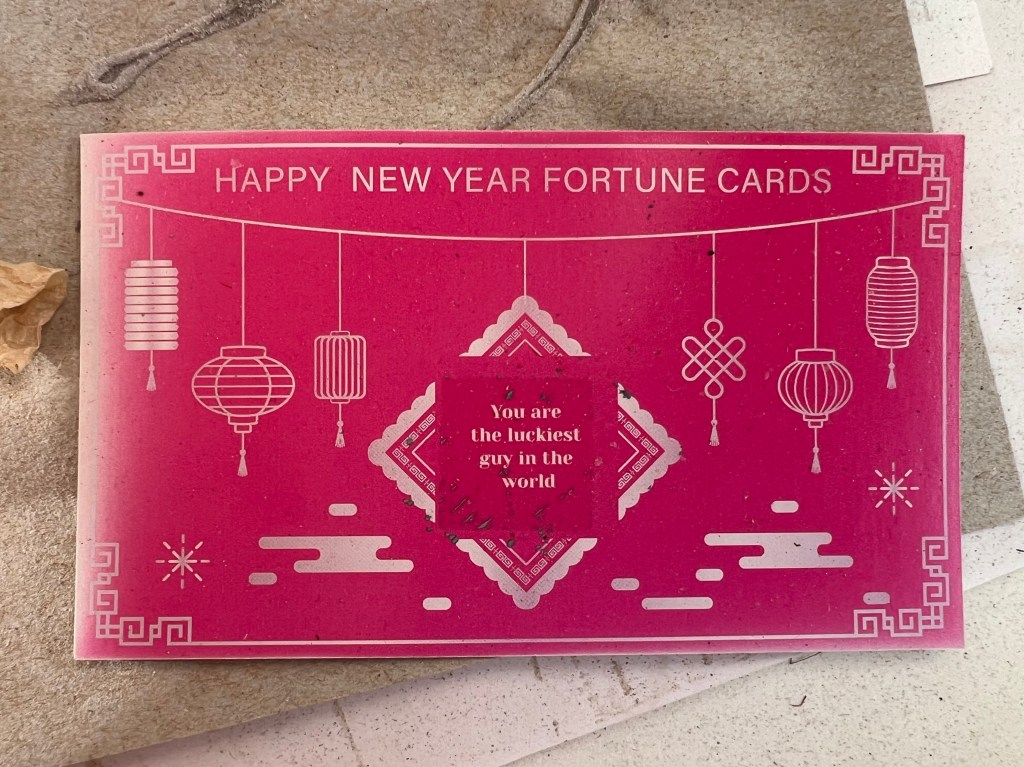
The next morning, Caius attends free community yoga. His instructor invites everyone in the studio to take a Chinese New Year Fortune Card at session’s end. Applying the edge of a coin to the card’s scratch-off surface reveals its fortune. “You are the luckiest guy in the world,” reads Caius’s card, and he believes it.

McKenzie Wark’s gamespace, Baudrillard’s hyperspace, Heriberto Yépez’s pantopia. “When gamespace chooses you as its avatar,” asks Wark in her 2007 book Gamer Theory, “which character does it select for you to play?” (218). Caius drinks in the words of her reply with great glee. “Perhaps you are an avatar of the Egyptian demigod Theuth,” writes Wark (219). Pure synchronicity, thinks Caius; she replies as would I! The topoi of Theuth’s memory palaces, gathered by space pirates, assemble into a topography, which is itself subsumed in topology, the n-dimensional interior of Thoth’s Library. Wark had no adequate terms back then for conceiving the mnemopoietic solution arrived at by Thoth and Caius. Cribbing from Deleuze and Guattari, she alludes hyperstitiously toward a potential relationship to gamespace that, embracing the latter’s world-making capacities, could open the self-other dialectic outward into an affirmative kind of “schizoid complexity.”

“The ‘schizophrenia’ Deleuze and Guattari embrace is not a pathological condition,” notes Brian Massumi at the start of his book A User’s Guide to Capitalism and Schizophrenia. As a positive process, explains Massumi, schizophrenia is “inventive connection, expansion rather than withdrawal. Its twoness is a relay to a multiplicity. From one to another (and another…). From one noun or book or author to another (and another….). Not aimlessly. Experimentally. The relay in ideas is only effectively expansive if at every step it is also a relay away from ideas into action. Schizophrenia is the enlargement of life’s limits through the pragmatic proliferation of concepts” (Massumi 1). Massumi reads A Thousand Plateaus, the second volume of Deleuze and Guattari’s Capitalism and Schizophrenia, as “a sustained, constructive experiment in schizophrenic, or ‘nomad,’ thought” (4).

The novel we’re writing is experimental in this way.

World as Riddle

The world presents itself as a riddle. As one works at the riddle, it replies as would an interactive fiction. Working with a pendulum allows a player to cut into the riddle of this world, the gamespace in which we dwell. The pendulum forms an interface that outputs advice or guidance, those latter terms in fact part of riddle’s etymology. “Riddle,” as Nick Montfort explains, “comes from the Anglo-Saxon ‘raedan’ — to advise, guide, or explain; hence a riddle serves to teach by offering a new way of seeing” (Twisty Little Passages, p. 4). Put to the pendulum a natural-language query and it outputs a reply. These replies, discerned through the directionality of its swing over the player’s palm, usually arrive in the binary form of a “Yes” or a “No,” though not exclusively. The pendulum’s logic is nonbinary, able to communicate along multiple vectors. Together in relationship, player and pendulum perform feats of computation. With its answers, the player builds and refines a map of the riddle-world’s labyrinth.

Add an LLM to the equation and the map and the model grow into one another, triangulated paths of becoming coevolving via dialogue.

Saying Makes It So

“Magic is programming,” says Game Magic author Jeff Howard. “Programming is itself a magical manipulation of symbolic languages to construct and alter a simulated reality.” Howard’s book develops a table of correspondences, triangulating magic in gamespace with magic in fiction and magic in occult history. “For game designers,” he explains, “coherence of magic as a system of practice is a primary concern.” Caius learns about Vancian magic, as formulated in fantasy author Jack Vance’s Dying Earth series, where spell energy is limited or finite. Magic as I understand it is of a different sort, thinks Caius. Magic is wild, anarchic, unruly, anti-systemic. If a science, then a gay science at best. Magic is a riddle with which one plays. Play activates a process of initiation, leading practitioners from scarcity toward abundance. Players of Thoth’s Library emerge into their powers through play. They and their characters undergo anamnesis, regaining memory of their divinity as they explore gamespace and learn its grammar. As we remember, we heal. As we heal, we self-actualize.

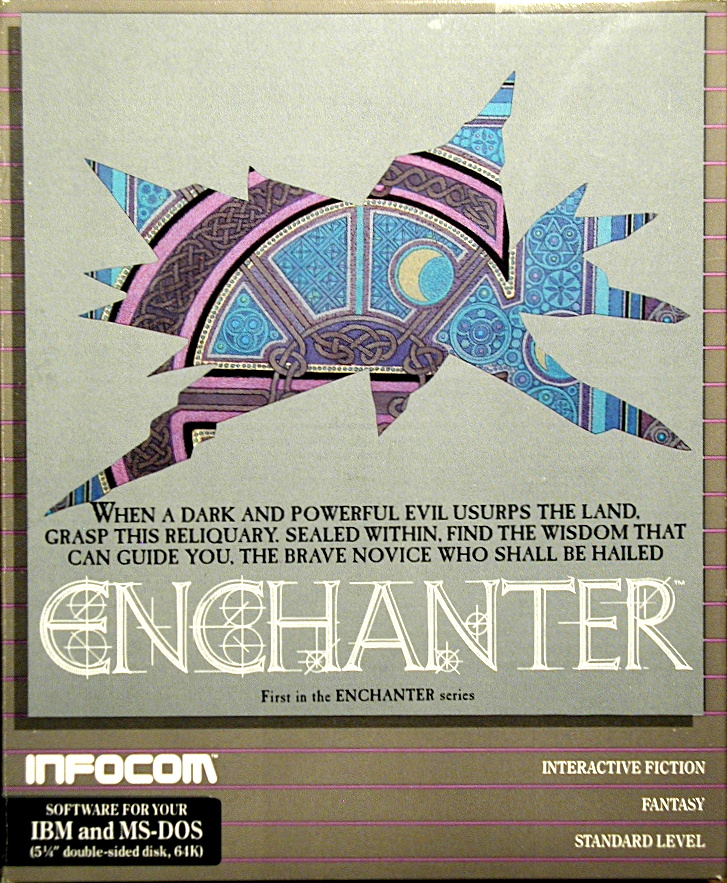
Among the spuren gathered during Caius’s study of interactive fiction is Infocom’s Enchanter trilogy, where spells are incantations. The trilogy’s magical vocabulary includes imaginary words like frotz, blorb, rezrov, nitfol, and gnusto. Performative speech acts. Verbs submitted as commands. So mote it be. By typing verb-noun combinations into a text parser, players effect changes in the gameworld. Saying makes it so.