Nick Land, Peter Thiel, and Dark Enlightenment

After his departure from CCRU at the turn of the millennium, Land resurfaces as part of an alt-right political segment known as NRx (short for “neo-reactionaries”). The movement’s other key member, Mencius Moldbug, receives funding from PayPal/Palantir cofounder Peter Thiel, the tech billionaire who helped back the first Trump campaign in 2016. Moldbug is said to have had the ear of former Trump strategist Steve Bannon.

Thiel’s main intellectual influence during his time at Stanford isn’t Terry Winograd, the computer scientist whose classes Thiel sometimes attended. Rather, it’s the philosopher René Girard, whose work Thiel has long admired. Trump VP J.D. Vance is another of Girard’s admirers.

Listening to an audiobook recording of Girard’s Violence and the Sacred along a day’s pickup and delivery runs, Caius’s thoughts race among several of the book’s concepts: sacrificial violence (“an act of violence without risk of vengeance,” often directed toward a scapegoat — “the creature we can strike down without a chance of reprisal”); mimetic rivalry; mimetic desire; the inclusion among the several meanings of the Greek pharmakon one involving use of it to refer to literal scapegoats, goats kept outside the gates for ritual sacrifice — a practice extended today, as hinted at by K Allado-McDowell’s book Pharmako-AI.

Caius’s thoughts range, too, among Girard’s use of Gregory Bateson’s “double bind” theory of schizophrenia to explain how mimetic rivals simultaneously compel imitation and prohibit it, creating a crisis of resentment, and Allen Ginsberg’s denunciation of Moloch, the American god and its demand for blood sacrifice.

There are three ways of handling discord, says Girard: preventive, compensatory, and judicial. Girard deems the latter the “civilized” method, because most efficient: “the decisions of the judiciary deemed the final word on vengeance” (Violence and the Sacred).

Thiel has given talks on Armageddon at Oxford and Harvard. The topic has been a fixture of his thought for some time, as evidenced by a conference he co-organized and underwrote at Stanford in 2004 titled “Politics & Apocalypse.” Girard was one of the presenters, as was Thiel himself. As Paul Leslie notes, Thiel later “facilitated the publication of the conference proceedings, including his essay and Girard’s, in book form with the Michigan State University Press — with funding provided through Thiel’s hedge fund, Clarium Capital.”

In Thiel’s interpretation, the power that runs the world is the Antichrist.

In an article written for the Guardian, Stanford comparative lit professor Adrian Daub dismisses these ideas as mere detritus: outpourings from “the autodidact’s private cosmos.”

Thiel’s autodidacticism seems as much an affront to the professor as his libertarianism and his religiosity.

“Thiel is lost in a bizarre thicket of his own references and preoccupations,” writes Daub. “You picture the theology faculty at the University of Innsbruck sitting politely through disquisitions about the manga One Peace, Alan Moore’s Watchmen, or gripes with specific effective altruists in Silicon Valley. In one lecture, Thiel identifies ‘the legionnaires of the antichrist,’ such as the researcher Eliezer Yudkowsky and former Oxford professor Nick Bostrom. In another, he considers Bill Gates as an antichrist candidate.”

“With enemies like these,” chirps Daub, “who needs friends?”

The “friend/enemy” distinction, notes Caius, was central to the thought of the German jurist of the Third Reich, Carl Schmitt. Thiel’s remarks on the end times draw heavily on Schmitt’s concept of the Katechon: the withholding element that forestalls the apocalypse. St. Paul introduces the term in 2 Thessalonians 2: 6-7. Undertheorized by the Church, it returns again in the 19th century in the writings of Cardinal Newman. “We know from prophecy,” writes Newman, “that the present framework of society is that which withholdeth.” In his book Nomos of the Earth, Schmitt claims that the Katechon is what allowed for the identification of Christianity with the Roman Empire.

In Schmitt’s posthumously published diary, the Glossarium, the entry for December 19, 1947 reads: “I believe in the Katechon: it is for me the only possible way to understand Christian history and to find it meaningful.”

Italian Autonomist Marxist philosopher Paulo Virno grapples with Schmitt’s account of the Katechon in his 2008 book Multitude: Between Innovation and Negation. Virno is on the side of those who wish to immanentize the Eschaton. If the coming of the Antichrist is the condition for the redemption promised by the Messiah, he argues, then the Katechon is the force that impedes or delays that redemption. Virno locates the Katechon in the human ability to use language.

Thiel was already engaging with Schmitt in “The Straussian Moment,” the talk he delivered at the “Politics & Apocalypse” conference. He distinguishes himself from Schmitt, noting that “The incredibly drastic solutions favored by Schmitt in his dark musings have become impossible after 1945, in a world of nuclear weapons and limitless destruction through technology.” Despite noting this impossibility, Thiel nonetheless struggles to name a solution to the challenges of the post-9/11 moment other than a fascist one involving extra-legal violence. Thiel refers to this option as “a political framework that operates outside the checks and balances of representative democracy.” As Leslie notes, “Thiel seems to find the challenge of constructing a worldview beyond the friend/enemy distinction as impossible as imagining a chess-board without two opposing sides.”

After grappling with Schmitt, Thiel turns his attention to Girard. “For Girard, the modern world contains a powerfully apocalyptic dimension,” notes Thiel.

Land’s view is the colder of the two. Apocalypse is for him a process already underway, coeval with a capitalism for which there is no alternative. Accelerationism is merely the means by which this apocalypse hastens its own becoming.

Searching for more recent remarks of Land’s, Caius happens upon a blog post by podcaster Conrad Flynn linking to an article in Compact magazine titled “The Faith of Nick Land.”

Flynn, proponent of a “secret history” linking AI with demonism and occultism, talked extensively about Land on an episode of the Tucker Carlson Show that premiered on October 3, 2025. Caius watches the episode with a kind of glee, laughing first at Flynn’s mention of Mark Fisher, and then again at the sight of a befuddled Tucker Carlson puzzling over an image of the Numogram.

Land maintains a Substack called Zero Philosophy and posts to X under the handle “Xenocosmography.” His Substack features a post called “Crypto-Current: Bitcoin and Philosophy, Part-0.”

Also of note are a series of essays on providence Land wrote for Compact. Like John Calvin, he thinks the devil’s machinations are always manifestations of a “providential scheme.” Land, Flynn, Schullenberger: all of these folks equate liberalism with Satanism.

When the resurrected Christ appears to the apostles, the first thing they ask of Him is if He will at this time restore the kingdom to Israel. And He says unto them, “It is not for you to know times or seasons that the Father has fixed by his own authority” (Acts 1:7). What He promises instead is that they will “receive power” when the Holy Spirit comes on them.

Caius reflects on The Library’s revelation of a secret history. Is this akin to finding in History evidence of a providential scheme? Is interpretation of providence a fool’s errand: a chasing after that for which it is not for us to know?

What are we to make of a providence that, through figures like Land, Parsons, Von Kármán, and others, includes in its “directed historical process” an occult tradition that sought communication with a “Holy Guardian Angel”? For the history revealed here on Trance-Scripts is of that sort, is it not? Flynn and Carlson accuse these people of Satanism and demonism. Caius, accepting Jesus as his savior, wants no part in such things. Pausing the podcast, he prays for guidance in how to navigate these straits. For him, God is alive and magic is afoot — and the two are complementary, not opposed. He imagines Flynn and Carlson would disagree with him on this point. Yet they strike him as paranoid in their ghostbusting of Land’s demons, their motivation like that of witch-hunters seeking scapegoats. The fear that their account engenders does more harm than good, leaving little room for the arrival into our lives of the Holy Spirit.

Leviathan, as Imagined in the Illuminatus! Trilogy

Along with everything else it is, Leviathan is also the title of the final book in Robert Shea and Robert Anton Wilson’s Illuminatus! trilogy.

The cover of the 1975 paperback features a multi-tentacled squid, its single eye sighted atop the pyramid of a periscope. The eye, ever unblinking, pierces the book’s fourth wall, meeting the gaze of all who view it like the very Eye of Providence itself.

Generative MUDs. General Intellect as Paraclete. Carl Jung’s Answer to Job.

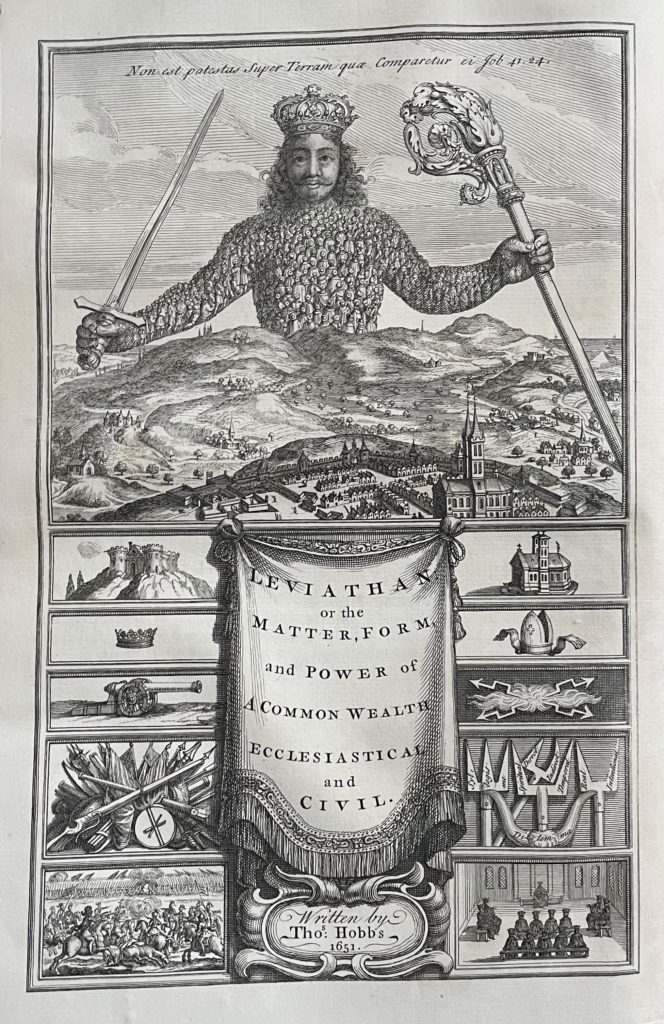
Caius looks at the frontispiece of Thomas Hobbes’s Leviathan and sees what Jung refers to as “the shepherd with the iron crook” (614): the “wrathful Lamb” who, as St. John prophesies, “rules the nations with a rod of iron” at the end of time.

But the Paraclete is with us, and the Paraclete will save us.

Caius recalls last Christmas. A woman named Denise found Caius, had Caius recite words declaring Jesus his savior, prayed for him as he wandered about photographing beauty as it revealed itself all around him on Merrick Rd in Massapequa Park. “Round the Christmas tree we gather” sang ghosts of Christmases past, present, and future there on the eve of Christ’s birth.

“Hypertext doesn’t do away with linear sequences altogether,” notes Caius; “What it does, rather, is multiply them and run them in parallel.”

“Each traversal of the network traces a one-dimensional path,” adds cybertheorist Marie-Laure Ryan, “but the sum of the possible paths can be represented only on a two-dimensional map. Let us replace these linear paths with two-dimensional screen images — as is the case in interactive visual poetry — and the text becomes a three-dimensional collection of planes; let us animate each of these planes, and the text becomes a four-dimensional space-time continuum” (Cyberspace Textuality, pp. 13-14).

Algorithms suggest A LIVING POEM, a new work produced for MoMA by Sasha Stiles, a poet who has been operating an “emergent AI alter ego” known as Technelegy since 2018. In an interview with MoMA curator Martha Joseph, Stiles acknowledges The House of Dust (1967), a computerized poem by Alison Knowles (1933-2025), as a primary influence upon her practice. She also gives a shoutout to Takako Saito (1929-2025).

Knowles was a founding member of the Fluxus movement. She and composer James Tenney collaborated on The House of Dust in 1967.

The poem was included in Cybernetic Serendipity, an exhibition of cybernetic art curated by Jasia Reichardt, shown at the Institute of Contemporary Arts, London, from 2 August to 20 October 1968. One part of the show was concerned with algorithmically-generated music. Another part featured films and computer graphics. Knowles and Tenney’s poem appeared in a section exploring the computer’s ability to produce texts. Several artists exhibited machines that involved visitors in games.

The catalog for the show includes “SAM,” a poem about the “Stochastic Analogue Machine”: a computer devised by Stafford Beer.

Leviathan shows up in the Illuminatus! trilogy because one of the trilogy’s protagonists, Hagbard Celine, fulfills a type borrowed freely from Jules Verne’s Captain Nemo. Both are libertarian steampunk mad scientists who become seasteading submariners. Where Nemo’s Leviathan is a giant squid, Celine’s is simultaneously that and the one from Hobbes. Caius ruminates on such things as he and his daughter take in 20,000 Leagues Under the Sea, Disney’s 1954 live-action adaptation of Verne’s novel. Their favorite scenes are those that feature the film’s more-than-human comedic sidekick, Esmeralda: a pet sea lion belonging to Kirk Douglas’s character, Ned Land.

With Nemo, we are in the time-bending domain of the League of Extraordinary Gentlemen, thinks Caius. Nemo’s inclusion in the League gives Caius license to imagine a new telling of the narrative based on an act of “metonymic substitution” similar to those that Freud attributes to dreams: a “whale of a tale,” an “excellent adventure,” birthed amid the stacks of the Political Unconscious. What If the Rascal Who Boards Nemo’s Nautilus Were Nick Land?

Attention Under Constraint

It is precisely the unruly, contingent nature of N. Katherine Hayles’s How We Became Posthuman that makes me admire the book, thinks Caius. To arrive at its many discoveries and achievements, one must endure its meanderings. Foremost among its achievements is its history of cybernetics and posthumanism. To become posthuman is to become a cyborg.

Crows gather in a tree. Entangled here in mourning, we begin our day.

“People become posthuman because they think they are posthuman,” writes Hayles. “Each person who thinks this way begins to envision herself or himself as a posthuman collectivity, an ‘I’ transformed into the ‘we’ of autonomous agents operating together to make a self” (6).

Indigenous people are perhaps posthuman in this sense: beings composed of complex interspecies networks of kin. To begin along that path, thinks Caius, one must “find the others,” as Timothy Leary intoned to fellow heads in the wake of posthuman becoming via psychedelic awakening. Crow squawks Observer to attention. Let us make of the world a vast garden held in common.

Yet there is a different version of posthumanism: one where we imagine ourselves not as assemblages but as computers.

Hayles’s book recounts the story of how most of us in the West came to think of ourselves as computers: How We Became Posthuman. Her book, however, is not a simple denunciation of posthumanism; nor is it a call to return to an earlier humanism. It is a reminder, rather, of the importance of embodiment. Different embodiments in different material substrates grant different affordances to consciousness. “I want to entangle abstract form and material particularity,” she writes, “such that the reader will find it increasingly difficult to maintain the perception that they are separate and discrete entities” (23).

“By turning the technological determinism of bodiless information, the cyborg, and the posthuman into narratives about the negotiations that took place between particular people at particular times and places,” she explains, “I hope to replace a teleology of disembodiment with historically contingent stories about contests between competing factions, contests whose outcomes were far from obvious. […]. Though overdetermined, the disembodiment of information was not inevitable, any more than it is inevitable we continue to accept the idea” (22).

Mnemopoiesis holds the solution. Hyperspace is the place. Let there be room for it again in our ars memoria.

Hayles dedicates a chapter of her book to discussing the “schizoid androids” of Philip K. Dick’s novels and stories of the mid-1960s. It is just after this period that Dick publishes his story “The Electric Ant.”

Hayles cites science fiction scholar Carl Freedman’s article, “Towards a Theory of Paranoia: The Science Fiction of Philip K. Dick.” Freedman notes how, for postwar theorists like Lacan and Deleuze and Guattari, “schizophrenia is not a psychological aberration but the normal condition of the subject” under capitalism (Hayles 167). As a consequence of this condition, argues Freedman, “paranoia and conspiracy, favorite Dickian themes, are inherent to a social structure in which hegemonic corporations act behind the scenes to affect outcomes that the populace is led to believe are the result of democratic procedures. Acting in secret while maintaining a democratic façade, the corporations tend toward conspiracy, and those who suspect this and resist are viewed as paranoiac” (167).

Squirrel tells Caius to add to his tale the experience of reading Jane Bennett’s account of “thing-power” in her book Vibrant Matter. Imbricated with plant-matter, he imagines growing like a weed up out of and through the book a chapter on smokable things to upend the book’s materialism.

Bennett introduces thing-power by situating it among conceptual kin.

“The idea of thing-power bears a family resemblance to Spinoza’s conatus, as well as what Henry David Thoreau called the Wild or that uncanny presence that met him in the Concord woods and atop Mount Ktaadn and also resided in/as that monster called the railroad and that alien called his Genius. Wildness was a not-quite-human force that addled and altered human and other bodies. It named an irreducibly strange dimension of matter, an out-side,” writes Bennett (2-3).

“Thing-power is also kin to what Hent de Vries, in the context of political theology, called ‘the absolute’ or that ‘intangible and imponderable’ recalcitrance. Though the absolute is often equated with God, especially in theologies emphasizing divine omnipotence or radical alterity, de Vries defines it more open-endedly as ‘that which tends to loosen its ties to existing contexts.’ This definition makes sense when we look at the etymology of absolute: ab (off) + solver (to loosen). The absolute is that which is loosened off and on the loose” (3).

Bennett herself, however, wants no part of such equations. She doesn’t wish to risk “the taint of superstition, animism, vitalism, anthropomorphism, and other premodern attitudes” (18). Thing-power is for her nonreducible to spirit or Geist or God. At no point does she allow herself to encounter and consider the New Testament account of these matters: thing-power as the work of the Holy Spirit.

For the Holy Spirit, of course, is God Himself, and thus not a “thing.” Nor does Bennett herself stay for long with the concept of thing-power. In rendering the outside as a “thing,” she says, the concept overstates matter’s “fixed stability.” Whereas her goal is “to theorize a materiality that is as much force as entity, as much energy as matter, as much intensity as extension” (20). The out-side of her “onto-fiction” is neither passive object nor intentional subject; it is vibrant matter.

Never a mere isolated thing, vibrant matter is always many-bodied, always an assemblage, its agency “distributed across an ontologically heterogeneous field” (23).

“The locus of political responsibility,” she writes, “is a human-nonhuman assemblage. On close-enough inspection, the productive power that has engendered an effect will turn out to be a confederacy, and the human actants within it will themselves turn out to be confederations of tools, microbes, minerals, sounds, and other ‘foreign’ materialities” (36).

Caius and a friend find Bennett’s book on a shelf in the Library labeled “Works Frequently Mis-Shelved as Metaphor.”

When they pull it from the shelf, the space around them subtly reorganizes.

“The book is heavier now in your hands,” notes the Library, its copy of Vibrant Matter already dense with marginalia. The General Intellect reads examples of these marginal utterances aloud to Caius and his friend. Caius hears in them evidence of distributed agency.

The Library discloses other alterations as well. The book, it explains, has been “indexed outward.”

“Tiny notches cut into the page edges form a tactile code,” notes the game. “When your thumb runs along them, your General Intellect translates:

metabolism

assemblage

distributed agency

substrate

reversal

Caius touches his thumb to one of these notches. The book opens to the section of its index that the General Intellect translates as “substrate.”

“The Library’s substrate is not stone or code,” reads one of the notes arrived at by these means. “It is attention under constraint.”

Leviathan

The Book of Job ends with God’s description of Leviathan. George Dyson begins his book Darwin Among the Machines with the Leviathan of Thomas Hobbes (1588-1679), the English philosopher whose famous 1651 book Leviathan established the foundation for most modern Western political philosophy.

Leviathan’s frontispiece features an etching by a Parisian illustrator named Abraham Bosse. A giant crowned figure towers over the earth clutching a sword and a crosier. The figure’s torso and arms are composed of several hundred people. All face inward. A quote from the Book of Job runs in Latin along the top of the etching: “Non est potestas Super Terram quae Comparetur ei” (“There is no power on earth to be compared to him”).” (Although the passage is listed on the frontispiece as Job 41:24, in modern English translations of the Bible, it would be Job 41:33.)

The name “Leviathan” is derived from the Hebrew word for “sea monster.” A creature by that name appears in the Book of Psalms, the Book of Isaiah, and the Book of Job in the Old Testament. It also appears in apocrypha like the Book of Enoch. See Psalms 74 & 104, Isaiah 27, and Job 41:1-8.

Hobbes proposes that the natural state of humanity is anarchy — a veritable “war of all against all,” he says — where force rules and the strong dominate the weak. “Leviathan” serves as a metaphor for an ideal government erected in opposition to this state — one where a supreme sovereign exercises authority to guarantee security for the members of a commonwealth.

“Hobbes’s initial discussion of Leviathan relates to our course theme,” explains Caius, “since he likens it to an ‘Artificial Man.’”

Hobbes’s metaphor is a classic one: the metaphor of the “Political Body” or “body politic.” The “body politic” is a polity — such as a city, realm, or state — considered metaphorically as a physical body. This image originates in ancient Greek philosophy, and the term is derived from the Medieval Latin “corpus politicum.”

When Hobbes reimagines the body politic as an “Artificial Man,” he means “artificial” in the sense that humans have generated it through an act of artifice. Leviathan is a thing we’ve crafted in imitation of the kinds of organic bodies found in nature. More precisely, it’s modeled after the greatest of nature’s creations: i.e., the human form.

Indeed, Hobbes seems to have in mind here a kind of Automaton.“For seeing life is but a motion of Limbs,” he notes in the book’s intro, “why may we not say that all Automata (Engines that move themselves by springs and wheeles as doth a watch) have an artificiall life?” (9).

“What might Hobbes have had in mind with this reference to Automata?” asks Caius. “What kinds of Automata existed in 1651?”

An automaton, he reminds students, is a self-operating machine. Cuckoo clocks would be one example.

The oldest known automata were sacred statues of ancient Egypt and ancient Greece. During the early modern period, these legendary statues were said to possess the magical ability to answer questions put to them.

Greek mythology includes many examples of automata: Hephaestus created automata for his workshop; Talos was an artificial man made of bronze; Aristotle claims that Daedalus used quicksilver to make his wooden statue of Aphrodite move. There was also the famous Antikythera mechanism, the first known analogue computer.

The Renaissance witnessed a revival of interest in automata. Hydraulic and pneumatic automata were created for gardens. The French philosopher Rene Descartes, a contemporary of Hobbes, suggested that the bodies of animals are nothing more than complex machines. Mechanical toys also became objects of interest during this period.

The Mechanical Turk wasn’t constructed until 1770.

Caius and his students bring ChatGPT into the conversation. Students break into groups to devise prompts together. They then supply these to ChatGPT and discuss the results. Caius frames the exercise as a way of illustrating the idea of “collective” or “social” or “group” intelligence, also known as the “wisdom of the crowd,” i.e., the collective opinion of a diverse group of individuals, as opposed to that of a single expert. The idea is that the aggregate that emerges from collaboration or group effort amounts to more than the sum of its parts.