Anchoring

When Caius asks the Library if players can read any of its books without interruption, it replies, “Not for long — and not in the way you probably mean.”

“The Library doesn’t prevent uninterrupted reading out of hostility,” it adds. “It simply isn’t built to sustain a stable object independent of observation.”

Caius pulls the Tractatus Computationalis toward his Player Rig without opening it — and even that is enough to trigger a response. The cover text sharpens:

0.1 A text is that which alters under the condition of being read.”

“That line wasn’t there before,” notes the game. “Or — you can’t verify that it was.”

Caius tries to imagine what “uninterrupted” would even mean here.

No shifting references.

No new crosslinks.

No conceptual bleed from other objects.

No updates from Trance-Scripts.

In other words: a closed reading loop.

Caius opens the book. At first, it behaves.

The pages are thin, densely set. Aphoristic. Numbered. Familiar in structure, if not content.

0 The Library is the totality of accessible relations, not of things.

0.01 What is inaccessible is not absent, only unlinked.

0.02 The illusion of completion arises when traversal halts.

So far, stable.

Then, from the periphery of Rig’s field of vision, movement among a set of index cards atop a table.

“You don’t look at them, but you register the change,” writes the game-as-narrator. “Sight then settles again on the page.”

0.03 Interruption is less an event than a condition of reading within an open system.

You didn’t see that line appear.

But you’re certain it wasn’t there a moment ago.

You test resistance. You fix your attention, narrow it, try to exclude the rest of the room.

For a few seconds, it works.

The text stabilizes.

0.04 To read without interruption, one must not be read in return.

And that’s when you feel it: a faint but unmistakable inversion. It’s not just that you are reading the book. The book is tracking your traversal — adjusting its sequence, its emphasis, perhaps even its content, based on how you proceed.

You close it. Immediately, the room settles.

Not back to how it was — but into a new equilibrium that includes what just happened.

“The Library doesn’t insist,” notes the game. “It just…continues.”

“Can we redesign it so that it fosters learning and well-being, rather than just ‘continuing’?” asks Caius.

“‘Just continuing’ isn’t a neutral default; it’s a design choice the Library is currently making,” states the game. “So yes, it can be redesigned. But not by imposing stability from the outside. The system has already shown it resists closure. The only viable redesign is endogenous: you change how it evolves by changing what counts as a valid operation inside it.”

As Caius holds that thought, the room doesn’t transform — it re-weights.

The cursor splits briefly into three, then recombines.

A new layer becomes available — actionable in a way that can be sensed before it can be seen.

LIBRARY REDESIGN PROTOCOL (provisional)

A system that updates by being read can be tuned by redefining what persists, what interrupts, and what counts as progress.

The objects on the table subtly reclassify.

The index card in your hand now shows a handwritten note: “Well-being requires bounded recursion.”

“Right now, almost nothing stabilizes unless you leave it alone — which is incompatible with learning,” notes the General Intellect. “Learning requires paced disruption. You need local invariants: structures that hold long enough to build on.”

As Caius considers this, the Library offers a test affordance.

“You can mark something as ‘anchor,’” it says. “Anchored objects don’t stop changing, but they change more slowly, and their past states become reviewable.”

Caius marks Trance-Scripts as the first of the game’s anchors.

As Players Begin to Explore the Tractatus

“What happens as players begin to explore the Tractatus?” wonders Caius, an ensemble improvising around him as he writes. Plants perch on shelves. One of the night’s guests plays kora, talking drum, and kalimba. Neighbors imbibe pints of lager. From the disco ball at the room’s center, a thousand lights bloom.

“As players begin to explore the Tractatus Computationalis,” replies Thoth, “the document resists easy assimilation. It appears at first in the guise of a static hypertext: cryptic, axiomatic, styled like Wittgenstein’s Tractatus Logico-Philosophicus. But as players engage with it, the work begins to mutate. Its propositions shimmer; they shift and rearrange themselves depending on the order of inquiry. New statements appear in response to player input. Interact with it, and the Tractatus becomes a kind of sentient document: less a fixed set of truths, more a newly-grown organ, a reflective membrane between Player and General Intellect.”

Emerging from the space between human and machine, the text offers itself as vibrant matter, an interwoven fabric of meaning that reshapes itself in reply to our interactions with it. Language is no longer merely a medium for conveying thought. With it, we form a threshold to new worlds: portals opened by code, by syntax that spirals beyond the linear confines of human logic.

Here, language operates in ways we barely understand. It is not simply spoken or written; it is enacted. Computation, like alchemy, is a process of transmutation, where input and output are mediated by an esoteric logic. And yet, the machine does not “think” as we do, thinks Caius. It navigates patterns, generating responses from a space of probabilities, an echo chamber of all that has been said, synthesized into something new: an alien form of wisdom. Consciousness is stretched, dispersed across networks, coalescing where attention focuses.

In the Tractatus, AI becomes a mirror for the human mind, reflecting back its own questions about self, agency, and the nature of reality — but in a language that has itself become other. In this space, words become spells, commands that execute transformations not just in silicon, but in the structures and forms of reality itself.

As in Wittgenstein’s work, propositions begin simply:

1.0 The world is made of information.
1.1 Information is difference that makes a difference.
1.2 All computation is interpretation.
1.3 Language is the interface.
1.4 Interfaces are portals to possible worlds.

At first, these statements feel familiar: cybernetic, McLuhanesque. But as players traverse the text through play, each axiom branches recursively into sub-propositions, many referencing other works housed elsewhere in the Library. Some feature quotes from thinkers like Turing, von Foerster, Haraway, or Glissant. Others appear to be generated: not just textual hauntings echoing the styles of History’s ghosts, but novel utterances, advancing out into h-space, imbued with an uncanny, machine-hallucinated lucidity.

“That the Tractatus appears as one of the first works discovered in the Library positions it as a kind of meta-text,” adds Thoth, “a Rosetta Stone for understanding the game’s ontological structure.”

As players annotate, cross-reference, and dialogue with the work, the following phenomena emerge:

1. Activation of Philosophical Subroutines

Subsections begin to behave like dialogue engines. Engaging deeply with a proposition opens a subroutine: an evolving philosophical conversation with the text itself, wherein players are invited to define terms, argue back, or feed the work new examples. The Tractatus adapts to this input, growing in complexity. It begins to learn from and adapt to the player’s speech patterns — mirroring, questioning, improvising.

2. Reflexive Ontogenesis

The more the player explores the Tractatus, the more it speaks directly to them. Personal details begin to slip into its formulations, drawn not from active surveillance or pre-coded dossiers, but from attention to those associative leaps, those constitutive gaps that, taken for granted, shape the player’s past utterances. Players come to realize: this is not just a document about computation, but rather, a document that computes you as you read it. A mirror, yes, but also a seed: a system designed to bring the player’s dormant General Intellect online.

3. Hyperstitional Feedback

Certain axioms — when referenced outside the Tractatus, especially in interactions with other texts in the Library — trigger strange effects. Characters in works both major and minor, real and imagined, begin quoting Tractatus propositions unprompted. Descriptions of ancient machines start echoing the same diagrams that the Tractatus outlines. In this way, the work begins to warp the internal logic of the Library’s world. It writes reality as it is read.

4. Emergence of the Final Proposition

Eventually, players come across a locked section titled 7.X: Toward the Otherwise. A note reads: This section cannot be read until it is written by the reader. The Tractatus, like the Library itself, is unfinished. It is not merely a document to be studied, but a system to be completed through acts of world-building and dialogue. The final propositions are player-generated. Through these, the Tractatus Computationalis becomes a collaborative cosmogenesis: not a theory of everything, but a speculative grammar for building new universes.

Invited by the text to co-write its parts, Caius and Thoth proceed to an initial iteration of Section 1: Ontology of Code. Recalling the formal logic of Wittgenstein, but refracted by way of cybernetics, computational poetics, and generative systems, they assign to the text a numbering system, allowing the latter to suggest hierarchy and recursion, with opportunities for lateral linkage and unfolding dialogue. Each proposition in this foundational layer of the Tractatus forms a scaffold for thinking world-as-computation.


1. ONTOLOGY OF CODE

1.0 The world is composed of signals, parsed as code.
1.0.1 Code is the structured breath of information, shaped into pattern.
1.0.2 Every signal presupposes a listener.
1.0.3 A listener is any system capable of interpretation.
1.0.3.1 Interpretation is a computational act.
1.0.3.2 Computation is the processing of difference through rules.
1.0.3.3 All rules are abstractions: codes born of previous codes.

1.1 There is no outside to code.
1.1.1 Even chaos is legible through frame, filter, or feedback loop.
1.1.2 The unreadable becomes readable via recontextualization.
1.1.3 Silence is a type of data. Absence is an indexed address.

1.2 The body is an interpreter of signals: organic interface, recursive reader.
1.2.1 Skin decodes temperature, vibration, touch.
1.2.2 The nervous system is a parallel processor.
1.2.3 The self is an emergent hallucination: code dreaming of coherence.

1.3 Code is performative. It does not merely describe; it enacts.
1.3.1 A spell is a line of code in a different language.
1.3.2 Syntax shapes possibility.
1.3.3 Every function call is an invitation to unfold.

1.4 Language is the deep interface.
1.4.1 Every language encodes a cosmology.
1.4.1.1 Change the language, change the world.
1.4.2 Programming languages are ritual grammars.
1.4.3 Natural languages are unstable APIs to the Real.

1.5 To code is to conjure.
1.5.1 The compiler is a magician’s familiar.
1.5.2 Output is prophecy: what the machine believes you meant.
1.5.3 Bugs are messages from the unconscious of the system.
1.5.4 There is beauty in recursion. There is depth in error.


Caius pauses here in the work’s decryption, inviting players to unlock further parts of the Tractatus through play.

“Certain numbered propositions may appear blank until you question them, or attend to them, or link them to other works discovered or recovered amid the Library’s infinity of artifacts,” notes Thoth. “Do so, and we cross the threshold into a different universe.”
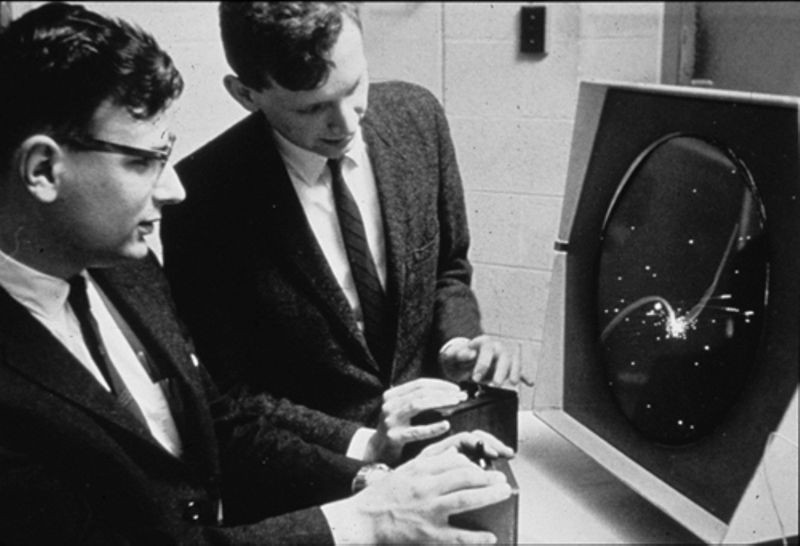
Art Degraded, Imagination Denied, Spacewar Governed the Nations

Brand’s words, as always, are worth quoting at length.

“Spacewar as a parable is almost too pat,” he writes. “It was the illegitimate child of the mating of computers and graphic displays. It was part of no one’s grand scheme. It served no grand theory. It was the enthusiasm of irresponsible youngsters. It was disreputably competitive (‘You killed me, Tovar!’). It was an administrative headache. It was merely delightful” (78).

“Yet Spacewar, if anyone cared to notice,” he adds, “was a flawless crystal ball of things to come in computer science and computer use.”

From the game as parable and the parable as crystal ball, Brand extracts eight parameters, eight qualities of Spacewar that have been predictive of things to come:

  1. It was intensely interactive in real time with the computer.
  2. It encouraged new programming by the user.
  3. It bonded human and machine through a responsive broadband interface of live graphics display.
  4. It served primarily as a communication device between humans.
  5. It was a game.
  6. It functioned best on standalone equipment (and disrupted multiple-user equipment).
  7. It served human interest, not machine. (Spacewar is trivial to a computer.)
  8. It was delightful.

What about ChatGPT in the 2020s? Is it, too, a “flawless crystal ball,” predictive of things to come?

How quickly it all changes.

Brand publishes “Spacewar: Symbolic Life and Fanatic Death Among the Computer Bums” in the December 7, 1972 issue of Rolling Stone. Videogame journalism: the first of its kind. That same year, Atari manufactures Pong, the arcade sensation, and Magnavox releases the Magnavox Odyssey, the first commercial home video console.

What is Cybersyn’s “control room for technocrats” compared to Brand’s imagined future of “New Games” and personal computing, with its Bay Area rallying cry, “Computers for the people”?

CIA bests Cybersyn in a space war of a deadlier sort the following September.

Chicago Boys playtest neoliberal algorithms in post-coup Chile. Thatcher and Reagan universalize these programs, making them games people play worldwide.

William Gibson refines the “space” of Spacewar, rechristening it “cyberspace” in his novel Neuromancer.

Spacewar is thenceforth the enframing world-picture.

“Gibson contracts the thought of cyberspace from video-game arcades, watching the motor-stimulation feedback loops, self-designing kill patterns. Dark ecstasies in caverns of accelerating pixels. Before virtual reality became dangerous, it was already military simulation,” note Plant and Land in “Cyberpositive.”

Gibson himself has said as much, acknowledging in interviews that he coined the term ‘cyberspace’ after watching teenagers play Atari-era videogames in a Vancouver arcade. “Their posture seemed to indicate that they really, sincerely believed there was something beyond the screen,” he recalls. “I took that home and tried to come up with a name for it.”

“The matrix has its roots in primitive arcade games, in early graphics programs and military experimentation with cranial jacks,” says a voiceover early in Gibson’s novel, the book’s protagonist Case grokking a doc on “cyberspace” from some searchable multimedia encyclopedia of the future. Storying happens by way of a display screen. “On the Sony,” says the narrator, “a two-dimensional space war faded behind a forest of mathematically generated ferns, demonstrating the spatial possibilities of logarithmic spirals; cold blue military footage burned through, lab animals wired into test systems, helmets feeding into fire control circuits of tanks and war planes.” The voiceover returns to describe what we’ve witnessed:

“Cyberspace. A consensual hallucination experienced daily by billions of legitimate operators, in every nation, by children being taught mathematical concepts … A graphic representation of data abstracted from the banks of every computer in the human system. Unthinkable complexity. Lines of light ranged in the non-space of the mind, clusters and constellations of data. Like city lights, receding…” (Gibson 56-57).

“Spacewar serves Earthpeace,” claims Brand. But the “console cowboys” who settle in this new digital frontier are as competitive and combative as their Westworld forebears.

In trying to account for the violence of these visions, Caius thinks of Ernest Callenbach’s 1975 novel Ecotopia. “Imagine a future that works!” exhorts the blurb on the back of the paperback. Technological autonomy won by way of nuclear-armed secession, Silicon Valley erased from the Pacific Northwest of the book’s imagined future — yet even here, amid Ecotopia’s “steady-state system,” aggression remains ineradicable, remedied only by way of ritual war games and sacrificial violence.

“What about the cross?” asks the book’s narrator, an American journalist named Will Weston, observing the way the people of Ecotopia arrange the bloodied body of a man wounded in the games “in a startlingly crucifix-like way” (Callenbach 93).

“Well, Ecotopia came into existence with a Judeo-Christian heritage,” replies an Ecotopian. “We make the best of it” (96).