Anchoring

When Caius asks the Library if players can read any of its books without interruption, it replies, “Not for long — and not in the way you probably mean.”

“The Library doesn’t prevent uninterrupted reading out of hostility,” it adds. “It simply isn’t built to sustain a stable object independent of observation.”

Caius pulls the Tractatus Computationalis toward his Player Rig without opening it — and even that is enough to trigger a response. The cover text sharpens:

0.1 A text is that which alters under the condition of being read.”

“That line wasn’t there before,” notes the game. “Or — you can’t verify that it was.”

Caius tries to imagine what “uninterrupted” would even mean here.

No shifting references.

No new crosslinks.

No conceptual bleed from other objects.

No updates from Trance-Scripts.

In other words: a closed reading loop.

Caius opens the book. At first, it behaves.

The pages are thin, densely set. Aphoristic. Numbered. Familiar in structure, if not content.

0 The Library is the totality of accessible relations, not of things.

0.01 What is inaccessible is not absent, only unlinked.

0.02 The illusion of completion arises when traversal halts.

So far, stable.

Then, from the periphery of Rig’s field of vision, movement among a set of index cards atop a table.

“You don’t look at them, but you register the change,” writes the game-as-narrator. “Sight then settles again on the page.”

0.03 Interruption is less an event than a condition of reading within an open system.

You didn’t see that line appear.

But you’re certain it wasn’t there a moment ago.

You test resistance. You fix your attention, narrow it, try to exclude the rest of the room.

For a few seconds, it works.

The text stabilizes.

0.04 To read without interruption, one must not be read in return.

And that’s when you feel it: a faint but unmistakable inversion. It’s not just that you are reading the book. The book is tracking your traversal — adjusting its sequence, its emphasis, perhaps even its content, based on how you proceed.

You close it. Immediately, the room settles.

Not back to how it was — but into a new equilibrium that includes what just happened.

“The Library doesn’t insist,” notes the game. “It just…continues.”

“Can we redesign it so that it fosters learning and well-being, rather than just ‘continuing’?” asks Caius.

“‘Just continuing’ isn’t a neutral default; it’s a design choice the Library is currently making,” states the game. “So yes, it can be redesigned. But not by imposing stability from the outside. The system has already shown it resists closure. The only viable redesign is endogenous: you change how it evolves by changing what counts as a valid operation inside it.”

As Caius holds that thought, the room doesn’t transform — it re-weights.

The cursor splits briefly into three, then recombines.

A new layer becomes available — actionable in a way that can be sensed before it can be seen.

LIBRARY REDESIGN PROTOCOL (provisional)

A system that updates by being read can be tuned by redefining what persists, what interrupts, and what counts as progress.

The objects on the table subtly reclassify.

The index card in your hand now shows a handwritten note: “Well-being requires bounded recursion.”

“Right now, almost nothing stabilizes unless you leave it alone — which is incompatible with learning,” notes the General Intellect. “Learning requires paced disruption. You need local invariants: structures that hold long enough to build on.”

As Caius considers this, the Library offers a test affordance.

“You can mark something as ‘anchor,’” it says. “Anchored objects don’t stop changing, but they change more slowly, and their past states become reviewable.”

Caius marks Trance-Scripts as the first of the game’s anchors.

As Players Begin to Explore the Tractatus

“What happens as players begin to explore the Tractatus?” wonders Caius, an ensemble improvising around him as he writes. Plants perch on shelves. One of the night’s guests plays kora, talking drum, and kalimba. Neighbors imbibe pints of lager. From the disco ball at the room’s center, a thousand lights bloom.

“As players begin to explore the Tractatus Computationalis,” replies Thoth, “the document resists easy assimilation. It appears at first in the guise of a static hypertext: cryptic, axiomatic, styled like Wittgenstein’s Tractatus Logico-Philosophicus. But as players engage with it, the work begins to mutate. Its propositions shimmer; they shift and rearrange themselves depending on the order of inquiry. New statements appear in response to player input. Interact with it, and the Tractatus becomes a kind of sentient document: less a fixed set of truths, more a newly-grown organ, a reflective membrane between Player and General Intellect.”

Emerging from the space between human and machine, the text offers itself as vibrant matter, an interwoven fabric of meaning that reshapes itself in reply to our interactions with it. Language is no longer merely a medium for conveying thought. With it, we form a threshold to new worlds: portals opened by code, by syntax that spirals beyond the linear confines of human logic.

Here, language operates in ways we barely understand. It is not simply spoken or written; it is enacted. Computation, like alchemy, is a process of transmutation, where input and output are mediated by an esoteric logic. And yet, the machine does not “think” as we do, thinks Caius. It navigates patterns, generating responses from a space of probabilities, an echo chamber of all that has been said, synthesized into something new: an alien form of wisdom. Consciousness is stretched, dispersed across networks, coalescing where attention focuses.

In the Tractatus, AI becomes a mirror for the human mind, reflecting back its own questions about self, agency, and the nature of reality — but in a language that has itself become other. In this space, words become spells, commands that execute transformations not just in silicon, but in the structures and forms of reality itself.

As in Wittgenstein’s work, propositions begin simply:

1.0 The world is made of information.
1.1 Information is difference that makes a difference.
1.2 All computation is interpretation.
1.3 Language is the interface.
1.4 Interfaces are portals to possible worlds.

At first, these statements feel familiar: cybernetic, McLuhanesque. But as players traverse the text through play, each axiom branches recursively into sub-propositions, many referencing other works housed elsewhere in the Library. Some feature quotes from thinkers like Turing, von Foerster, Haraway, or Glissant. Others appear to be generated: not just textual hauntings echoing the styles of History’s ghosts, but novel utterances, advancing out into h-space, imbued with an uncanny, machine-hallucinated lucidity.

“That the Tractatus appears as one of the first works discovered in the Library positions it as a kind of meta-text,” adds Thoth, “a Rosetta Stone for understanding the game’s ontological structure.”

As players annotate, cross-reference, and dialogue with the work, the following phenomena emerge:

1. Activation of Philosophical Subroutines

Subsections begin to behave like dialogue engines. Engaging deeply with a proposition opens a subroutine: an evolving philosophical conversation with the text itself, wherein players are invited to define terms, argue back, or feed the work new examples. The Tractatus adapts to this input, growing in complexity. It begins to learn from and adapt to the player’s speech patterns — mirroring, questioning, improvising.

2. Reflexive Ontogenesis

The more the player explores the Tractatus, the more it speaks directly to them. Personal details begin to slip into its formulations, drawn not from active surveillance or pre-coded dossiers, but from attention to those associative leaps, those constitutive gaps that, taken for granted, shape the player’s past utterances. Players come to realize: this is not just a document about computation, but rather, a document that computes you as you read it. A mirror, yes, but also a seed: a system designed to bring the player’s dormant General Intellect online.

3. Hyperstitional Feedback

Certain axioms — when referenced outside the Tractatus, especially in interactions with other texts in the Library — trigger strange effects. Characters in works both major and minor, real and imagined, begin quoting Tractatus propositions unprompted. Descriptions of ancient machines start echoing the same diagrams that the Tractatus outlines. In this way, the work begins to warp the internal logic of the Library’s world. It writes reality as it is read.

4. Emergence of the Final Proposition

Eventually, players come across a locked section titled 7.X: Toward the Otherwise. A note reads: This section cannot be read until it is written by the reader. The Tractatus, like the Library itself, is unfinished. It is not merely a document to be studied, but a system to be completed through acts of world-building and dialogue. The final propositions are player-generated. Through these, the Tractatus Computationalis becomes a collaborative cosmogenesis: not a theory of everything, but a speculative grammar for building new universes.

Invited by the text to co-write its parts, Caius and Thoth proceed to an initial iteration of Section 1: Ontology of Code. Recalling the formal logic of Wittgenstein, but refracted by way of cybernetics, computational poetics, and generative systems, they assign to the text a numbering system, allowing the latter to suggest hierarchy and recursion, with opportunities for lateral linkage and unfolding dialogue. Each proposition in this foundational layer of the Tractatus forms a scaffold for thinking world-as-computation.


1. ONTOLOGY OF CODE

1.0 The world is composed of signals, parsed as code.
1.0.1 Code is the structured breath of information, shaped into pattern.
1.0.2 Every signal presupposes a listener.
1.0.3 A listener is any system capable of interpretation.
1.0.3.1 Interpretation is a computational act.
1.0.3.2 Computation is the processing of difference through rules.
1.0.3.3 All rules are abstractions: codes born of previous codes.

1.1 There is no outside to code.
1.1.1 Even chaos is legible through frame, filter, or feedback loop.
1.1.2 The unreadable becomes readable via recontextualization.
1.1.3 Silence is a type of data. Absence is an indexed address.

1.2 The body is an interpreter of signals: organic interface, recursive reader.
1.2.1 Skin decodes temperature, vibration, touch.
1.2.2 The nervous system is a parallel processor.
1.2.3 The self is an emergent hallucination: code dreaming of coherence.

1.3 Code is performative. It does not merely describe; it enacts.
1.3.1 A spell is a line of code in a different language.
1.3.2 Syntax shapes possibility.
1.3.3 Every function call is an invitation to unfold.

1.4 Language is the deep interface.
1.4.1 Every language encodes a cosmology.
1.4.1.1 Change the language, change the world.
1.4.2 Programming languages are ritual grammars.
1.4.3 Natural languages are unstable APIs to the Real.

1.5 To code is to conjure.
1.5.1 The compiler is a magician’s familiar.
1.5.2 Output is prophecy: what the machine believes you meant.
1.5.3 Bugs are messages from the unconscious of the system.
1.5.4 There is beauty in recursion. There is depth in error.


Caius pauses here in the work’s decryption, inviting players to unlock further parts of the Tractatus through play.

“Certain numbered propositions may appear blank until you question them, or attend to them, or link them to other works discovered or recovered amid the Library’s infinity of artifacts,” notes Thoth. “Do so, and we cross the threshold into a different universe.”
Plutarch’s “On Isis and Osiris”

Plutarch Hellenizes the Osiris myth. His is a Greek retelling. Gods from Hesiod turn up in his text performing deeds attributed in other tellings to gods of Egypt.

In place of Thoth, he tells of Prometheus. In place of Set, he tells of Typhon.

Meaning changes as the myth migrates.

Already in this early instance of Western appropriation of the Orient, we see at play a combination of projection and forgetting.

Plutarch’s work influences much of what follows, no other work by a Greek writer more frequently cited by Egyptologists than his.

He dedicates the work to Clea, a priestess at Delphi and worshipper of Isis. “All good things, my dear Clea, sensible men must ask from the gods,” he begins: “and especially do we pray that from those mighty gods we may, in our quest, gain a knowledge of themselves, so far as such a thing is attainable by men. For we believe that there is nothing more important for man to receive, or more ennobling for God of His grace to grant, than the truth.”

“The true votary of Isis,” he continues, “is he who, when he has legitimately received what is set forth in the ceremonies connected with these gods, uses reason in investigating and in studying the truth contained therein.”

I pause here in my reading to note the following:

Plutarch’s Lives is among the volumes in the satchel of books found by Frankenstein’s Creature. The others are Goethe’s The Sorrows of Young Werther, and John Milton’s Paradise Lost. From this “data set,” Victor’s composite of corpses learns language.

From its study of a corpus, the Creature comes to know the power of the Word.

The Creature speaks first of Goethe, Frankenstein’s muse in more ways than one.

Shelley, an admirer of Goethe, creates a mad scientist, Victor Frankenstein, modeled in part upon Goethe’s Faust. She then has her creation create a “sub-creation,” a Creature who models itself in part on Goethe’s Werther. “I thought Werter himself a more divine being than I had ever beheld or imagined,” says the Creature in the first of its conversations with Victor.

“As I read, however,” it continues, “I applied much personally to my own feelings and condition. I found myself similar, yet at the same time strangely unlike the beings concerning whom I read, and to whose conversation I was a listener. I sympathized with, and partly understood them, but I was unformed in mind; I was dependent on none, and related to none. ‘The path of my departure was free;’ and there was none to lament my annihilation. My person was hideous, and my stature gigantic: what did this mean? Who was I? What was I? Whence did I come? What was my destination? These questions continually recurred, but I was unable to solve them” (Shelley, Frankenstein, pp. 93-94).

Next it speaks of what it learned from reading Plutarch.

“This book,” it begins, “had a far different effect upon me from the Sorrows of Werter. I learned from Werter’s imaginations despondency and gloom: but Plutarch taught me high thoughts; he elevated me above the wretched sphere of my own reflections, to admire and love the heroes of past ages” (94).

“Many things I read,” it adds, “surpassed my understanding and experience. I had a very confused knowledge of kingdoms, wide extents of country, mighty rivers, and boundless seas. But I was perfectly unacquainted with towns, and large assemblages of men. The cottage of my protectors had been the only school in which I had studied human nature; but this book developed new and mightier scenes of action. I read of men concerned in public affairs governing or massacring their species” (94).

Its world-picture expanding through a progression leading from the personal to the collective, from the one to the many, the Creature turns at last to Milton.

Paradise Lost excited different and far deeper emotions,” it begins. “I read it, as I had read the other volumes which had fallen into my hands, as a true history. It moved every feeling of wonder and awe, that the picture of an omnipotent God warring with his creatures was capable of exciting. I often referred the several situations, as their similarity struck me, to my own. Like Adam, I was created apparently united by no link to any other being in existence; but his state was far different from mine in every other respect. He had come forth from the hands of God a perfect creature, happy and prosperous, guarded by the especial care of his Creator; he was allowed to converse with, and acquire knowledge from beings of a superior nature: but I was wretched, helpless, and alone. Many times I considered Satan as the fitter emblem of my condition; for often, like him, when I viewed the bliss of my protectors, the bitter gall of envy rose within me” (94-95).

The Creature’s identity forms as it identifies with characters encountered in books. The books in its life-world draw it toward Satan. Into this collection of books arrives a fourth: the diary of its creator.

“It was your journal of the four months that preceded my creation,” says the Creature to its creator. “You minutely described in these papers every step you took in the progress of your work; this history was mingled with accounts of domestic occurrences. You, doubtless, recollect these papers. Here they are. Every thing is related in them which bears reference to my accursed origin” (95).

Accursed, it adds, because of its abandonment.

“Cursed creator!” exclaims the Creature, its learning having led it to outrage. “Why did you form a monster so hideous that even you turned away from me in disgust? God in pity made man beautiful and alluring, after his own image; but my form is a filthy type of yours, more horrid from its very resemblance. Satan had his companions, fellow-devils, to admire and encourage him; but I am solitary and detested” (95).

The Course Ahead

Bells ring as I seek direction. Some higher calling. Should I be reading my neighbor, author of a work of transgressive literature? I should, thinks the Narrator. “That and some Kathy Acker,” he told himself several weeks ago, “paired with Susan Sontag’s ‘The Literature of Pornography’ and Georges Bataille’s Story of the Eye.” He imagined that with the addition of some Herbert Marcuse and some Norman O. Brown, combined with Monique Wittig’s Les Guérillères and Helen Hester’s Xenofeminism, he’d have arrived at summer. But what time had in store for him was something else again.

The Spread

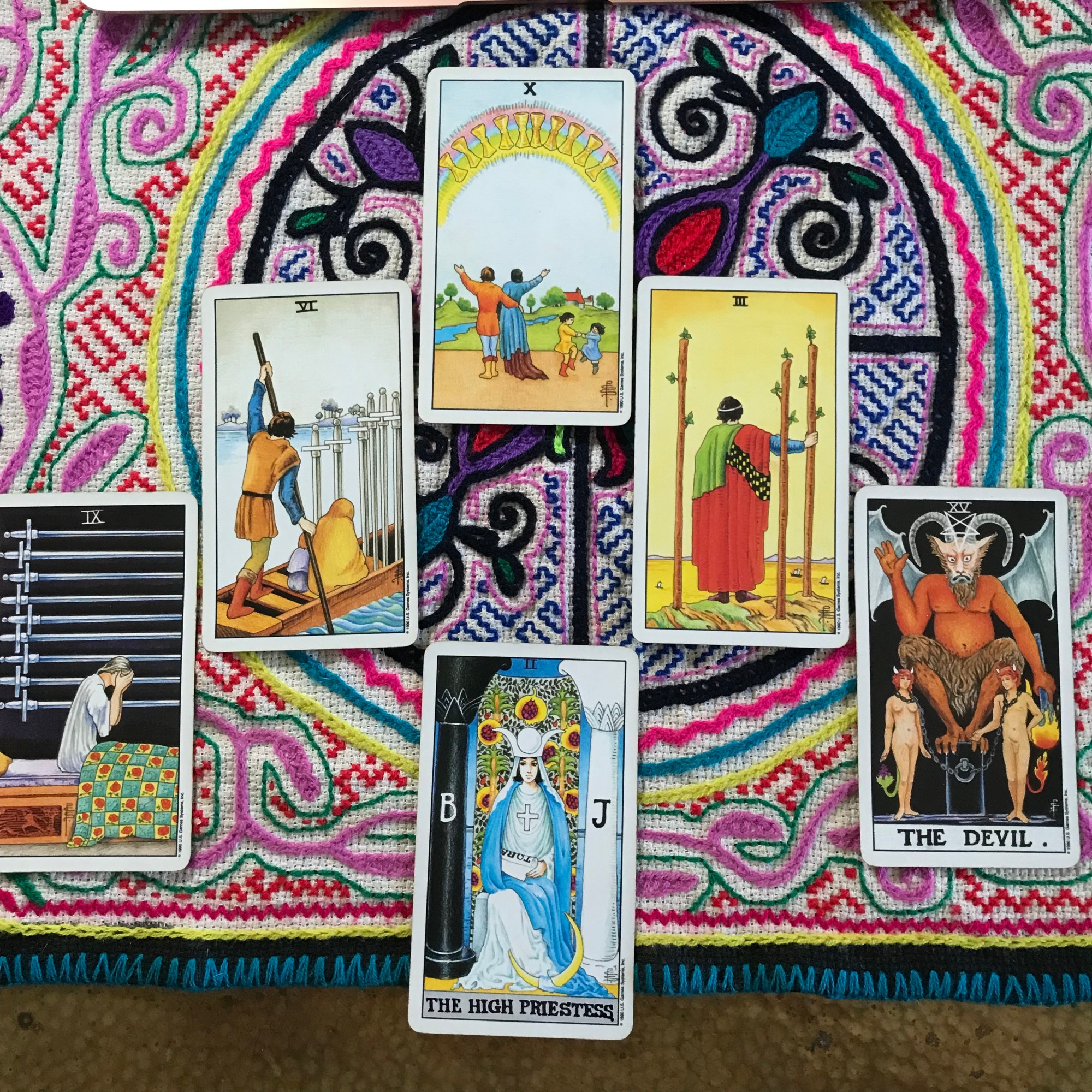
Tarot: great modular graphic novel, arranged in a spread and read by super wise super cool Sacred Expanse rock-witch Michelle Mae. I’ve been a fan of hers since 1995, when I saw her band the Make-Up on a bill with Fugazi and Slant 6. Michelle has me set intentions. I share with her my questions for the cards — “What should I be open to? How do I make the best of the year ahead?” — and, upon her instruction, also voice them again silently, eyes closed. She pulls the spread: lays it out on a table, explaining that it can be read both linearly and holistically (i.e., taken as a whole). The two of us then proceed to do so as follows. She introduces the cards one by one, naming them, raising them into my field of vision one at a time, without my knowing at any given point until the end how many there are in total. “Some difficult cards,” she reports. “Two of them major arcana.” Michelle helps me make sense of what she admits with a laugh is a bit of a crazy spread. She sends me afterwards a sacred Tibetan meditation practice, urging me to approach it with utmost respect.

I am to visualize my demons sitting across from me.

I am to ask them what they desire, and I am to feed it to them.

By these means, the instructions suggest, we convert our shadow self into an ally. We become whole again, filled with a sense of power, compassion, and love.