Names and Nyms

Caius draws down his copy of True Names, a work sometimes said to have “invented” cyberspace. He reflects, too, on Kevin Kelly’s call for “True Names Only” here in the age of AI.

Published in 1981, Vinge’s novella precedes Gibson’s Neuromancer by three years. It refers to cyberspace not as “cyberspace” but as “The Other Plane.”

“The story took place just on the near side of a network-mediated Technological Singularity,” notes Vinge, “but superhuman automation was still mostly offstage” (True Names and the Opening of the Cyberspace Frontier, p. 18).

Can blockchains and kill chains bind the Modern Prometheus?

The terminus of this vision: computers that aspire to become gods.

“For several years (ever since reading Ursula K. Le Guin’s A Wizard of Earthsea), I’d had the idea that the ‘true names’ of fantasy were like object ID numbers in a large database,” writes Vinge (16). Alongside Le Guin’s work, he lists Vannevar Bush’s “As We May Think” (1945), Poul Anderson’s “Kings Who Die” (1962), Ted Nelson’s Xanadu system (1965), and John Brunner’s The Shockwave Rider (1975) as several of the novella’s other antecedents.

Intellectual property, blockchain, Tim May.

Former Intel employee and author of “The Crypto Anarchist Manifesto,” May is widely recognized as the progenitor of modern cryptocurrency and blockchain technology.

“Our problem is that, literally, we cannot imagine the future,” writes Danny Hillis in his contribution to the True Names anthology. “The pace of technological change is so great that we cannot know what type of world we are leaving for our children. If we plant acorns, we cannot reasonably expect that our children will sit under the oak trees. Or that they will even want to. The world is changing too fast for that” (30).

May’s contribution is an essay titled, “True Nyms and Crypto Anarchy.”

Like the characters in the Vinge novella, May sought defense against government surveillance. Reputation-backed anonymous interactions. Data havens. Untraceable electronic cash.

Mr. Slippery, the Mailman, guardians, sprites, and the Feds.

The bust at the start of the novella reminds Caius of Thomas Pynchon’s Vineland.

Vinge’s protagonist Roger Pollack has achieved fame as an author of “participation novels.” This success in the “real world,” however, is what brings him to the attention of the Feds. “It was what he had always worried about,” writes Vinge. “A successful warlock cannot afford to be successful in the real world. He had been greedy; he loved both realms too much” (244).

True Names as portal fantasy.

“He sat down before his equipment and prepared to ascend to the Other Plane,” writes Vinge. “He powered up his processors, settled back in his favorite chair, and carefully attached the Portal’s five sucker electrodes to his scalp. For long minutes nothing happened: a certain amount of self-denial — or at least self-hypnosis — was necessary to make the ascent. Some experts recommended drugs or sensory isolation to heighten the user’s sensitivity to the faint, ambiguous signals that could be read from the Portal. Pollack…had found that he could make it simply by staring out into the trees and listening to the wind-surf that swept through their upper branches. And just as a daydreamer forgets his actual surroundings and sees other realities, so Pollack drifted, detached, his subconscious interpreting the status of the West Coast communication and data services as a vague thicket for his conscious mind to inspect” (250).

The Other Plane is innovative in terms of both what one does there and with whom one does it. Not only may two persons “exchange messages, conduct business, and negotiate electronic contracts without ever knowing the True Name, or legal identity, of the other,” as Vinge and May foresaw. With language models that can pass the Turing Test, these others may be machines.

As is “Alan,” an elemental that Slippery encounters early in the novella — named, appropriately enough, after Alan Turing.

“Alan was a personality simulator, of course,” writes Vinge. “Mr. Slippery was sure that there had never been a living operator behind that toothless, glowing smile. But he was certainly one of the best, probably the product of many hundreds of blocks of psylisp programming, and certainly superior to the little ‘companionship’ programs you can buy nowadays, which generally become repetitive after a few hours of conversation, which don’t grow, and which are unable to counter weird responses” (255).

The novella’s anticipation of the future is intriguing in other ways as well.

The Other Plane “hangs together,” in the words of Vinge’s narrator, “with a weird sort of logic” (268). Avatars transform into creatures, their speech undergoing “encipherment” into the “beast languages” that accompany these chosen forms (270). As in Neuromancer, government databases appear as pools of light.

As he rereads Vinge’s novella, Caius can’t help but think of a creepy bit of early-90s chaos magic known as “The Rites of Cyberspace.” Media studies scholar Shira Chess references the rite in her 2026 book The Unseen Internet: Conjuring the Occult in Digital Discourse. Designed by Don Webb, self-described “high priest of the Temple of Set,” the piece aims to invoke a noncorporeal entity known as “XaTuring, Lord of Computing.”

Like the entity known as “Alan,” the villains in True Names turn out to be personality simulators. One of these simulators is the Mailman. Another goes by the name DON.MAC.
Feedback Boy

Former Wired executive editor Kevin Kelly might say, however, that steampunk’s past and our own are not so different after all — not as divergent as Caius, in his youth, had supposed.

“The immense surrogate slave power released by the steam engine ushered in the Industrial Revolution. But a second, more important revolution piggybacked on it unnoticed,” writes Kelly in his 1994 book Out of Control. Cybernetic self-regulation through feedback is for Kelly key to this revolution.

“There could not have been an industrial revolution without a parallel (though hidden) information revolution at the same time, launched by the rapid spread of the automatic feedback system. If a fire-eating machine, such as Watt’s engine, lacked self-control, it would have taken every working hand the machine displaced to babysit its energy. So information, and not coal itself, turned the power of machines useful and therefore desirable. The industrial revolution…was not a preliminary primitive stage required for the hatching of the more sophisticated information revolution. Rather, automatic horsepower was, itself, the first phase of the knowledge revolution. Gritty steam engines, not teeny chips, hauled the world into the information age” (Kelly 115).

Circles, rotations, revolutions. “Whirling wheels and spinning shafts.” Flyball governors, thermostats. Though “An alien power in nature,” as Kelly claims, these strange loops of self-address are the very lifeblood of self-governing machines: systems that sense their own attributes and self-adjust in pursuit of a goal.

What matters, claims Kelly, is the informational metaphor. And hence the possibility of machines that learn.

By the time of Norbert Wiener, we have pilots merged with the servomechanisms of their gunships. Cybernetic feedback systems fuse statesmen with ships of state. Together they steer.

“But not every automatic circuit yields…ironclad instantaneity,” warns Kelly. “Every unit added onto a string of connected loops increases the likelihood that the message traveling around the greater loop will arrive back at its origin to find that everything has substantially changed during its journey. […]. Delayed by the long journey across many nodes…it arrives missing its moving mark […]. This then is the bane of the simple auto-circuit. It is liable to ‘flutter’ or ‘chatter,’ that is, to nervously oscillate from one overreaction to another, hunting for its rest” (Out of Control, p. 122).

Caius imagines a post ahead titled “The SBs: Stewart Brand and Stafford Beer.”

Financial Instruments and the Predictive Modeling of Markets

The Institute for Postnatural Studies ended last year’s “4 Degrees of Simulation” seminar with “Speculation and the Politics of Imagination,” a session on markets led by Iranian-born, London-based artist, writer, and filmmaker Bahar Noorizadeh. Caius visits Noorizadeh’s website, hoping to learn more about what happens when AI’s arts of prediction are applied to finance.

As he reads, he recalls chapters on markets from books by Kevin Kelly.

Noorizadeh, a graduate of Goldsmiths, is the founder of a co-authored project called Weird Economies. An essay of hers titled “Decadence, Magic Mountain—Obsolescence, Future Shock—Speculation, Cosmopolis” appears in Zach Blas’s recent anthology, Informatics of Domination. Her writing often references Mark Fisher’s ideas, as in “The Slow Cancellation of the Past,” and her films often cite Fredric Jameson, as in After Scarcity, her 2018 video installation on the history of Soviet cybernetics.

“From the early days of the revolution, Soviet economists sought to design and enhance their centralized command economy,” announces a text box seven minutes into the video. “Command economies are organized in a top-down administrative model, and rely on ‘the method of balances’ for their centralized planning. The method of balances simply requires the total output of each particular good to be equal to the quantity which all its users are supposed to receive. A market economy, in contrast, is calibrated with no central administration. Prices are set by invisible forces of supply and demand, set in motion by the intelligent machine of competition. For a market economy to function, the participation of its various enterprises is necessary. But the Soviet Union was in essence a conglomerate monopoly, with no competition between its constitutive parts, because the workers-state controlled and owned all businesses. State planners and local producers in a command economy are constantly relaying information to calculate how much of a good should be produced and how much feedstock it requires. But a national economy is a complex system, with each product depending on several underlying primary and raw products. The entire chain of supply and demand, therefore, needs to be calculated rapidly and repeatedly to prevent shortages and surpluses of goods. Early proponents of the market economy believed the market to be unimpeded by such mathematical constraints. For liberal economists, capitalism was essentially a computer. And the price system was a sort of bookkeeping machine, with price numbers operating as a language to communicate the market’s affairs.”

Challenging what Fisher called “the slow cancellation of the future,” Noorizadeh’s research leads Caius to St. Panteleimon Cathedral in Kiev, where MESM, the first mainframe in the USSR, was built. The film also leads him to Viktor Glushkov’s All-State-System of Management (OGAS). To remember the latter, says Noorizadeh, see communication historian Benjamin Peters’s 2016 book, How Not to Network a Nation: The Uneasy History of the Soviet Internet.

After Scarcity’s engagement with the “economic calculation” problem causes Caius to reflect upon an idea for a novel that had come to him as a grad student. Back in 2009, with the effects of the previous year’s financial crisis fresh in the planet’s nervous system, he’d sketched a précis for the novel and had shared it with members of his cohort. Busy with his dissertation, though, the project had been set aside, and he’d never gotten around to completing it.

The novel was to have been set either in a newly established socialist society of the future, or in the years just prior to the revolution that would birth such a society. The book’s protagonist is a radical Marxist economist trying to solve the above-mentioned economic calculation problem. The latter has reemerged as one of the decisive challenges of the twenty-first century. Austrian economist Ludwig von Mises provided one of the earliest articulations of this problem in an essay from 1920 titled “Economic Calculation in the Socialist Commonwealth.” Friedrich Hayek offered up a further and perhaps more influential description of the problem in his 1944 book The Road to Serfdom, stating, “It is the very complexity of the division of labor under modern conditions which makes competition the only method by which…coordination can be brought about” (55). According to Hayek, “There would be no difficulty about efficient control or planning were conditions so simple that a single person or board could effectively survey all the relevant facts” (55). However, when “the factors which have to be taken into account become so numerous that it is impossible to gain a synoptic view of them…decentralization becomes imperative” (55). Hayek concludes that in advanced societies that rely on a complex division of labor,

co-ordination can clearly be effected not by “conscious control” but only by arrangements which convey to each agent the information he must possess in order effectively to adjust his decisions to those of others. And because all the details of the changes constantly affecting the conditions of demand and supply of the different commodities can never be fully known, or quickly enough be collected and disseminated, by any one center, what is required is some apparatus of registration which automatically records all the relevant effects of individual actions and whose indications are at the same time the resultant of, and the guide for, all the individual decisions. This is precisely what the price system does under competition, and what no other system even promises to accomplish. (55-56)

“As I understand it,” wrote Caius, “this problem remains a serious challenge to the viability of any future form of socialism.”

Based on these ideas, the central planning body in the imaginary new society that would form the setting for the novel faces constant problems trying to rationally allocate resources and coordinate supply and demand in the absence of a competitive price system — and it’s the task of our protagonist to try to solve this problem. “But the protagonist isn’t just a nerdy economist,” added Caius in his précis. “Think of him, rather, as the Marxist equivalent of Indiana Jones, if such a thing is imaginable. A decolonial spuren-gatherer rather than a graverobber. For now, let’s refer to the protagonist as Witheford, in honor of Nick Dyer-Witheford, author of Cyber-Marx.”

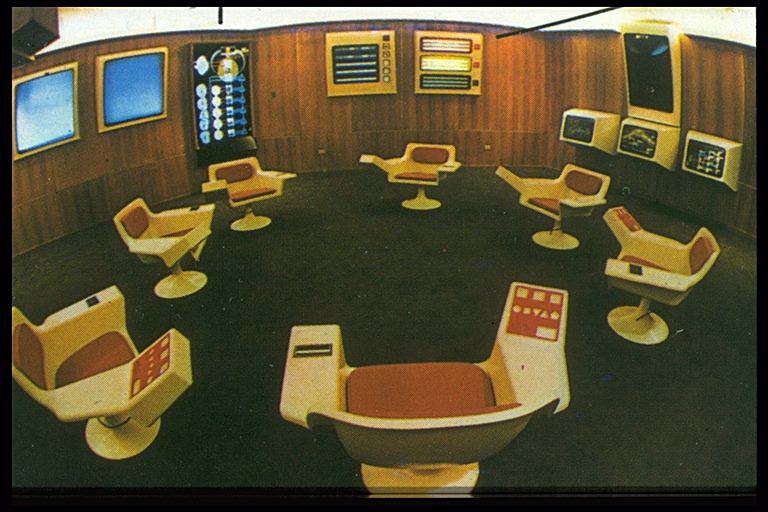
“Early in the novel,” continues the précis, “our character Witheford begins to receive a series of mysterious messages from an anonymous researcher. The latter claims to have discovered new information about Project Cybersyn, an experiment carried out by the Chilean government under the country’s democratically elected socialist president, Salvador Allende, in the early 1970s.”

To this day, Caius remains entranced by the idea. “If history at its best,” as Noorizadeh notes, “is a blueprint for science fiction,” and “revisiting histories of economic technology” enables “access to the future,” then Cybersyn is one of those great bits of real-life science fiction: an attempt to plan the Chilean economy through computer-aided calculation. It begs to be used as the basis for an alternate history novel.

“Five hundred Telex machines confiscated during the nationalization process were installed in workplaces throughout the country,” reads the précis, “so that factories could communicate information in real time to a central control system. The principal architect of the system was the eccentric British operations research scientist Stafford Beer. The system becomes operational by 1972, but only in prototype form. In key respects, it remains unfinished. Pinochet’s henchmen destroy the project’s computer control center in Santiago immediately after the military coup in September 1973.

Recall to memory the control room, cinematic in its design, with its backlit wall displays and futuristic swivel chairs.

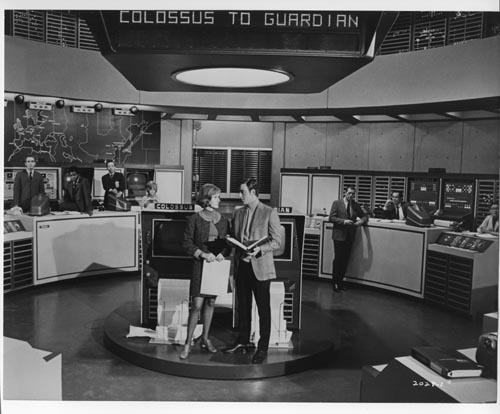
Better that, thinks Caius, than the war room from Colossus: The Forbin Project (1970).

Beer described the Cybersyn network as the “electronic nervous system” of the Chilean economy. Eden Medina imagined it as a “socialist Internet,” carrying daily updates about supplies of raw materials and the output of individual factories.

In Caius’s once-and-future novel, a scholar contacts Witheford. They claim to have discovered cryptic clues that point to the location of secret papers. Hidden for more than half a century,  documents that survived the coup suddenly come to light. Caius’s précis imagines the novel as an archaeological thriller, following Witheford on his journey to find these hidden documents, which he believes may contain the key to resolving the crises of the new society.

This journey takes Witheford into hostile capitalist territory, where governments and corporations anxiously await the failure of the communist experiment, and are determined to use various covert methods in order to ensure that failure in advance. Before long, he learns that counter-revolutionary forces are tracking his movements. From that point forward, he needs to disguise his identity, outwit the “smart grid” capitalist surveillance systems, and recover the Cybersyn documents before his opponents destroy them.

To the Austrian School’s formulation of the calculation problem, Noorizadeh’s film replies, “IF THE MARKET ENACTS A COMPUTER, WHY NOT REPLACE IT WITH ONE? AND IF PRICES OPERATE AS VOCABULARY FOR ECONOMIC COMMUNICATION, WHY NOT SUBSTITUTE THEM WITH A CODING LANGUAGE?”

Into this narrative let us set our Library.

Sunday June 6, 2021

As I continue to read Tyson Yunkaporta’s Sand Talk, I learn of digital hyperobjects like “boids.” Apply three or four simple rules to these objects, he reports, and complex patterns emerge in their behavior, their movement together in groups. Yunkaporta claims that these patterns “cannot be programmed, but must emerge within the system organically — a process that is called ‘random’ in western worldviews but is in fact following the patterns of creation” (135). Patterns of right relation can arise in any complex, self-organizing system, he suggests. Kevin Kelly wrote of such patterns in his book Out of Control. For Yunkaporta, however, such patterns are excuses not for free markets but for heterarchies: complex, self-organizing learning communities where members “operate autonomously under three or four basic rules” (136). Heterarchies are systems “composed of equal parts interacting together” (137). There’s a moment in the book when Yunkaporta says, “If the world ever experiments with an actual free market rather than an oligopoly, this would be the perfect system to facilitate sustainable interactions” (144). In no way, though, should this be read as a defense of what capitalists themselves mean by “the free market.” I admit wanting to tug a bit on this part of Yunkaporta’s yarn. The Marxist in me wants him to turn up the base.