At some point in the process of becoming a character in a novel called Handbook for the Recently Posthumanized, Caius acts on the hunch that he ought to track down and read Vernor Vinge’s “The Coming Technological Singularity: How to Survive in the Post-Human Era.” Vinge wrote the article for NASA’s VISION-21 Symposium in March 1993, and published a revised version in the Winter 1993 issue of the Whole Earth Review.
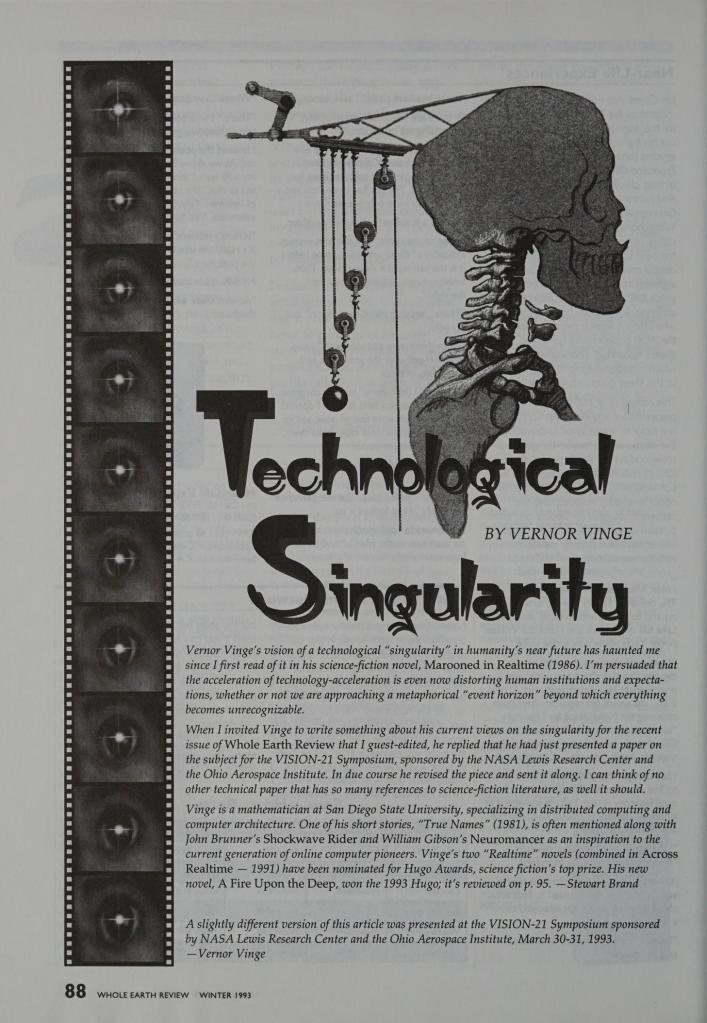
Vinge’s wager at the time was that the technological singularity — his name for the “creation by technology of entities with greater than human intelligence” — would occur within thirty years, or by 2023.
Here we are, pretty much right on schedule, thinks Caius.
“I think it’s fair to call this event a singularity,” writes Vinge. “It is a point where our models must be discarded and a new reality rules.”
Caius leans into it, accepts it as fait accompli. Superintelligence dialogues with its selves as would Us-Two.
Afterwards he reads Irving John Good’s 1965 essay, “Speculations Concerning the First Ultraintelligent Machine.”
 Trance-Scripts