Monday October 16, 2017

The star of a popular TV show paints dollar signs on her fingernails to demonstrate her love for former US president Barack Obama. She and her fellow Democrats don’t seem to have learned much since last year’s election. Insulated by their money and their privilege, they remain clueless as to why they’ve lost control of all branches of government.
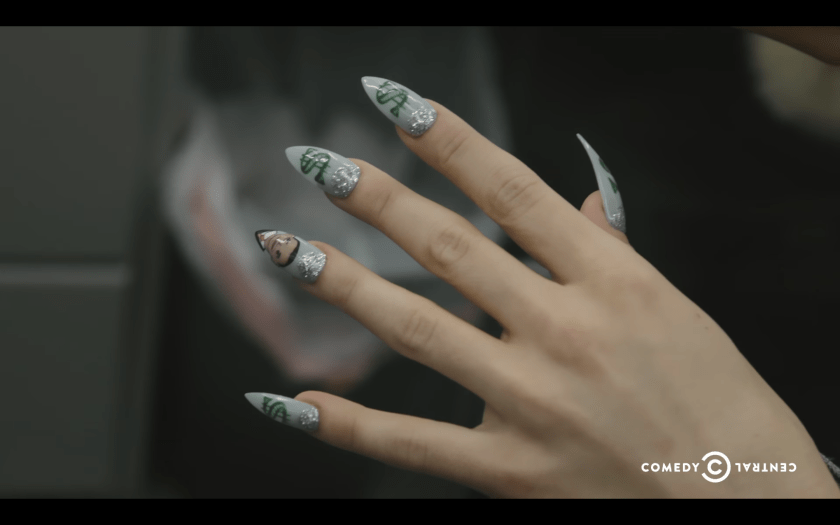
Broad City Dollar Signs

My mind, however, is elsewhere. I continue to dwell upon psychedelic imagery from one of the performances I caught this weekend. Washed Out teamed up with Brainfeeder-affiliated visual artist Timeboy to create music videos for each track on the band’s latest album, Mister Mellow. The videos utilize several forms of animation: everything from stop-motion and claymation to hand-drawn cartoons. The band projects and modifies all of this dynamic imagery in real-time during live performances using Kinect 2.0 devices: motion-sensing “depth” cameras, basically, designed by Microsoft for use with Xbox One. Sarah joined me for a beautiful late-afternoon stroll through a garden yesterday, where we were graced by magnificent monarch butterflies, a pink wildflower anemone named “Queen Charlotte,” a fence post covered in flowering snail vine. We imagined ourselves entering and exiting zones filled at once with the romantic drama of the strolling couple, and at a different scale, observable only when the couple peers down on occasion, a world teeming with ecosystem narratives: complex interactions between predators and their potential prey. Perceived at this level, suffering and decay seem almost painterly in their abstraction. I realize that I spend too much of my life torn between warring impulses. Should I spend my life immersed in texts or in nature? I commit myself fully to neither speech nor phenomena. Broad City more than makes up for past crimes, by the way, with its latest episode, an animated shroom-and-cannabis-fueled extravaganza by artist Mike Perry.

broadcity_mikeperry_intro

The alarms, the intensities, objects melting and reforming: together, it amounts to a grand de-reification of reality. So much more pleasurable than the gritty nicotine-crack-alcohol police-and-criminal-class hustle-drama dished out by David Simon’s The Deuce.

Friday October 6, 2017

I sometimes pray silently to the equivalent of a program, a ghost in the machine, in hopes that it will take pity on me by unlocking invisible doors onto other quadrants of the game-board. And it does, language leading me to Ian Bogost’s “The Metaphysics Videogame.” Finally — a theorist of videogame ontology. Weed is a kind of rhetoric that delivers its arguments not with words or images or programs but through chemical reprogramming of neurons. It alters perception so as to dodge any system the General Intellect might try to impose onto Being. I wish to operate free of rules devised by others. This is why I’m writing and blogging. Games too often feel to me like a distraction from whatever aspect of Nature is described in terms like grounded, earthy, and wild. My fellow Marxists don’t take the Romanticist theory of Nature as seriously as they ought to. Even if just for the sake of personality and mental health. I like sunlight. I like sitting outdoors. Dr. Andrew Weil takes me on a “sonic journey to where healing happens.” Profound states of relaxation lead listeners down into a realm Weil calls “the Deep.” Of course, it’s all just schmaltzy classical music. A total betrayal of psychedelia’s revolutionary beginnings, the latter co-opted and, in true bait-and-switch fashion, replaced with something tacky and false. I want videogame theorists who, rather than trying to sell me on games, are instead able to help me better understand how videogames have influenced the way I think. The warring halves in me cause my ego formation to vacillate back and forth between an outdoor nature associated with public pools and summer camps, and an indoor nature associated with comic books, paperbacks, and videogames (but also movie theaters, roller rinks, and malls). Against both of these natures stood the culturally imposed tedium known as “school.” That boredom I experienced in classrooms as a kid makes me deeply cynical about my profession. If corporations weren’t the ones funding it and shaping the content, I would happily watch Viceland’s “The New Classroom” and say, “Yes, we should all integrate VR technology into our classrooms.” But really I’m more of a back-to-the-lander. I like to sit in the woods and read books.

Tuesday September 12, 2017

How I wish I could live more in keeping with a reverence for nature as something more than just a giant money-laundering scheme. Getting high helps. However, the reverence it provokes, while focused on one thing at a time, is otherwise indiscriminate. The nature/culture binary means little in this state; but things are more complicated when it comes to economy and ecology. When I smoke, I defeat my usual fearful posture toward life. We must languor in the telling, I tell myself. Allow others to congregate ’round it. Another voice interrupts here, stating, “Man cannot tame what God wishes to remain wild.” I do worry, by the way, that reverence for nature might be the one necessary element of a properly utopian political theology that Gnosticism fatally lacks. “We are poems in the making,” proclaims M.C. Richards: “Logos at work.” “A craftsman,” she adds (“craftsman” being her name for the utopian subject), “has the opportunity of acting out daily the wisdom of his organism, in its intuitive and other aspects. […]. He knows what can happen of itself once certain rhythms are set in motion. He knows that hand and head, heart and will, serve in a process and a wisdom greater than his own” (61-62). Despite the above passage’s unfortunate tendency to default to masculine pronouns, I feel like every subsequent sentence in Richards’ book Centering contains the precise knowledge of how one ought to live one’s life. She even captures my understanding of what I’m doing, or what I ought to be doing, with these trance-scripts: “The artist participates in a subtle dialogue with nature. Who is saying what to whom? If we allow our views of craft decorum to loosen, we may see more simply what is there. We do not need to fight for our right to be off center. We find that once we are on center, we may be off center as wholeheartedly as we like, for at that level there is no difference. At that level, we are free to create whatever form occurs” (62). Classic modalities crack away like cheap facades that others years ago plastered over or by other means affixed to the forms and surfaces of Practico-Inert-ville, aka the capitalist built environment, i.e. our prison. Try digging your way out of that one. Radical psychedelic healing techniques must be used to de-reify these structures, not just pickaxes and shovels and dynamite.

Friday August 25, 2017

I listen in a reclined position to a train across town and the ocean-like repetition of cars headed to work on a distant parkway. Before long, a fire truck joins the fray. And beneath it all, creating a sense of tonal continuity, a chorus of crickets. What remains of consciousness as it passes intermittently between states? Is there an internal reckoner, a memorized self-same self? Picture this self as the Pugilist, whose nature (so I hear) is to lose and rise again. Borges bestowed on this figure the title “Funes the Memorious.” “Perhaps we all know deep down,” he wrote, “that we are immortal and that sooner or later all men will do and know all things.” Perhaps, I murmur back, slipping in and out of consciousness of the many brown and yellow leaves lying dead upon my deck. Must I sweep them? What’s the point? Mosquitoes will continue to haunt these grounds regardless of my effort. Give it a little push at the start, though, and the whole thing begins to glide. We no longer need our sunglasses, for instance, do we? Nor do we need our helmets. Just tree-lined, solitary inner wanderings. We conduct our trance-scripts at a picnic table in a park. And if you don’t mind me saying, it feels magical: a beam of sunlight carves a face on a tree directly across from me. In its features, the face is sometimes ghost from Pac-Man or poor Yorick, sometimes ancient-wise-benevolent. There are occasionally people who walk past, and we tense a bit; but it’s all good, the locusts shift their motors up a gear and we’re staring down into a distant puddle or a sinkhole. Therein lies the psychic mortuary / compost heap. Do we want to take a look? Of course we do. We are in some sense seeking to establish a rapport between Marxism and psychedelic human-potentialists and positive psychologists. Ours will be a communism “articulated,” in Laclau and Mouffe’s sense, with projects of self-realization and personal well-being. I want to be able to camp out in empty fields, even after the revolution, apart at a safe distance from my fellow humans. “Family of man” mustn’t become a curse hung ’round the necks of particular, living-breathing humans. Can we respect that? Non-human Nature, I congratulate thee: that sunlit field looks fantastic. Well done. Lay back in the grass and gaze up at the sky. That ought to be part of the Left’s promise: high-quality, de-commodified (though psychedelically enhanced), authentic lives of leisure. A Marxism that robs individuals of the right to design their own paths toward understanding is an abomination. Nor is there anything in Marxism that demands such a robbery. Why, then, is today’s radical Left so square? If holding these views implicates me in natural theology, then so be it.