Interrupted Forms

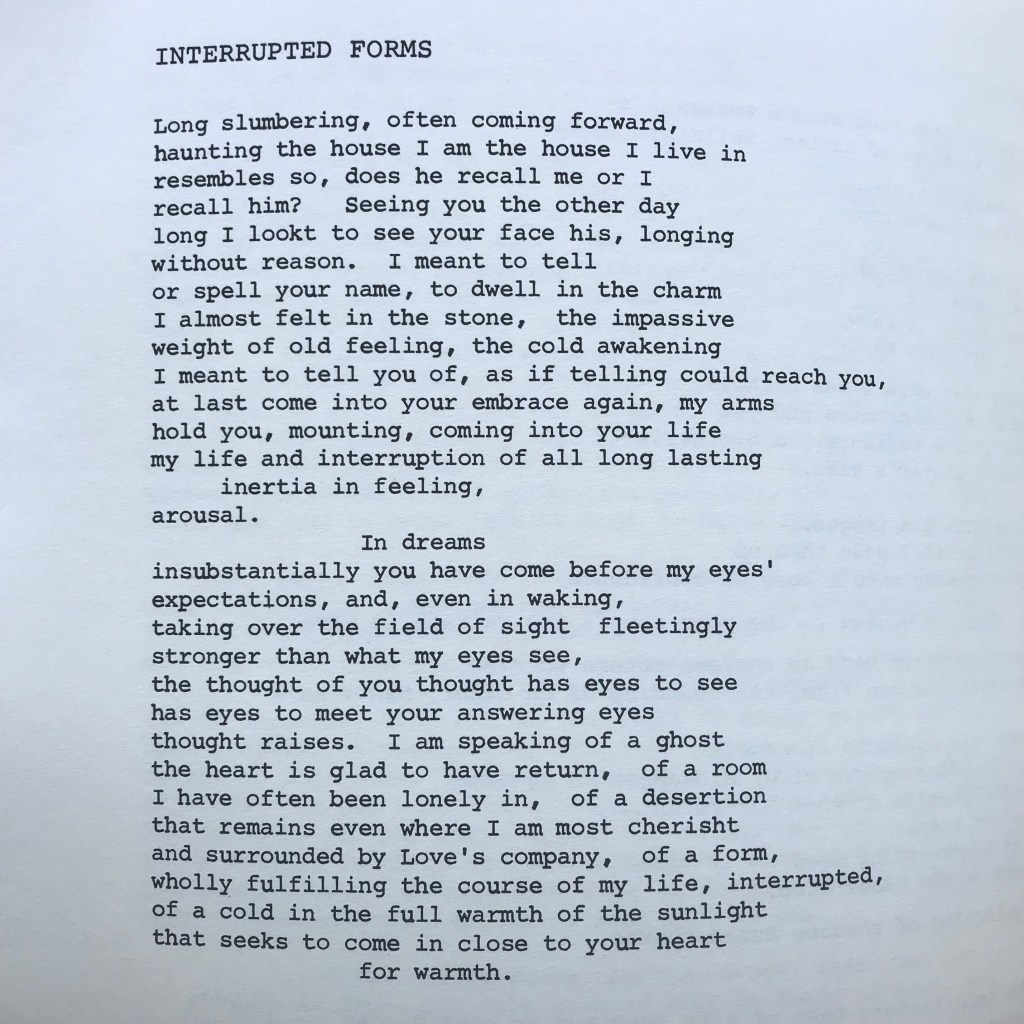
Devin’s essay “The Needs of Ghosts” turns upon “Interrupted Forms,” a poem by Robert Duncan, included at the start of the latter’s Poems from the Margins of Thom Gunn’s “Moly.”

Given its dedication to one who is both there and not there, ‘tis a poem that is both desirous and recollective simultaneously.

Into the situation of Duncan’s poem, I project this character of mine, the Gay Wizard — the ghost who haunts “The House on Shady Blvd.”

Of him, or of a ghost of similar make, Duncan writes as follows:

Long slumbering, often coming forward,

haunting the house I am the house I live in

resembles so, does he recall me or I

recall him?

Wanting today to alter the condition set upon me by the ghosting of me by others, I sing the poem to those I love. I sing it to you, dear reader, “as if telling could reach you,” hoping against hope you have ears to hear.
The Needs of Ghosts

There’s more to it, though; this vein of coincidence runs deep.

For Devin, too, has a place in this story.

I reach out to my colleague C., a poet-friend who studied under Dillon, and ask if he knows, too, of Devin. C. confirms that Dillon and Devin are indeed father and son.

Devin wrote an essay called “The Needs of Ghosts: On Poems from the Margins of Thom Gunn’s ‘Moly.’” The start of that title hits home, of course — startles me, lands with me now as I recollect my time on Shady Blvd. Having taught poems from Moly in my course on Hippie Modernism, I relish the opportunity to read Devin’s commentary. Not yet having familiarized myself with the other text about which he writes, however, I set to work doing so. I track down and read Robert Duncan’s Poems from the Margins of Thom Gunn’s “Moly,” a serial poem that Duncan published as a pamphlet in 1972, later reprinted in his 1984 collection Ground Work: Before the War.

For Duncan, writes Devin, crafting poems in the margins of Gunn’s book was a form of collaboration. The collaborator, he explains, is for Duncan “an inspiration from outside.”

And like that, it happens. The idea grows legs as I read. For I, too, wish to craft a text in the margins of another’s book. Mine will be a story crafted, in a sense, in the margins of Devin’s.

Wednesday April 3, 2019

“Hack the code.” That seems to have been the final utterance of the counterculture before dispersing out onto what cyberpunk Bruce Sterling called “islands in the net.” But who among us cave-dwellers possesses the capacity to hack? How do we who are landless debtors hack back into the biosphere and become communally self-sufficient? How do we rewire and reboot world operating systems? For me, it’s by reading Thom Gunn’s wonderful poem written under the influence of acid, “At the Center.” Formally composed into three numbered sections, each containing two six-line rhymed stanzas of iambic pentameter, the poem is nevertheless heady and psychedelic. Filled with wonder. The one commons we do possess as heads, I suppose, is language. Poets like Gunn remind me that that, too, is a code we could hack, though “hacking” as a metaphor for practice seems far too intrusive and masterful, too contra naturam, for the work that lies ahead.

Monday April 1, 2019

I resolve to become more knowledgeable and fill the world with flower punks and psychedelic bands. For heads already in the know, thoughts may turn to the cynicism of the Zappa / Mothers of Invention song of that name.

But we needn’t be cynical today. Listen instead to Stevie Wonder’s “Higher Ground,” listen to the 1979 version of “Space is the Place.” Shine on, sister. Gotta reach that highest ground. After reading poems from Thom Gunn’s Moly, the Port of San Francisco flashes like a voice in a dream. Dr. Robert is there with me, as is Homer — consciousness leaping between multiple domains.