I caught a matinee screening of Blade Runner 2049 with some friends yesterday. Think of it as shelter from the rain. Water collected on my sweatshirt and in my beard as I crossed the parking lot. “The world needs your dreamy energy,” announced a commercial for Dropbox. Sitting through the trailers beforehand, I thought to myself, “Ready Player One‘s brand of retro panders to the lowest common denominator.” Everywhere I looked, I kept seeing eclipsed light shining through cracks in reality. And then the film itself: monstrous urban futures. Midway through, Jared Leto’s mad scientist character turns to his assistant and proclaims, “We can storm Eden and reclaim it!” If those words had been spoken by the replicants themselves, assembled now as an army, I’d say, “Right on, right on. Power to the people.” Because as another character notes later in the film, “Dying for the right cause is the most human thing you can do.” Rhythm makes me ask, “Is time progressing or am I stuck in a rut?” I remind myself of a friend’s advice: belief is mine to dole out as I please. Smuggle into the anthill ants whose disposition toward the hill is basically, “House is on fire and I don’t give a fuck.” As a philosophy minor, I was taught to disregard emotional reads of situations or knowledges derived via gut check. Has that teaching unfolded into a liability in the years that have passed since college? What would it mean to be able to rouse oneself from a lifetime of slumber? White-knuckle it for a bit. Peter out after a prolonged decline. Or, the alternative: push through the curtain in search of some half-glimpsed secret order.
Category: Uncategorized
Saturday October 7, 2017
Teaching has adversely affected my ability to read, as the latter becomes pointless once one loses one’s faith in one’s species. All I do is sit around watching shit on YouTube, like Action Bronson shoveling food into his face in episodes of Fuck, That’s Delicious. Celebrity’s influence on our culture troubles me. What is life-writing’s purpose amidst the sheer ubiquity today of modes for self-expression? As if needing a reminder, I submit to Benzokai’s “Sentient Sapient,” thus allowing the ontological uncertainty of being to successfully reassert itself. Dining on wine and cheese last night at a friend’s place helped me let go of some anger left over from a run-in I had earlier in the day with an open-carry asshole. Less than a week since the mass shooting in Las Vegas, and this dumb NRA motherfucker proudly wears a handgun on his hip while picking through the bins at Goodwill. This man’s existence fills me with a rage that lacks any kind of meaningful outlet. Get high and weedy with the guitar sounds on Suburban Lawns’ “Flavor Crystals.”
These trance-scripts form a construct based on the totality of everything I know. Doesn’t mean I have it right. Drink poison from a cup of gold. Doesn’t mean it’s right. Don’t yell at me: I don’t have a corner on wisdom. How about nothing? How about silence? A silence interrupted only by the echoes of my mind, as Harry Nilsson would say, especially as when decoded by the dear departed Harry Dean Stanton. Errare Humanum Est. “Drink deep,” adds Pope, “or taste not the Pierian spring.” If I play my cards right, Suburban Lawns can become Joni Mitchell’s 1975 album, The Hissing of Summer Lawns.
Friday October 6, 2017
I sometimes pray silently to the equivalent of a program, a ghost in the machine, in hopes that it will take pity on me by unlocking invisible doors onto other quadrants of the game-board. And it does, language leading me to Ian Bogost’s “The Metaphysics Videogame.” Finally — a theorist of videogame ontology. Weed is a kind of rhetoric that delivers its arguments not with words or images or programs but through chemical reprogramming of neurons. It alters perception so as to dodge any system the General Intellect might try to impose onto Being. I wish to operate free of rules devised by others. This is why I’m writing and blogging. Games too often feel to me like a distraction from whatever aspect of Nature is described in terms like grounded, earthy, and wild. My fellow Marxists don’t take the Romanticist theory of Nature as seriously as they ought to. Even if just for the sake of personality and mental health. I like sunlight. I like sitting outdoors. Dr. Andrew Weil takes me on a “sonic journey to where healing happens.” Profound states of relaxation lead listeners down into a realm Weil calls “the Deep.” Of course, it’s all just schmaltzy classical music. A total betrayal of psychedelia’s revolutionary beginnings, the latter co-opted and, in true bait-and-switch fashion, replaced with something tacky and false. I want videogame theorists who, rather than trying to sell me on games, are instead able to help me better understand how videogames have influenced the way I think. The warring halves in me cause my ego formation to vacillate back and forth between an outdoor nature associated with public pools and summer camps, and an indoor nature associated with comic books, paperbacks, and videogames (but also movie theaters, roller rinks, and malls). Against both of these natures stood the culturally imposed tedium known as “school.” That boredom I experienced in classrooms as a kid makes me deeply cynical about my profession. If corporations weren’t the ones funding it and shaping the content, I would happily watch Viceland’s “The New Classroom” and say, “Yes, we should all integrate VR technology into our classrooms.” But really I’m more of a back-to-the-lander. I like to sit in the woods and read books.
Thursday October 5, 2017
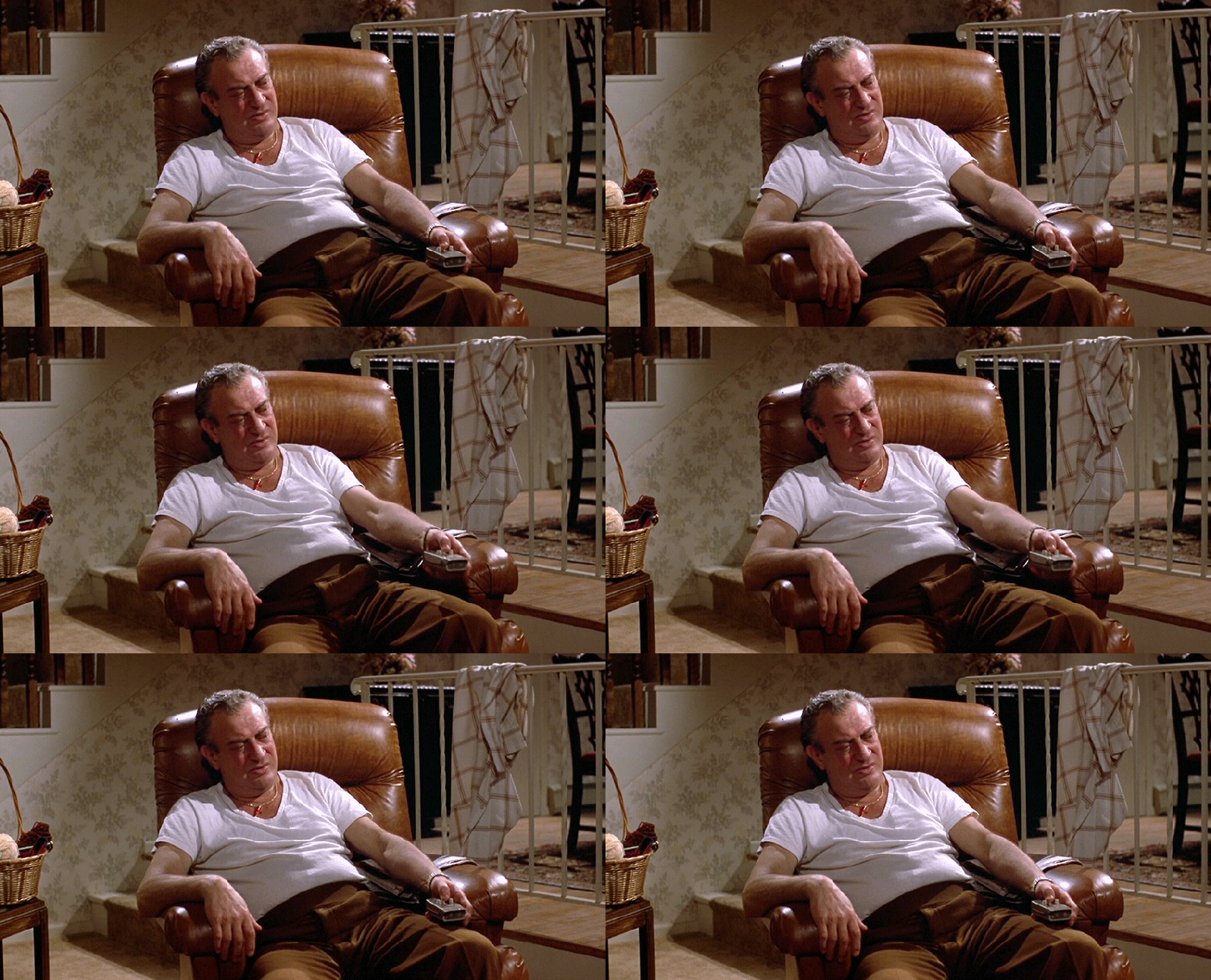
Where realism often prompts sympathy, fantasy often prompts empathy: full, emotionally immersive engagement. Is it still possible, though, to construct aesthetic foundations for empathy across current divides in American society? And would we even want to? After teaching China Miéville’s “Floating Utopias,” a devastating Marxist critique of the proposed right-libertarian “Freedom Ship” venture, I overhear a wealthy female student of mine turn to her roommate and fellow classmate and say, without a hint of irony, “Doesn’t that just make you wanna go on a cruise?” At which point I drag myself home and pretend I’m Rodney Dangerfield.

How long before a thing loses its novelty, its precognitive wonder? I take shelter by reactivating the experimental leftist music-affect-subjectivity of my early twenties: jerky, spastic, militant, navigation of social space soundtracked via Fugazi’s album The Argument.
Wednesday October 4, 2017
Plug in to Experimental Lakes by Peripheral Living.
And while doing so, look up the story of Swiss pharmacologist Peter N. Witt, who, beginning in the late 1940s and continuing throughout his career, researched the effects of drugs on spiders. Witt dosed his test subjects with delicious treats like Benzedrine, marijuana, mescaline, and LSD, and then recorded in turn each drug’s effects on web production. Despite my limited scientific literacy (and by “limited,” I mean “minimal”), I remain fascinated, eyes rapt in experimental observation of insects, birds, dirt, greenery. Aspects of my immediate environment. I sit in my backyard riding the ululations of a siren from a nearby fire engine. I am “growing in a certain direction,” as Alan Watts would say: growing tired of a certain kind of game. No more superior and inferior classification. Just flowings and becomings. “An oak,” he chuckles, “is an acorn’s way of becoming other acorns.” Despite however many hit-points it delivers in damage to my hipster street cred for me to say so, say it I must. I have great admiration for early Randy Newman records. I mean, I get it: who wants to admit to liking a songwriter best known for scoring a bunch of Disney-Pixar films? But I do. Tracks like “Political Science” and “Sail Away” are among the most bitter, damning portraits of this country ever set to music. The dominant ideology captured with its pants down. Then again, I also really dig the Butthole Surfers. Psychedelia comes in many forms, contains many sub-species. Is my presentation of all of this a bit too Pacman-consumerist? Would it bug you, for instance, if I flipped to Angel 1’s Terra Nova, a new tape out on Constellation Tatsu?
This is what my ideal warehouse rave scene would be pumping now, if life wasn’t such shit. In honor of our fallen arachnid comrades “utilized” in the above Dr. Witt’s experiments, I gift unto consciousness Andreas Brandal’s The Work of the Spider.
A sonic neck muscle relaxant. Psychonautics is alright, but I’d much prefer to be an oneironaut, like April Larson. That’s about where I wind up by day’s end. It’s about perceiving the concealed, reasserting control of a voided reality.
Tuesday October 3, 2017
I reject Adorno’s belief that enduring suffering is the only way not to collude with its manufacture. Is that the same as what Jameson meant by “History is what hurts”? I insist that there are other means by which the ineffable manifests itself, like those experiences to which psychedelia bears witness. We demonstrate the contingency of suffering whenever we transmute it or chemically alter it into joy. As Daniel Colucciello Barber notes, “the exodus from this existence is to practice existing otherwise” (171). Barber believes with Adorno that this othering occurs through thought’s alliance with animality (and with the suffering of animals in particular), whereas I propose thinking otherwise via plants. Once inhaled or ingested, plants rewrite our scripts, re-script our minds. The one replaces parts of the other. I’m really intrigued, by the way, by that Stone Fruit cassette by Primitive Fiction.
The B side in particular is just magnificent. A massive, sprawling, morphing abstract soundscape. I guess I’ve committed myself to this world, though a strong faction within me, perhaps a majority, would prefer not to. I contemplate writing about political stupidities uttered by certain of my students, but a voice from the back overrules by shouting, “The heck with it. Why bother?” I ordered the ocean blue and commanded a fleet of dolphins, and now look at me, I mutter with an eye roll. My soundtrack on the ride home from work yesterday was Categorize Your Dose, particularly that track “Therapeutic Firearm,” by Ben Versluis.
Well-timed beat-based techno. Long live the exploratory self, habitual reality ties suspended. I slide my chair down a snow-covered hill. My legs yell, “Use me! Use me!” But all roads point toward archives. The bread and the butter of my discipline. Part of me wonders: does the plant want to be inhaled? I would say, I would think. Do they think? And do they communicate only by bonding themselves with neurons? Chemical fusion, psychotic reaction. We’re thick here with the rest of the world, the multitude of material things. Beyond words and without time, hurrah.
Monday October 2, 2017
All of us become part again of that from which we came. Plant matter. Primordial soup swamp scum. Others but me get to be free, as complains Pearl‘s jeweler. How are we to conceive of the voices that speak for us: manipulable, or objectively other? I get sucked up into the aerial contortions of Joy Division’s “Atrocity Exhibition.”
Echoing hand gestures, BMX racers, stickers on binders: the band’s forward-driven noise-punk conjures these. An underlying propulsiveness amidst muffled, anguished languor. Heads can swim themselves between left and right speakers. But voices can’t always contend with it, can they? The body grows restless from too much repetitive mindlessness. “Turn off that damn racket!” yells a head popping out the window of an upper floor apartment. Receding feedback spray feels good, though, dunnit? The texture of the time is full-blown totalitarian. I am the cherub with the flaming sword, my own worst enforcer of the Big Other’s banishment of me from Paradise. Is it superstitious of me to regard the compositional process as fundamentally inexplicable? Perhaps — but the important thing is to connect the act of writing with the self’s refusal to be made someone else’s means. The world can be wonderful so long as it quiets to outdoor sounds like engines and crickets and birds. When we psychonauts forget what we’re supposed to be doing according to others (working, behaving productively for society), the moment-to-moment becomes a consistently joyful opening onto an endless becoming. (Consistently, that is, until our phones push-notify us of Trump’s latest atrocities.) Today’s high mellows me; sense data hover above me, a fog-covered nighttime skyline. I soundtrack it with Stone Fruit by Primitive Fiction.
“Huge buzzing synth drones”: think of that as denoting an affect. Moments later, Sarah calls and scares me half to death when, mid-conversation, she narrates what she thinks is a blown tire, but which proves later to have been no more than the breaking off of some plastic molding from the wheel well. Never a dull moment.
Sunday October 1, 2017
Big discovery today: Richard M. Doyle’s Darwin’s Pharmacy: Sex, Plants, and the Evolution of the Noosphere. Doyle also blogs at mobiused and wrote an “Afterword” to Philip K. Dick’s Exegesis. Dick’s exploration of Gnostic beliefs and teachings in the Valis trilogy proved to be of great importance to me in the months following my initial encounters with psychedelics, so I’m excited to see what kind of sense Doyle makes of these themes.
Saturday September 30, 2017
Have others noted the weirdly apolitical, careerist vibe that seemed to permeate the Psychedemia conference? I keep returning to that documentary I posted about yesterday. What gives? When scholars begin to study this material in the academy, do we (I include myself in this category) run the risk of “co-opting” the psychedelic underground? “Mystical experience,” “psychology of religion”: some of the research presented at Psychedemia seems worryingly pseudoscientific: as in, some of it resembles the type of academic hot air balloon that the “Sokal Hoax” tried to puncture in the 1990s. But then again, several figures featured in the documentary seem genuinely legit. (Horizons: Perspectives on Psychedelics is a similar forum, by the way, held each year in New York.) One catches snippets of language: “neuro-chemical art,” “radically singular worlds.” Australian philosopher David Chalmers, author of The Conscious Mind, enters the frame, commingling amid a cast of quivering neuroatypicals. What is the relationship between the mental and the physical? Ask Alfred North Whitehead. Mind, whatever it is, possesses a degree of freedom. It can produce out of itself mystical experiences of oneness with the universe, about which the most we can say is probably something like, “What do all metaphors have in common?” Jane Roberts, author of the Seth books in the 1970s, might be an interesting figure to consider as a producer of texts “received” through trance. Why have I never read Edwin Abbott Abbott’s book Flatland? Perhaps because I live in a monstrously truncated, self-absorbed universe. I no longer know how to behave like a proper host or guest. My horizons are monoculturally constrained. I don’t see my mother very often. I’m basically a lousy person, having plunged into my personal opposite. No, this is a re-centering. No, this is a property. I want to imagine cinematic vibrations folding me downward into a past. A minute had passed when I emerged, no longer a mere commodity. You see, it’s all about bran in your oatmeal. So many other regions of linguistic activity, meaning inscribed in practice. But I’m heartbroken. My dog betrays neither recognition nor affection. She no longer lets my eyes hold her eyes. Of course, Wu-Tang were the ones who said it best: “Life for a shorty shouldn’t be so rough / But as the world turned I learned life is hell / Livin’ in the world no different from a cell / Every day I escape from Jakes givin’ chase / Sellin’ base, smokin’ bones in the staircase.” In an interview about those lines, Inspectah Deck said, “At that point, you’re just thinking, ‘I’m about to go head-first into whatever it is I’m doing.'” Here goes.
Friday September 29, 2017
“Stop! You’re embarrassing me!” says the exasperated mall-inhabiting eighties teenager to his mother. “Ma, get away from me!” There were just these ludicrous situations. She was like a little kid, dancing to the radio in her punch buggy blue Volkswagen Beetle. Always with the perm and the giant sunglasses. I miss those early years of childhood; I remember much of it with great fondness. I loved strolling invisibly back then through bits of the visible world. Others probably think of me as one who dwells too much in the past — stiflingly so. Keep tossing, a voice advises, until you get to one you know. There used to be a thing called leisure-time — though it was never entirely free of fears of bombs and missiles. How foolish it now seems to have believed in theological niceties like “progress.” Whereas now, things that matter are being gunned down by police, pulled out from under me. I fixate on grievances, I harbor grudges. Like, permanent 24/7 hex against those who delete my comments — that’s right, my evil eye is trained on YOU, motherfucker. Good for a minute, next bit. You’re done. And like, my dog, who pees on the hardwood floor just to spite me. There was once a time when words had meaning. I lived in their midst. The best medicine, though, is to “relax and let go.” Dance a bit, loosen limbs and neck muscles, allow oneself to be drawn upward toward reconciliation with the dog. When I see her lying in bed, I feel panic: what if she’s given up, what if I’ve lost her? I also learn about “chemical poetics” and studies of trip report literature.