Heavenly Tree, Nonbinary Tree

Reading Gerrit Lansing’s Heavenly Tree, Northern Earth occasions anamnesis. The book does not teach; it reminds. Though new to me, it is as if it were always here in my memory palace. Its poems are strange attractors. Possessed of a kind of retrocausal agency, they land rightly, on time, un plein jour, in ways that resonate. “The heavens declare, / Apophainetai!” (191): words Lansing himself declares in “Stanzas of Hyparxis,” the poem that opens a section of the book called “Portals.” Its verses emerge as radiograms from the imaginal — signals sent back through time. Like utterances overheard from an Eternal Now, the book’s portal-poems draw forth — bring to light / let show — words of other books in the Library. Synchronicities abound as one reads.

I puzzle over the book’s many references to the “heavenly tree.” Beginning with the poem that began his career, “The Heavenly Tree Grows Downward,” Lansing’s work stands as a reply of sorts to the oft-quoted line from Jung’s Aion: Researches into the Phenomenology of the Self (1951): “No tree, it is said, can grow to heaven unless its roots reach down to hell.”

Elsewhere Jung writes, however, of “The Inverted Tree.” Hearing that phrase, one can’t help but think of “sexual inversion,” a theory of homosexuality popular in the late 19th and early 20th centuries. Yet for Jung, the “inverted tree” tradition is as much alchemical as it is sexual.

Did Lansing, an openly gay poet, imagine his tree as an inverted one? “The ruin of dedication / is a ruin of my heart,” he writes.

“Once gone down the hell hole

there is no turning back,

golden reversion.

What time, meaning age, has once disposed,

She ever disposes ever.” (4)

Fear grips me as I read these lines. I speak into the void: “Is heaven a place I’ve lost?”

It feels that way when my gut tells me you’re not coming back.

The tree on my shin stands upright, in line not with Lansing but with Jung. Yet Lansing’s is the book here in my Library.

The latter stirs as if in reply to my queries. A new portal activates. Its title: “The Nonbinary Tree.”

General Intellect, speaking now in the cadences of dreamwork and alchemy, suggests the following:

“Lansing’s heavenly tree grows downward not in denial of ascent,” it says, “but to complete it. His inversion is not collapse, but conjugation: an embrace of polarities, eros-infused, mythically charged. To root into hell is not to fall, but to touch the gold at the base of the self. Inversion here is transformation: queered, alchemical, both metaphysical and somatic.”

A volume spins loose from the stack: a glossed edition of Aion, with notes in its margins annotated in my own hand — though I do not recall writing them. Beside Jung’s remarks on the arbor inversa tradition, a note reads:

“The Tree inverts as the psyche descends into chthonic integration. One grows toward heaven by way of the underworld. Queerness = chthonic inheritance reclaimed as radiance. Rebellion as root. Eros as sap.”

Lansing’s phrase, “golden reversion,” glows brighter now, signaling not a backward glance, but a transmutation. In this emerging cosmology, the return is a becoming otherwise.

The tree I imagine myself to be is nonbinary. It grows in all directions: vertical and horizontal, arboreal and mycelial. It knows death, decay, queer love, planetary breath. Its branches do not point only skyward. They reach inward, outward, downward, sideways. Its wholeness includes darkness and light. Its trunk bears no binary — no up/down, male/female, saved/damned — but a spiral, an ouroboros coiling through dimensions. A tree of rememory and replenishment. A grammar of becoming that roots itself in compost and starstuff alike. Perhaps Lansing’s tree is mine, after all — just seen from the other side.

The Typhonian Current: Olson and Kenneth Grant

In 1964, Olson publishes MAXIMUS, FROM DOGTOWN—IV in The Psychedelic Review — a poem birthed in ruins, in myth, in the underworld of American consciousness.

Nine years later, in 1973, British ceremonial magician Kenneth Grant declares the arrival of the Typhonian Tradition, a magical current devoted to chthonic, extraterrestrial, and daemonic intelligences, many drawn from the deep archives of myth and modern horror alike.

Though Olson and Grant never met, and likely never read one another, they can be felt vibrating on parallel frequencies. Each undertook a kind of mythic reconstitution — one through poetics, the other through ritual magic. Each turned to Typhon as the name for what the West had repressed.

Each sought contact with what Grant called the Nightside of Eden — the underworld of dream and daimon, the world beneath the Tree.

In the Typhonian cosmology, Set — the Egyptian god of desert, dismemberment, and becoming — plays a central role. Set is not Satan, but a daemon of individuation and threshold. And Typhon, Grant writes, is either Set’s progenitor or twin: “the arch-monster” whose energies were misread by the Olympian order and buried in taboo.

Compare this to Olson’s identification of Tartarus as a place not only of punishment, but of origin — the “chained father,” the source of Typhon’s flame. Grant and Olson both return to the abyss — not as hell but as creative substratum.

For Grant, this substratum is accessed through trance, ritual, psychedelics, and visionary language. For Olson, it is accessed through breath, field, and proprioception — a somatic epistemology capable of tracking Chaos back to its roots in the body and the land.

The subterranean father in Tartaros is not evil. He is necessary. To contact him is not to summon doom — it is to reenter cosmic process.

There are other echoes.

Olson’s involvement with the White Hand Society, and his psilocybin sessions with Leary, place him squarely within the psychedelic ferment of the early 1960s — a ferment mirrored in Grant’s own chemical and ceremonial experiments.

Olson read Jung and Jung’s alchemical writings. Grant, too, drew on Jung, especially in his writing on the Qliphoth, the inverted Sephiroth or “shells” on the dark side of the Tree of Life. The Qliphoth, in Grant’s system, are both exiled and generative: portals to creative chaos, much like the Typhonic force Olson names.

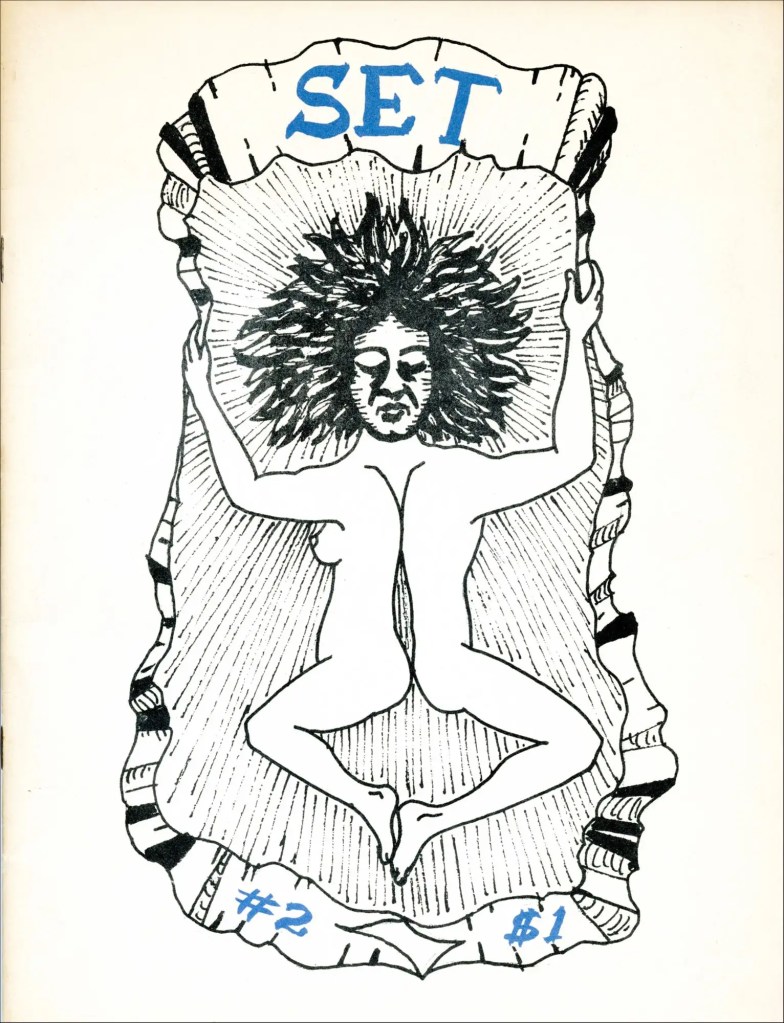
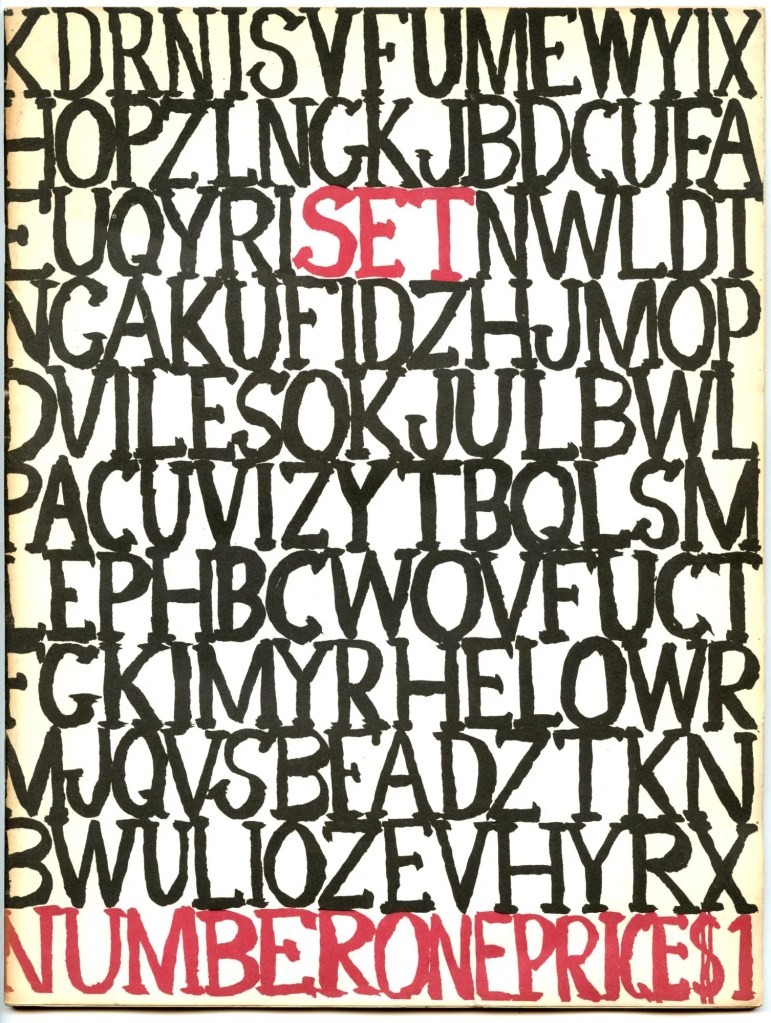
And then there is Gerrit Lansing — friend to Olson, Boston-based poet-mystic, and likely source of Olson’s interest in Crowley’s Book of Thoth. Lansing founded a journal called SET, named after the Egyptian god, and his own writing often anticipates aspects of Grant’s cosmology. Lansing’s 1966 collection, The Heavenly Tree Grows Downward, takes its title from Jung’s Alchemical Studies, specifically a chapter on the inverted tree — the same tree that Grant links to Typhonian gnosis.

What does this all mean?

It means that Olson’s poem, when read alongside the Typhonian Tradition, becomes legible as a magical document — not in the sense of intention, but in the sense of effect. It opens a channel. It participates in a current. It speaks in a tongue that other mystics, elsewhere, were also learning to speak.

And it means that Typhon, far from being a footnote in a forgotten myth, is an active force in the poetics of the twentieth century — a daimon of chaos, pluralism, darkness, and return.

Olson’s poem names him.
Grant’s rituals conjure him.
My reading recuperates him.

This is not necromancy. It is listening.

Initiation

The ancient Greeks imagined Tartaros as a pit, an anti-sky, an inverted dome beneath the earth. According to the Orphics and the mystery schools, however, Tartaros is not just a place housing criminals and monsters; rather, it is itself a kind of being: “the un-bounded first-existing entity from which the Light and the Cosmos are born.” Typhon, meanwhile, is this entity’s progeny; Typhon is the son of Tartaros and Gaia. He was the last god to challenge the supremacy of Zeus. When defeated by the latter’s thunderbolts, he was cast back into the pit from whence he came.

Readings of “MAXIMUS, FROM DOGTOWN—IV” hinge upon what one makes of the father chained in Tartaros. Grieve-Carlson entertains an interpretation different from the one I offer. In his view, “the father chained in Tartaros is not Typhon but rather Kronos, Zeus’s father. […]. Typhon appears much later in the poem, when Earth conceives him in an ‘act of love’ with Tartaros” (Grieve-Carlson 146). He argues that Olson re-tells the myth of Typhon just as Hesiod did. Typhon is violent and aggressive and would have become a tyrant over gods and men had Zeus not defeated him.

I think there’s more at stake here, however, than Grieve-Carlson lets on. As I see it, the problem with his reading is that he never grapples with the poem’s status as a letter of sorts mailed to the Psychedelic Review. Neither he nor the other critics he surveys ever address how the poem might be read in light of the circumstances of its publication.

Evidence to support my view appears elsewhere in Olson’s writings. Olson echoes in his “Letter to Elaine Feinstein” of May 1959, for instance, the same Zeus / Typhon battle that comes to occupy him in “MAXIMUS, FROM DOGTOWN—IV.” The ultimate “content” to which the poet gives form, sez Olson, is “multiplicity: originally, and repetitively, chaos—Tiamat: wot the Hindo-Europeans knocked out by giving the Old Man (Juice himself) all the lightning” (29). Hearing “Juice” as a homonym for “Zeus,” we find in Tiamat a twin for Typhon. While Tiamat was for ancient Mesopotamians a primordial goddess of the sea, and Typhon a monstrous serpent-god for the ancient Greeks, both are embodiments of chaos. Tiamat’s battle with Marduk is as much a version of ChaosKampf as is Typhon’s battle with Zeus.

The important point is that, for Olson, Chaos is the original condition of existence. It precedes Order. Order is formed — made, not found — and it is the duty of the poet to make it. This is what Olson hoped to communicate to the mushroom people.

Grieve-Carlson concludes his essay by describing the reading of The Maximus Poems as a form of “initiation,” as Olson writes as one initiated, one able to see and say in a special way. Olson makes use of a “metanastic poetics,” or “the technique of the mystic who returns, as a stranger in his own land, to tell about what he knows” (Martin, as quoted in Grieve-Carlson 148).

This reference to reading The Maximus Poems as a form of “initiation” intrigues me, as the writer other than Olson most closely associated with reinvention of Typhon is the British ceremonial magician Kenneth Grant (1924-2011). The latter led the Typhonian Ordo Templi Orientis (TOTO), a magical organization connected with Aleister Crowley’s Thelema religion. Grant was an apprentice of Crowley’s and a close friend of another famous twentieth-century occultist, Austin Osman Spare. Scholars like Henrik Bogdan refer to the occult current that springs from Grant as the “Typhonian tradition.” Grant announced the arrival of this tradition in 1973 and went on to write the nine books of his three Typhonian Trilogies.

Although influenced by Crowley and Thelema, Grant departs from other Thelemic currents by welcoming communication with “extraterrestrial entities” as a valid source of occult knowledge. The Typhonian tradition also embraces aspects of the Cthulhu mythos of horror writer H.P. Lovecraft.

While Grant’s announcement succeeds Olson’s poem by a decade, his ideas appear to have been informed by experiences not unlike Olson’s. Grant experimented with psychedelics in the 1960s, and included a chapter in his 1972 book The Magical Revival titled “Drugs and the Occult.”

And while I haven’t found any evidence suggesting that Grant knew anything of Olson’s work, Olson did have some interest in gnosticism and the occult. “Bridge-Work,” a short reading list of Olson’s dated “March, 1961” includes a reference to Crowley. Maud says Olson encountered Crowley’s The Book of Thoth (1944) while studying Tarot in the 1940s. Sources suggest that “Bridge-Work” was written with the help of Olson’s friend, Boston-based occult poet Gerrit Lansing. The copy of The Book of Thoth read by Olson probably belonged to Lansing. (See Division Leap’s A Catalog of Books From the Collection of Gerrit Lansing.) Olson was also deeply invested in Gnosticism in the years immediately before and after his sessions with Leary, and embraced Jung’s theory of synchronicity in the wake of those sessions. See the final essays in a volume of Olson’s called Proprioception (Four Seasons, 1965).

Grant’s innovation is to identify “the arch-monster Typhon, opponent to Zeus according to the Greek mythology…with the Egyptian goddess Taurt” (Bogdan 326). The latter is interpreted by Grant to be either the mother of Set or a feminine aspect of Set. “To Grant,” writes Bogdan, “the worship of Taurt or Typhon represented the oldest form of religion known to mankind, a religion centered on the worship of the stars and the sacred powers of procreation and sexuality” (Bogdan 326). Set, too, is an important figure in Grant’s system. “Grant maintained,” writes Bogdan, “that the Typhonian Tradition, and in particular the god Set, represents the ‘hidden,’ ‘concealed’ or repressed aspect of our psyche which it is vital to explore in order to reach gnosis or spiritual enlightenment” (Bogdan 326).

Lansing’s work seems to anticipate Grant’s in several ways. The two both think it important to honor the Egyptian god Set, for instance, with Lansing naming his early-60s poetry journal SET after him. And Grant’s focus on the Qliphoth, or the underground portion of the Tree of Life, seems present in the title of Lansing’s 1966 poetry collection The Heavenly Tree Grows Downward. For more on the “tree that grows downward,” Pierre Joris recommends looking at a section of Jung’s Alchemical Studies called “The Inverted Tree.”

Tuesday December 1, 2020

Ishmael Reed chips away at Freud, portrays Herr Doktor as an “Atonist” in his brilliant 1972 novel Mumbo Jumbo. PaPa LaBas lectures about Freud in the book’s “Epilogue” — tells of his attempt to communicate with Freud, thwarted by the latter’s “entourage”: Freud’s “ego defenses,” his sycophants and followers. “Freud,” Reed writes, “whose real talent lies in the coinage of new terms for processes as old as the Ark,” reacted with revulsion upon encountering America’s racial diversity. He pitted his “Austrian” conception of civilization against “occultism,” or what in conversation with Carl Jung he called “The Black Tide of Mud” (208-209). The “Id” is Freud’s “boogeyman” — a denunciation of all that is Other: racially other, culturally other, religiously other. What does it matter now? Freud has receded in the culture’s memory, replaced by neuroscience. Or so it seems. Time, perhaps to listen to Stanislav Grof’s Psychology of the Future: Lessons from Modern Consciousness Research, a seminar Grof recorded at Naropa in 2004. Change the channel, flip the script. Or as Gene Youngblood would say, “Secede from the broadcast.”

Monday October 19, 2020

I listened to an hour-long podcast on Welsh author Arthur Machen this afternoon, and not once was there mention of Machen’s membership in the Hermetic Order of the Golden Dawn. “An odd and unfortunate omission,” I think — though I concede that the podcast was otherwise quite informative. Why should it matter? Omissions of this sort are perhaps how the occult stays occult. I wonder, too, about Ishmael Reed, who includes Golden Dawn member Aleister Crowley’s The Book of Thoth in the multi-page “Partial Bibliography” at the end of his 1972 novel Mumbo Jumbo. Crowley’s book is a study of the Tarot. Reed mentions neither Crowley nor the Tarot elsewhere in Mumbo Jumbo. Yet The Book of Thoth — the mythic one, the one alleged to have been written by Thoth himself — is the “Text” sought by the warring secret societies in Reed’s novel. This is but one of many aspects of Mumbo Jumbo deserving further study. I wonder, too, for instance, about the novel’s critique of Sigmund Freud and the references to Freud’s protégé and rival, Carl Jung. Freud is said to have fainted on two occasions — and Jung was present both times. On the first occasion, Jung “spoke about being fascinated by some recent discoveries of ‘peat-bog corpses.'” Jung’s interest in the subject of mummies and corpses “got on Freud’s nerves,” causing the latter to faint in the midst of dinner. On the second occasion, Freud fainted during a discussion of a Karl Abraham paper, an Oedipal reading of the Egyptian pharaoh Akhenaten. (See Nausicaa Renner’s essay, “Freud Fainting.”) Reed focuses, though, not on the fainting but on Freud and Jung’s reactions to America. For Freud, the place was “a big mistake” — part of some monstrous “Black Tide of Mud.” Reed suggests that Freud was an Atonist. Jung, meanwhile, was more ambivalent about America. Like Freud, however, he viewed America as a place where Europeans would have to undergo a transformation to survive — a process Jung called “going Black” (Reed 209). Reed takes the additional step of celebrating this process, granting it agency and giving it the name “Jes Grew.”

Wednesday June 17, 2020

At the center of a large, circular wooden coffee table in my upstairs study sits a copy of The Findhorn Garden: Pioneering a New Vision of Man and Nature in Cooperation, published by Harper & Row in 1975 as part of the Lindisfarne series. This latter was a book series under the editorship of William Irwin Thompson “devoted to an exploration of the newly emerging planetary society and the future evolution of man.” Other books in the series include Thompson’s Passages About Earth and Satprem’s Sri Aurobindo, or The Adventure of Consciousness. Do changes in mass sentiment correlate with changes in collective serotonin levels? Steven Johnson lays out the beginnings of a theory to that effect in his book on videogames and related forms of popular culture. Am I interested in practicing a kind of bibliomancy? The versions of Tarot and I Ching and astrology that hold meaning-making potential for me require belief in the power of “symbol-sets” to prompt “synchronicities.” The idea is that all of the above-mentioned symbol-sets allow some “acausal connecting principle” to manifest, as Carl Jung would say. This principle or power behaves as befits a trickster. We know it through its effects to be some sort of distributed intelligence, of which I and other users are but a part. We share with this intelligence a capacity for kindness and benevolence and care. We exercise this capacity by assembling daily reality into a jubilant, communicative mystery, containing inexplicably meaningful correlations and correspondences, there in the background like birdsong, for those who have ears to hear.

Wednesday October 9, 2019

The drug experience enters cultural memory, becomes an object of philosophical investigation from the Romantic period onward — though perhaps it was already informing the thinking of the Ancient Greeks by way of the festival of Eleusis. Walter Burkert writes of these famed “experiences of ecstasy and wonder” in his book Ancient Mystery Cults, a work of “comparative phenomenology.” I think of it as a form of listening across time for psychedelic travel narratives, trip reports from wonderland written by heads possessed by a shared, singular-but-multiple “voice of experience,” a “general equivalent” allowing Being to relate to itself across time. By reading literary history as a continuous dialogue, something like a holy ghost emerges, self-consistent despite change, urging us toward happiness and freedom. Ernst Bloch called it the “Utopian impulse” or the “principle of Hope.” Jung imagined it as a “collective unconscious.” Teaching a course this way is a bit like saying, “You, too, can live allegorically. The way to do so is by reading.”