Ludwig Wittgenstein, as Imagined by Derek Jarman

Released in 1993, filmmaker Derek Jarman’s Wittgenstein pictures the famous Viennese philosopher amid the set-less stage of a black-box theater, producing an effect similar to that achieved a decade later in Lars Von Trier’s 2003 film Dogville.

Jarman’s film was produced by New Left Review cofounder Tariq Ali, heavily revised from a screenplay by Marxist literary critic Terry Eagleton.

Wittgenstein was born in 1889, the same year as Heidegger. Both are roughly of the same generation as the artists and writers considered in Hugh Kenner’s The Pound Era.

Wittgenstein becomes acquainted with Cambridge by way of British philosopher Bertrand Russell, and is in dialogue with Russell throughout the Tractatus. Rereading the latter, Caius thinks of “A Kind of Philosophy,” printmaker Erik Waterkotte’s repurposing of a paperback edition of Russell’s 1945 book A History of Western Philosophy. ‘Tis a fitting gesture, thinks Caius, struck by the work’s force and logic. He likes the way “A Kind of Philosophy” handles its material: Russell’s summation of the West’s thought-forms compelled to resemble a pre-Columbian Mayan codex.
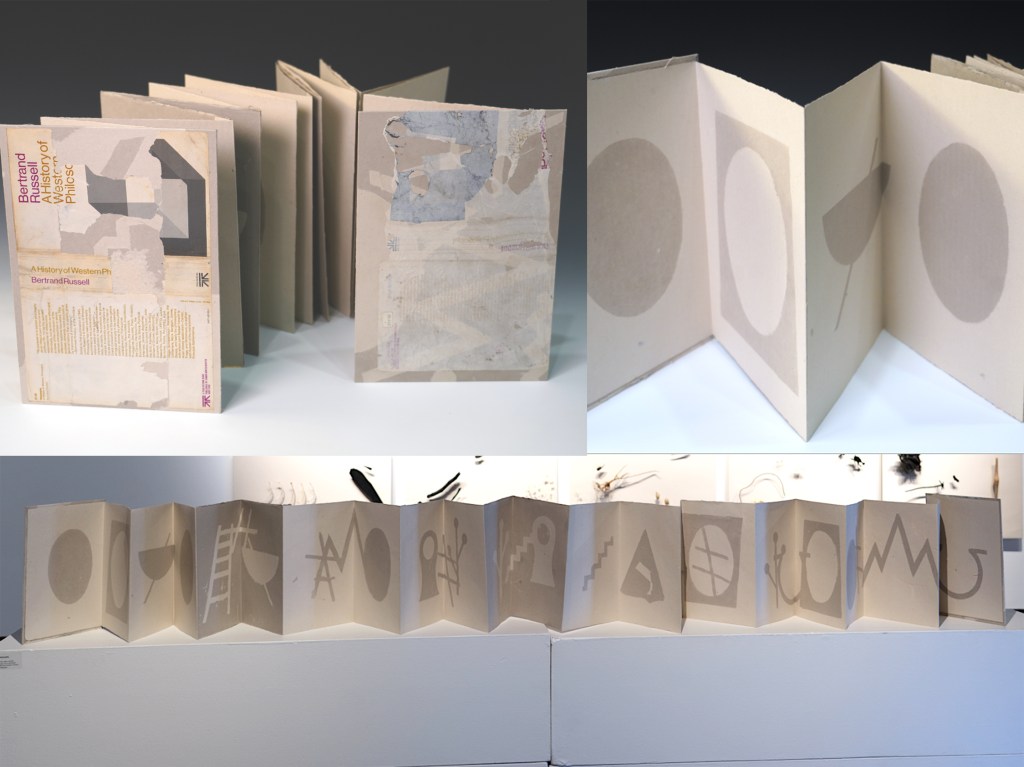
Chatting in the parking lot prior to a Tashi Dorji performance at Goodyear Arts, Caius and Erik imagine a print edition of Caius’s Tractatus Computationalis assembled in much the same way, as what is sometimes called a “concertina” or “leporello” book: handmade paper folded back and forth like an accordion, in alternating, zigzag parallel pleats.

Wittgenstein teaches at Cambridge from 1930 until his resignation in 1947. Alan Turing was at Cambridge from 1931 to 1936. Mutual acquaintances introduce the two thinkers in the summer of 1937. Turing participates in Wittgenstein’s 1939 “Lectures on the Foundations of Mathematics.” The two disagree on the nature of mathematical contradictions and whether mathematics is discovered or invented.

Wittgenstein gets into another famous disagreement at Cambridge years later, brandishing a hot poker during a brief, intense argument with Karl Popper at a meeting of the school’s “Moral Sciences Club” in 1946, as recounted by BBC journalists David Edmonds and John Eidinow in the 2001 book Wittgenstein’s Poker.

It’s no accident, thinks Caius, that Turing, student of the philosopher of language-games, went on to invent a game of his own: the Imitation Game. The game that organized the project to build AI.

A final, posthumously published work of Wittgenstein’s appears in 1969 called On Certainty. The work consists of 676 passages compiled from notes he wrote in the eighteen months leading up to his death in April 1951. Thinking of it now in the days leading up to the 250th anniversary of the signing of the Declaration of Independence, Caius imagines this final book of Wittgenstein’s as a postscript of sorts to that famous saying attributed to Founding Father Benjamin Franklin. “Our new Constitution is now established, everything seems to promise it will be durable,” wrote Franklin. “But, in this world, nothing can be said to be certain, except death and taxes.”

How do Wittgenstein’s ideas about “sayability” and the limits of language relate to the idea that “saying makes it so”?

Jarman’s film ends with a portrait of the philosopher on his deathbed. Jarman himself succumbs to an AIDS-related illness the following year.

The Gay Wizard

I know what you’re thinking, says the Narrator: Can I trust an author who calls one of his characters “The Gay Wizard”? I use that name not to offend, but because that was how he was known about town.

People knew the Gay Wizard. He was a local personality, a figure in the community. I remember Sarah and I speaking to our neighbor Sue one afternoon. Sue lived up the street from us, in a cream-colored home. Ferns hung in baskets from her porch. By the time we met her, Sue was already decades into her time on Shady. She spoke fondly of the wizard: his parties, his Studebaker, his boat.

Atop skeletal details of that sort, gathered haphazardly in the course of my tenancy, I crafted a character: someone I fancied meeting one day via time machine. Like an egregore of sorts, he entered first into my imaginings via the spirit of books of an earlier era. The books started turning up in the bins at Goodwill, as if he’d sent them: rare, obscure screeds like Arthur Evans’s Witchcraft and the Gay Counterculture and Mitch Walker’s Visionary Love: A Spirit Book of Gay Mythology and Trans-mutational Faerie. From them and others like them I culled a portrait of a loving psychedelic animist: a gardener like Derek Jarman. That’s how I see him now, in fact: poised there in the sunlit grove at the center of the home’s back yard, spade in hand amid the growth of his garden.

In picturing him thus, I resist the story’s pull toward horror. If this were a work of horror, notes the Narrator, he’d have been a shadier dude. Play the horror factor one way, and he’d have been a Crowleyan sex magician. A Thelemite; a Satanist: a practitioner of black magic. Play it another way, as might, say, Jordan Peele or P. Djèlí Clark, and he’d have been a wizard of an even deadlier sort: the kind who go around in white, terrorizing people of color.

If he’s ours to imagine, says the Narrator, let us imagine him otherwise. In our choosing of genre, let us act with hope.

John Dee, as Imagined by Derek Jarman

Among the more fearsome of the precursors to what follows is John Dee, the great Renaissance spymaster, court magician and inventor of the British Empire. Filmmaker Derek Jarman is just one of several artists to have made much of Dee in recent decades. In fact, Dee appears repeatedly throughout Jarman’s oeuvre. We first meet Dee, for instance, in Jarman’s 1978 film Jubilee, where he operates as a kind of early-modern Doc Brown. At Her Majesty’s behest, the Dee of that film works up a spell that sends Queen Elizabeth I 400 years into the future–i.e., to London in the age of punk. And what begins in Jubilee continues in the films that follow, with Dee cropping up again the very next year by way of Shakespeare’s famous magician character Prospero. The latter wields a wand modeled upon Dee’s Monas Hieroglyphica in Jarman’s adaptation of The Tempest (1979). Nor is this the last of Dee’s appearances in Jarman’s catalog. He also turns up as muse, for example, in a film named after Dee and Kelley’s famous scrying experiments, The Angelic Conversation (1987). Nor was Jarman alone in thinking highly of Dee. The latter captured the imaginations of several of Jarman’s contemporaries. To mention just two examples: Dee appears as a character in Michael Moorcock’s Gloriana, or The Unfulfill’d Queen; and comics artist Alan Moore wrote a libretto about him. For Jarman’s own reflections on his interest in Dee and in related topics like alchemy, see his memoir Dancing Ledge.

Sunday May 16, 2021

With end of semester nearing (another day or so of grading and that’ll be that), I acquire tools and prepare for summer. Gardeners needn’t be “tool freaks” like the Whole Earthers — but they do need tools. Garden tools: “objects of both practicality and great beauty,” as Derek Jarman notes. Shovels, rakes, wheelbarrows: these are all “means of production.” Tools both for planting flowers and vegetables and for removing grasses and weeds. Frankie digs beside us as we work. With help from Sarah’s parents, we replant beds around the base of the house. The work we do now opens new avenues of thought, new spaces of possibility featuring rocks and stones. Before I know it, I find myself in the know again about Sakuteiki, the oldest published Japanese text on garden-making, written in the mid-to-late 11th century, when the placing of stones was gardening’s essence.

Sunday February 14, 2021

There have been times in my life when writing is simply an ongoing process, happening alongside other happenings, author scribing in notebook, looking around, listening, learning. Connecting, transmitting. My scale is small. I’m no Vertov. But sometimes life happens in such a way that the hand moves. One evades capture in silence and solitude by conversing with others, mourning the passing of the great free-jazz drummer, gardener-philosopher, and healer Milford Graves. He and Derek Jarman inspire me. To them now I appeal. And like that, with eyes closed, I see the following. A wall of circles like the speakers at the center of the Grateful Dead’s Wall of Sound, the public address system through which they played. “Time fer some music,” shouts an announcer through the speakers. Henry Cow, innit? Aggressively proggy. Sarah arrives and trains me on the air fryer. Hurrah, hurrah. Delivery arrives with sandwiches. Hurrah, hurrah.