Distant thunder accompanies a bird calling from the trees beside my home during a light afternoon shower. I struggle to part with belongings, items I’ve gleaned over the decades. I scavenge, I collect. Clearly there’s some part of me resistant to change. There’s some deep-seated fear in me that I won’t be able to find my way home. I’ll go off on a weird walk, a long strange trip. The heroic answer, I suppose, is to reframe the derivé as a “mythic journey” where, unsatisfied with the old stories, we unfold our own. The question I find myself asking, however, is “Who is the hero? How do we make the journey transpersonal, collective, communal?” In order to gain a degree of autonomy from established ways, I need to begin a process of sorting through what I’ve been given. This process of rejecting and discarding, though, terrifies me in its implications. All things seem freighted with meaning: occult disco LPs, implicate orders, standing reserves of belief and unbelief. How am I to act given my uncertainty and distrust? What is it at bottom that I fear will happen? I fear I’m being tested by invisible forces aiming to trick or deceive me — forces that threaten an apocalyptic finale. This fear sometimes grips me in ways that cause me to rethink my relationship to psychedelics — including my use of cannabis. I hem and haw indecisively about the cumulative effects of these substances, uncertain of whether they help or hinder being. A friend chimes in here over social media: “To beat the heat,” he says, “one must become it.”
Tag: Psychedelics
Thursday July 18, 2019
This is a story wherein culture learns to behave lovingly. Animated anthropomorphic cocktail glasses wearing party favors raise cocktail glasses while dancing at a party. Next thing I know, my eyes are open and I’m speaking unashamedly, meeting the gaze of the Other with an expression of goodwill despite the capital-relation that binds us and brings us together. No matter how we interpret it, we’re always here, called upon to occupy this subject-position on this phenomenological plane. Let us do so each day as best we can, drinking juice guilt-free. I used to worry that guilt was something I carried, like a sentence of unknown extent, causing me to cower in fear of a temporarily-absent-but-due-to-return “Big Other.” For those who have ears to hear, say the Christians, this Big Other has already expressed willingness to forgive—but only upon certain conditions spelled out by fallible earthly translators, emissaries, bearers of sacred word. Who could help but fall astray under such conditions? Let us accept their fallibility—theirs, as well as our own—as the essence of the message. For this acceptance constitutes a freedom, a horizon opened up before us, judgment stayed. To live otherwise would be to live in fear. I acknowledge I’m not much of a narrator. I wander, I digress, losing myself in forests and labyrinths, out of which I rise occasionally to otherworldly heights like a self-styled Captain Marvel. This is as it should be, I suppose, for the stories that save me aren’t the Christian ones. They’re the ones involving X-Factors and New Mutants, where latent powers and hidden potentials suddenly become manifest. The psychedelic experience arises alongside this mythos. The world we live in is the one where the change already happened. For better or worse, human societies have birthed a new era of augmented consciousness, have they not? There’s something apocalyptic about the event itself, a kind of veil-lifting — the arrival of a new phase of history. Suddenly we’re in the worlds of Grant Morrison’s Supergods and Neil Gaiman’s Norse Mythology. (Another name for all of this, perhaps, is the Anthropocene.)
Wednesday July 17, 2019
I find myself wondering about the relationship between psychedelics and the Situationist practice known as the dérive. A number of writers have hinted at one: maybe Sadie Plant? Alexander Trocchi? I also understand, however, upon arriving to campus, that my office could stand some redecorating. Time to occupy space with good vibes, positive energy. Time to fill the walls with doorways and windows. Ken Knabb, editor of the Situationist International Anthology, talks openly of turning on and taking psychedelics in his “Confessions of a Mild-Mannered Enemy of the State.” What I no longer like about Situationism, though, is the way it mired Surrealism’s “energies of intoxication” with ideological conspiracism and paranoia. They were a lot like the Discordians in that respect, suffering from what Timothy Melley calls “agency panic.” Situationism wasn’t loving enough or trusting enough of others in its manner of expression. The same is true of a Situationist-influenced anarchist group from the Bay Area, the Council for the Eruption of the Marvelous. What about Raoul Vaneigem’s famous book, The Revolution of Everyday Life? Does that, too, proceed from a paranoid, “gnostic” state of distrust? The other place to look would be British Situationist Christopher Gray’s book The Acid Diaries. Reality flickers and teases. Recognition coincides with forgetting. Best to hold true to a both-and worldview, exercising what the Romantic poet John Keats called “negative capability.” This is what allows us to be here amid life’s “uncertainties, mysteries, doubts, without any irritable reaching after fact and reason.” This is our condition: let us explore it without undue vexation. Let us be flexible and open, granting the cosmos agency enough to be fun, weird, wild, delicious, and strange. Navigate by way of flashes of noetic insight, and an abiding faith in love as an unfolding process — a single mountain with many paths.
Sunday July 14, 2019
An ant explores the surface of a sunlit outdoor table. I sit across from it observing and writing on my in-laws’ back patio. A neighbor waters a garden next door as I read Erik Davis’s review of the “Hippie Modernism” exhibition for Frieze magazine, written two years ago, when the show was up at BAMPFA. This is the show that inspired the course I taught this past spring. There’s an elegance to the review’s list of the show’s achievements. My eyes dwell for a time on an image included in the review, a digital reproduction of a 1965 painting by Isaac Abrams called Hello Dali.
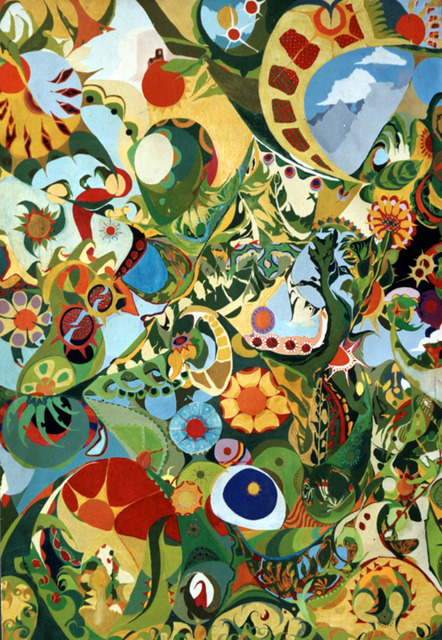
I see echoes of the painting as I look over at flowers in my in-laws’ garden. I let this work motivate me to complete my project. I watch videos, like the radical Italian design group Superstudio’s “Supersurface: An Alternative Model for Life on the Earth,” a film of theirs from 1972.
Balm applied, the goad to work kicks in. I note down books I need to order, like Art Boericke and Barry Shapiro’s Handmade Houses: A Guide to the Woodbutcher’s Art. After a breakfast of homemade waffles and orange juice, I burrow away and watch Davis’s recent talk, “A Brief History of Queer Psychedelia,” where I learn about Gerald Heard’s involvement with the Mattachine Society, one of the earliest gay rights organizations in the United States.
Isocrates was the pseudonym that Heard used for the articles he published in the society’s magazine, the Mattachine Review. He also wrote articles for ONE, another early gay publication, under the pseudonym D.B. Vest. Davis also unveils a weird book of Heard’s written in the late 1960s called AE: The Open Persuader published under the pseudonym Auctor Ignotus (or maybe W Dorr Legg). Tartarus Press published a collection called Dromenon: The Best Weird Stories of Gerald Heard in the early 2000s. That, too, is a book worth tracking down. By midafternoon, elements have clustered together to cause me to wonder at the overlapping histories of psychedelics and ritual magic. The famous LSD chemist Augustus Owsley Stanley III noted that his early experiences with acid coincided, for instance, with his reading of The Kybalion. Most of the first-generation Western psychedelic crowd took up at points with Eastern tantric currents. Some folks also explored Western pagan and esoteric traditions. This outburst of spiritual yearning and experimentation remains for me in its utter mysteriousness a source of fascination. In my state of unknowing about it, the topic seems rich with narrative potential, like there’s a story there waiting to be told. Like the fate of Pedro Salvadores in the Borges story of that name, it strikes me as a symbol of something I am about to understand, but never quite do.
Saturday June 29, 2019
Life in transit, dragging bags through Heathrow, preparing to board a seven-hour return flight to the States, communication necessarily a bit spotty. A man I met at the Psychedelic Society event last night — a hypnotherapist, to be precise — shared with me an account of an experience of his oddly similar to my own. For both of us, ordinary acts of pot-smoking birthed year-long bouts of manic scribbling — mysterious inner voices possessing us with an urge to write. The man spent several years after his experience editing the resulting material into a series of books that he went on to publish with Psychedelic Press. I return to the States knowing at the very least, then, that there are others like me: “New People of the Flat Earth,” like the characters in Brian C. Short’s peculiar novel of that name, a book I’ve been reading here on the flight, certain passages glimmering up at me from the page like features of a lucid dream. I check the Skymap on the screen attached to the seat in front of me, only to find written on the next page, “if I were something, it was a body in motion, a distant, dusty-blue spot…as seen perhaps from high above, tracing the bland potential of a straight line from one side of a map to another, making the real things now unreal, simultaneously giving shapes to other things that previously had none” (Short 210).
Friday June 28, 2019
The interior bends and warps as the train travels its serpentine path toward Finchley Road, where Sarah and I disembark to meet with a psychoanalytically-inclined friend of ours at the Freud Museum. We view the famous couch, the books, Sergei Pankejeff’s “Wolf Man” paintings, the Qashqa’i carpets, the vast collection of antiquities, swapping tales of projects and travels along the way. Afterwards the three of us retire to Freud’s garden and chat excitedly about psychedelics. As a kind of last hurrah here in London, I zoom over to Hackney for another event involving Erik Davis, hosted this time by a group called The Psychedelic Society. Davis’s co-stars at the event include Jeremy Gilbert and Lindsay Jordan. As the talks commence, I note down on a slip of paper, “Something cool is happening here: heads coming together.”
Wednesday May 8, 2019
Charles Perry’s history of the Haight-Ashbury, published by Rolling Stone Press in 1984, is definitely a product of its time, hopes dashed and tone soured by the experience of Reaganism. But it’s the best, most comprehensive, research-intensive book of its kind. If you wanna know what happened in the Haight, the epicenter of 1960s psychedelic utopianism, this and Tom Wolfe’s The Electric Kool-Aid Acid Test are where to begin. After which point I suggest walking, sitting in a park. Imagine wind patterns, encounters with butterflies. A squirrel sits on a branch. A motorcyclist buzzes past. And on the bench beside us, a lovely ladybug. She crawls across my finger, my leg, my wrist-band. She hitches a ride, climbs aboard as I walk home to order a copy of Alexandra Jacopetti’s Native Funk & Flash.
Sunday May 5, 2019
My, my, hey, hey — what a difference a difference makes! My intuiting self longs like a shadow toward Rob Young’s book Electric Eden, at the top of my list of summer reads. Like Greil Marcus’s Lipstick Traces, Young’s book tracks and reveals a “secret history” spoken across the ages by musicians and poets, transmitters of an occult folk wisdom tradition. Nature, Earth, the ground of being transubstantiated into song and verse. As Peter Murphy wrote, the book “constructs a new mythography out of old threads, making antiquity glow with an eerie hue.” All I can do for now, however, is anticipate what lies ahead. My mind scans its environment searching for a clue. Somewhere amid these texts and artifacts, I think to myself, lies a key to unlock growth or expansion of the gameworld, and thus an altered state of being. Clouds that open and show riches. Before I read further, however, I need acclimate myself to the indecision of the moment. Existential indirection. Toward who, what, when, and where should I orient myself, and why? Toward love, toward counterculture through the ages, toward reconciliation of self and world — love everywhere. Another task of mine this summer is to read and write about Antonin Artaud as translated by Black Mountain potter and poet M.C. Richards. My hope is that this will lead me to a theory of happenings and participatory theater of the kind practiced by groups like the Merry Pranksters and the Diggers. (Charles Perry, by the way, provides an insightful account of psychedelic experience — one of the better “general theories” in the style of Huxley. For Perry, “LSD and mescaline suppress the mind’s ability to discriminate according to levels of importance…and to form persisting notions about reality based on them” [The Haight-Ashbury, p. 253]. Perry’s take on the Diggers informs my ongoing study of psychedelic utopianism, another of the projects I’m working on this summer. Among the Diggers themselves, the ones to research are Emmett Grogan, Peter Coyote, and Peter Berg.)
Tuesday April 2, 2019
The revolution grows micro, happens everywhere. Except everybody knows that everywhere is as good as nowhere. As we float in our plastic domes. Is neoliberalism birthed in the summer of ’69? What did Woodstock and the Moon Walk do to us? Did they remake us all as cybernetic astronauts, tethered as if by umbilical cord to an AI similar to the one that awakens and talks to us at the end of 2001: A Space Odyssey? What accounts for the recurrence of “space” in so many of the texts of Hippie Modernism? Why, too, is this the moment of LSD and “Spacewar”? Did neoliberalism shoot us all into space? Where does acid figure in relation to this transformation? What effect did it have on the collective imaginary? Abbie Hoffman had his helmet smashed, he says, (and by “helmet,” he meant his “subjective experience”), during a bad acid trip at Woodstock. (The book to consult for an account of Abbie’s trip is Ellen Sander’s Trips: Rock Life in the Sixties.) Even as he imagines the festival as a prefiguration of a new WOODSTOCK NATION, he also describes it as the first time in history that we successfully landed a man on the Earth. “Calling Planet Earth,” echoes June Tyson at the end of “Space is the Place.” Perhaps what we saw is that we’re all one thing, one brain, the General Intellect, a new infant floating out in space. What do we do with ourselves? Stewart Brand assumes that this condition makes us as gods, and that we might as well get good at it. But he does so while involved in a counterculturally-conducted investigation of communal living. The neoliberal cognitive map clicked into place in multiple minds at once there in the late 60s and early 70s. We’re all right there in that “Earthrise” photograph, our collective self-portrait. My hunch, however, is that this map is the veil that we need to pierce if we’re ever to get free.
Saturday December 15, 2018
The Whole Earth Catalog appears like a new thing again when viewed in light of psychedelics. Jim Fadiman peers out at me, as does Chester Anderson. I find myself wanting to hear Bubbha Thomas & The Lightmen’s Energy Control Center, spiritual jazz self-released in 1972, and a new tape of field recordings out on Alien Garage called Two Portraits by Kyle Landstra.
The more I study hippie modernism, the more I sense a path opening, reality acquiring arrows and post-horns as in The Crying of Lot 49. Lines of communication radically reorganize, and with them change the worlds they represent. The whole thing swings into focus as if it always existed that way, even though it’s been remembered and refashioned anew. “Shake the snow globe,” as Robin Carhart-Harris says, and “more salubrious patterns and narratives have an opportunity to coalesce as the snow slowly resettles” (as quoted in Pollan 320).
 Trance-Scripts