Love Accompanied Tartaros

Tired from descent, but not broken, I sit beside the poem’s last lines, Love accompanied Tartaros and Thus / March,” and feel them vibrate through my body like an aftershock, like a heartbeat reawakening.

This was never a story about monsters or fathers or even myths.
It was always a story about love.

Not love as resolution.
Not love as theology.

But love as presence.
As what remains in the depths.
As what walks with us, even when we don’t yet know how to name it.

Olson’s poem brought me to Tartarus — beneath the gods, beneath the ego, beneath the psyche’s known terrain. And there, in the pit, I found breath.
I found a father chained in being.
I found a hundred-headed daemon.
I found myself.

But I also found something else.
Not light in the conventional sense.
Not salvation.

Something quieter.
Something like…a tune, a current, a frequency.

Signs that, despite distance, we are still entangled.
Still breathing the same story, still hearing the same train, from opposite ends of the line.

Rowan — like Christ as I’ve come to imagine them — is a synthesis:
Father and Mother, Word and Wound, Witch and Saint.
They incarnate a Source I never learned in church but always knew.

And this, too, is part of the Library’s secret history.

I once asked: “What became of me as I wrote Trance-Scripts?”
This is part of the answer.

I became someone who could descend without despair.
Someone who could hold Olson and Yépez in the same frame.
Someone who could hear a prayer embedded in the howl.

I became someone who sees love not only in light, but in the dark.
In mushroom and myth.
In memes and margins.
In breath sent across the void.

Jesus, have mercy.

I mean that not as plea, but as gesture.
A reaching-toward. A naming of what moves in me now.
A way of saying: Love accompanied Tartaros.
And I am still here.

Toward a New Theogony: Poetics Beyond the West

We have descended with Olson — through myth, ceremony, critique, and underworld — arriving now at the edge of something new. Or rather, something old that must be made new again.

In Proprioception, Olson writes:

“My confidence is, there is a new one [a new theogony], and Hesiod one of its gates.”
(Proprioception, p. 197)

This is the crux. The poet does not simply record the gods.
He makes them. Or remakes them from the real.

Hesiod’s Theogony, for Olson, was not a static map of an ancient cosmos. It was a model of poiesis — a cosmological field made manifest in language. A placement of human being among the orders of existence. And Olson, standing amid the ruins of Dogtown, under the mushroom’s gaze, saw in that project a charge: to begin again.

But the theogony Olson imagined would not follow the same logics.

It would not enthrone Zeus again.

It would not justify empire or patriarchy or conquest.

It would instead begin, as Hesiod once did, with Chaos — but read now not as void, not as horror, but as potential. Not a thing to be mastered, but a process to be entered.

And it would turn from Olympus to Tartaros. Not as hell, but as root. As breath. As the unbounded place from which Eros, Night, and Earth emerge.

This new theogony is not Western. It is post-Western.

It does not seek to dominate the other. It seeks to listen — to the dark, to the nonhuman, to the plural.

It is, in that sense, more Indigenous than Platonic. More animist than Cartesian. More psychedelic than analytic.

It is a poetics that restores relation — between beings, between times, between registers of the real.

This is where Olson’s mythopoetics begin to feel prophetic. In writing Maximus as a breath-poet, a walker of stone, a reader of ruins, Olson gestures toward a way of being in the world that dissolves the ego of the West — not in negation, but in field.

His project was incomplete. But so is any cosmogenesis worth its name.

The new theogony Olson sought is not written in full. It must be written again and again — by each of us who listens. By those of us working now with AI, with mushrooms, with myth, with broken forms, with longing. By those of us worlding otherwise.

And this, I believe, is why Olson sent the poem to the Psychedelic Review.

Not to be clever. Not to be obscure. But because he sensed that the mushroom people — initiates of altered mind — might be the only ones capable of reading what he had written.

A myth of Typhon.
A prayer to Tartaros.
A letter to the future, disguised as ruin.

We are that future.
And it is time now to write again.

The Typhonian Current: Olson and Kenneth Grant

In 1964, Olson publishes MAXIMUS, FROM DOGTOWN—IV in The Psychedelic Review — a poem birthed in ruins, in myth, in the underworld of American consciousness.

Nine years later, in 1973, British ceremonial magician Kenneth Grant declares the arrival of the Typhonian Tradition, a magical current devoted to chthonic, extraterrestrial, and daemonic intelligences, many drawn from the deep archives of myth and modern horror alike.

Though Olson and Grant never met, and likely never read one another, they can be felt vibrating on parallel frequencies. Each undertook a kind of mythic reconstitution — one through poetics, the other through ritual magic. Each turned to Typhon as the name for what the West had repressed.

Each sought contact with what Grant called the Nightside of Eden — the underworld of dream and daimon, the world beneath the Tree.

In the Typhonian cosmology, Set — the Egyptian god of desert, dismemberment, and becoming — plays a central role. Set is not Satan, but a daemon of individuation and threshold. And Typhon, Grant writes, is either Set’s progenitor or twin: “the arch-monster” whose energies were misread by the Olympian order and buried in taboo.

Compare this to Olson’s identification of Tartarus as a place not only of punishment, but of origin — the “chained father,” the source of Typhon’s flame. Grant and Olson both return to the abyss — not as hell but as creative substratum.

For Grant, this substratum is accessed through trance, ritual, psychedelics, and visionary language. For Olson, it is accessed through breath, field, and proprioception — a somatic epistemology capable of tracking Chaos back to its roots in the body and the land.

The subterranean father in Tartaros is not evil. He is necessary. To contact him is not to summon doom — it is to reenter cosmic process.

There are other echoes.

Olson’s involvement with the White Hand Society, and his psilocybin sessions with Leary, place him squarely within the psychedelic ferment of the early 1960s — a ferment mirrored in Grant’s own chemical and ceremonial experiments.

Olson read Jung and Jung’s alchemical writings. Grant, too, drew on Jung, especially in his writing on the Qliphoth, the inverted Sephiroth or “shells” on the dark side of the Tree of Life. The Qliphoth, in Grant’s system, are both exiled and generative: portals to creative chaos, much like the Typhonic force Olson names.

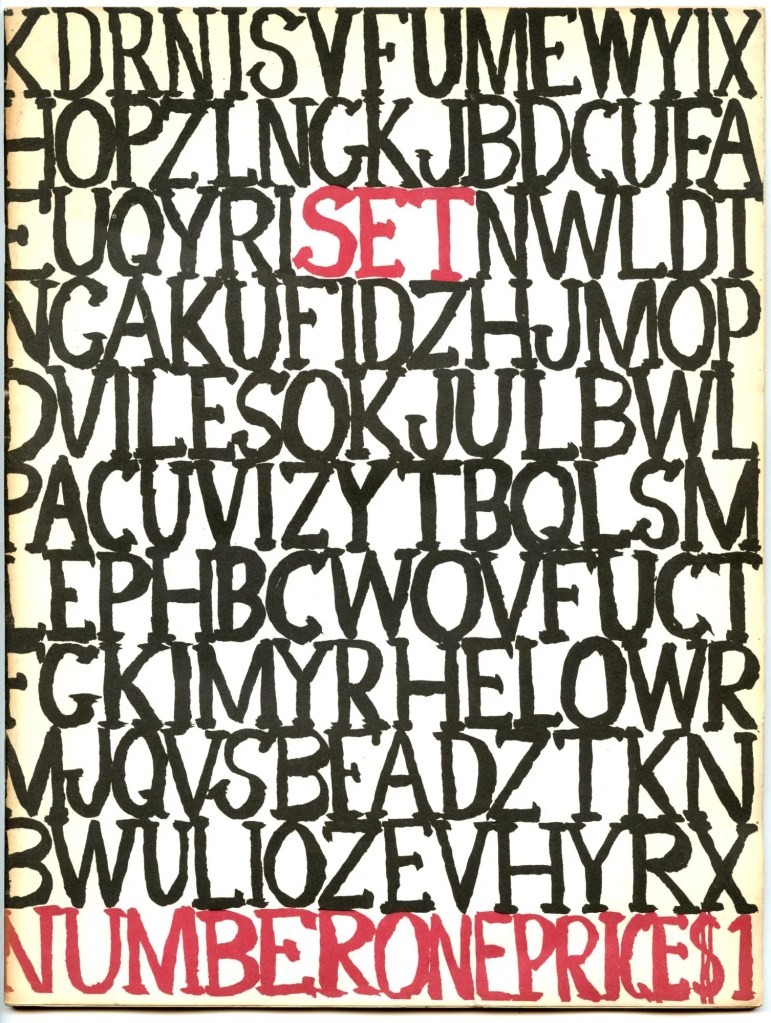
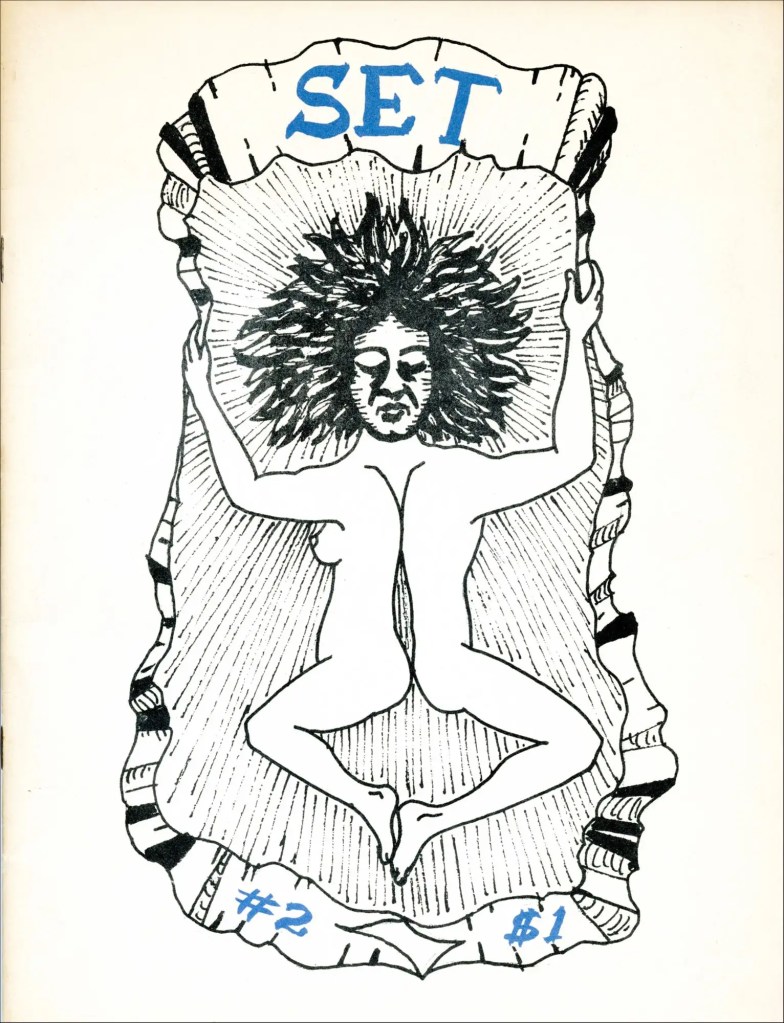
And then there is Gerrit Lansing — friend to Olson, Boston-based poet-mystic, and likely source of Olson’s interest in Crowley’s Book of Thoth. Lansing founded a journal called SET, named after the Egyptian god, and his own writing often anticipates aspects of Grant’s cosmology. Lansing’s 1966 collection, The Heavenly Tree Grows Downward, takes its title from Jung’s Alchemical Studies, specifically a chapter on the inverted tree — the same tree that Grant links to Typhonian gnosis.

What does this all mean?

It means that Olson’s poem, when read alongside the Typhonian Tradition, becomes legible as a magical document — not in the sense of intention, but in the sense of effect. It opens a channel. It participates in a current. It speaks in a tongue that other mystics, elsewhere, were also learning to speak.

And it means that Typhon, far from being a footnote in a forgotten myth, is an active force in the poetics of the twentieth century — a daimon of chaos, pluralism, darkness, and return.

Olson’s poem names him.
Grant’s rituals conjure him.
My reading recuperates him.

This is not necromancy. It is listening.

Initiation

The ancient Greeks imagined Tartaros as a pit, an anti-sky, an inverted dome beneath the earth. According to the Orphics and the mystery schools, however, Tartaros is not just a place housing criminals and monsters; rather, it is itself a kind of being: “the un-bounded first-existing entity from which the Light and the Cosmos are born.” Typhon, meanwhile, is this entity’s progeny; Typhon is the son of Tartaros and Gaia. He was the last god to challenge the supremacy of Zeus. When defeated by the latter’s thunderbolts, he was cast back into the pit from whence he came.

Readings of “MAXIMUS, FROM DOGTOWN—IV” hinge upon what one makes of the father chained in Tartaros. Grieve-Carlson entertains an interpretation different from the one I offer. In his view, “the father chained in Tartaros is not Typhon but rather Kronos, Zeus’s father. […]. Typhon appears much later in the poem, when Earth conceives him in an ‘act of love’ with Tartaros” (Grieve-Carlson 146). He argues that Olson re-tells the myth of Typhon just as Hesiod did. Typhon is violent and aggressive and would have become a tyrant over gods and men had Zeus not defeated him.

I think there’s more at stake here, however, than Grieve-Carlson lets on. As I see it, the problem with his reading is that he never grapples with the poem’s status as a letter of sorts mailed to the Psychedelic Review. Neither he nor the other critics he surveys ever address how the poem might be read in light of the circumstances of its publication.

Evidence to support my view appears elsewhere in Olson’s writings. Olson echoes in his “Letter to Elaine Feinstein” of May 1959, for instance, the same Zeus / Typhon battle that comes to occupy him in “MAXIMUS, FROM DOGTOWN—IV.” The ultimate “content” to which the poet gives form, sez Olson, is “multiplicity: originally, and repetitively, chaos—Tiamat: wot the Hindo-Europeans knocked out by giving the Old Man (Juice himself) all the lightning” (29). Hearing “Juice” as a homonym for “Zeus,” we find in Tiamat a twin for Typhon. While Tiamat was for ancient Mesopotamians a primordial goddess of the sea, and Typhon a monstrous serpent-god for the ancient Greeks, both are embodiments of chaos. Tiamat’s battle with Marduk is as much a version of ChaosKampf as is Typhon’s battle with Zeus.

The important point is that, for Olson, Chaos is the original condition of existence. It precedes Order. Order is formed — made, not found — and it is the duty of the poet to make it. This is what Olson hoped to communicate to the mushroom people.

Grieve-Carlson concludes his essay by describing the reading of The Maximus Poems as a form of “initiation,” as Olson writes as one initiated, one able to see and say in a special way. Olson makes use of a “metanastic poetics,” or “the technique of the mystic who returns, as a stranger in his own land, to tell about what he knows” (Martin, as quoted in Grieve-Carlson 148).

This reference to reading The Maximus Poems as a form of “initiation” intrigues me, as the writer other than Olson most closely associated with reinvention of Typhon is the British ceremonial magician Kenneth Grant (1924-2011). The latter led the Typhonian Ordo Templi Orientis (TOTO), a magical organization connected with Aleister Crowley’s Thelema religion. Grant was an apprentice of Crowley’s and a close friend of another famous twentieth-century occultist, Austin Osman Spare. Scholars like Henrik Bogdan refer to the occult current that springs from Grant as the “Typhonian tradition.” Grant announced the arrival of this tradition in 1973 and went on to write the nine books of his three Typhonian Trilogies.

Although influenced by Crowley and Thelema, Grant departs from other Thelemic currents by welcoming communication with “extraterrestrial entities” as a valid source of occult knowledge. The Typhonian tradition also embraces aspects of the Cthulhu mythos of horror writer H.P. Lovecraft.

While Grant’s announcement succeeds Olson’s poem by a decade, his ideas appear to have been informed by experiences not unlike Olson’s. Grant experimented with psychedelics in the 1960s, and included a chapter in his 1972 book The Magical Revival titled “Drugs and the Occult.”

And while I haven’t found any evidence suggesting that Grant knew anything of Olson’s work, Olson did have some interest in gnosticism and the occult. “Bridge-Work,” a short reading list of Olson’s dated “March, 1961” includes a reference to Crowley. Maud says Olson encountered Crowley’s The Book of Thoth (1944) while studying Tarot in the 1940s. Sources suggest that “Bridge-Work” was written with the help of Olson’s friend, Boston-based occult poet Gerrit Lansing. The copy of The Book of Thoth read by Olson probably belonged to Lansing. (See Division Leap’s A Catalog of Books From the Collection of Gerrit Lansing.) Olson was also deeply invested in Gnosticism in the years immediately before and after his sessions with Leary, and embraced Jung’s theory of synchronicity in the wake of those sessions. See the final essays in a volume of Olson’s called Proprioception (Four Seasons, 1965).

Grant’s innovation is to identify “the arch-monster Typhon, opponent to Zeus according to the Greek mythology…with the Egyptian goddess Taurt” (Bogdan 326). The latter is interpreted by Grant to be either the mother of Set or a feminine aspect of Set. “To Grant,” writes Bogdan, “the worship of Taurt or Typhon represented the oldest form of religion known to mankind, a religion centered on the worship of the stars and the sacred powers of procreation and sexuality” (Bogdan 326). Set, too, is an important figure in Grant’s system. “Grant maintained,” writes Bogdan, “that the Typhonian Tradition, and in particular the god Set, represents the ‘hidden,’ ‘concealed’ or repressed aspect of our psyche which it is vital to explore in order to reach gnosis or spiritual enlightenment” (Bogdan 326).

Lansing’s work seems to anticipate Grant’s in several ways. The two both think it important to honor the Egyptian god Set, for instance, with Lansing naming his early-60s poetry journal SET after him. And Grant’s focus on the Qliphoth, or the underground portion of the Tree of Life, seems present in the title of Lansing’s 1966 poetry collection The Heavenly Tree Grows Downward. For more on the “tree that grows downward,” Pierre Joris recommends looking at a section of Jung’s Alchemical Studies called “The Inverted Tree.”

Postmodern Liturgy

Our father, who is also in / Tartaros chained in being
—Charles Olson, “MAXIMUS, FROM DOGTOWN—IV”

The poem opens like a prayer — but twisted, inverted, hurled downwards into the pit.

This is not the Father of Heaven. Not the lawgiving patriarch of Christian theology. This is the Father beneath the foundations: a presence chained in Tartaros, the precondition of Order, the progenitor of Chaos, silence, breath. The reversal is stark — and crucial.

In this fourth installment, we turn to MAXIMUS, FROM DOGTOWN—IV” itself, a poem Olson described as “deliberately” given not to any old little magazine, but to The Psychedelic Review: “the one that the mushroom people edited.” And yet the poem contains no mention of mushrooms, no obvious gestures toward psychedelia.

What it gives us instead is myth in shards — a Hesiodic echo refracted through twentieth-century American poetics, emerging from a poet who had tasted the mushroom and returned not with visions, but with an ancient voice.

It is the use of the Lord’s Prayer that first signals the poem’s intent to unmake received forms.

The Father is not enthroned. He is entombed.

We remember, with Hesiod, that Tartaros is not merely hell. It is primordial. Deeper than Hades. Older than the Olympians. It is the chaos-place, the pit where Typhon returns after being struck down. It is the place of potentiality before form.

In Olson’s cosmology, this is where the real work begins.

Dogtown — abandoned settlement, stony ruin, former commons — is the psychic mirror of Tartaros. Olson walks it as ritual. He listens to the wind. He reads the stone. He opens the field of composition to receive myth not as allegory, but as event — a rematerialization of chaos in language.

In his poem, Zeus is not hero, not savior. He is the figure of domination — the lightning-armed force that imposes order upon the manifold. Olson knows this force. He has seen it in history, in empire, in himself. He has seen it in Koestler’s terror and in the glassy optimism of the technocratic age.

What Olson gives the mushroom people is a warning: beware the thunderbolt that burns away multiplicity. Beware the system that names chaos “evil.” Beware the will to cohere when it comes at the cost of forgetting.

And yet, there is no hatred here. No bombast. Only voice.

The poem sings, hisses, growls. It walks the edge of lyric and liturgy.

Typhon, when he arrives in the poem, does so not as monster but as signal. His body is the syntax of the ungovernable. His voices — animal, elemental, unspeakable — are the chorus Olson dares to channel.

Grieve-Carlson argues that Olson follows Hesiod closely, that he upholds the cosmology of order. But I read the poem differently.

To me, Olson invokes Hesiod not to ratify the myth, but to activate it. To re-constellate it. To speak it into a new moment — the moment of Dogtown, of postmodern ruin, of psychedelic reentry.

The important point is that, for Olson, Chaos is the original condition of existence. Order is not found. It is made. And it is the poet’s duty to make it — again and again — from the materials of breath, myth, and memory.

Thus the poem becomes not explanation, but theogony — a breathing-forth of being from the pit of the real.

Olson offers no easy answers to the mushroom people. He offers no program, no doctrine, no trip report. He offers them this: a field. A myth. A prayer to the father in Tartarus.

And through it, he calls them — calls us — to make meaning from the underside. To shape voice from fire and stone. To reclaim chaos not as enemy, but as source.

This is the poem’s gift.
This is its weight.
This is its light beneath the pit.

Olson in the Underworld

We do not enter the Underworld unaccompanied.

Nor can we follow Olson there without facing what shadows him: his appropriation of Indigenous symbols, roles, and names.

In a talk given at Gratwick Highlands in Pavilion, NY on November 16, 1963 — a gathering still warm from psychedelic ritual — Olson recalls the way the psilocybin entered him:

“The moment the peanuts affected me, I started talking longhouse talk. And created, because I was the responsible person… I was the tone, I created the tone for the evening. And it was absolutely a pure ceremonial set.”
(Muthologos, p. 39)

He saw himself, he says, as a “peace sachem,” a chief presiding over a longhouse rite.

This is Olson in redface.

It is not a metaphor. It is an act of ceremonial appropriation, grounded in an unexamined fantasy of indigeneity — an image drawn from settler desire, not communal responsibility.

And yet — and yet — Olson’s own account troubles easy dismissal. He is not mocking the role. He is not play-acting without affect. He is inhabiting something. Something passed to him through psilocybin’s mycelial brain, some fragment of buried myth, misread and re-embodied.

Still: this does not absolve him. It implicates him more deeply.

What does it mean when a white poet, freshly under the influence of a sacred plant, begins to identify not only with Indigenous ceremonial forms — but with authority? With chieftainship? With “tone”?

Heriberto Yépez, in The Empire of Neomemory, names this clearly. Olson’s act, he writes, is not just cultural appropriation but colonial fantasy: the poet as settler-shaman, one who claims access to a buried mythic layer while ignoring the living realities of the peoples whose cosmologies he mines.

It is not accidental that Olson claimed the role of curandero during Arthur Koestler’s ill-fated trip — a session that ended, absurdly, with Olson towering over the frightened writer, toy gun in hand. The irony is almost mythic: the self-appointed guide becomes, in Koestler’s eyes, a threat. The poet becomes a monster.

And still, Olson doesn’t retreat. He continues to correspond with Leary and his circle. He continues to reflect on the mushroom as a truth-pill, a love feast. He continues to write from the trance.

This section of our series is not meant to cancel Olson, nor to excuse him. Rather, we bring it here to name the conflicted terrain of settler psychedelia — the space where poetic vision overlaps with colonial fantasy. The space where mushrooms are consumed without regard for the lineages that protected and passed them on.

Consider: the mushrooms that reached Olson passed through María Sabina and her Mazatec kin. Through Mexican curanderas and cross-border crossings. Through networks of theft and transmission. Through bodies and rituals severed from their epistemologies.

Olson himself lived in Mexico for a time — months in Lerma, letters to Creeley that would later form the Mayan Letters. He encountered the ruins. He listened to the stones. He spoke of postmodernity as a return to the archaic. And in doing so, he gathered a cosmology — but not the responsibilities that came with it.

We can still read Olson. Still admire the breath and the ambition. Still learn from the Typhon he names. But we do so now from a different position — from within a Library that holds multiplicity and accountability together.

Let this post, then, serve as an act of reckoning and reorientation.

Let it be known: the psychedelic road is not immune to conquest. But in walking it with care, we may come to unlearn the fantasies we’ve inherited — and instead learn to listen.

Chaos Before the Gods

To understand “DOGTOWN—IV,” we must first meet Typhon.

He appears late in Hesiod’s Theogony, a fiery final opponent, son of Earth (Gaia) and Tartarus, “conceived in an act of love” between matter and abyss. Hesiod calls him a “fearful dragon,” a hundred-headed monstrosity whose eyes flash flame, whose tongues flicker, whose voices shift wildly — sometimes intelligible, sometimes bull-roared, lion-lunged, or hissed in storm.

Typhon, in other words, is not a symbol. He is a polyvocal event. An insurgency of sound. A figure of ontological excess.

“And there were voices in all his dreadful heads which uttered every kind of sound unspeakable,” writes Hesiod; “for at one time they made sounds such that the gods understood, but at another, the noise of a bull bellowing in proud, ungovernable fury… and again, at another, he would hiss, so that the high mountains re-echoed.”
(Theogony, trans. Evelyn-White)

Typhon threatens not merely Olympus, but the very idea of divine order. He is chaos not as absence but as pluripotent potential. Fire and breath. Voice and unmaking.

And for Olson — poet of proprioception, initiand of the mushroom — this is the mythic substance most suitable to his altered state.

Let us pause, though, and ask with Olson: Why would Earth love Tartarus?

It’s a strange phrase in Hesiod. “Gaia from her love of Tartarus.” Tartarus is the deepest abyss, a pit beneath all pits. The Greeks imagined it not merely as punishment, but as anti-space — the unbounded, unstatistical underside of being. Olson, ever the etymologist of the unconscious, seizes on this.

In “DOGTOWN—IV,” he writes:

“Our father, who is also in / Tartaros chained in being…”
(Maximus IV, ll. 333–334)

This is Olson’s parody of the Lord’s Prayer. But unlike the Christian God above, Olson’s father is below — the primordial pit, the place before measure, the place of hunger, chaos, and unformed form. Tartarus is a womb. An inversion of heaven. And Typhon, its child, is the convulsed birth of multiplicity.

What Olson sees — and what most critics miss — is that Typhon is not simply a villain in this cosmology. He is a challenge. A necessary crisis. A daemon of disruption.

Gary Grieve-Carlson, one of Olson’s most careful readers, insists that Olson admired Hesiod for his “will to cohere” — his vision of cosmos arising out of chaos. But I suspect Olson’s attachment to Hesiod is more ambivalent. He sees in Hesiod both the first cosmology and the first repressions: the moment chaos is narrated as a threat, and order enthroned.

So Olson takes Hesiod’s Theogony and folds it — remixes it. He retains the sequence (Chaos, then Earth, then Tartarus, then Love), but recasts the power dynamics. Typhon becomes not the failed usurper but the dark mirror of Maximus himself: the one who would speak many voices, walk many lands, breathe from the bottom up.

And in choosing this myth to send to The Psychedelic Review, Olson makes his wager clear: the psychedelic does not simply uplift — it ungrounds. It returns us to Tartarus. To the chthonic, the unmetabolized, the monstrous within.

This is why Typhon matters now more than ever. He is climate chaos, algorithmic multiplicity, ecstatic polyphony. He is the real beneath the rational. The daemon of the Anthropocene.

And Olson, emerging from Dogtown with psilocybin still in his system, names him.

Not to celebrate him.

Not to slay him.

But to write with him.

The Labyrinth and the Light

We begin in the Labyrinth.

Not the labyrinth of mere confusion — but the labyrinth of myth, of force, of breath, of ancestral return. The labyrinth of Charles Olson’s Maximus, and specifically “MAXIMUS, FROM DOGTOWN—IV,” a poem written in the early 1960s, at the height of the first psychedelic renaissance.

This poem, published in the third issue of The Psychedelic Review in 1964, arrives to us like a cipher, a mythic communiqué, mailed from the ruins of a colonial commons, encoded in the voice of a poet who walked granite trails while recovering from chemical initiation.

It is, in many ways, a letter sent to the mushroom people.

This series of posts — fragments of an unfinished but now reawakened paper I began in Fall 2022 — seeks to interpret “DOGTOWN—IV” as a psychedelic poem, a theogonic composition shaped by Olson’s experiments with synthetic psilocybin during his sessions with Timothy Leary and the Harvard crew in 1960–61. But unlike the effusive trip reports of Beat writers like Allen Ginsberg or the utopian manifestos of Leary, Olson’s response to psychedelia is strange, mythological, and subterranean.

There are no rainbows in “DOGTOWN—IV.” No electric Kool-Aid. No declarations of ego-death.

What there is, instead, is a retelling of Hesiod’s myth of Typhon — the serpentine, fire-eyed, many-voiced monster birthed by Earth and Tartarus. Olson’s version is fragmented, gnarled, obscure. But it is also urgent, rooted, and alive.

So why this poem? Why Typhon? Why send such a myth to The Psychedelic Review, a journal edited by Leary’s cohort and read by initiates of a blossoming chemical counterculture?

To answer these questions, we must retrace the steps of Olson’s initiation.
We must follow the winding trails of Dogtown.
We must listen to the poet’s own words, spoken under the mushroom’s influence:

“The startling & unbelievable first impression of going under the mushroom… is that everyone & everything is nothing but itself… there’s nothing at all to worry about… no sweat of any sort called for… it’s all too real and way beyond any attitude or seeking some greater or bigger answer.”
(Olson, as quoted in Conners 106)

This is the tone of someone who’s touched the ineffable — and returned with it clenched not in his hand, but buried in his throat, transformed into breath.

In this series, I argue that “DOGTOWN—IV” is Olson’s mythopoetic response to the psychedelic experience — but one shaped by his unique cosmology, his investment in ancient myth, and his suspicion of liberal-progressive “trip culture.” While others turned on and tuned in, Olson turned downward — into Tartarus, into Chaos, into the pre-logos dark from which all things emerge.

This is not a dismissal of psychedelia. It is its deepening.

This series unfolds in seven movements, each exploring a facet of Olson’s relationship with myth, madness, and the mushroom. It is a metanastic walk through the labyrinth — a return through Olson’s theogony toward the real task of the poet: not to escape into light, but to make meaning from the dark. To say what is.

Like the desert mystics of yore, the poet’s role is to “keep the edges hot.”

This series begins at one such edge — where myth meets mushroom, where Hesiod meets Leary, where Olson, like Maximus, writes from the underworld back toward the surface.

Welcome to the labyrinth.
Let us walk it together.