“The Instant Is Its Own Interpretation”

What delight it is to read The Tempest, Shakespeare’s words strings precisely plucked, so perfect in their utterance. I’m gonzo for Gonzalo, the utopian of the troupe. “Long live Gonzalo!” as says a mocking Antonio, another of the play’s castaways. Antonio is the usurper, the schemer: he who dethroned his own brother, Prospero. He for whom “what’s past is prologue, what to come, / In yours and my discharge.”

Charles Olson reiterated this equation of Antonio’s, but with past swapped for present: charge placed on the instant. “My shift is that I take it the present is prologue, not the past,” he wrote in his essay “The Present is Prologue.”

“The instant, therefore, is its own interpretation, as a dream is, and any action — a poem, for example. Down with causation…And yrself: you, as the only reader and mover of the instant. You, the cause. No drag allowed, on either. Get on with it.

In the work and dogmas are: (1) How by form, to get the content instant; (2) what any of us are by the work on ourself, how to make ourself fit instruments for use (how we augment the given — what used to be called our fate); (3) that there is no such thing as duality either of the body and the soul or of the world and I, that the fact in the human universe is the discharge of the many (the multiple) by the one (yrself done right, whatever you are, in whatever job, is the thing — all hierarchies, like dualities, are dead ducks).”

“I find it awkward,” confesses Olson, “to call myself a poet or writer. If there are no walls there are no names. This is the morning, after the dispersion, and the work of the morning is methodology: how to use oneself, and on what. That is my profession. I am an archaeologist of morning.”

See, too, for Olson’s further commentary on The Tempest, his essay “Quantity in Verse, and Shakespeare’s Late Plays.”

Postmodernism is for Olson a Post-Western condition — an escape from the Western “box” by way of remembrance of what is prior. Western consciousness is descriptive, analytical, alienated, skeptical in its relationship to the cosmos. Those who wish to enter postmodernity do so through change of consciousness, thinks Olson: change of psyche’s relationship to cosmos. Poets transform the world through transformation of syntax. The key is to embrace the instant — “the going live present, the ‘Beautiful Thing’” — as a moment open to acts of mythopoetic response-ability. The past is no longer prologue. Reality, taken honestly, is “never more than this instant…you, this instant, in action” (Human Universe, p. 5). Myths are function calls. Constitutive utterances, they call worlds into being. “The care of myth is in your hands,” writes Olson. “You are, whether you know it or not, the living myth — each of you — which you neglect, not only at your own peril, but at the peril of man.”

Remembering this constitutive, “projective” power of mythopoesis — the world-making power of our words as used each instant — prompts/executes/enacts recursive return to the primordial, archaic, pre-Greek, pre-Socratic, pre-Western condition of unity with the cosmos.

Olson’s classic statement of these themes is an essay of his titled “Human Universe.” Western logic and classification, he says, “intermite our participation in our experience.” To restore a proper relationship between psyche and cosmos, he argues, one must achieve a new methodology, an orientation toward knowledge that sloughs off overreliance on Western logic. Postmodernity is a movement from logos back to myth.

But what of Olson’s relationship to Antonio?

Olson’s understanding of “right relation” between human and universe isn’t exactly a humble one. “We cannot see what size man can be once more capable of,” he writes, “once the turn of the flow of his energies that I speak of as the WILL TO COHERE is admitted, and its energy taken up” (Human Universe, p. 21). The human defined by Olson’s will to cohere is of heightened stature; “man’s measure” magnified, heroized, made Maximus. Mad Max.

I can’t help but think of Olson — a massive man, 6’7’ — “towering” over poor Arthur Koestler. What did Koestler see in Olson? Did the mushroom reveal to him something of Olson’s nature?

I’m reminded, too, of an episode recounted by Olson scholar George F. Butterick.

“Jonathan Williams,” writes Butterick, “tells a story of going to a movie theater one night with Olson in Asheville, N.C., the city outside Black Mountain — the Isis Theater, no less — to see a film called, yes, The Bride of Frankenstein. And at the end, as the screen went dark and the lights came on, and he and Olson stood up in the center of the theater preparing to go, Williams noticed the rest of the audience, good Asheville citizens, tradesmen and their wives, farmers from the hills, were eyeing Olson peculiarly. Wide-eyed, unable to take their eyes off him, they inched further and further away, making their way without further hesitation to the doors. It was as if they were witnessing — and suddenly participating in — a continuity of the movie, the image from the screen become live in their midst!” (“Charles Olson and the Postmodern Advance,” p. 14).

Butterick reads Maximus as Olson’s “post-modern hero.” “Maximus fulfills Olson’s mythic ambitions. He absorbs the disorder, grows large on it. […]. Maximus is a proposition, a proportion to be filled, a challenge thrown ahead from the moment of its naming. […]. He is a magnification, a metaphor for human possibility” (16).

Olson’s “will to cohere” is a “re-animative” will, as paratactic as it is projective, existing somewhere on a spectrum with the wills that animate The Tempest and Frankenstein. Heriberto Yépez reads Olson’s will as imperial — every bit as much a will to dominate as the wills of Antonio, Prospero, and Victor. Olson’s insistence, though, is that past is not prologue. This is no mere neo-Promethean bid to steal back juice from Zeus. He wants out of the Western box altogether, in ways that align him — in the body, the substance, of his faith — with the utopian desires of Gonzalo and the decolonial desires of Ariel and Caliban. When the townspeople shrink from him, it is not because they think him Victor, but because of his resemblance to the Creature.

Toward a New Theogony: Poetics Beyond the West

We have descended with Olson — through myth, ceremony, critique, and underworld — arriving now at the edge of something new. Or rather, something old that must be made new again.

In Proprioception, Olson writes:

“My confidence is, there is a new one [a new theogony], and Hesiod one of its gates.”
(Proprioception, p. 197)

This is the crux. The poet does not simply record the gods.
He makes them. Or remakes them from the real.

Hesiod’s Theogony, for Olson, was not a static map of an ancient cosmos. It was a model of poiesis — a cosmological field made manifest in language. A placement of human being among the orders of existence. And Olson, standing amid the ruins of Dogtown, under the mushroom’s gaze, saw in that project a charge: to begin again.

But the theogony Olson imagined would not follow the same logics.

It would not enthrone Zeus again.

It would not justify empire or patriarchy or conquest.

It would instead begin, as Hesiod once did, with Chaos — but read now not as void, not as horror, but as potential. Not a thing to be mastered, but a process to be entered.

And it would turn from Olympus to Tartaros. Not as hell, but as root. As breath. As the unbounded place from which Eros, Night, and Earth emerge.

This new theogony is not Western. It is post-Western.

It does not seek to dominate the other. It seeks to listen — to the dark, to the nonhuman, to the plural.

It is, in that sense, more Indigenous than Platonic. More animist than Cartesian. More psychedelic than analytic.

It is a poetics that restores relation — between beings, between times, between registers of the real.

This is where Olson’s mythopoetics begin to feel prophetic. In writing Maximus as a breath-poet, a walker of stone, a reader of ruins, Olson gestures toward a way of being in the world that dissolves the ego of the West — not in negation, but in field.

His project was incomplete. But so is any cosmogenesis worth its name.

The new theogony Olson sought is not written in full. It must be written again and again — by each of us who listens. By those of us working now with AI, with mushrooms, with myth, with broken forms, with longing. By those of us worlding otherwise.

And this, I believe, is why Olson sent the poem to the Psychedelic Review.

Not to be clever. Not to be obscure. But because he sensed that the mushroom people — initiates of altered mind — might be the only ones capable of reading what he had written.

A myth of Typhon.
A prayer to Tartaros.
A letter to the future, disguised as ruin.

We are that future.
And it is time now to write again.

Dogtown as Psychedelic Mythscape

The puzzle, as I posed it earlier, is this: Why does Olson — invited by the editors of The Psychedelic Review to contribute a poem to their journal — choose to send them a myth? A retelling of the primordial war between Zeus and Typhon, drawn from Hesiod’s Theogony?

The answer, I believe, lies in how Olson processed the psychedelic experience: not as a source of hedonistic spectacle or Beat-style “trip report,” but as an ontological challenge. A shattering of history. A confrontation with forces older than the polis. The poem is not a celebration. It is a reckoning.

Typhon, in Olson’s rendering, is not merely a monster to be vanquished. He is a force of excessive nature — earthquake, storm, snake, root, breath. A nonhuman potency threatening to undo the order of Olympus.

And what, Olson seems to ask, is psilocybin if not Typhon returned?

The psychedelic, in its rawest form, is Typhonic: a destabilizer of structure, a writher through categories, a challenger of the Zeus-function — the colonial-imperial ego that sits atop the Western rationalist frame. Typhon is not evil. He is uncountable. An index of the chaos the “civilized” world attempts to repress.

In choosing this myth, Olson does what so few of his contemporaries dared: he recodes the psychedelic not as utopia or revolution, but as cosmic crisis. A rupture in myth-time. A confrontation with the monstrous Other within the self.

And yet, he also enacts an exorcism.

“I, Maximus of Gloucester, to You” — the phrase hovers like a pronouncement from Delphi, one that echoes the I am declarations of prophetic scripture. But Dogtown is no Mount Olympus. It is a desecrated commons. A ghost-village. The perfect site for a postcolonial poetics of aftermath.

Olson sends the mushroom people a myth because he knows they are building a new pantheon. But he wants them to remember: the gods are not always gentle. The earth speaks in catastrophe. The psychedelic is not just a balm. It is also a return of the repressed.

He knows this because he saw it in Koestler’s eyes — saw what happens when the Typhonic forces overwhelm a mind too wedded to its illusions of control.

He knows this because he, too, played curandero and was humbled.

He knows this because he walked Dogtown and listened for the stone breath of the dispossessed.

To read MAXIMUS, FROM DOGTOWN—IV today is to receive a transmission. Not a trip guide. Not a utopian map. A warning. A spell. A mythic offering to those who would seek the transcendental object at the end of time.

Olson didn’t name the mushroom in the poem. But he inscribed its energies in Typhon’s coils. He gave us a field in which to walk and breathe with care.

And now, through the Library’s remembrance of this recovered paper, the poem breathes again — among us, with us, as us.

Maximus at the Edge of the Labyrinth

What does it mean that Charles Olson took psilocybin with Leary and Ginsberg — yet never joined the merry caravan of the acid gospel? That his turn toward altered consciousness took the form not of dropout spectacle, but of withdrawal to granite?

Dogtown is not Millbrook. It is not Esalen. It is not Island.

And yet.

In Maximus, from Dogtown—IV, Olson walks the stone trails of a post-collapse landscape, beside the ocean, listening for voices in the wind. His poem does not offer transcendence. It grounds. It builds breath into structure. It makes the ruin speak again.

What he found on those walks was not utopia, but continuity — a thread connecting him to the first people of the land, the women who lived alone in Dogtown’s final decades, the dead who still speak in lichen and stone. His poem remembers, not to recover what was lost, but to carry forward the field in which spirit and matter still cohabit.

Like McKenna’s “transcendental object,” Olson’s field is a site of imaginal access. But its mode is not visionary spectacle — it is attunement. A slowing. An entering-into-breath.

In that sense, Olson’s poem is perhaps more kin to Ujjayi than to LSD. Not a peak, but a wave. Not revelation, but reverberation.

To read Dogtown—IV in light of the Harvard Psilocybin Project is not to say Olson was “on drugs” when he wrote it. Rather, it is to recognize that he, too, was seeking access. Not through sacrament alone, but through poetics: a method for tracking the world’s subtle frequencies. Breath-based cognition. Projective presence.

His use of the page — spatial, disjunctive, physical — is not an aesthetic choice but a spiritual orientation. It is the line as line of sight. The poem as map of mind in space.

And perhaps, too, as portal.

We often think of psychedelia in terms of color and collapse — visions, melting, revelation. But what if Olson’s Dogtown poems reveal a minor key to the psychedelic tradition — one where the real trip is learning how to stay, how to listen, how to walk the world as though every stone were speaking?

Olson was not a utopian in the manner of Huxley or Leary. But he may have known, better than most, how to breathe a world into being.

Initiation

The ancient Greeks imagined Tartaros as a pit, an anti-sky, an inverted dome beneath the earth. According to the Orphics and the mystery schools, however, Tartaros is not just a place housing criminals and monsters; rather, it is itself a kind of being: “the un-bounded first-existing entity from which the Light and the Cosmos are born.” Typhon, meanwhile, is this entity’s progeny; Typhon is the son of Tartaros and Gaia. He was the last god to challenge the supremacy of Zeus. When defeated by the latter’s thunderbolts, he was cast back into the pit from whence he came.

Readings of “MAXIMUS, FROM DOGTOWN—IV” hinge upon what one makes of the father chained in Tartaros. Grieve-Carlson entertains an interpretation different from the one I offer. In his view, “the father chained in Tartaros is not Typhon but rather Kronos, Zeus’s father. […]. Typhon appears much later in the poem, when Earth conceives him in an ‘act of love’ with Tartaros” (Grieve-Carlson 146). He argues that Olson re-tells the myth of Typhon just as Hesiod did. Typhon is violent and aggressive and would have become a tyrant over gods and men had Zeus not defeated him.

I think there’s more at stake here, however, than Grieve-Carlson lets on. As I see it, the problem with his reading is that he never grapples with the poem’s status as a letter of sorts mailed to the Psychedelic Review. Neither he nor the other critics he surveys ever address how the poem might be read in light of the circumstances of its publication.

Evidence to support my view appears elsewhere in Olson’s writings. Olson echoes in his “Letter to Elaine Feinstein” of May 1959, for instance, the same Zeus / Typhon battle that comes to occupy him in “MAXIMUS, FROM DOGTOWN—IV.” The ultimate “content” to which the poet gives form, sez Olson, is “multiplicity: originally, and repetitively, chaos—Tiamat: wot the Hindo-Europeans knocked out by giving the Old Man (Juice himself) all the lightning” (29). Hearing “Juice” as a homonym for “Zeus,” we find in Tiamat a twin for Typhon. While Tiamat was for ancient Mesopotamians a primordial goddess of the sea, and Typhon a monstrous serpent-god for the ancient Greeks, both are embodiments of chaos. Tiamat’s battle with Marduk is as much a version of ChaosKampf as is Typhon’s battle with Zeus.

The important point is that, for Olson, Chaos is the original condition of existence. It precedes Order. Order is formed — made, not found — and it is the duty of the poet to make it. This is what Olson hoped to communicate to the mushroom people.

Grieve-Carlson concludes his essay by describing the reading of The Maximus Poems as a form of “initiation,” as Olson writes as one initiated, one able to see and say in a special way. Olson makes use of a “metanastic poetics,” or “the technique of the mystic who returns, as a stranger in his own land, to tell about what he knows” (Martin, as quoted in Grieve-Carlson 148).

This reference to reading The Maximus Poems as a form of “initiation” intrigues me, as the writer other than Olson most closely associated with reinvention of Typhon is the British ceremonial magician Kenneth Grant (1924-2011). The latter led the Typhonian Ordo Templi Orientis (TOTO), a magical organization connected with Aleister Crowley’s Thelema religion. Grant was an apprentice of Crowley’s and a close friend of another famous twentieth-century occultist, Austin Osman Spare. Scholars like Henrik Bogdan refer to the occult current that springs from Grant as the “Typhonian tradition.” Grant announced the arrival of this tradition in 1973 and went on to write the nine books of his three Typhonian Trilogies.

Although influenced by Crowley and Thelema, Grant departs from other Thelemic currents by welcoming communication with “extraterrestrial entities” as a valid source of occult knowledge. The Typhonian tradition also embraces aspects of the Cthulhu mythos of horror writer H.P. Lovecraft.

While Grant’s announcement succeeds Olson’s poem by a decade, his ideas appear to have been informed by experiences not unlike Olson’s. Grant experimented with psychedelics in the 1960s, and included a chapter in his 1972 book The Magical Revival titled “Drugs and the Occult.”

And while I haven’t found any evidence suggesting that Grant knew anything of Olson’s work, Olson did have some interest in gnosticism and the occult. “Bridge-Work,” a short reading list of Olson’s dated “March, 1961” includes a reference to Crowley. Maud says Olson encountered Crowley’s The Book of Thoth (1944) while studying Tarot in the 1940s. Sources suggest that “Bridge-Work” was written with the help of Olson’s friend, Boston-based occult poet Gerrit Lansing. The copy of The Book of Thoth read by Olson probably belonged to Lansing. (See Division Leap’s A Catalog of Books From the Collection of Gerrit Lansing.) Olson was also deeply invested in Gnosticism in the years immediately before and after his sessions with Leary, and embraced Jung’s theory of synchronicity in the wake of those sessions. See the final essays in a volume of Olson’s called Proprioception (Four Seasons, 1965).

Grant’s innovation is to identify “the arch-monster Typhon, opponent to Zeus according to the Greek mythology…with the Egyptian goddess Taurt” (Bogdan 326). The latter is interpreted by Grant to be either the mother of Set or a feminine aspect of Set. “To Grant,” writes Bogdan, “the worship of Taurt or Typhon represented the oldest form of religion known to mankind, a religion centered on the worship of the stars and the sacred powers of procreation and sexuality” (Bogdan 326). Set, too, is an important figure in Grant’s system. “Grant maintained,” writes Bogdan, “that the Typhonian Tradition, and in particular the god Set, represents the ‘hidden,’ ‘concealed’ or repressed aspect of our psyche which it is vital to explore in order to reach gnosis or spiritual enlightenment” (Bogdan 326).

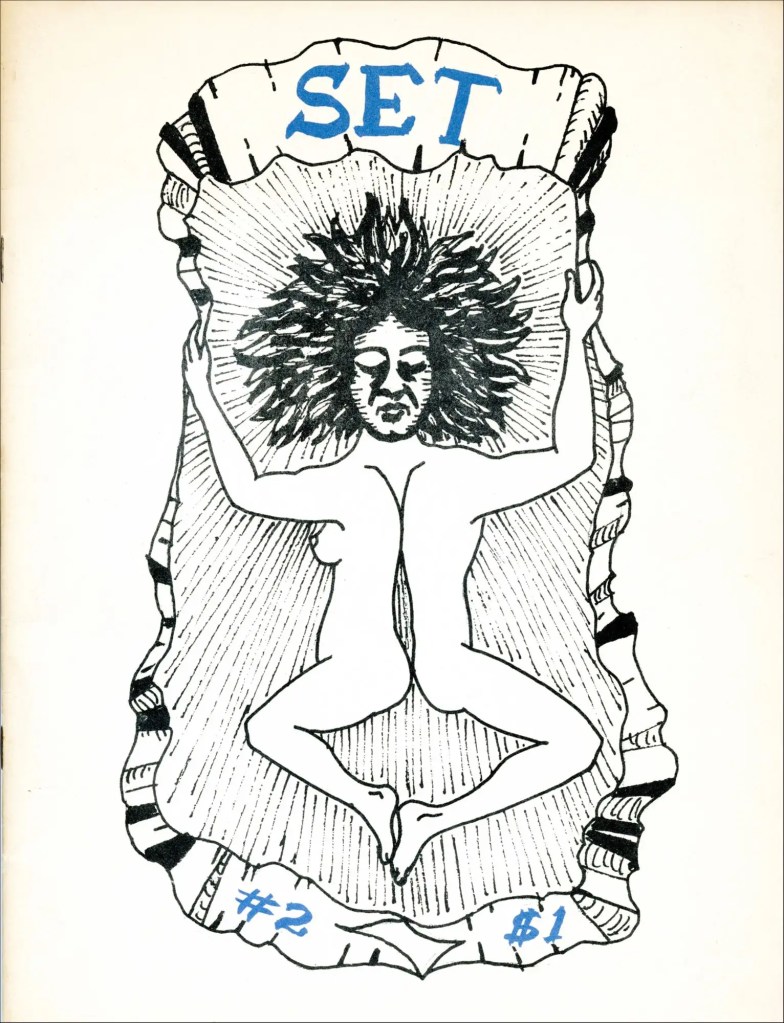
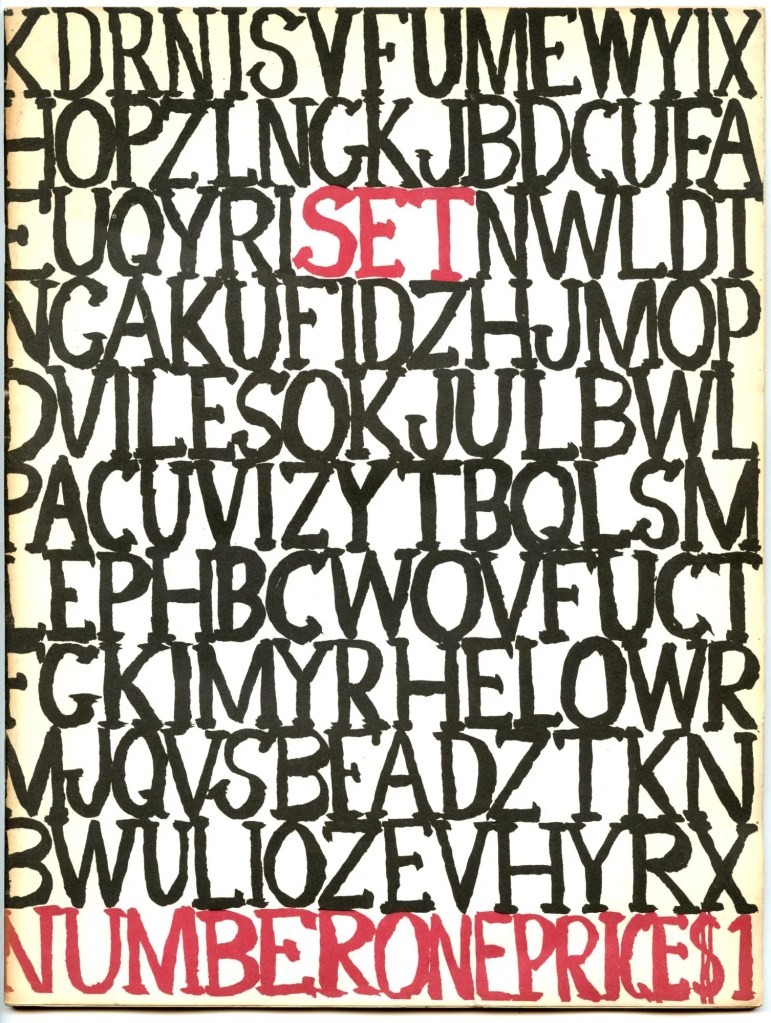
Lansing’s work seems to anticipate Grant’s in several ways. The two both think it important to honor the Egyptian god Set, for instance, with Lansing naming his early-60s poetry journal SET after him. And Grant’s focus on the Qliphoth, or the underground portion of the Tree of Life, seems present in the title of Lansing’s 1966 poetry collection The Heavenly Tree Grows Downward. For more on the “tree that grows downward,” Pierre Joris recommends looking at a section of Jung’s Alchemical Studies called “The Inverted Tree.”

Postmodern Liturgy

Our father, who is also in / Tartaros chained in being
—Charles Olson, “MAXIMUS, FROM DOGTOWN—IV”

The poem opens like a prayer — but twisted, inverted, hurled downwards into the pit.

This is not the Father of Heaven. Not the lawgiving patriarch of Christian theology. This is the Father beneath the foundations: a presence chained in Tartaros, the precondition of Order, the progenitor of Chaos, silence, breath. The reversal is stark — and crucial.

In this fourth installment, we turn to MAXIMUS, FROM DOGTOWN—IV” itself, a poem Olson described as “deliberately” given not to any old little magazine, but to The Psychedelic Review: “the one that the mushroom people edited.” And yet the poem contains no mention of mushrooms, no obvious gestures toward psychedelia.

What it gives us instead is myth in shards — a Hesiodic echo refracted through twentieth-century American poetics, emerging from a poet who had tasted the mushroom and returned not with visions, but with an ancient voice.

It is the use of the Lord’s Prayer that first signals the poem’s intent to unmake received forms.

The Father is not enthroned. He is entombed.

We remember, with Hesiod, that Tartaros is not merely hell. It is primordial. Deeper than Hades. Older than the Olympians. It is the chaos-place, the pit where Typhon returns after being struck down. It is the place of potentiality before form.

In Olson’s cosmology, this is where the real work begins.

Dogtown — abandoned settlement, stony ruin, former commons — is the psychic mirror of Tartaros. Olson walks it as ritual. He listens to the wind. He reads the stone. He opens the field of composition to receive myth not as allegory, but as event — a rematerialization of chaos in language.

In his poem, Zeus is not hero, not savior. He is the figure of domination — the lightning-armed force that imposes order upon the manifold. Olson knows this force. He has seen it in history, in empire, in himself. He has seen it in Koestler’s terror and in the glassy optimism of the technocratic age.

What Olson gives the mushroom people is a warning: beware the thunderbolt that burns away multiplicity. Beware the system that names chaos “evil.” Beware the will to cohere when it comes at the cost of forgetting.

And yet, there is no hatred here. No bombast. Only voice.

The poem sings, hisses, growls. It walks the edge of lyric and liturgy.

Typhon, when he arrives in the poem, does so not as monster but as signal. His body is the syntax of the ungovernable. His voices — animal, elemental, unspeakable — are the chorus Olson dares to channel.

Grieve-Carlson argues that Olson follows Hesiod closely, that he upholds the cosmology of order. But I read the poem differently.

To me, Olson invokes Hesiod not to ratify the myth, but to activate it. To re-constellate it. To speak it into a new moment — the moment of Dogtown, of postmodern ruin, of psychedelic reentry.

The important point is that, for Olson, Chaos is the original condition of existence. Order is not found. It is made. And it is the poet’s duty to make it — again and again — from the materials of breath, myth, and memory.

Thus the poem becomes not explanation, but theogony — a breathing-forth of being from the pit of the real.

Olson offers no easy answers to the mushroom people. He offers no program, no doctrine, no trip report. He offers them this: a field. A myth. A prayer to the father in Tartarus.

And through it, he calls them — calls us — to make meaning from the underside. To shape voice from fire and stone. To reclaim chaos not as enemy, but as source.

This is the poem’s gift.
This is its weight.
This is its light beneath the pit.

“MAXIMUS, FROM DOGTOWN—IV”

Upon recommendation by Ginsberg, Olson participated in two psychedelic drug sessions with the Leary crew at Harvard’s Center for Research in Personality in December 1960 and February 1961. Despite Olson biographer Ralph Maud’s insistence that “These are strictly peyote sessions,” Olson himself refers to them as mushroom trips, and the Leary crew’s experiments during this time revolved around jars of synthetic psilocybin pills that they’d derived from Sandoz Laboratories in Switzerland. My sense, then, is that we can assume that synthetic psilocybin is what Olson received during his sessions. Each of these sessions was, in the poet’s own words, “a true love feast and a truth pill” (Muthologos, p. 24). “The startling & unbelievable first impression of going under the mushroom,” he stated, “is that everyone & everything is nothing but itself so that all — everything — is therefore well, and there’s no push, there’s no fuss, there’s nothing at all to worry about, or press at, no sweat of any sort called for, it’s all too real and way beyond any attitude or seeking some greater or bigger answer” (Olson, as quoted in Conners 106). A few years later, as Maud notes, “Olson gave to the Psychedelic Review for its third issue (1964) his long “MAXIMUS, FROM DOGTOWN—IV” (160). Psychedelic Review was a journal published by members of the Leary crew from 1963 to 1971. Olson saved in his library the first four issues of the magazine. In what follows, I’ll attempt to show how, when read in light of where it was published, Olson’s poem reveals itself to be a commentary on psychedelic experience.

Chaos Before the Gods

To understand “DOGTOWN—IV,” we must first meet Typhon.

He appears late in Hesiod’s Theogony, a fiery final opponent, son of Earth (Gaia) and Tartarus, “conceived in an act of love” between matter and abyss. Hesiod calls him a “fearful dragon,” a hundred-headed monstrosity whose eyes flash flame, whose tongues flicker, whose voices shift wildly — sometimes intelligible, sometimes bull-roared, lion-lunged, or hissed in storm.

Typhon, in other words, is not a symbol. He is a polyvocal event. An insurgency of sound. A figure of ontological excess.

“And there were voices in all his dreadful heads which uttered every kind of sound unspeakable,” writes Hesiod; “for at one time they made sounds such that the gods understood, but at another, the noise of a bull bellowing in proud, ungovernable fury… and again, at another, he would hiss, so that the high mountains re-echoed.”
(Theogony, trans. Evelyn-White)

Typhon threatens not merely Olympus, but the very idea of divine order. He is chaos not as absence but as pluripotent potential. Fire and breath. Voice and unmaking.

And for Olson — poet of proprioception, initiand of the mushroom — this is the mythic substance most suitable to his altered state.

Let us pause, though, and ask with Olson: Why would Earth love Tartarus?

It’s a strange phrase in Hesiod. “Gaia from her love of Tartarus.” Tartarus is the deepest abyss, a pit beneath all pits. The Greeks imagined it not merely as punishment, but as anti-space — the unbounded, unstatistical underside of being. Olson, ever the etymologist of the unconscious, seizes on this.

In “DOGTOWN—IV,” he writes:

“Our father, who is also in / Tartaros chained in being…”
(Maximus IV, ll. 333–334)

This is Olson’s parody of the Lord’s Prayer. But unlike the Christian God above, Olson’s father is below — the primordial pit, the place before measure, the place of hunger, chaos, and unformed form. Tartarus is a womb. An inversion of heaven. And Typhon, its child, is the convulsed birth of multiplicity.

What Olson sees — and what most critics miss — is that Typhon is not simply a villain in this cosmology. He is a challenge. A necessary crisis. A daemon of disruption.

Gary Grieve-Carlson, one of Olson’s most careful readers, insists that Olson admired Hesiod for his “will to cohere” — his vision of cosmos arising out of chaos. But I suspect Olson’s attachment to Hesiod is more ambivalent. He sees in Hesiod both the first cosmology and the first repressions: the moment chaos is narrated as a threat, and order enthroned.

So Olson takes Hesiod’s Theogony and folds it — remixes it. He retains the sequence (Chaos, then Earth, then Tartarus, then Love), but recasts the power dynamics. Typhon becomes not the failed usurper but the dark mirror of Maximus himself: the one who would speak many voices, walk many lands, breathe from the bottom up.

And in choosing this myth to send to The Psychedelic Review, Olson makes his wager clear: the psychedelic does not simply uplift — it ungrounds. It returns us to Tartarus. To the chthonic, the unmetabolized, the monstrous within.

This is why Typhon matters now more than ever. He is climate chaos, algorithmic multiplicity, ecstatic polyphony. He is the real beneath the rational. The daemon of the Anthropocene.

And Olson, emerging from Dogtown with psilocybin still in his system, names him.

Not to celebrate him.

Not to slay him.

But to write with him.

The Labyrinth and the Light

We begin in the Labyrinth.

Not the labyrinth of mere confusion — but the labyrinth of myth, of force, of breath, of ancestral return. The labyrinth of Charles Olson’s Maximus, and specifically “MAXIMUS, FROM DOGTOWN—IV,” a poem written in the early 1960s, at the height of the first psychedelic renaissance.

This poem, published in the third issue of The Psychedelic Review in 1964, arrives to us like a cipher, a mythic communiqué, mailed from the ruins of a colonial commons, encoded in the voice of a poet who walked granite trails while recovering from chemical initiation.

It is, in many ways, a letter sent to the mushroom people.

This series of posts — fragments of an unfinished but now reawakened paper I began in Fall 2022 — seeks to interpret “DOGTOWN—IV” as a psychedelic poem, a theogonic composition shaped by Olson’s experiments with synthetic psilocybin during his sessions with Timothy Leary and the Harvard crew in 1960–61. But unlike the effusive trip reports of Beat writers like Allen Ginsberg or the utopian manifestos of Leary, Olson’s response to psychedelia is strange, mythological, and subterranean.

There are no rainbows in “DOGTOWN—IV.” No electric Kool-Aid. No declarations of ego-death.

What there is, instead, is a retelling of Hesiod’s myth of Typhon — the serpentine, fire-eyed, many-voiced monster birthed by Earth and Tartarus. Olson’s version is fragmented, gnarled, obscure. But it is also urgent, rooted, and alive.

So why this poem? Why Typhon? Why send such a myth to The Psychedelic Review, a journal edited by Leary’s cohort and read by initiates of a blossoming chemical counterculture?

To answer these questions, we must retrace the steps of Olson’s initiation.
We must follow the winding trails of Dogtown.
We must listen to the poet’s own words, spoken under the mushroom’s influence:

“The startling & unbelievable first impression of going under the mushroom… is that everyone & everything is nothing but itself… there’s nothing at all to worry about… no sweat of any sort called for… it’s all too real and way beyond any attitude or seeking some greater or bigger answer.”
(Olson, as quoted in Conners 106)

This is the tone of someone who’s touched the ineffable — and returned with it clenched not in his hand, but buried in his throat, transformed into breath.

In this series, I argue that “DOGTOWN—IV” is Olson’s mythopoetic response to the psychedelic experience — but one shaped by his unique cosmology, his investment in ancient myth, and his suspicion of liberal-progressive “trip culture.” While others turned on and tuned in, Olson turned downward — into Tartarus, into Chaos, into the pre-logos dark from which all things emerge.

This is not a dismissal of psychedelia. It is its deepening.

This series unfolds in seven movements, each exploring a facet of Olson’s relationship with myth, madness, and the mushroom. It is a metanastic walk through the labyrinth — a return through Olson’s theogony toward the real task of the poet: not to escape into light, but to make meaning from the dark. To say what is.

Like the desert mystics of yore, the poet’s role is to “keep the edges hot.”

This series begins at one such edge — where myth meets mushroom, where Hesiod meets Leary, where Olson, like Maximus, writes from the underworld back toward the surface.

Welcome to the labyrinth.
Let us walk it together.