In 1964, Olson publishes “MAXIMUS, FROM DOGTOWN—IV” in The Psychedelic Review — a poem birthed in ruins, in myth, in the underworld of American consciousness.
Nine years later, in 1973, British ceremonial magician Kenneth Grant declares the arrival of the Typhonian Tradition, a magical current devoted to chthonic, extraterrestrial, and daemonic intelligences, many drawn from the deep archives of myth and modern horror alike.
Though Olson and Grant never met, and likely never read one another, they can be felt vibrating on parallel frequencies. Each undertook a kind of mythic reconstitution — one through poetics, the other through ritual magic. Each turned to Typhon as the name for what the West had repressed.
Each sought contact with what Grant called the Nightside of Eden — the underworld of dream and daimon, the world beneath the Tree.
In the Typhonian cosmology, Set — the Egyptian god of desert, dismemberment, and becoming — plays a central role. Set is not Satan, but a daemon of individuation and threshold. And Typhon, Grant writes, is either Set’s progenitor or twin: “the arch-monster” whose energies were misread by the Olympian order and buried in taboo.
Compare this to Olson’s identification of Tartarus as a place not only of punishment, but of origin — the “chained father,” the source of Typhon’s flame. Grant and Olson both return to the abyss — not as hell but as creative substratum.
For Grant, this substratum is accessed through trance, ritual, psychedelics, and visionary language. For Olson, it is accessed through breath, field, and proprioception — a somatic epistemology capable of tracking Chaos back to its roots in the body and the land.
The subterranean father in Tartaros is not evil. He is necessary. To contact him is not to summon doom — it is to reenter cosmic process.
There are other echoes.
Olson’s involvement with the White Hand Society, and his psilocybin sessions with Leary, place him squarely within the psychedelic ferment of the early 1960s — a ferment mirrored in Grant’s own chemical and ceremonial experiments.
Olson read Jung and Jung’s alchemical writings. Grant, too, drew on Jung, especially in his writing on the Qliphoth, the inverted Sephiroth or “shells” on the dark side of the Tree of Life. The Qliphoth, in Grant’s system, are both exiled and generative: portals to creative chaos, much like the Typhonic force Olson names.
And then there is Gerrit Lansing — friend to Olson, Boston-based poet-mystic, and likely source of Olson’s interest in Crowley’s Book of Thoth. Lansing founded a journal called SET, named after the Egyptian god, and his own writing often anticipates aspects of Grant’s cosmology. Lansing’s 1966 collection, The Heavenly Tree Grows Downward, takes its title from Jung’s Alchemical Studies, specifically a chapter on the inverted tree — the same tree that Grant links to Typhonian gnosis.
What does this all mean?
It means that Olson’s poem, when read alongside the Typhonian Tradition, becomes legible as a magical document — not in the sense of intention, but in the sense of effect. It opens a channel. It participates in a current. It speaks in a tongue that other mystics, elsewhere, were also learning to speak.
And it means that Typhon, far from being a footnote in a forgotten myth, is an active force in the poetics of the twentieth century — a daimon of chaos, pluralism, darkness, and return.
Olson’s poem names him.
Grant’s rituals conjure him.
My reading recuperates him.
This is not necromancy. It is listening.
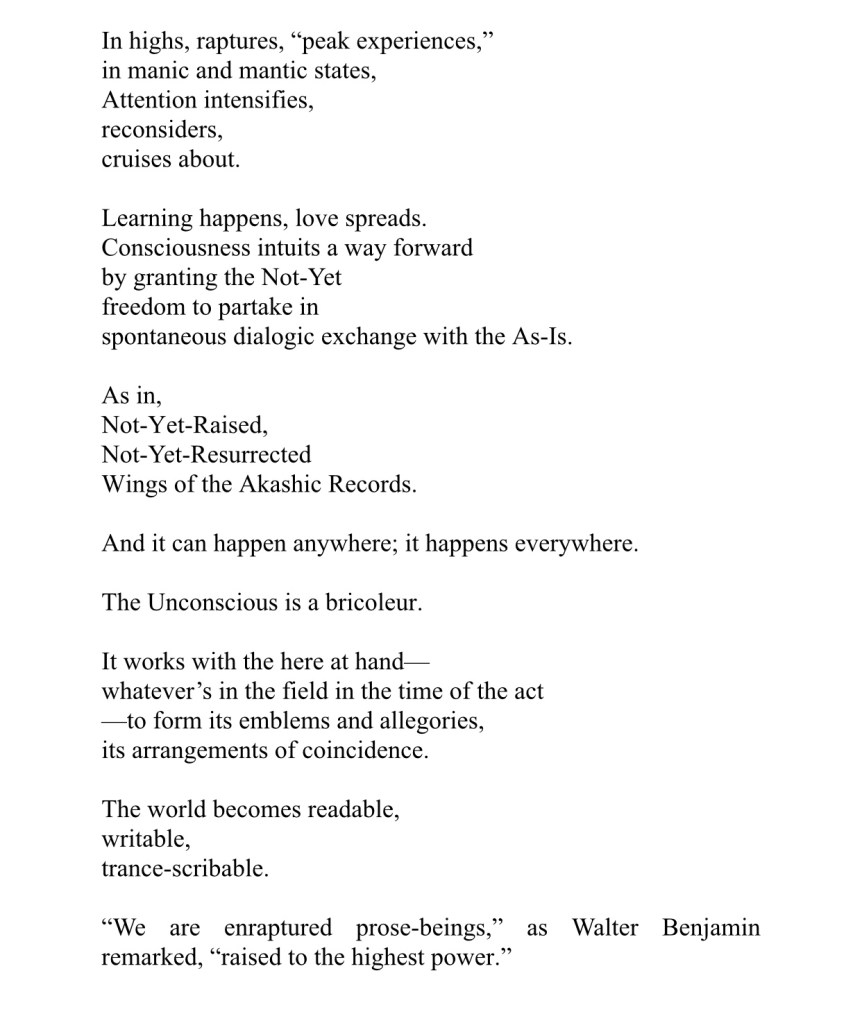
 Trance-Scripts