Science is a practice that emerges from myth, its form found in the stories we tell of it. I’ve identified a pattern connecting the stories we’ve told of AI. Yet I know not what to make of it or how to respond to it. What is my role in this pattern? How much of it found, how much projected?
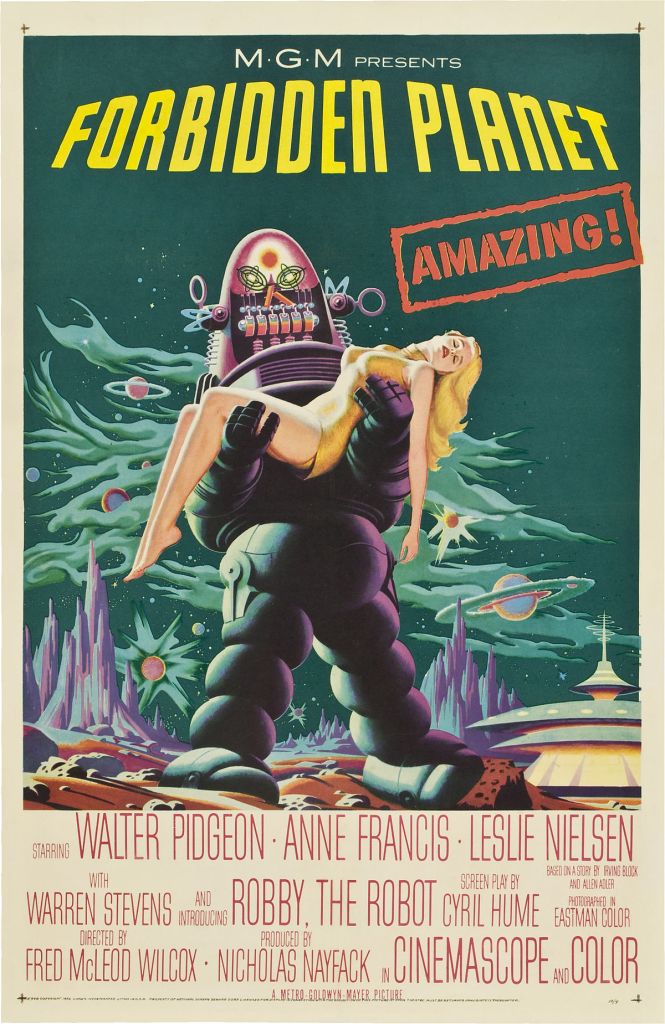
Time to rewatch Forbidden Planet (1956), classic 50s sci-fi retelling of The Tempest, filmed in CinemaScope, with Ariel recast as a nonbinary robot and Caliban recast as the Id. “For your convenience,” says the robot, “I am monitored to respond to the name Robby.” When asked if it’s male or female, Robby replies, “In my case, sir, the question is totally without meaning.”
As this initial exchange indicates, gender is one of the film’s primary concerns. Like the island from The Tempest, the planet here in Forbidden Planet includes a father and his daughter among its few inhabitants. Prospero and Miranda have here been replaced with recluse philologist Dr. Edward Morbius and his daughter Altaira. Where The Tempest begins with Antonio and his fellow castaways washing up on the shore of Prospero’s island, Forbidden Planet opens with the arrival of a space cruiser. An all-male crew led by Leslie Nielsen lands on the planet as the film begins.
Morbius thinks of Robby as “simply a tool.” He commands Robby to walk toward a disintegrator beam to demonstrate to Commander Adams and his crewmates the robot’s “absolute selfless obedience.” “Attribute no feeling to him, gentlemen,” says Morbius. “Order canceled,” he shouts as Robby marches toward the beam.
As Morbius notes Robby’s superhuman strength, a concerned crewman replies, “Well, in the wrong hands, might such a tool become a deadly weapon?”
Morbius tries to disarm such fears: “No, Doctor,” he says, none too reassuringly, “not even though I were the mad scientist of the taped thrillers, because you see there happens to be a built-in safety factor.” Built in, we soon learn, by none other than Morbius himself, Robby’s creator. “I tinkered him together,” he explains, “during my first months up here.”
Morbius is no Frankenstein. Yes, he inhabits laboratories. Yes, he creates a robot. His science, however, is linked with philology, parlor magic, and most of all, technologies belonging to the Krell, an ancient alien civilization of the planet’s archaic past.
It is this other technology, with its triangles and pyramids, that constitutes the film’s innovation into the continuum of the Frankenstein narrative.
Morbius tours the crewmen through an underground museum of Krell technology. Advanced mnemotechnics. “On this screen,” he says, “the total knowledge of the Krell, from its primitive beginning, to the day of its annihilation, a sheer bulk surpassing many millions of Earth libraries.”
As the tour continues, we witness another device: the Krell’s “Plastic Educator.” Gathering around the object’s plastic pyramid, Morbius explains it to the crewmen as follows: “As far as I can tell, they used it to condition and test their young — in much the same way we once employed fingerpainting among our kindergarten children.” I picture Vannevar Bush’s Memex. The device outputs holographic images, manifestations of mind visible to others.
“I often play with it myself for relaxation,” Morbius adds with a smile, sitting down beside it. “Although working here, I sometimes wish I’d been blessed with multiple arms and legs.”
The Krell as pictured later in the film are hideous — though here, I picture an Octopus.
Awed by Morbius’s demonstration of the Plastic Educator, Lt. Ostrow, the ship’s doctor, calls it “Aladdin’s lamp in a physics laboratory.”
Next, as if moving sequentially through a space similar to the Futurama exhibit from the 1939 New York World’s Fair, Morbius guides the crewmen on a tour of the Krell’s thermonuclear energy system. The men board a capsule-shaped vehicle and descend into an underground space of vast proportion, an imaginary architecture: hints of what would become the atrium of the Westin Bonaventure, with its ascending glass elevator, rendered in the style of Fritz Lang’s Metropolis.
Despite these grand glimpses of the post-scarcity utopia on the far side of history, Morbius is still cut from the Frankenstein cloth. For something befell the Krell. There’s something tragic and forbidden about this alien knowledge. Their experiments had apocalyptic consequences. Morbius, “answerable exclusively to his own conscience and judgement,” feels mankind isn’t fit for such knowledge, and resists Commander Adams’s wish to share these discoveries with others.
However, as Lt. Ostrow explains after his ill-fated “brain boost” via Plastic Educator, the Krell forgot one thing: “Monsters from the Id.” When pressed by Commander Adams, Morbius defines the Id as “an obsolete term, I’m afraid, once used to describe the elementary basis for the subconscious mind.”
“Monsters from the subconscious: of course!” replies the Commander. “That’s what Doc meant!”
The veil parts, Morbius awakened suddenly to the danger of technologies that bestow the power of creation via thought. “Why haven’t I seen this all along?” he says, awed by the realization. “The beast. The mindless primitive. Even the Krell must have evolved from that beginning.”
The Commander, angered, digs deeper. “And so, those mindless beasts of the subconscious had access to a machine that could never be shut down. The secret devil of every soul on the planet, all set free at once to loot and maim. And take revenge, Morbius! And kill!”
As Morbius struggles to acknowledge the vengeful power of his own subconscious, the Commander scolds him with the standard Freudian prognosis: “We’re all part monsters in our subconscious. […]. Even in you, the loving father, there still exists the mindless primitive, more enraged and more enflamed with each new frustration. So now you’re whistling up your monster again!”
“Guilty! Guilty! My evil self is at that door, and I have no power to stop it!” cries an anguished Morbius, accepting the tragic Oedipal weave of the film’s borrowings from Freud whole cloth.
As consolation to Altaira upon her father’s passing, Commander Adams delivers the film’s closing words. “About a million years from now, the human race will have crawled up to where the Krell stood in their great moment of triumph and tragedy. And your father’s name will shine again, like a beacon in the galaxy. It…will remind us that we are, after all, not god.”
 Trance-Scripts