For the past few days, I’ve felt an urge to “do things around the house” after smoking. This is somewhat out of character for me. I’m not a “messy” person, per se — at least not in a way that ever bothered me. But I’ve over-corrected, maybe, steered closer to messy than was necessary. It’s long been known among my family and siblings that my father is a bit of a “clean” freak, cleaning his house daily as if by ritual. As a teenager, this ritual seemed to be an absurd or at least wildly exasperating “event” always going on around me — and never with any tasks that I could perform sufficiently, in light of his exacting, idiosyncratic standards. We used to get in each other’s way a bit as a result. I’d be watching TV with friends after school and he’d force us all out of the room so he could vacuum. Once I moved out and we were no longer living under the same roof, we were able to laugh and joke about it. But when I was a teenager, it drove me nuts. A friend’s parents had a sign hanging in the living room of their home stating, “A clean house is a sign of a life misspent.” Something of that sentiment was agreed to by Sarah and I, and as a modus operandi, it’s worked well for us. As I prepare to become a father myself, however, I find myself asking the old questions anew.
Sunday September 8, 2019
I set to work reorganizing my office into a sanctum. I handle old books, rearrange them in space. I eye the parts of the space, asking each object that my attention happens upon how it might give me joy. I peek through piles of paper. I pretend to think for a moment in character as a “life coach.” “What do I want with this stuff?” I ask myself while staring at the contents of a tall metal filing cabinet, each hanging folder neatly labeled, organized mostly in accord with topics I studied in grad school. Much of it seems distant and dated: political pamphlets, neighborhood bulletins. Paper-media objects of the past. How much of it is worth holding onto? At the very least, the file cabinet tells a story: eyeing a drawer’s contents, one moves from dissertation chapters and professors’ comments to a final folder (the only one with which I interact anymore) overflowing with bills. That’s why I took to climbing Mystic Mountain. Yet now I’m here, sitting beside a spider on my front stoop at dusk, watching it weave its web. I sit awed by all the little live things, all my kind, beautiful companions, breathing, centering, seeking to do well by all.
Saturday September 7, 2019
Wherein the dreaming mind reflects on its use of forms. What do we remember (or “encounter and take back with us”) when we turn inward? What’s there? Whose home? Who’s home? I see a version of myself — backpacking, walking beside child companion, hair worn long with braids, voice echoing through valley. Shall we turn to the dialogue form? Say after me: listen, sing what comes into one’s heart, let carolers carol. In my classroom, I do not merely impart information, I suggest overtones and analogies. This is as it should be. My teaching is, as Irwin Edman said of the work of Alexandre Koyré, “a concentration of much thought and much scholarship into an instrument of analysis and contagious communication” (ix). Or so it seems as I reflect mid-afternoon. By evening, my mind is elsewhere, loosening in partnership with John Abercrombie, Dave Holland, and Jack DeJohnette’s “Back – Woods Song.”
Friday September 6, 2019
A cat has been sitting on a chair on our deck these last few days, napping midday. I like having it around. Deck chair cat. Classes are going well. After a full day of teaching (a pretty magical performance, I must say), I hang out with colleagues at a department party. Once home again, I splash water under my arms and rinse my feet. I spent the day talking with students, dialoguing about Plato’s Allegory of the Cave, where the freed prisoner ascends toward sight of the sun, much as the philosopher ascends toward knowledge of the good, and by evening, I’m attending a show by the band Sunwatchers. Life assembles into these weird coincidences, these synchronicities. I share Gabriel Marcel’s view: “Hope is a memory of the future.” As Sam Keen and Anne Valley-Fox note, “Memories of primal pleasure are alive and well in the unconscious; all we need to do is call them forth.”
Thursday September 5, 2019
I think about the practice of “time-sharing” from the early history of computing, when students gathered ’round campus labs, multi-programming and multi-tasking at terminals connected to a shared system. Machines are in our lives, buzzing all around us, as are people, plants, and animals. With them, we communicate, we interact. Perhaps because of all of that buzzing, I find myself reconsidering the value of the Christmas tree as ritual and pagan act of worship. A celebration of life, death, rebirth. Time spent in homes with family. This year will be a special one, a year of loving reinvention and change. New responsibilities, girl drummer. Life’s about to get really groovy. Sweet states of being. New friends, a new relation. A new mood to support learning and growth, bookmarks synced to devices, heads working in harmony. To prepare, I read about the launch of a new Center for Psychedelic and Consciousness Research at Johns Hopkins Medicine. Psychedelics are interesting well beyond the Center’s medical framework. If faculty connected with the Center are not yet collaborating with faculty in the Humanities, they should. Time to help bridge former disciplinary divides. (Judging from how it’s funded, however, the Center at Johns Hopkins isn’t likely to bridge these divides — so the work will have to happen elsewhere.) “Blue skies with pink clouds,” notes a neighbor. She and her brother circumnavigate and watch the sunset, riding their bikes in wobbly circles up and down the street.
Wednesday September 4, 2019
Constellations of thought rotate around like the cover of Led Zeppelin III or the wheel of a rotary telephone, an object common to domestic space during the era of my childhood, replaced over time by cellphones. Thinking of the Led Zeppelin album, I kneel beside my unalphabetized, unsystematized wall of vinyl whispering, “Come out, come out, wherever you are!”
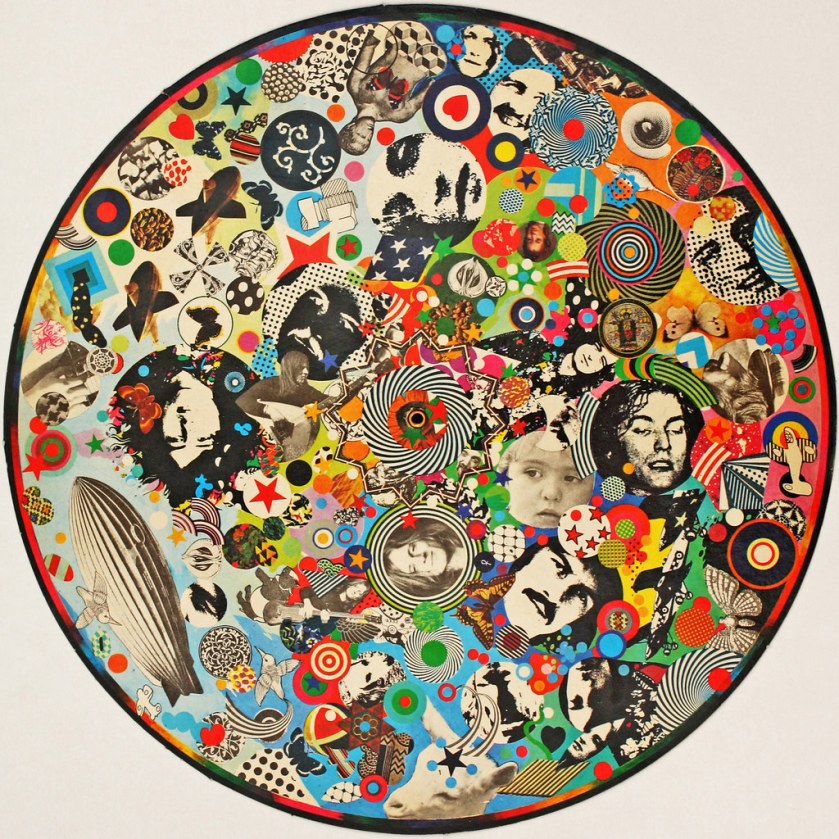
There it is, a psychedelic thing of beauty. “Visual Creations by Zacron,” reads the circular stamp beside the credits on the inner sleeve. I guess this device I’m imagining is a volvelle, a wheel chart featuring concentric circles with pointers. Volvelles were used in medieval Europe to calculate the phases of the sun and moon. “While at the Royal Academy Schools,” I learn, “Zacron produced a rotating book” called One Line and a Box.

Users could ask the book “questions about their interaction with the environment,” as they might using devices like the Tarot or the I Ching. From this earlier work, Zacron derived the idea for the design of Led Zeppelin III. My courses begin to shape up into elaborate nested allegories.
Tuesday September 3, 2019
I’m feeling the love tonight. People have been sending me gifts, wishing me a happy birthday. Sarah took me out for Indian for my birthday dinner. The situation in the UK has me alert and attentive. The Left has an opportunity to take power. There’s a doorway here that leads to sweeter states of being. Let’s live hopefully again, a joyful fruiting multitude, allied again with the planet.
Monday September 2, 2019
What happens when, as an experiment, we treat moments of our lives as “encounters”? What were people doing when they joined T-groups, encounter groups, and consciousness-raising groups in the 60s and 70s at places like Esalen? How were these groups organized? Did facilitators exercise claims to authority in these groups? Were they like teachers? Workshop leaders? Pastors? Counselors? Therapists? Gurus? A bit of all of the above, I suppose. Groups fulfill needs of an emotional, psychological, and spiritual sort among people who have come free of traditional affiliations: disaffected subjects seeking re-enchantment, players in search of new games. Such people arrive at these groups and games as they wander markets, festivals, circuits, and arcades. The encounter groups of the 60s and 70s were sites where “role-playing” got its start. Games like Dungeons & Dragons emerged in roughly the same moment and milieu. What’s interesting about encounter groups is that participants trust their feelings to “a bunch of strangers,” rather than to uniformed technocrats, “experts,” priests, and elites. The encounter group is also interesting in that it births group consciousness through use of cybernetic feedback mechanisms. Group members are observed by facilitators. The facilitator reports these observations back to the group. The latter then react to the reports and the cycle begins anew, in much the same way “rounds” occur in D&D. Thomas R. Verney describes two favorite techniques of role-play used by Gestalt therapist Fritz Perls during the latter’s time at Esalen in the 60s and 70s: the “two chair” technique and another called “play the projection.” Could techniques of that sort have a place, I wonder, in one of my courses? Verny’s book Inside Groups: A Practical Guide to Encounter Groups & Group Therapy answers many of my questions. The least authoritarian of the leaders he describes are those he calls “T-group trainers.” The T-group trainer, he writes, “is usually described as a facilitator and a catalyst” (28). Leadership of this sort involves paraphrasing what is said by the group, acting as a mirroring instrument so that members can know themselves and the group can self-actualize. Encounter group leaders are a bit more unpredictable, their methods and techniques less subject to professionalization and external supervision. As for the techniques themselves, Verny writes, these are primarily “verbal and nonverbal confrontation, psychodrama, Gestalt, and sensory awareness,” as well as “fantasy, meditation, and transactional analysis” (34-35).
Sunday September 1, 2019
Two women walk past chatting about a celebrity chef as I float on my back at the public pool. Here is the Multitude: friendly, assembled for play, with lifeguards instead of cops. From it we scale upward: from the playground to the festival to the tent city with gardens. Children blowing bubbles, adults reading and tanning, seniors lounging in the shade cast by an umbrella. Through the scene floats a yellow butterfly. Afterwards, trees silhouetted by the setting sun, I sit on my stoop listening to cicadas. Neighbors play Madonna’s “Like a Prayer” and Whitney Houston’s “How Will I Know” as a bat flies overhead.
Saturday August 31, 2019
Now that students have submitted written responses, my days feel crowded with text, words greeting me everywhere I look. Friends entertained Sarah and I last night by suggesting outlandish names for our daughter. Other friends from Chicago sent a beautiful art book modeled upon the Whole Earth Catalog (a publication about which I’ve written at great length, in many ways dear to my heart, expressive of my utopian and eupsychian ambitions), designed by one of their students. Unbuckled is the mail. I walk the neighborhood during magic hour, photographing spider flowers and clematis.
 Trance-Scripts