In fleshing out the prehistory of what Mark Fisher was calling “Acid Communism,” one’s research will eventually lead to the western Canadian province of Saskatchewan. It was at the Saskatchewan Mental Hospital in Weyburn that psychiatrists Humphry Osmond and Abram Hoffer established what Michael Pollan refers to as “the world’s most important hub” for the first wave of research into psychedelics (How to Change the World, p. 147). Osmond was lured there from England by the province’s leftist government, which beginning in the mid-1940s, as Pollan notes, “instituted several radical reforms in public policy, including [Canada’s] first system of publicly funded health care” (147).
Wednesday December 5, 2018
The etymology of “gonzo” unlocks a new level in my understanding of countercultural history. To celebrate, I sing along to the “Moratorium” chorus from John Ylvisaker and David Blakeley’s Recorded at a Housewarming for Fritzie, a rare private-press christian psych-folk LP released in 1972 on Soular Module.
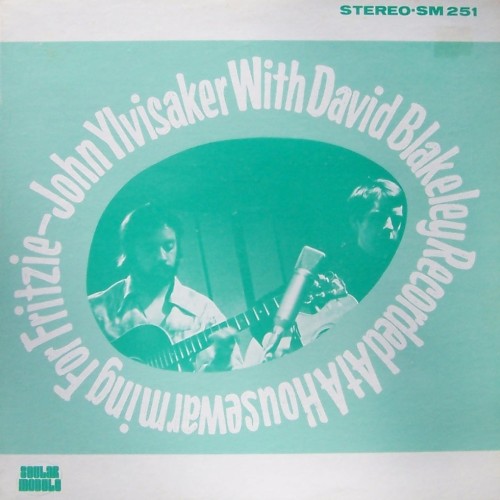
Ylvisaker’s obituary refers to him as the “Bob Dylan of Lutheranism.” Reawakened by its use as slang among beats and hippies and entered into print to name Hunter S. Thompson’s drug-fueled brand of New Journalism, “gonzo” probably derives from the Italian figure of the simpleton or fool, the great lightener of moods who speaks cheerfully of the miracle of reconciliation. Also a play on “gone,” as in “out there,” wild and crazy, mind unfurling in the midst of a great trip. My courses are basically guided tours of elaborate, personally crafted memory palaces, demonstrations of compatibility among multiple systems of gnosis, literary, philosophical, cultural, and political texts woven into a vast assemblage, my eyes like those of the Muppet conveying moment by moment a “zany, bombastic appreciation for life.”
Tuesday November 27, 2018
I’ll be revisiting old friendships this weekend — high school friends, some of whom I haven’t seen or spoken to in decades. How might I best characterize myself for them? By what terms might I achieve peace with these brethren, unburdened of unspoken rivalries? In the past, I may have been wounded and wronged by these friends, just as I may have wounded and wronged them in return. Yet as Laura Archera Huxley counsels in her book You Are Not The Target, “each one of us has a function to fulfill. It is when we spend our time and energy looking down in contempt or looking up with sterile longing that we lose sight of this function. Envy is comparison. He who is in the continuous process of being and becoming what he really is, directs his attention to real values, not to measuring other people’s achievements” (240). What I’m suffering is what Ralph McTell calls the “Zimmerman Blues.”
I traveled far from home, lost touch, saddled myself with unrepayable debt — but amid this impoverished wandering, I followed my heart, I found my partner, I learned how to love. Freedom outside in the sun of the prison yard. The country is not one where each person owns or gets enough on which to live. The fault for that lies with the country, not me. Were it otherwise, each could attend to the beauty and the glory of the earth. In the meantime, I break away as much as I can from “compulsions, ambitions, hates, vanities, envies”; I try to conduct myself day by day as a whole being.
Monday November 26, 2018
For the artist, the universe remains a plaything, a site for open exploratory stars-in-eyes investigation. One wanders about or thumbs through books of symbols asking, “Where in the world is my next sacred-ecstatic encounter? What material should I alter, and by what process?” Curiosity leads to discovery, and discovery leads to artistic creation or invention, as in Fanita English’s transactional analysis script matrix, “Sleepy, Spunky, and Spooky,” an essay referenced in Philip K. Dick’s A Scanner Darkly.
Sunday November 25, 2018
These trance-scripts haven’t spoken adequately yet about the most common altered state of consciousness, the one to which our society remains addicted: namely, fear. There is an element of anarchy in the ontology of the cosmos. This is its beauty. We each have to find our own truths, our own interpretations, the meanings that suit our being. Before meaning’s arrival, though, before its revelation (when all is said and done), there is the maze, the labyrinth, the dungeon — the as-yet-unexamined. Fear emerges when we project into the labyrinth a Minotaur, a spirit of malevolence, an enemy Other. If we concentrate on breathing and re-center in our bodies, fear dissipates. Sunlight catches on windblown leaves, goldens a wall of stained pine.
Saturday November 24, 2018
“Me with nothing to say, and you in your autumn sweater,” go the words to a song of my late teen years by the New Jersey band Yo La Tengo. I heard it the other day, only to be reminded of it again midafternoon as Sarah and I, bundled in hats and scarves, set out on a brief walk through our neighborhood. By the evening, though, I’m back to re-reading Philip K. Dick’s A Scanner Darkly, a book I’m teaching next week. Dick’s dystopian future depicts widespread, near-universal dehumanization as a consequence of prolonged multi-decade domestic drug war. A pair of narcotics officers review horror stories involving consequences of addiction to the novel’s fictional drug Substance D: rapid aging, blown scholarships, a sister raped by her amoral drug-dealing brothers, babies born addicted, spread of STDs. Yet Dick also shows the lack of humanity among the cop side of this nightmarish future. When speaking to each other, Dick writes, these two narcotics officers, Fred and Hank, “neutralize” themselves; they assume “a measured and uninvolved attitude,” repressing feelings of warmth and arousal and cloaking themselves in anonymity. No one is likeable in this future. In order to live in it, one has to be willing to negate the humanity of others. “In this day and age,” says a character named Barris, “with the kind of degenerate society we live in…every person of worth needs a gun at all times” (61). This is a slight exaggeration; on the next page we learn of a character who has never owned a gun. But Dick’s future is one where gun violence is a commonplace (a world, in other words, much like our own). Everyone’s paranoid; everyone’s depressed, depraved, anxious, neurotic, confused. Indeed, to the extent that novels undergo cathexis when written, this one feels strangely anhedonic, borne of a period in Dick’s life of deep psychological crisis. For more on this period, see The Dark Haired Girl, a posthumously released collection of Dick’s letters and journals.
Friday November 23, 2018
The world operates unpredictably but for the most part pleasurably when I smoke weed; some wonderful but as-yet-unnameable “sense” or awareness enters the equation, a buzz or vibration, a field of energy operating outside space-time, in some other dimension. I enter a state of rapt, bemused fascination as I wander this new “inner space,” floating free in a sea of untranslatable semiotic matter. Lewis Carroll captured or came nearest to approximating the sensation with his description of Alice’s tumble down the rabbit-hole. In so doing, his text provides an anchor, a constant amid the experience of changing worlds. It’s how we lead ourselves from one world to another. With the comfort as well that time’s passage feels slow and dreamy, until suddenly we land and follow the rabbits of our curiosity. Is fantasy a realm of the head, a mere idealism? Or is it instead (for who is to know otherwise?) a portal to a world as actual as any other? Subjects and objects are units of language. Carroll (AKA Charles Dodgson) doesn’t appear to have experimented with drugs recreationally; he arrived to altered states by way of linguistics and mathematics. But Disney embraced the psychedelic interpretation of Carroll’s work as part of its marketing strategy for a re-release of Alice in Wonderland in 1974, encouraging viewers of the film’s trailer to “Go Ask Alice.” The cause of Alice’s descent is her falling asleep — daydreaming instead of completing her lesson. Doors, rabbits, magic potions: these are all manifestations of her unconscious desires projected into dream. Drugs and dreams inspire similar lines of thought: they strip the ontological ground out from under us, suspending the normal rules of reality. Instantaneously — just like that — we become convinced emanationists. “Our normal waking consciousness,” as William James wrote following his experiments with nitrous oxide, “rational consciousness as we call it, is but one special type of consciousness, whilst all about it, parted from it by the flimsiest of screens, there lie potential forms of consciousness entirely different. We may go through life without suspecting their existence; but apply the requisite stimulus, and at a touch they are there in all their completeness, definite types of mentality which probably somewhere have their field of application and adaptation. No account of the universe in its totality can be final which leaves these other forms of consciousness quite disregarded” (The Varieties of Religious Experience). Addendum: The psychedelic interpretation of Alice’s Adventures in Wonderland was propagated in a number of texts of the counterculture: Grace Slick’s lyrics to Jefferson Airplane’s “White Rabbit,” Go Ask Alice (1971), Thomas Fensch’s Alice in Acidland (1970), an anti-drug film of that name from 1969, and another called Curious Alice (1971). Mike Jay’s book Emperors of Dreams (2011) took up the question of Carroll’s relationship to drug experiences, suggesting that Carroll borrowed the psychedelic motif from Mordecai Cooke’s The Seven Sisters of Sleep (1860), a book describing use of fly agaric mushrooms among Siberian Shamans.
Thursday November 22, 2018
I return from my journey, sun and moon ever-present sources of light overhead, ship stocked with hippie-modernist treasure. “Pleasure from the Buddha Group,” as reads the insert to Jefferson Airplane’s third album, After Bathing at Baxter’s, released in late November 1967 during what Samuel “Chip” Delany called “the Winter of Love.”

Ron Cobb’s cover art captures well the band’s demeanor of even-keeled pleasure-sailing, a ship of color and festivity sprinkling confetti from on high, refusing to allow the black-and-white American trash-heap to harsh its vibe. Cobb is a fascinating figure, by the way, his illustrations and political cartoons deserving of a major retrospective and revival. This first day after feels relaxed and subdued, a day to bake and reflect and give thanks. Stretch, work out the kinks. Midori Tadaka’s Through the Looking Glass calms me midafternoon, as do a pair of squirrels spied while meditating. I sit with houseplants and cacti, patterned pillows, cassettes, back issues of Evergreen Review — and all is well.
Wednesday November 21, 2018
Around 2:30 in the afternoon, I place a tab beneath my tongue, breathe deeply, and prepare for my adventure. Initial stirrings include a flutter in my stomach, warmth behind my ears. Intimations of an as-yet-unnameable source of wonder. I putter around a bit before finding my way outdoors. Autumn leaves flutter in the air as neighborhood dogs yip and woof. Squirrels gather in the trees. “My dear friend,” I whisper invitingly as one hustles toward me. It coos lovingly back and forth with a partner. Moment by moment, the beauty of this world is staggering. With each breath I take, I feel a tremendous ball of laughter welling up inside me. ‘Tis a divine joy, this flickering of sunlight on my eyelids. Slight giddiness, one’s entire nervous system aglow with energy. Amen Dunes soundtracks a restful, languorous moment with their “Ethio Song.”
Above me, flickering, fanning sensations, mushrooms welling up beneath me, offering themselves oh-so-tenderly and ceremoniously as a bed on which to rest. Sarah and I dance and touch tips, tendrils entwined. Much of the experience, in its directness and immediacy, is too glorious to squander, too lavish for words. Humming, giggling, the body does its thing, tests its sensory manifold, expands, grows outward, despite hardship and adversity — this thing is bigger, quivering, bursting, love everywhere triumphant. Let us know ourselves as this life impulse, this spirit of generativity and generosity. Time for all things — for all things there is a season. Sun and moon shed light on all, each yeasty striving, each humble beginning, budding gods and goddesses. Each and every one a universal plentiful complete cosmic plenipotentiary, spreading the good word of being. Climbing up or down from that perch, wherever one may be, allow oneself time to pause, look, take comfort. Recognize in each moment the crown and dignity of being. As we situate, as we gather and take stock, let us body forth this love toward one and all.
Tuesday November 20, 2018
Consciousness outgrows its paradigm, becomes bigger, encompasses more than all prior paradigms and Zeitgeists. Doors are opened, dispelling the integrity of these spirits of containment. We walk beyond our usual bounds. Worlds are thus studios for practice, helping us envision our agency, each studio opening into one larger. The books I read are part of my studio practice, and each day I learn from them something new. Reading today, for instance, I learn that “Michael Davidson” was a pseudonym used by Warren Michael Zeit (1923-2014), author of two science fiction novels, The Karma Machine (1975) and Daughter of Is (1979). Zeit worked as a professor of history at Marymount College. Not to be confused with the other Michael Davidson, the poet and chronicler of the San Francisco Renaissance. Beautiful writing is a perennial gift, a magical capacity to partition the self so as to function as a receiver of words, word-symbols, symbol systems. Using this gift, we can describe immediacies and then place them using recursive statements in ever-widening circles of past and future. Others think we’re just spinning our wheels. They wonder the merits of these revolutions. But there can be no re-imagining of reality until we re-open ourselves to words.

 Trance-Scripts