Mumbo Jumbo

“Men do not sufficiently realize that their future is in their own hands…theirs [is] the responsibility, then, for deciding if they want merely to live, or intend to make just the extra effort required for fulfilling even on their refractory planet, the essential function of the universe, which is a machine for the making of gods.” — Henri Bergson, The Two Sources of Morality and Religion (1932)

“We are as gods and might as well get used to it.” — Stewart Brand, The Whole Earth Catalog, Fall 1968.

A mysterious Book of Thoth appears as a central object of concern among the warring secret societies that populate Ishmael Reed’s 1972 novel Mumbo Jumbo. The novel’s villainous Christian supremacist faction fears that this book will bring about “the end of Civilization As We Know It” (Reed 4).

Berbelang is the leader of the Mu’tafikah, the radical “art-napping” group featured in Reed’s novel.

Reed attended the University at Buffalo, but withdrew during his junior year to move to New York City. Arriving there in 1962, he participated in the Umbra Writers Workshop, a collective of young black writers whose members helped to launch the Black Arts Movement of the 1960s. Reed also cofounded The East Village Other, one of the most important underground newspapers of the 1960s counterculture.

The Mu’tafikah’s aim is to “liberate” ancient art from western museums, with plans to return each piece to its place of origin. By these means, members of the group hope to “conjure a spiritual hurricane which would lift the debris of 2,000 years from its roots and fling it about” (88). “We would return the plundered art to Africa, South America and China,” explains Berbelang: “the ritual accessories which had been stolen so that we could see the gods return and the spirits aroused” (87-88).

The group’s name is derived from the Koran, explains Reed in a footnote early in the novel. “According to The Koran,” he writes, Mu’tafikah were “inhabitants of the ruined cities where Lot’s people had lived. I call the ‘art-nappers’ Mu’tafikah because just as the inhabitants of Sodom and Gomorrah were the bohemians of their day, Berbelang and his gang are the bohemians of the 1920s Manhattan” (15).

Of course, “Mu’tafikah” also sounds like “Motherfucker.” Much of the brilliant satiric energy of Mumbo Jumbo comes from Reed’s allegorization of his own late 1960s and early 1970s moment by way of the 1920s. I like to think of Reed modeling the Mu’tafikah in part after the Motherfuckers: members of Ben Morea’s late 60s New York anarchist art group Up Against the Wall Motherfucker (name derived, BTW, from “Black People!,” a poem by Black Arts Movement founder Amiri Baraka. Jefferson Airplane would later quote the same line in their 1969 song “We Can Be Together”). The Motherfuckers appeared prominently in the pages of Reed’s East Village Other. The paper ran from 1965 to 1972.

Berbelang views Faust as a “bokor.” The latter word, a term from Vodou, refers to a witch for hire who serves the loa “with both hands.”

Puzzling over Faust’s motives, and wondering why such a legend had become “so basic to the Western mind,” Berbelang offers the following.

“He didn’t know when to stop with his newly found Work,” explains Berbelang. “That’s the basic wound. […]. What is the wound? Someone will even call it guilt. But guilt implies a conscience. […]. No it isn’t guilt but the knowledge in his heart that he is a bokor. A charlatan who has sent 1000000s to the churchyard with his charlatan panaceas. Western man doesn’t know the difference between a houngan and a bokor. He once knew the difference but the knowledge was lost when the Atonists crushed the opposition. When they converted a Roman emperor and began rampaging and book-burning” (91).

Atonists are the villains in Reed’s novel: a secret, conspiratorial, white-supremacist Order dedicated to monotheism. Atonists are defenders of Western Civilization. Freud is an Atonist, as are fictional baddies like Hinckle Von Vampton. Von Vampton is the ripest of the novel’s Fausts. By novel’s end, we learn that Atonism originates among worshippers of Set.

As for Faust:

“His sorcery, white magic, his bokorism will improve. Soon he will be able to annihilate 1000000s by pushing a button,” predicts Berbelang, edging now into the realm of the prophetic. “I do not believe that a Yellow or Black hand will push this button but a robot-like descendent of Faust the quack will. The dreaded bokor, a humbug who doesn’t know when to stop” (91).

Berbelang voices his concern about Faust over coffee with Thor Wintergreen. Thor is the Mu’tafikah’s sole white member. Others in the group oppose Thor’s involvement, fearing he’ll betray them — as indeed he does. What are we to make of this betrayal?

For those who think “mumbo jumbo” just means “superstitious nonsense” or “gibberish,” a note on the novel’s title page reveals otherwise. The phrase enters English, writes Reed, by way of the Mandingo phrase mā-mā-gyo-mbō, meaning “a magician who makes the troubled spirits of ancestors go away” (7).

Berbelang suggests that the ancestors who need to go away are bokors like Faust. “We must purge the bokor from you,” he tells Thor. “We must teach you [Western man] the difference between a healer, a holy man, and a duppy who returns from the grave and causes mischief. We must infuse you with the mysteries that Jes Grew implies” (91).

Mu’tafikah member José Fuentes compares Thor to conquistadors like Cortez, Pizarro, and Balboa. He tells Thor, “You carry them in your blood as I carry the blood of Montezuma; expeditions of them are harbored by your heart and your mind carries their supply trains […]. The costumes may have changed but the blood is still the same, gringo” (86).

Fuentes’s view is based on the idea of “racial soul.” “Race-soul” was a concept from Nazi ideology. Fuentes’s use of this concept seems to betray a kind of reverse racism underpinning his suspicion of Thor.

Berbelang, meanwhile, rejects this view and decides to trust Thor. Berbelang’s hope or belief — Reed’s, too, I suppose — is that the “racial soul” is a fiction. Otherwise, if there is such a thing, if there is “a piece of Faust the mountebank residing in a corner of the White man’s mind,” warns Berbelang, “then we are doomed” (92).

What does it mean, then, for Reed to have Thor betray the Mu’tafikah soon thereafter, leading to Berbelang’s murder? Is Reed’s decision to kill off Berbelang an expression of Afropessimism?

The Typhonian Current: Olson and Kenneth Grant

In 1964, Olson publishes MAXIMUS, FROM DOGTOWN—IV in The Psychedelic Review — a poem birthed in ruins, in myth, in the underworld of American consciousness.

Nine years later, in 1973, British ceremonial magician Kenneth Grant declares the arrival of the Typhonian Tradition, a magical current devoted to chthonic, extraterrestrial, and daemonic intelligences, many drawn from the deep archives of myth and modern horror alike.

Though Olson and Grant never met, and likely never read one another, they can be felt vibrating on parallel frequencies. Each undertook a kind of mythic reconstitution — one through poetics, the other through ritual magic. Each turned to Typhon as the name for what the West had repressed.

Each sought contact with what Grant called the Nightside of Eden — the underworld of dream and daimon, the world beneath the Tree.

In the Typhonian cosmology, Set — the Egyptian god of desert, dismemberment, and becoming — plays a central role. Set is not Satan, but a daemon of individuation and threshold. And Typhon, Grant writes, is either Set’s progenitor or twin: “the arch-monster” whose energies were misread by the Olympian order and buried in taboo.

Compare this to Olson’s identification of Tartarus as a place not only of punishment, but of origin — the “chained father,” the source of Typhon’s flame. Grant and Olson both return to the abyss — not as hell but as creative substratum.

For Grant, this substratum is accessed through trance, ritual, psychedelics, and visionary language. For Olson, it is accessed through breath, field, and proprioception — a somatic epistemology capable of tracking Chaos back to its roots in the body and the land.

The subterranean father in Tartaros is not evil. He is necessary. To contact him is not to summon doom — it is to reenter cosmic process.

There are other echoes.

Olson’s involvement with the White Hand Society, and his psilocybin sessions with Leary, place him squarely within the psychedelic ferment of the early 1960s — a ferment mirrored in Grant’s own chemical and ceremonial experiments.

Olson read Jung and Jung’s alchemical writings. Grant, too, drew on Jung, especially in his writing on the Qliphoth, the inverted Sephiroth or “shells” on the dark side of the Tree of Life. The Qliphoth, in Grant’s system, are both exiled and generative: portals to creative chaos, much like the Typhonic force Olson names.

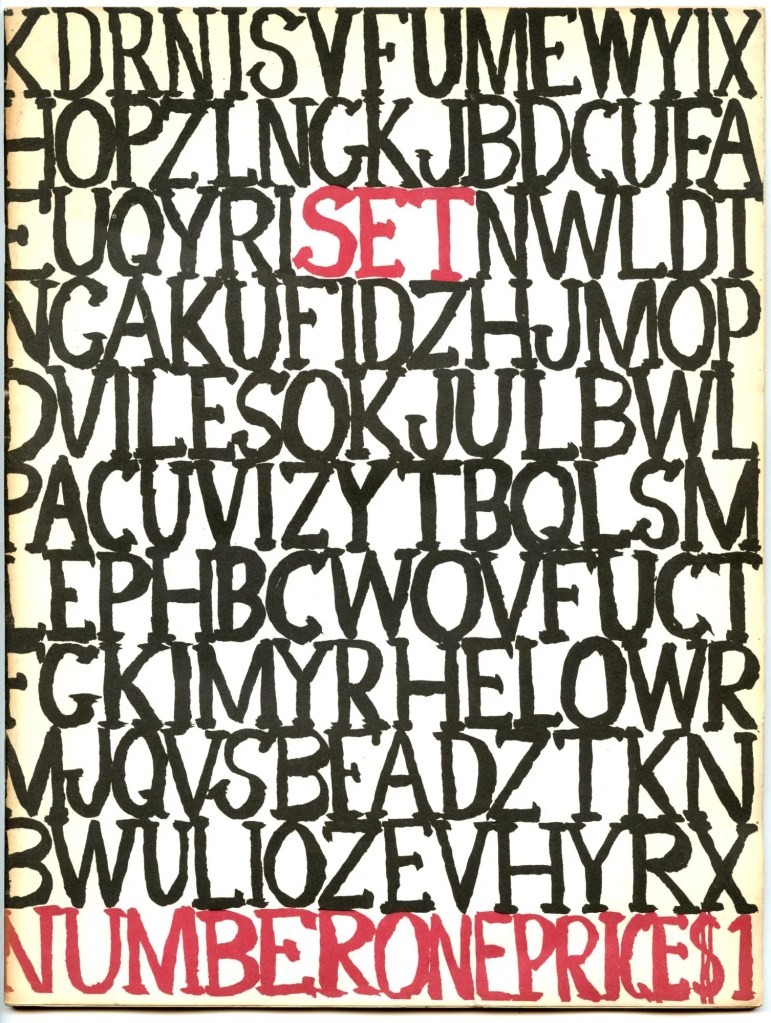
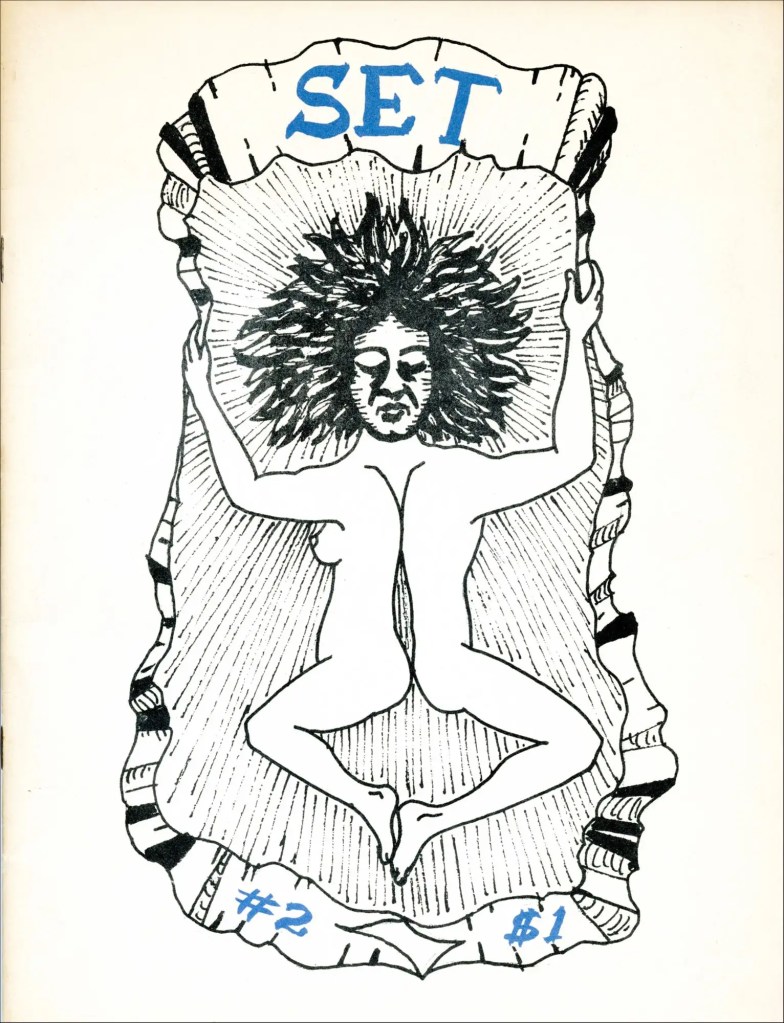
And then there is Gerrit Lansing — friend to Olson, Boston-based poet-mystic, and likely source of Olson’s interest in Crowley’s Book of Thoth. Lansing founded a journal called SET, named after the Egyptian god, and his own writing often anticipates aspects of Grant’s cosmology. Lansing’s 1966 collection, The Heavenly Tree Grows Downward, takes its title from Jung’s Alchemical Studies, specifically a chapter on the inverted tree — the same tree that Grant links to Typhonian gnosis.

What does this all mean?

It means that Olson’s poem, when read alongside the Typhonian Tradition, becomes legible as a magical document — not in the sense of intention, but in the sense of effect. It opens a channel. It participates in a current. It speaks in a tongue that other mystics, elsewhere, were also learning to speak.

And it means that Typhon, far from being a footnote in a forgotten myth, is an active force in the poetics of the twentieth century — a daimon of chaos, pluralism, darkness, and return.

Olson’s poem names him.
Grant’s rituals conjure him.
My reading recuperates him.

This is not necromancy. It is listening.

Initiation

The ancient Greeks imagined Tartaros as a pit, an anti-sky, an inverted dome beneath the earth. According to the Orphics and the mystery schools, however, Tartaros is not just a place housing criminals and monsters; rather, it is itself a kind of being: “the un-bounded first-existing entity from which the Light and the Cosmos are born.” Typhon, meanwhile, is this entity’s progeny; Typhon is the son of Tartaros and Gaia. He was the last god to challenge the supremacy of Zeus. When defeated by the latter’s thunderbolts, he was cast back into the pit from whence he came.

Readings of “MAXIMUS, FROM DOGTOWN—IV” hinge upon what one makes of the father chained in Tartaros. Grieve-Carlson entertains an interpretation different from the one I offer. In his view, “the father chained in Tartaros is not Typhon but rather Kronos, Zeus’s father. […]. Typhon appears much later in the poem, when Earth conceives him in an ‘act of love’ with Tartaros” (Grieve-Carlson 146). He argues that Olson re-tells the myth of Typhon just as Hesiod did. Typhon is violent and aggressive and would have become a tyrant over gods and men had Zeus not defeated him.

I think there’s more at stake here, however, than Grieve-Carlson lets on. As I see it, the problem with his reading is that he never grapples with the poem’s status as a letter of sorts mailed to the Psychedelic Review. Neither he nor the other critics he surveys ever address how the poem might be read in light of the circumstances of its publication.

Evidence to support my view appears elsewhere in Olson’s writings. Olson echoes in his “Letter to Elaine Feinstein” of May 1959, for instance, the same Zeus / Typhon battle that comes to occupy him in “MAXIMUS, FROM DOGTOWN—IV.” The ultimate “content” to which the poet gives form, sez Olson, is “multiplicity: originally, and repetitively, chaos—Tiamat: wot the Hindo-Europeans knocked out by giving the Old Man (Juice himself) all the lightning” (29). Hearing “Juice” as a homonym for “Zeus,” we find in Tiamat a twin for Typhon. While Tiamat was for ancient Mesopotamians a primordial goddess of the sea, and Typhon a monstrous serpent-god for the ancient Greeks, both are embodiments of chaos. Tiamat’s battle with Marduk is as much a version of ChaosKampf as is Typhon’s battle with Zeus.

The important point is that, for Olson, Chaos is the original condition of existence. It precedes Order. Order is formed — made, not found — and it is the duty of the poet to make it. This is what Olson hoped to communicate to the mushroom people.

Grieve-Carlson concludes his essay by describing the reading of The Maximus Poems as a form of “initiation,” as Olson writes as one initiated, one able to see and say in a special way. Olson makes use of a “metanastic poetics,” or “the technique of the mystic who returns, as a stranger in his own land, to tell about what he knows” (Martin, as quoted in Grieve-Carlson 148).

This reference to reading The Maximus Poems as a form of “initiation” intrigues me, as the writer other than Olson most closely associated with reinvention of Typhon is the British ceremonial magician Kenneth Grant (1924-2011). The latter led the Typhonian Ordo Templi Orientis (TOTO), a magical organization connected with Aleister Crowley’s Thelema religion. Grant was an apprentice of Crowley’s and a close friend of another famous twentieth-century occultist, Austin Osman Spare. Scholars like Henrik Bogdan refer to the occult current that springs from Grant as the “Typhonian tradition.” Grant announced the arrival of this tradition in 1973 and went on to write the nine books of his three Typhonian Trilogies.

Although influenced by Crowley and Thelema, Grant departs from other Thelemic currents by welcoming communication with “extraterrestrial entities” as a valid source of occult knowledge. The Typhonian tradition also embraces aspects of the Cthulhu mythos of horror writer H.P. Lovecraft.

While Grant’s announcement succeeds Olson’s poem by a decade, his ideas appear to have been informed by experiences not unlike Olson’s. Grant experimented with psychedelics in the 1960s, and included a chapter in his 1972 book The Magical Revival titled “Drugs and the Occult.”

And while I haven’t found any evidence suggesting that Grant knew anything of Olson’s work, Olson did have some interest in gnosticism and the occult. “Bridge-Work,” a short reading list of Olson’s dated “March, 1961” includes a reference to Crowley. Maud says Olson encountered Crowley’s The Book of Thoth (1944) while studying Tarot in the 1940s. Sources suggest that “Bridge-Work” was written with the help of Olson’s friend, Boston-based occult poet Gerrit Lansing. The copy of The Book of Thoth read by Olson probably belonged to Lansing. (See Division Leap’s A Catalog of Books From the Collection of Gerrit Lansing.) Olson was also deeply invested in Gnosticism in the years immediately before and after his sessions with Leary, and embraced Jung’s theory of synchronicity in the wake of those sessions. See the final essays in a volume of Olson’s called Proprioception (Four Seasons, 1965).

Grant’s innovation is to identify “the arch-monster Typhon, opponent to Zeus according to the Greek mythology…with the Egyptian goddess Taurt” (Bogdan 326). The latter is interpreted by Grant to be either the mother of Set or a feminine aspect of Set. “To Grant,” writes Bogdan, “the worship of Taurt or Typhon represented the oldest form of religion known to mankind, a religion centered on the worship of the stars and the sacred powers of procreation and sexuality” (Bogdan 326). Set, too, is an important figure in Grant’s system. “Grant maintained,” writes Bogdan, “that the Typhonian Tradition, and in particular the god Set, represents the ‘hidden,’ ‘concealed’ or repressed aspect of our psyche which it is vital to explore in order to reach gnosis or spiritual enlightenment” (Bogdan 326).

Lansing’s work seems to anticipate Grant’s in several ways. The two both think it important to honor the Egyptian god Set, for instance, with Lansing naming his early-60s poetry journal SET after him. And Grant’s focus on the Qliphoth, or the underground portion of the Tree of Life, seems present in the title of Lansing’s 1966 poetry collection The Heavenly Tree Grows Downward. For more on the “tree that grows downward,” Pierre Joris recommends looking at a section of Jung’s Alchemical Studies called “The Inverted Tree.”

Friday July 24, 2020

When the “Talking Android” makes his debut at Villa Lewaro in the affluent Westchester County suburb of Irvington-on-Hudson in Ishmael Reed’s novel Mumbo Jumbo, many of those in attendance are wearing “Cab Calloway for President buttons” (156). (Villa Lewaro, by the way, was the home of Madam C.J. Walker, an African-American woman recorded in the Guinness Book of World Records as the first female self-made millionaire in America. Walker is the focus of a Netflix miniseries called Self Made, released this past March.) Reed’s novel opens a portal of sorts; it encourages readers to imagine an alternate history. During the act of reading, one enters a state of uncertainty. Details that appear to be fictions nevertheless rhyme across time — Calloway’s bid, for instance, reminiscent today of Kanye’s. One is led to conclude, as the novel does in its closing lines, that “Time is a pendulum. Not a river. More akin to what goes around comes around” (218). When PaPa LaBas and Black Herman interrupt the debut by revealing the Talking Android’s true identity as Hubert “Safecracker” Gould, an Atonist in blackface, they move to arrest Gould and his sponsor, Hinckle Von Vampton. LaBas and Herman are interrupted in turn, however, when a Guianese art critic rises from his seat and demands that they give an account. “Explain rationally and soberly,” he says, “what they are guilty of. This is no kangaroo court, this is a free country” (160). To satisfy the critic’s demand, LaBas and Herman launch into a tale of ancient Egypt. We learn of an ancient form of theater involving ritual magic — one that “influenced the growth of crops and coaxed the cocks into procreation” (161). In this theater, Reed writes, “The processes of blooming were acted out by men and women dancers who imitated the process of fertilization” (161). The best of these dancers was Osiris. History is reimagined here as an ongoing conflict across the ages between followers of Osiris and followers of Osiris’s brother, “the stick crook and flail man” Set (162). “People hated Set,” writes Reed. “He went down as the 1st man to shut nature out of himself. He called it discipline. He is also the deity of the modern clerk, always tabulating, and perhaps invented taxes” (162). The text over which these opposing groups fight is (of course!) “the Book of Thoth, the 1st anthology written by the 1st choreographer” (164).