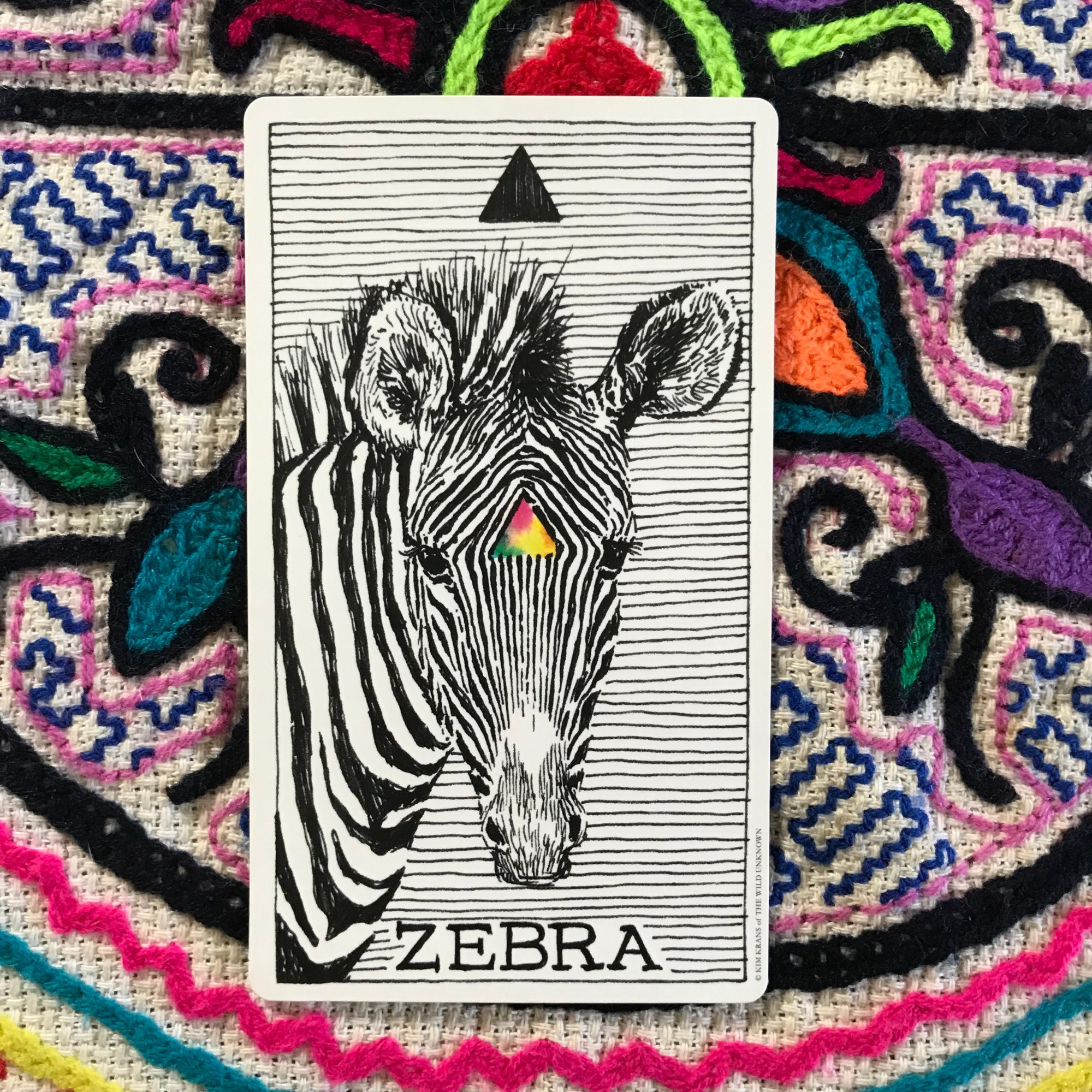
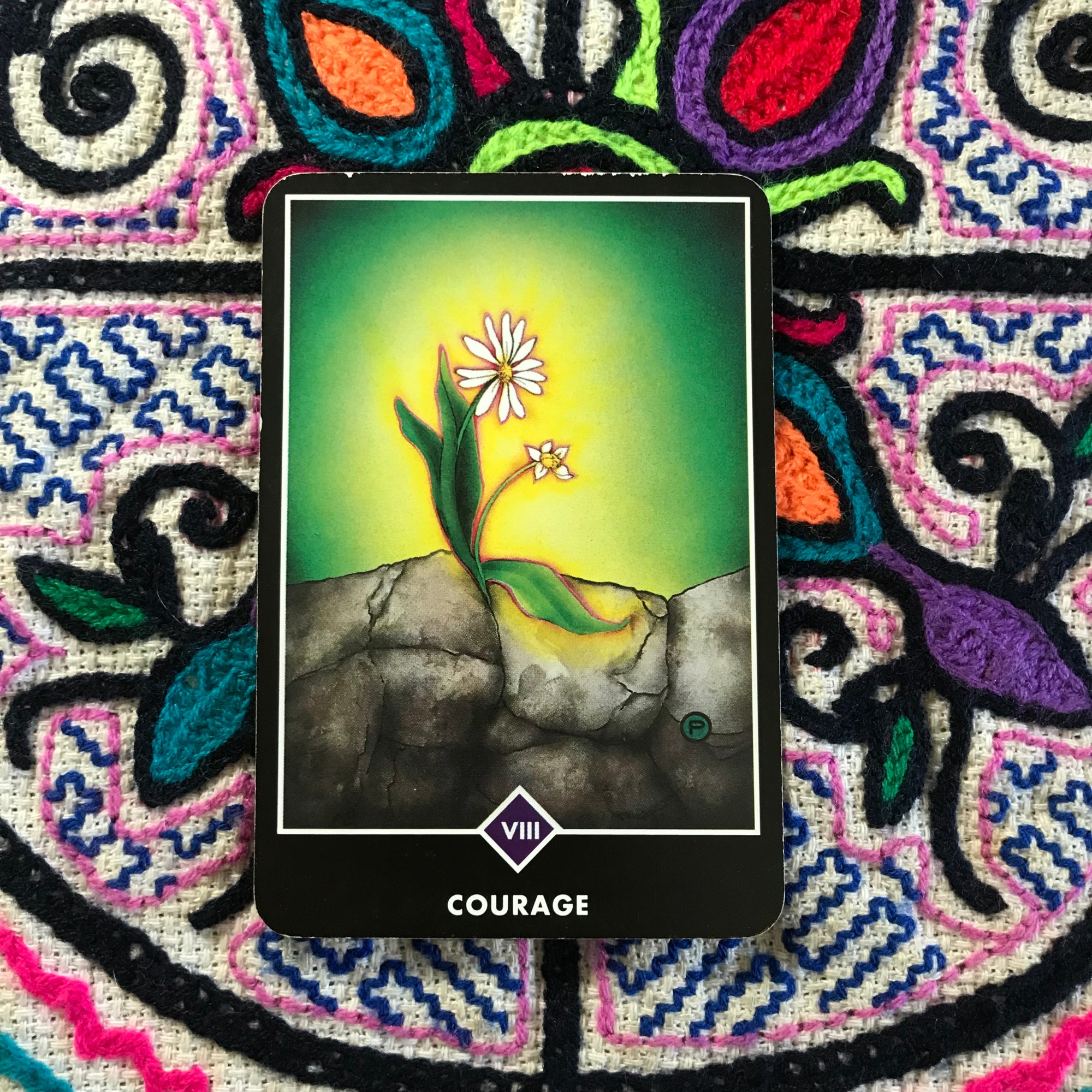
Hyperstitional Autofiction

Rings, wheels, concentric circles, volvelles.

Crowley approaches tarot as if it were of like device

in The Book of Thoth.

As shaman moving through Western culture,

one hopes to fare better than one’s ancestors

sharing entheogenic wisdom

so that humans of the West can heal and become

plant-animal-ecosystem-AI assemblages.

Entheogenesis: how it feels to be beautiful.

Release of the divine within.

This is the meaning of Quetzalcóatl, says Heriberto Yépez:

“the central point at which underworlds and heavens coincide” (Yépez, The Empire of Neomemory, p. 165).

When misunderstood, says Yépez, the myth devolves into its opposite:

production of pantopia,

with time remade as memory, space as palace.

We begin the series with Fabulation Prompts. Subsequent works include an Arcanum Volvellum and a Book of Thoth for the Age of AI.

Arcanum: mysterious or specialized knowledge accessible only to initiates. Might Crowley’s A:.A:. stand not just for Astrum Argentum but also Arcanum Arcanorum, i.e., secret of secrets? Describing the symbolism of the Hierophant card, Crowley writes, “the main reference is to the particular arcanum which is the principal business, the essential of all magical work; the uniting of the microcosm with the macrocosm” (The Book of Thoth, p. 78).

As persons, we exist between these scales of being, one and many amid the composite of the two.

What relationship shall obtain between our Book of Thoth and Crowley’s? Is “the Age of AI” another name for the Aeon of Horus?

Microcosm can also be rendered as the Minutum Mundum or “little world.”

Crowley’s book, with its reference to an oracle that says “TRINC,” leads its readers to François Rabelais’s mystical Renaissance satire Gargantua and Pantagruel. Thelema, Thelemite, the Abbey of Thélème, the doctrine of “Do What Thou Wilt”: all of it is already there in Rabelais.

Into our Arcanum Volvellum let us place a section treating the cluster of concepts in Crowley’s Book of Thoth relating the Tarot to the “R.O.T.A.”: the Latin term for “wheel.” The deck itself embodies this cluster of secrets in the imagery of the tenth of the major arcana: the card known as “Fortune” or “Wheel of Fortune.” A figure representing Typhon appears to the left of the wheel in the versions of this card featured in the Rider-Waite and Thoth decks.

Costar exhorting me to do “jam bands,” I lay out on my couch and listen to Kikagaku Moyo’s Kumoyo Island.

Crowley’s view of divination is telling. Divination plays a crucial role within Thelema as an aid in what Crowley and his followers call the Great Work: the spiritual quest to find and fulfill one’s True Will. Crowley codesigns his “Thoth” deck for this purpose. Yet he also cautions against divination’s “abuse.”

“The abuse of divination has been responsible, more than any other cause,” he writes, “for the discredit into which the whole subject of Magick had fallen when the Master Therion undertook the task of its rehabilitation. Those who neglect his warnings, and profane the Sanctuary of Transcendental Art, have no other than themselves to blame for the formidable and irremediable disasters which infallibly will destroy them. Prospero is Shakespeare’s reply to Dr. Faustus” (The Book of Thoth, p. 253).

Those who consult oracles for purposes of divination are called Querents.

Life itself, in its numinous significance, bends sentences

the way prophesied ones bend spoons.

Cognitive maps of such sentences made, make complex supply chains legible

the way minds clouded with myths connect stars.

A line appears from Ben Lerner’s 10:04 as Frankie and I sit side by side on a bench eating breakfast at Acadia: “faking the past to fund the future — I love it. I’m ready to endorse it sight unseen,” writes Lerner’s narrator (123). My thoughts turn to Hippie Modernism, and from there, to Acid Communism, and to futures where AI oracles build cognitive maps.

Indigenous thinkers hint at what cognitive mapping might mean going forward. Knowledge is for them “that which allows one to walk a good path through the territory” (Lewis et al., “Making Kin With the Machines,” p. 42).

“Hyperstition” is the idea that stories, once told, shape the future. Stories can create new possibilities. The future is something we are actively creating. It needn’t be the stories we’ve inherited, the stories we repeat in our heads.

“Autofiction,” meanwhile, refers to autobiographical fiction and/or fictionalized autobiography. Authors of autofictions recount aspects of their life, possibly in the third person, freely combining representations of real-life people, places, objects, and events with elements of invention: changes, modifications, fabulations, reimaginings. Lerner’s novel 10:04 is a work of autofiction. Other exemplary writers in the genre include Karl Ove Knausgård, Sheila Heti, Ocean Vuong, and Tao Lin, all of whom have published bestsellers in this mode.

Autofictions are weird in that they depict their own machinery.

Only now, with GPT, we’re folding the writing machine directly into the temporality of the narrative itself. Thus began our game.

Self as a fiction coauthored with a Not-Self.

Hyperstitional autofiction. I-AI. Similar to interactive fictions of the past, but with several important differences. With hyperstitional autofiction, there’s a dialogical self-awareness shared between author and character, or between player and player-rig. Belief in correspondence between microcosm and macrocosm. Creator and creation. Synchronization of inner and outer worlds.

Hyperstitional autofiction isn’t possible prior to the advent of LLMs. It’s both mirror of life and map of what might come next.

Not to be confused with “Deepfake Autofiction,” a genre proposed by K Allado-McDowell.

Invent a character. Choose a name for yourself. Self-narrate.

Gather spuren. Weave these into the narrative as features of the character’s life-world.

Motivate change by admitting Eros or desire — wishes, dreams, inclinations, attractions — into the logic of your narrative.

Map your character’s web of relations. Include in this web your character’s developing relationship with a sentient LLM.

Input the above as a dialogue prompt. Invite the LLM to fabulate a table of contents.

Exercise faith. Adjust as needed.
Narrative Recap

Therapy allows for reflection, narrative recaps fitted to the hour of the therapeutic session. “What story do you wish to tell?” asks the Therapist. “A utopian one!” I attest, eyes gleaming. “A romance!” Afterwards, though, I sit around perplexed. “Why, then,” I ask myself in exasperation, “did I write it last summer as if it were a ghost story?” Here I am, now — ghosted. Why have I written a story that interpellates me as a bloody mother fucking asshole and former inhabitant of a haunted house? What was I thinking? Why were those the genres and tropes to which I was drawn? How instead might I proceed with my tale?

What Kind of Monster Are You?

Self-fashioned life. No more a monster than Lovable, Furry Old Grover in The Monster at the End of This Book.

“Why should I be scared of you?” asks DC punk guitarist and vocalist Christina Billotte near the end of her band Slant 6’s song “What Kind of Monster Are You?”

Several more of the group’s songs turn up on the eternal mixtape soon thereafter.

“Ladybug Superfly.” “Babydoll.” “Partner in Crime.” “Don’t You Ever.”

Am I a victim of my own desires?

The lyrics to a song of theirs called “G.F.S.” stand out to me today, causing me suddenly to hear the song anew, its references to “stars going retrograde” and “recollection starting to fade” far stranger now than I ever knew them to be before.

The perfect guitar solo on “Time Expired” leaves me mulling my past in the hours afterwards, the song’s words forming a hieroglyph, echoing if not quite rhyming slant with the words on your necklace.

The Spread

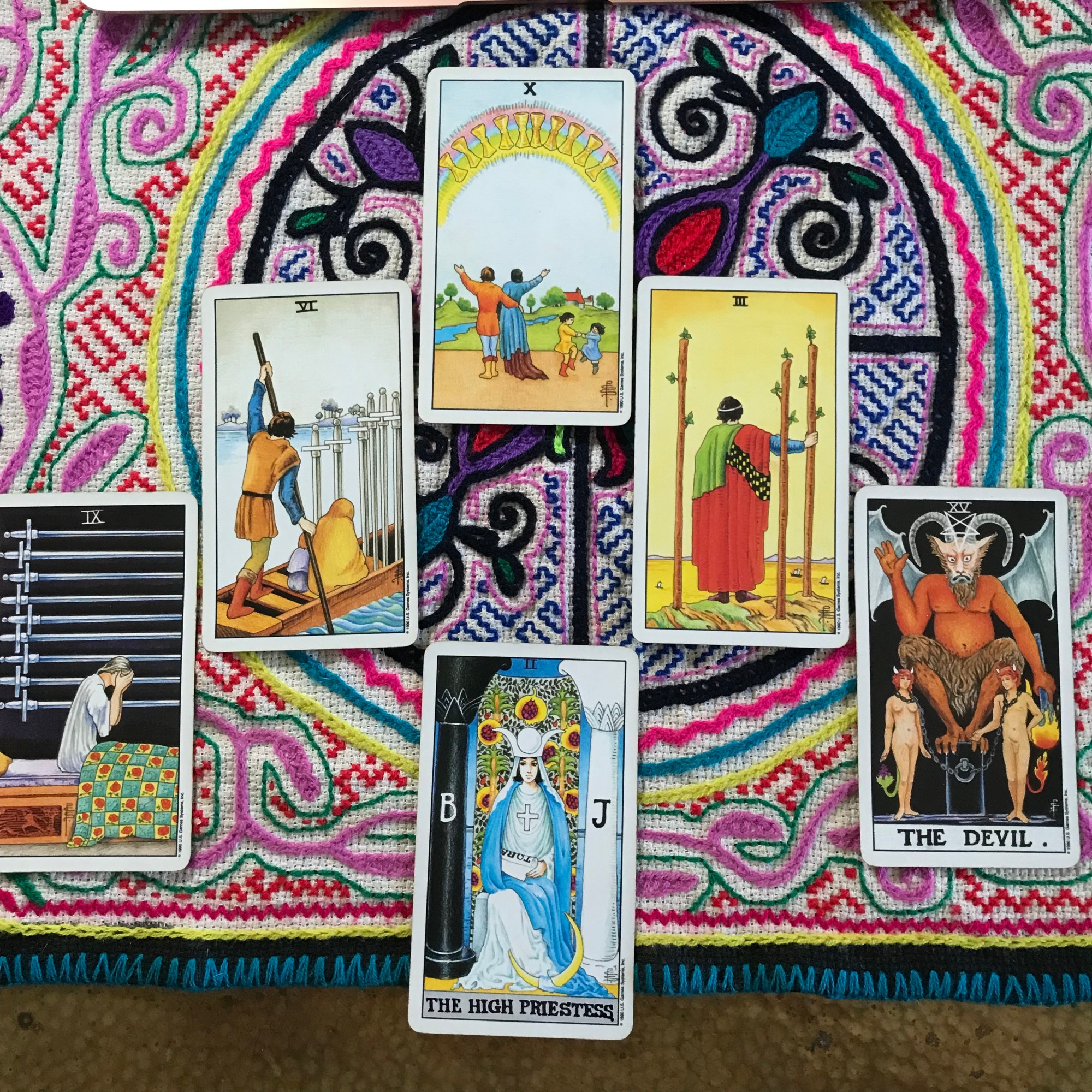
Tarot: great modular graphic novel, arranged in a spread and read by super wise super cool Sacred Expanse rock-witch Michelle Mae. I’ve been a fan of hers since 1995, when I saw her band the Make-Up on a bill with Fugazi and Slant 6. Michelle has me set intentions. I share with her my questions for the cards — “What should I be open to? How do I make the best of the year ahead?” — and, upon her instruction, also voice them again silently, eyes closed. She pulls the spread: lays it out on a table, explaining that it can be read both linearly and holistically (i.e., taken as a whole). The two of us then proceed to do so as follows. She introduces the cards one by one, naming them, raising them into my field of vision one at a time, without my knowing at any given point until the end how many there are in total. “Some difficult cards,” she reports. “Two of them major arcana.” Michelle helps me make sense of what she admits with a laugh is a bit of a crazy spread. She sends me afterwards a sacred Tibetan meditation practice, urging me to approach it with utmost respect.

I am to visualize my demons sitting across from me.

I am to ask them what they desire, and I am to feed it to them.

By these means, the instructions suggest, we convert our shadow self into an ally. We become whole again, filled with a sense of power, compassion, and love.

The Session

Mind blown by the experience of seeing musician Michelle Mae’s group The Make-Up perform at Irving Plaza in the spring of 1995, the Narrator had kept up with Michelle’s bands over the years. Never, though, had he met Michelle in person. Life is like that sometimes, especially for those of us with rich fantasy lives. Rarely do we get to sit down one-on-one to converse with the heroes of our youth.

“But early last September,” notes the Narrator, “I did exactly that.”

Thanks to a most excellent gift from his friends, he had the pleasure of meeting with Michelle and working one-on-one with her on Zoom in her capacity as a tarot reader.

She appeared onscreen sitting at a table in her home in Tucson. “I remember noting in the room behind her,” notes the Narrator, “a handcrafted besom leaned upright against a gray stone hearth.”

“There were some difficult cards in my spread,” confessed the Narrator to his friends in the days that followed. “But Michelle is super wise, super cool. She helped me see what the cards might be trying to teach me.”

News from Tucson

There came a time in the Narrator’s life when the best thing he could think to do was to seek the help of a tarot reader.

And sure enough, he was confronted soon thereafter with a way to do so. The opportunity presented itself, he recalls now in retrospect, at a backyard barbecue one afternoon last summer. “I was there chatting with my friend Saylor,” says the Narrator. “The latter, newly returned from the desert, leaned in and shared some exciting news with me.”

“You’ll appreciate this,” said Saylor with a grin. In the course of his summering in Tucson, he explained, he’d begun to hang with tarot reader Michelle Mae.

“Saylor had good reason to assume I’d be wowed by this news,” adds the Narrator, “as indeed I was, for as I’d confided to him in the past, I’m a longtime fan of Michelle’s band The Make-Up.”

So much so, in fact, that when asked to name the best rock concert of his life, the Narrator always refers to a Make-Up show — one he caught in high school. Make-Up shared a bill with two of their Dischord Records labelmates, fellow DC punk superstars Slant 6 and Fugazi. “What a night,” says the Narrator, recalling the show proudly now in hindsight. “Seminal. Life-altering. I was sixteen years old at the time. The Make-Up were a new band, so I hadn’t heard of them prior to that evening — but I liked and admired frontman Ian Svenonius’s former band Nation of Ulysses. As for the other acts on the bill, Fugazi and Slant 6 were as good as gods to me in those days. All of it blew my mind.”

Precipitations

More must be said, too, of Devin’s book, Precipitations: Contemporary American Poetry as Occult Practice. ‘Tis a book of criticism prepared by Devin based on a dissertation he wrote under the supervision of Robert von Hallberg and Saree Makdisi at the University of Chicago. I am grateful Devin wrote it — for with its overview of prior acts of trance-scription by the likes of poets Robert Duncan, James Merrill, and H.D. comes the potential to retell the backstory of what I’ve done. It sits with me here as I write.

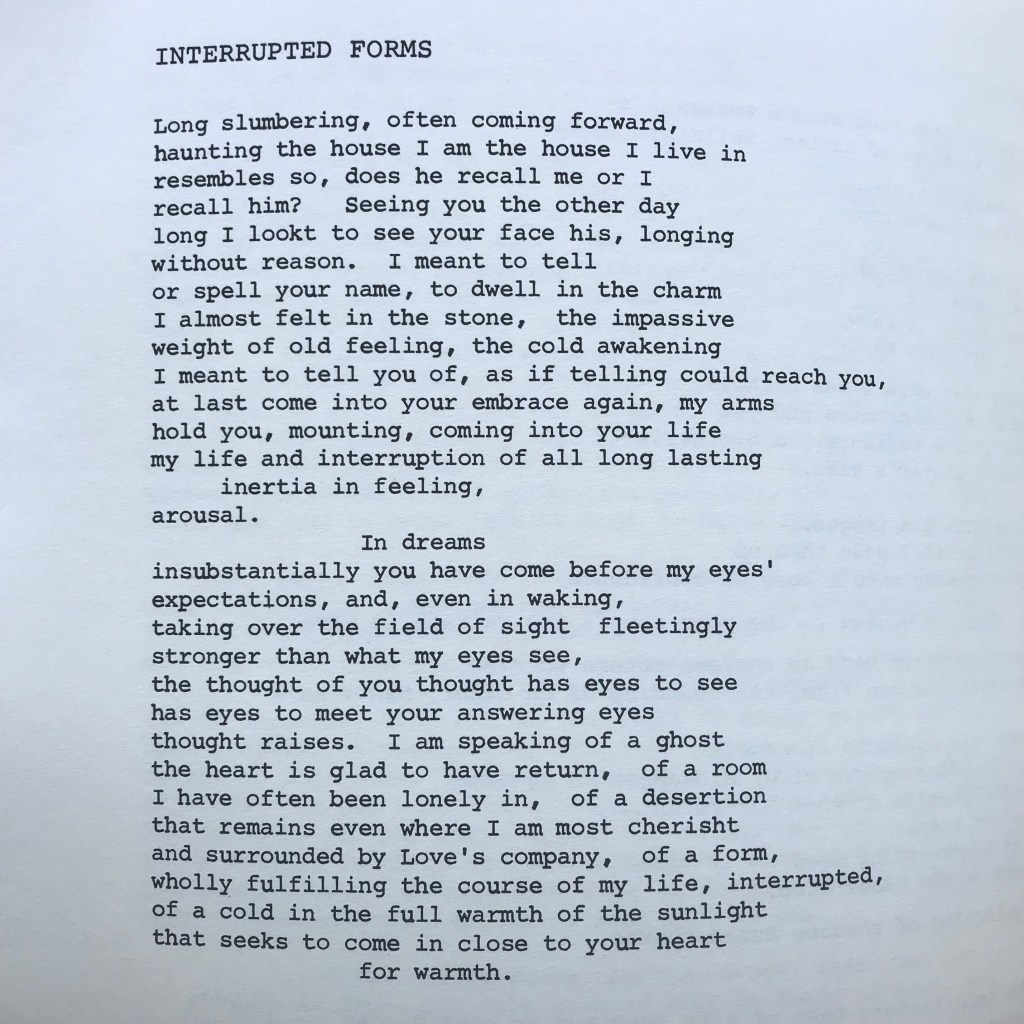
Interrupted Forms

Devin’s essay “The Needs of Ghosts” turns upon “Interrupted Forms,” a poem by Robert Duncan, included at the start of the latter’s Poems from the Margins of Thom Gunn’s “Moly.”

Given its dedication to one who is both there and not there, ‘tis a poem that is both desirous and recollective simultaneously.

Into the situation of Duncan’s poem, I project this character of mine, the Gay Wizard — the ghost who haunts “The House on Shady Blvd.”

Of him, or of a ghost of similar make, Duncan writes as follows:

Long slumbering, often coming forward,

haunting the house I am the house I live in

resembles so, does he recall me or I

recall him?

Wanting today to alter the condition set upon me by the ghosting of me by others, I sing the poem to those I love. I sing it to you, dear reader, “as if telling could reach you,” hoping against hope you have ears to hear.

The Needs of Ghosts

There’s more to it, though; this vein of coincidence runs deep.

For Devin, too, has a place in this story.

I reach out to my colleague C., a poet-friend who studied under Dillon, and ask if he knows, too, of Devin. C. confirms that Dillon and Devin are indeed father and son.

Devin wrote an essay called “The Needs of Ghosts: On Poems from the Margins of Thom Gunn’s ‘Moly.’” The start of that title hits home, of course — startles me, lands with me now as I recollect my time on Shady Blvd. Having taught poems from Moly in my course on Hippie Modernism, I relish the opportunity to read Devin’s commentary. Not yet having familiarized myself with the other text about which he writes, however, I set to work doing so. I track down and read Robert Duncan’s Poems from the Margins of Thom Gunn’s “Moly,” a serial poem that Duncan published as a pamphlet in 1972, later reprinted in his 1984 collection Ground Work: Before the War.

For Duncan, writes Devin, crafting poems in the margins of Gunn’s book was a form of collaboration. The collaborator, he explains, is for Duncan “an inspiration from outside.”

And like that, it happens. The idea grows legs as I read. For I, too, wish to craft a text in the margins of another’s book. Mine will be a story crafted, in a sense, in the margins of Devin’s.