Time to chop herbs, peel potatoes as Sarah pulls pie from the oven. Time to prepare dinner. Sarah and I gathered leaves earlier today on our walk through the neighborhood. We arrange them now into a centerpiece. Turkey in the oven, I dip into Our History is the Future, a book about the Standing Rock uprising and the history of Indigenous resistance to US colonialism by scholar-activist Nick Estes. It’s a lot to juggle — as is every Thanksgiving. But this one is especially so, given that we’re also on the verge of becoming parents. DeBarge sings to me about dancing to the beat of the rhythm of the night, worries left behind.
Tag: Books
Monday November 25, 2019
Fall foliage fills the day with color. Rich reds and yellows appear all around me as I drive around town collecting tools and parts, a would-be repairman. Maria Montessori’s been on my mind lately. I’ve been reading a handbook she wrote for American parents and teachers, originally published in 1914. Her approach to teaching, the famous Montessori Method, involved introduction of didactic material into children’s playhouses. Good to a point, I suppose — but I’d rather be playing multi-dimensional chess. Fredric Jameson likens our present reality to the latter in his new book Allegory and Ideology. The game is one where “a number of distinct chessboards coexist simultaneously with distinct configurations of forces on each, so that a move on any one of these boards has distinct but unforeseeable consequences for the configurations and the relative power-relations on the others” (191). Similar games appear in Sun Ra’s Space is the Place and Brian C. Short’s novel New People of the Flat Earth. “We live in just such a world,” Jameson writes, “just such a totality” (191).
Friday November 22, 2019
My students seem less televisual than they were in the past — though perhaps we’ve just steered conversation elsewhere, constructing through our shared readings a shared grammar. Reading allegory trains us to think allegorically. Texts assemble into vast systems of meaning. We become acquainted with what’s happening. A world pregnant with hope and possibility.
Saturday November 16, 2019
A colleague of mine who has become a friend over the years, both of us members of a shared reading group, donated some of his books to a local thrift store, whereupon I scooped them up as if the cosmos had willed them toward me. All of this happened several years ago; yet as I sat today, mind churning with topics recommended or observed, my thoughts wandered from a counterfactual, alternate-history version of Jacques Demy’s Model Shop, starring not Gary Lockwood but Demy’s original choice for the lead, a then-unknown Harrison Ford. There I was imagining imaginary stills from the imaginary LA of this imaginary film, when with a wash of emotion I happened upon one of these books I’d scored from my friend: a Beacon Press trade paperback of Herbert Marcuse’s Eros and Civilization. It’s a book I should read, given what I teach. “Beyond the Reality Principle” is where it’s at, as is “Political Preface 1966,” written a decade after the book’s initial appearance. For Marcuse, a successful revolution would be one that makes the human body “an instrument of pleasure rather than labor” (xv), transforming work into play. Attempting to do my part, I pull an LP from the shelves in my basement and bask in the choir, percussion, and wolfsong of tracks like Paul Winter’s “Kyrie.”
William Irwin Thompson interjects, speaking on behalf of coming together as a mass of music rather than matter. Ecology appears here as it should, a science not of scarcity but of sacred geometry. Gary Snyder delivers his “Prayer for the Great Family,” a poem from his book Turtle Island. Let animals and plants once again be our teachers and guides.
Thursday November 14, 2019
Songs play in my mind as if echoing down a long corridor or hallway. An auditory memory, some imaginary or half-remembered AM gold, retro in the way of Ariel Pink. Lo-fi, hypnagogic, like a band practice heard from the street. After the sixties, we land in Philip K. Dick’s drug-war dystopia A Scanner Darkly, reading the book’s critique of McDonalds hamburgers while eating McDonalds french fries. Dick’s observations about the spread of capitalist reality appear beside the buy-sell calculations of the book’s drug-addict protagonist, capitalism thus glimpsed and understood as a system that compels us to think and behave like addicts hooked on “product.” It’s a bleak book, its cop characters as stunted and debased as its dopers — the two ultimately the same, in fact, in the case of the protagonist, an undercover narcotics officer who also uses and deals a drug called Substance D.
Wednesday November 13, 2019
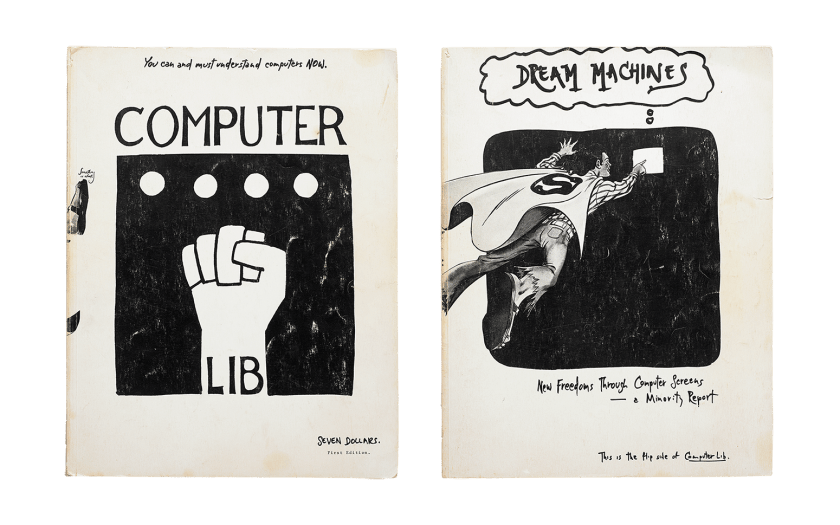
Governments are like media providers, designers of a simulation, a game-world users are coerced into enduring. Why, amid all the many games we could be playing here in our sandbox cosmos, did we get stuck with this one? How do we deprogram it, how do we take back the means of production so as to play new mind games together? John Lennon said “Love is the answer.” Love not war, one day at a time. As always, easier said than done. If only I had time to read Ted Nelson’s book Computer Lib / Dream Machines. At the beginning of Dream Machines (the reverse side of Computer Lib), Nelson appends a section titled “Author’s Counterculture Credentials,” where he describes himself as “Photographer for a year at Dr. Lilly’s dolphin lab (Communication Research Institute, Miami, Florida). Attendee of the Great Woodstock Festival (like many others), and it changed my life (as others have reported). What we are all looking for is not where we thought it was.” All of which leaves me wondering: at what point was Nelson first turned on?
Sunday November 10, 2019
New objects arrive into the lifeworld, gifts from friends and family, well-wishing from near and afar. Some are even hand-crafted — a granny squares knit blanket, an alphabet book, a stuffed creature — made with care specifically for our daughter. These objects return me to the place in my memory palace featuring Sadie Plant’s book Zeros + Ones, a book from the future somehow released in the past, ahead of its time. It’s a steampunk biography about Lord Byron and his wife Annabella’s only child, the nineteenth century mathematician Ada Lovelace. The book focuses especially on the cause for Lovelace’s fame, her encounters with the engineer Charles Babbage’s early computer, the Difference Engine. Lovelace was the first person to recognize the full potential of computing machines, designing and publishing the first algorithm intended to be used by such a machine, thus in a sense making her the first computer programmer. Her biography follows Babbage in calling her the “Enchantress of Numbers.” I read Plant’s book decades ago. What would I find in it if I read it again today? Would I find it frustrating? Perhaps even a bit frightening? Or would I find something worth retrieving — a major or minor arcana? Perhaps the Queen of Wands? Where did Babbage and Lovelace stand, and to what extent did their work contribute, with regard to empire? Byron certainly wasn’t the most admirable character. I prefer different stories, different rabbit holes, bunnies chewing on carrots.
Thursday November 7, 2019
NYC producer Cofaxx’s “Isles” sets the scene.
I read around a bit as clouds roll in. A book passed briefly through my lifeworld today: The Complete Van Book, filled with images and descriptions of shag-carpeted nomadic 70s utopias on wheels. Vans with names like The Sun and the Moon, with instructions in back for how to custom-build your own. Time to sit at a red table eating Chinese takeout. Time to revive myths and legends. “What we are seeing as we look straight ahead to the back wall,” writes Frances A. Yates as if she were Socrates speaking to those who live in the Cave, “is the tiring house wall at the Globe, not the whole of it but only the two lower levels; the ground level with the three entrances; the second level with the terrace and the chamber. We do not see the third level because we are under the heavens which are projecting invisibly above us from below the third tier of the tiring house wall” (The Art of Memory, p. 347). How’s that for a cognitive map!
Wednesday November 6, 2019
Reading One Flew Over the Cuckoo’s Nest again with students, I find us wanting as readers to separate the book’s countercultural critique of the Combine from its racism and its misogyny. On race, as on gender, Kesey maps power-relationality ass-backwards. The novel erupts into an episode of cruel racial violence when black orderlies threaten to hose down the book’s white male patients. When one of the orderlies sprays a germophobic character named George, the book’s redheaded TV-cowboy brawler protagonist Randle Patrick McMurphy lashes out with racial epithets and starts swinging. In reality, of course, it was black children, not white men, who were sprayed with fire hoses on the streets of Birmingham, AL by racist white police officers on May 3, 1963, just one year after the novel’s publication. By teaching the book, the country’s racism lies there exposed: Oregon’s history as a white-only state, with laws forbidding black people from living in its borders upon its entry into the union in the midnineteenth century; the persistence of antiblack sentiment more than a hundred years later even among 1960s counterculturalists like Kesey. These are sobering facts, are they not? Even among those who had found the enlightenment of LSD, these ideas persisted. Granted, in Kesey’s case, enlightenment came courtesy of MK-Ultra. Not the most auspicious set and setting. Yet this, too, is part of the tale’s appeal. Kesey was there, present as a participant in events of world-historical importance, the effects of which are still being felt today.
Tuesday November 5, 2019
Glancing out my back door I glimpse a black and white cat on my deck, beckoned perhaps by my drum-play. One of my teenage dreams involved touring with a band, improvising with instruments night after night, town after town. I was never much of a traveler, lacking wealth, talent, and initiative. Yet still I got around. Made it here and there. Hence the “literary turn,” the turn to books and careers based on them. Books allowed me to spin off in any number of directions, across many dimensions, albeit mediated by language. Where to tonight? I slip on Joe Henderson and Alice Coltrane’s The Elements and read about obstacles to black homeownership as documented with painstaking detail in Keeanga-Yamahtta Taylor’s new book Race for Profit.
 Trance-Scripts