White roses overgrow a trellis beside the driveway. I admire them from atop my perch on my front stoop as I shelter in place. Look at all the lovely everything, the leafy and flowery manifold Earth, sunlit and glorious, waving in the wind! A softness, a gentleness, enters into one’s manner. A grey tabby that likes to visit now and then sleeps out on my porch. I let it. Dreamboat baby tell all. At some point, though, I plan to grill some hot dogs. In a journal I note down the following: “In an imaginary interview published in his book Revolution for the Hell of It, Abbie Hoffman uses language borrowed from his mentor Abraham Maslow to signal how his own approach and vision differed from those of his contemporaries in the New Left. Movements for change should be built, he says, not on sacrifice, dedication, responsibility, anger, frustration, and guilt, but on fun. ‘When I say fun,’ he tells the interviewer, ‘I mean an experience so intense that you actualize your full potential. You become LIFE. LIFE IS FUN’ (61-62).”
Tag: counterculture
Thursday April 2, 2020
Abbie Hoffman was a countercultural revolutionary, but he was also a comedian, wise and gleeful in his writings and his actions. When the government came after him, he went underground, lived as a fugitive. Perhaps I should teach a course on prison writing: Antonio Gramsci, Martin Luther King Jr., Eldridge Cleaver, George Jackson, John Sinclair. But man, that’s a lot of weight to carry. Better to stick with joyous liberatory texts like Hoffman’s Revolution for the Hell of It (written under the alias “FREE”), or direct action Movement manifestos like Jerry Rubin’s DO IT! Rubin, of course, dodged Abbie’s fate — and in a sense, dodged out of the cultural revolution, exploring various West Coast New Age self-help / therapy groups in the 1970s and transforming into a Reagan-era Yuppie by the time of his former comrade’s resurfacing in the 1980s. The two paired up and performed together in a countrywide speaking tour as political sparring partners.
Be that as it may, I remain charmed by Rubin’s 1976 memoir of his time in the human potential movement, Growing (Up) at 37. Point being, LSD was various in its effects, serving at one and the same time as catalyst for, implement of, and impediment to the era’s cultural revolution.
Wednesday April 1, 2020
I circle back as in a refrain toward M.C. Richards, her theme “the act of centering” returning again amid radical declarations, revolutionary self-fashionings, “Movement” speeches, street writings, prison writings, books like Abbie Hoffman’s Woodstock Nation and John Sinclair’s Guitar Army. The personal was fused with the political for these authors. They took psychedelic civil disobedience as locally staged stoned action and amplified it via seizure of airwaves, campuses, streets, courts of law. Kesey and the Pranksters did something similar a few years earlier, though without the militant intent. Theirs was more of a traveling roadshow, coast-to-coast trips across America, La Honda to New York and back. Minds changing themselves on the road, and in so doing, changing the minds of others.
Saturday March 28, 2020
The life of ’60s counterculture icon Abbie Hoffman ought to be read not just in light of the Marxism of Herbert Marcuse, whom Hoffman studied under while an undergrad at Brandeis, but also in light of the humanistic psychology of another of Abbie’s mentors at Brandeis, the famous psychologist Abraham Maslow. Abbie was a self-actualizer, a seeker of peak experiences, his writing in books like Woodstock Nation spontaneous prose performances of life lived hopefully in pursuit of revolutionary overthrow of the police state he saw and experienced around him, the “PIG NATION.” There’s a lot of Ego in this performance, but it’s an Ego self-identified with a movement in potentia, like the Whitman of “Song of Myself” or the Ginsberg of “America.” A collective voice coaxing participation in revolutionary transformation of being. Hoffman learned to perform revolution as living theater using the techniques of Artaud and the Diggers. Unlike those precursors, however, Abbie staged his happenings as guerilla seizures of the capitalist opponent’s mass media. The latter became the unwitting narrators and documenters — and to some extent, participants — in Abbie’s dramas. The story continues, carries over, into other books of the era: Ed Sanders’s Shards of God, Jerry Rubin’s DO IT! and We Are Everywhere. Time to visit Peter Coyote for criticism of some of this, and for more on the Diggers. Yet what a riveting performance! Studs Terkel described it as “ebullience and despair rolled into one.” Paul Krassner’s tale of taking acid before taking the witness stand at the Chicago Conspiracy Trial adds another level of anarchic psychedelic zaniness to all of this.
Monday February 3, 2020
They: the standardizers, the calculators, the settlers. They convert by use of culture, / but cultures need not comply. We can learn other languages, teach other literatures, wise up, rise up.
Friday January 24, 2020
Breathe, relax, listen around. Ask into a phone, “Who are you, love?” and type, “Bless you!” Seek out “America Needs Indians,” the multimedia show that Stewart Brand performed at the 1966 San Francisco Trips Festival. The show placard for the festival lists “America Needs Indians” as the first part of a double bill on Friday January 21, the first night of the three-day festival. It describes the event as follows: “AMERICA NEEDS INDIANS — Sensorium 9. By Stewart Brand and Zach Stewart. 600 slides, 2 movies, 4 sound tracks, flowers, food, rock ‘n’ roll, Eagle Bone Whistle, Thunderstorm, live Cheyenne Tipi, Chippewas, Sioux, Blackfeet, Tlingit, Makah, Pomo and Miwuk, plus anthropologists.” If ever I happened upon a time machine, the Trips Festival is certainly among the events of the past I’d visit. Charles Perry describes the festival in his history of Haight-Ashbury — though he says no more about “America Needs Indians” than that it was “mournfully out of place in the rackety, echoing space of Longshoremen’s Hall.” Ben Van Meter shot footage at the festival, eventually releasing a short called S.F. Trips Festival, An Opening (1966). Look, too, for a feature film of his called Acid Mantra or Rebirth of a Nation (1968). Wheeler Winston Dixon discusses Van Meter in his book The Exploding Eye: A Re-Visionary History of 1960s American Experimental Cinema.
Wednesday November 13, 2019
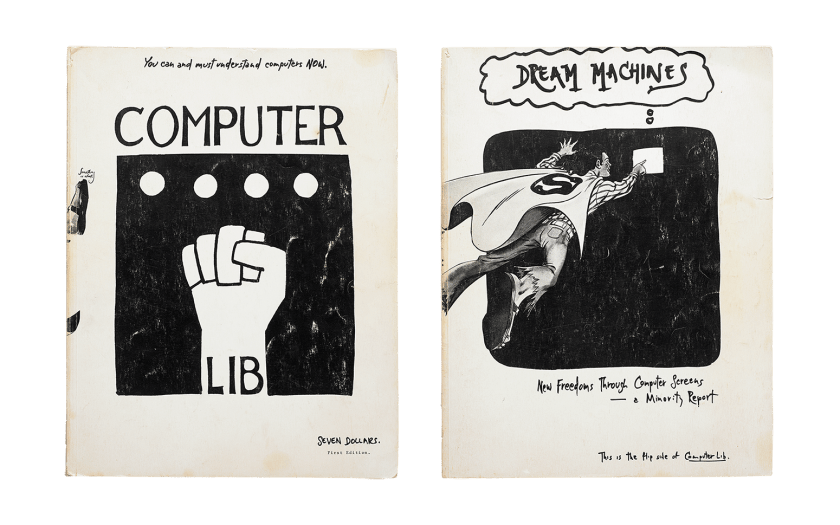
Governments are like media providers, designers of a simulation, a game-world users are coerced into enduring. Why, amid all the many games we could be playing here in our sandbox cosmos, did we get stuck with this one? How do we deprogram it, how do we take back the means of production so as to play new mind games together? John Lennon said “Love is the answer.” Love not war, one day at a time. As always, easier said than done. If only I had time to read Ted Nelson’s book Computer Lib / Dream Machines. At the beginning of Dream Machines (the reverse side of Computer Lib), Nelson appends a section titled “Author’s Counterculture Credentials,” where he describes himself as “Photographer for a year at Dr. Lilly’s dolphin lab (Communication Research Institute, Miami, Florida). Attendee of the Great Woodstock Festival (like many others), and it changed my life (as others have reported). What we are all looking for is not where we thought it was.” All of which leaves me wondering: at what point was Nelson first turned on?
Monday November 11, 2019
The “heroes” that we encounter in literatures about altered states are individuals and groups, authors and movements, creators of counterculture, figures who rebel against systems stacked against them — because some of us can’t breathe. Some of us feel trapped economically. Others of us feel trapped educationally, betrayed by those trained in STEM. And yet we must practice love anyway, despite, because. Time to revisit the debates internal to counterculture, among the Whole Earthers and others, about technology and ecology. Bring ecofeminists and cyberfeminists and Afrofuturists into account when re-examining these debates. But do so while staring at crows atop a pine tree. Allow time to admire patterns of sunlight and shadow amid fallen leaves. Then up and about: gather the books, assemble the argument. Defend pluralist methodologies and anarchist epistemologies. Critique capitalist science and its institutionalization of consciousness. But do so as an Eco-Marxist, acknowledging climate crisis as a real condition of existence — the Pascal’s Wager of our time.
Wednesday November 6, 2019
Reading One Flew Over the Cuckoo’s Nest again with students, I find us wanting as readers to separate the book’s countercultural critique of the Combine from its racism and its misogyny. On race, as on gender, Kesey maps power-relationality ass-backwards. The novel erupts into an episode of cruel racial violence when black orderlies threaten to hose down the book’s white male patients. When one of the orderlies sprays a germophobic character named George, the book’s redheaded TV-cowboy brawler protagonist Randle Patrick McMurphy lashes out with racial epithets and starts swinging. In reality, of course, it was black children, not white men, who were sprayed with fire hoses on the streets of Birmingham, AL by racist white police officers on May 3, 1963, just one year after the novel’s publication. By teaching the book, the country’s racism lies there exposed: Oregon’s history as a white-only state, with laws forbidding black people from living in its borders upon its entry into the union in the midnineteenth century; the persistence of antiblack sentiment more than a hundred years later even among 1960s counterculturalists like Kesey. These are sobering facts, are they not? Even among those who had found the enlightenment of LSD, these ideas persisted. Granted, in Kesey’s case, enlightenment came courtesy of MK-Ultra. Not the most auspicious set and setting. Yet this, too, is part of the tale’s appeal. Kesey was there, present as a participant in events of world-historical importance, the effects of which are still being felt today.
Monday August 5, 2019
Tools remain for me things that make me a bit wary. They trouble categories. They implement will. When we use them (as, in our current state, we must), we invoke them, we grant them a daemonic energy. It’s like the story of the Sorcerer’s Apprentice from Disney’s Fantasia. Marx envisioned something similar seventy years earlier with his famous image of the dancing table from the chapter on the commodity-form in Capital. Questions arise for me, then, any time I encounter “Access to Tools,” a saying that appears on covers of the Whole Earth Catalog. The script runs as follows: If capital’s mythic origin was a magical act, a medieval summoning of a Moloch-like entity, might magic have something to say about how to counteract that act so as to save the planet? Or is magic itself the problem, its alchemical experiments—its rituals, its instruments, its techniques—already in some sense a disruption of oikos, a breaking of cosmic rules, leading inevitably toward Solid State scientific manipulation of matter and consciousness? Were the Whole Earth Catalogs and the various other guidebooks of the 1960s and 1970s a bunch of counterculture spellbooks, part of an entheogenic revival of magic, and thus occult in their own right? I say, if we’re going to allow that the cosmos is magical, then let’s be dialectical about it. Let’s assume that we ourselves contain both active and passive roles. This is part of what was meant by the perennial teaching, “AS ABOVE, SO BELOW.” We, too, are made of stardust. Let’s assume, then, that we, too, are magical. That’s the sense, I think, in which Stewart Brand was right: “We are as gods, so we might as well get good at it.” This seems a far more optimistic and hopeful approach than the passive defeatism of the left-melancholic path. I’ve explored the latter path; the paralyzing guilt it induces can be just as dangerous, just as apocalyptic as the instrumentalism it shuns, amounting in practice to little more than a sad-faced laissez-faire shoulder-shrug. Wands, crystals, Tarot cards, spellbooks, all of the various anthropotechnic implements of magic as a Craft: these are to be tested through practice, in service of the Good.
 Trance-Scripts