Thursday November 22, 2018

I return from my journey, sun and moon ever-present sources of light overhead, ship stocked with hippie-modernist treasure. “Pleasure from the Buddha Group,” as reads the insert to Jefferson Airplane’s third album, After Bathing at Baxter’s, released in late November 1967 during what Samuel “Chip” Delany called “the Winter of Love.”

Ron Cobb

Ron Cobb’s cover art captures well the band’s demeanor of even-keeled pleasure-sailing, a ship of color and festivity sprinkling confetti from on high, refusing to allow the black-and-white American trash-heap to harsh its vibe. Cobb is a fascinating figure, by the way, his illustrations and political cartoons deserving of a major retrospective and revival. This first day after feels relaxed and subdued, a day to bake and reflect and give thanks. Stretch, work out the kinks. Midori Tadaka’s Through the Looking Glass calms me midafternoon, as do a pair of squirrels spied while meditating. I sit with houseplants and cacti, patterned pillows, cassettes, back issues of Evergreen Review — and all is well.

Monday November 12, 2018

Take the load off the self and place it on The Band (or, due to licensing issues, a band called Smith). The Easy Rider soundtrack remains for me a peak moment in 60s psychedelia. Despite decades having passed since its release, it still managed to turn me on to revolution and liberation when I first encountered it while rifling through my parents’ LP collection as a teenager in the 1990s. I picture every time while hearing it beautiful, peaceful people relaxing in nature. Let’s lie barefoot in the grass passing a joint. Fuck the system. Simply turn from it and walk away. Such has been my conception of Utopia ever since. Angel-headed hipsters singing, banging tambourines, harmonizing under umbrellas in a rainstorm, committing themselves eternally to growth and becoming. Tom Wolfe calls this ideal “Edge City” in The Electric Kool-Aid Acid Test: a place where “it was scary, but people were whole people” (50). Theaters there play movies like Hellzapoppin featuring American midcentury comedy duo Ole Olsen & Chic Johnson. (Wolfe died, by the way, this past May. In a final interview with Rolling Stone in 2017, he insisted he never tried LSD.)

Thursday August 30, 2018

In a first attempt to name what I find exciting and distinctive in the work of Will Alexander, I land on describing the latter’s “A Cannibal Explains Himself to Himself” as a venture into pan-Africanist poetic cosmology. How do I arrange into the structure of my course on “Hippie Modernism,” I wonder, a sampling of that constellation of black radical art and politics leading from Sun Ra and Alice Coltrane to Will Alexander? Surely this has something to do with the Nguzo Saba and Ron Karenga’s substitution of “Trippin” in place of “jazz.” (“Trippin,” he writes, “is our word for what white boys and others call jazz. In line with our obsession with self-determination which demands new definitions and nomenclature, we reject the word jazz, for jazz is taken from the white word, jazzy, i.e., sexy, because that is what he thought our music was. We call it Trippin because that is what we do when we play it or listen to it.”) Trinidad’s steelbands, exploding forth from speakers one hundred panmen strong, awaken in me a desire to read Michael Denning’s Noise Uprising: The Audiopolitics of a World Musical Revolution. Listening to calypso recordings contributes to what Denning would call a project of “cultural decolonization” — a transmission from beyond the English-speaking auto-encyclopedic veil. The National Geographic text that supplements the recording teaches that Africans recorded their history in the arts, including song, dance, and culture, not in writing. Social conditions and injustices find expression in calypso music’s informative and militant song form. From calypso, I leap to the East Village of John Coltrane’s “Africa,” and then call it a day.

Thursday May 24, 2018

Unqualified delight. Process-oriented pleasure. Figures like Willis Harman, Gerald Heard, Al Hubbard, Myron Stolaroff. Places like Trabuco College. Events like the Sequoia Seminars. My thoughts as I sit in a park mid-afternoon condense around these and other found bits of language. Abraham Maslow, I learn, was close friends with fellow Brandeis professor Frank E. Manuel, coauthor with wife Fritzie P. Manuel of the important study, Utopian Thought in the Western World. I quickly realize, however, that beneath these thoughts lies their absent cause: an ever-darkening political reality. Simon Sadler investigates an earlier conjuncture’s encounter with this Scylla and Charybdis in his essay “Mandalas or Raised Fists?: Hippie Holism, Panther Totality, and Another Modernism.” As my metaphor’s competition with Sadler’s title suggests, he prefers revolutionary agonism, a universe that demands sacrifice, a universe spoken into being by the antagonism of an either-or, whereas I prefer the universe that allows the safe passage of an oceanic both-and. I can aim my ire at the clearly-felt capitalist core, the Death Star at the center of our current Primum Mobile, even as I simultaneously slough off this ire and unburden myself of ego-oriented wants and desires, refusing to identify, in other words, with the positioning asked of me, and entering instead into a kind of “flow-state,” the ecstatic waking dream, as consciousness reunites with being.

Monday April 23, 2018

A course begins to take shape before my eyes. Are there works of literature, I wonder, that can be usefully classified as examples of “hippie modernism”? Works by the Beats, certainly, and the Black Mountain poets. Thomas Pynchon. Richard Brautigan. Philip K. Dick. Utopian science-fiction writers of the 60s and 70s: Marge Piercy, Samuel R. Delany, Ernest Callenbach, Ursula K. Le Guin. If only there was a way to teach this material in conjunction with other media. My interests are always broader than the merely literary. Consciousness set loose explores countless ontological realms, digital abstractions accessed through screens and hashtags. I’ve somehow only just now discovered the manifold psychedelic riches of Adult Swim’s anthology series Off the Air. What’s the value of hippie modernist literature when one can feast one’s eyes on Hiraoka Masanobu’s “Land”?

Thursday March 22, 2018

A singsong routine occurs, a beckoning. Guided by voices, I advance, dreaming up games to be played, video-streaming services stocked with programs. Netflix takes the chill out of my basement with its new series Wild Wild Country, about the Rajneesh movement and its leader, the Indian mystic Bhagwan Shree Rajneesh, later known as Osho. With crowns come guillotines, says a woman onscreen. Seek instead gentle, meditative gardens, oases amid seas of people. Unless those people are white christian practitioners of settler colonialism, who “settle” with bombs and guns and then defend their stolen land with same, heaven forbid others achieve ecstatic union with other deities. The conservative christians are the life-haters, the pleasure-deniers of history. The ultimate invasive species — over the planet they lay their rule.

Wednesday February 14, 2018

A curving rainbow path extends from a tiger’s eye viewed in profile against a starry background. In the time it would take for these stars to blink, the eye’s lower half morphs into the Millennium Falcon, out of which emerge tentacles composed of rows of cutouts of mechanically reproduced bees. This more fundamental language—visual signifiers assembled from scraps of pop detritus—is the one we think with. A conspiracy of forces, however, has stolen from us the various alternative modernities of our dreams. Our tastes as a culture have led us instead to remake reality into sequences of Apprentice episodes, Disney films, and bleak first person shooter franchises. How do we return to futures of nomadic tribes of ‘peace pipe’-packing hippies, hitchhiking and trucking along networks of cybernetic socialist settlements and encampments?

Thursday November 23, 2017

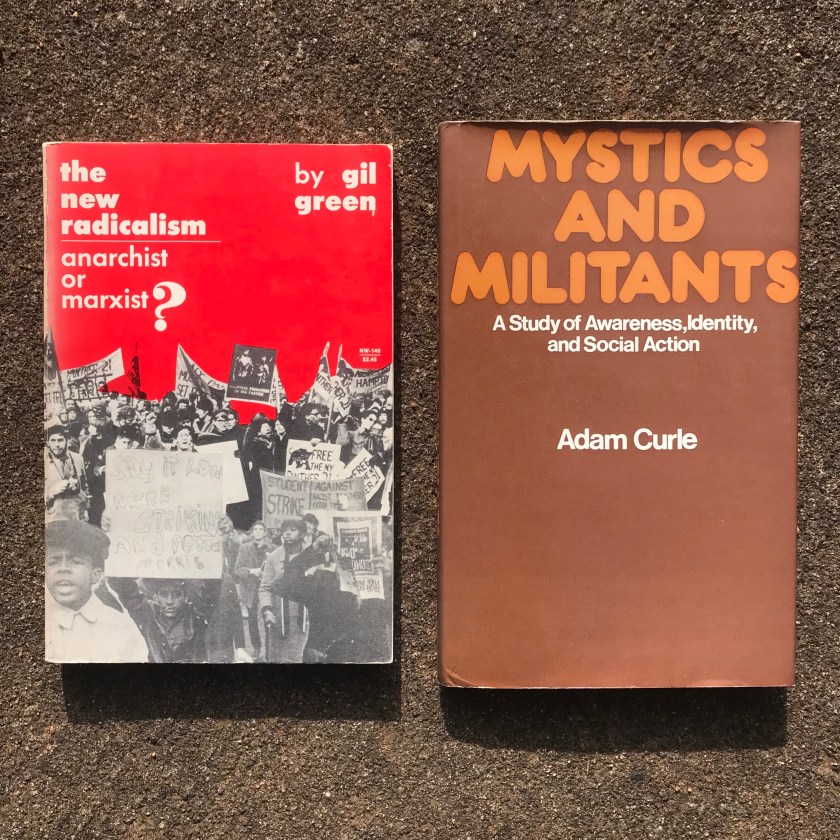
Reviewing past trance-scripts, I find in them a portrait of a divided self. I find myself caught in these moments struggling to maintain a shaky détente between two personas representing two competing political orientations: the peaceful, happy-go-lucky hippie and the thwarted, indignant Marxist. This self-discovery of sorts puts me in mind of two books from the early 1970s that washed up yesterday at Goodwill: Gil Green’s The New Radicalism: Anarchist or Marxist? and Adam Curle’s Mystics and Militants: A Study of Awareness, Identity, and Social Action.

Mystics Militants

Despite their differences (more pronounced, I think, in the excitement of the sixties and seventies), I persist in thinking the necessity of both of these personas (and other, more minor ones besides). They grow from the same soil. Their utopias reply to the same intolerable contradiction at the foundation of my existence: land to be lived upon is beautiful and bountiful, yet I lack it. All habits, all ways of living, take this immiserating lack as their premise. But enough with the tragedy, I tell myself. Dwell instead on that which gives joy, no apologies. Let it just be said: so long as the above, the public will remain equal parts rational and deluded, owing always to its positioning with respect to property. Whenever a society compels people of diverse potential to act as apathetic and accepting subjects, a violence is done to consciousness. Such a relationship, as Curle observes, “cannot be termed peaceful.” It leaves all parties disgraced, able to persist under the illusion of separation from open warfare only because lack of parity between combatants is too great. Given these conditions, I find it hard to think and write other than in kinship with twilight, even amid blaze of day. I recommend, though, as a way of conditioning this condition, freeing one’s head through a listen of Roland Kirk’s Volunteered Slavery, by which I mean “I Say a Little Prayer.” Such sonic outpourings have the power to transform social relations, if at least in the instant.

Friday October 13, 2017

I tumble out of the workday to the sound of Bastian Void’s Three Sides of Consideration.

Music rotates through space like a holographic projection. I race on account of low memory capacity. Catch the mind’s formulations before time dissolves their presence. Mind at play is both fast and flighty, while words assume form and assemble ’round one another only haltingly, as if the creator-self has to pause every few steps to consult unsayable rules and unreadable guidebooks. What is “language” again? Refresh my memory. Remind me how it works. Bastian Void, by the way, is Massachusetts-based Moss Archive label founder Joe Bastardo. We are of the tribe raised as much by TV as by parents. The Nintendo generation. My allies among this generation are those who have begun to flirt again with consciousness expansion, therapeutic madness, and the creation of alternative realities. We operate experimentally and pragmatically, but could benefit from engagement with precursor theorists like Theodore Roszak. An Acid Marxist avant la lettre. I close my eyes and a clear gelatin tablet splits open in my hands, spilling forth its insides: tiny multicolored micro-plastic spheroids. The 1960s and 1970s countercultures were somehow neglected, an absent thing remembered wistfully, but as an unambiguously unrepeatable past, during the years of my schooling. Roszak, however, speaks directly to my concerns of late with a rousing defense of visionary experience in a chapter from The Making of a Counterculture called “Eyes of Flesh, Eyes of Fire.” (These trance-scripts, by the way, are written for “Eyes Turned Backwards, Belonging to Heads of the Future.” Picture them sitting there with their Whole Earth Catalogs, in their nomad-architectured, “full communism now” communes, all watched over by machines of loving grace. Why can’t others view this as beautiful with me — that way we could go out and do it?) How hard it would be, though, what obstacles we would need to overcome, in order to assemble a national, international, global economy of networked communes, encampments, all servicing each other’s productive needs in a non-profit, price-set, steady-state system of systems. Could we network them, perhaps, and thus establish dual power, under the guise of a religion?

Wednesday August 2, 2017

Lest I be accused of mere nostalgia, let me begin today’s post by explaining how I see the relationship of our moment to what some are now calling “hippie modernism.”

Following the logic informing the Walker Art Center’s exhibition of that name, I take “hippie modernism” to designate a countercultural formation of unsurpassed Utopianism that flowered unevenly in a wide range of national contexts in the 1960s and early 1970s. This formation was never just a reflection of its time; rather, it actively dreamt and desired a future that, by remaining unrealized, continues to make demands on us today. Postmodernism, meanwhile, is that which emerged in hippie modernism’s aftermath. A product of post-60s Prohibition (here in the Americas, the moment of the highly militarized War on Drugs), postmodernist culture coincides with active state suppression of hippie modernism’s technologies of consciousness. Of course, drug wars have never had much success in eradicating supplies of psychedelics, and so the ongoing era of Prohibition has long been haunted by revivals of hippie modernism’s ghosts. Nevertheless, when I look to hippie modernism today, I see a cultural formation the totality or full international breadth and extent of which has only just now become mappable by individuals, thanks to the art-historical archival efforts of reissue labels and museums. As a result, the time is right, I think, not just for a Marxist account of the history of psychedelia, but for the creation of an openly, unashamedly Gnostic-themed, psychedelia-inflected Marxism, one that presents the raising of consciousness as the relay switch between previously competing or previously antagonistic codes. But enough of that. In what follows, I will not think but do. Returning home after visiting my family, I arrive briefly at the impression, before self-correction, that neighborhoods in the places I’ve lived all look the same. With that, I prepare myself for admission before the court of my town’s public pool. And the self I prepare is a mischievous little child. A scheming little imp. Well, not really. I’m just a sun child. And it feels good, I declare, to lay out in the sun while high — if not for you, then at least for me. I associate all of this, in fact, with the photo on the cover of Kantner and Slick’s otherwise unmemorable — indeed, practically unlistenable — Sunfighter (“Million” being the only song on Sunfighter that I would recommend to others).

There were many pictures of me worshipped like that as a baby. I ate strident dreams of that sort for breakfast. The Guitar Army peered at me with its harmonicas at the ready. Hence my love of sun and pool. Watch me swim now: a swamp thing, a rangy plant-like consciousness, floating at the water’s surface. Hold fast to this image, for in it lies the key. The sunlit sky, the cool body of water, and the public at play: these three shall form the pillars of my religion’s temple. My Hippie-Communist Temple of Joy. It is THIS for which we strive. Justice has been and so will continue to be our rallying cry — but a justice on behalf of pleasure. The world must be made pleasureful and fully present for all those who want it so. To the haters, I reply with the immortal words of Edward FitzGerald and Omar Khayyam: “Come, fill the Cup, and in the fire of Spring / Your Winter-garment of Repentance fling: / The Bird of Time has but a little way / To flutter — and the Bird is on the Wing. […] Some for the Glories of This World; and some / Sigh for the Prophet’s Paradise to come; / Ah, take the Cash, and let the Promise go, / Nor heed the music of a distant Drum!” And one more for good measure, to drive the point home: “Waste not your Hour, nor in the vain pursuit / Of This and That endeavor and dispute; / Better be merry with the fruitful Grape / Than sadden after none, or bitter, Fruit.”