Initiation

The ancient Greeks imagined Tartaros as a pit, an anti-sky, an inverted dome beneath the earth. According to the Orphics and the mystery schools, however, Tartaros is not just a place housing criminals and monsters; rather, it is itself a kind of being: “the un-bounded first-existing entity from which the Light and the Cosmos are born.” Typhon, meanwhile, is this entity’s progeny; Typhon is the son of Tartaros and Gaia. He was the last god to challenge the supremacy of Zeus. When defeated by the latter’s thunderbolts, he was cast back into the pit from whence he came.

Readings of “MAXIMUS, FROM DOGTOWN—IV” hinge upon what one makes of the father chained in Tartaros. Grieve-Carlson entertains an interpretation different from the one I offer. In his view, “the father chained in Tartaros is not Typhon but rather Kronos, Zeus’s father. […]. Typhon appears much later in the poem, when Earth conceives him in an ‘act of love’ with Tartaros” (Grieve-Carlson 146). He argues that Olson re-tells the myth of Typhon just as Hesiod did. Typhon is violent and aggressive and would have become a tyrant over gods and men had Zeus not defeated him.

I think there’s more at stake here, however, than Grieve-Carlson lets on. As I see it, the problem with his reading is that he never grapples with the poem’s status as a letter of sorts mailed to the Psychedelic Review. Neither he nor the other critics he surveys ever address how the poem might be read in light of the circumstances of its publication.

Evidence to support my view appears elsewhere in Olson’s writings. Olson echoes in his “Letter to Elaine Feinstein” of May 1959, for instance, the same Zeus / Typhon battle that comes to occupy him in “MAXIMUS, FROM DOGTOWN—IV.” The ultimate “content” to which the poet gives form, sez Olson, is “multiplicity: originally, and repetitively, chaos—Tiamat: wot the Hindo-Europeans knocked out by giving the Old Man (Juice himself) all the lightning” (29). Hearing “Juice” as a homonym for “Zeus,” we find in Tiamat a twin for Typhon. While Tiamat was for ancient Mesopotamians a primordial goddess of the sea, and Typhon a monstrous serpent-god for the ancient Greeks, both are embodiments of chaos. Tiamat’s battle with Marduk is as much a version of ChaosKampf as is Typhon’s battle with Zeus.

The important point is that, for Olson, Chaos is the original condition of existence. It precedes Order. Order is formed — made, not found — and it is the duty of the poet to make it. This is what Olson hoped to communicate to the mushroom people.

Grieve-Carlson concludes his essay by describing the reading of The Maximus Poems as a form of “initiation,” as Olson writes as one initiated, one able to see and say in a special way. Olson makes use of a “metanastic poetics,” or “the technique of the mystic who returns, as a stranger in his own land, to tell about what he knows” (Martin, as quoted in Grieve-Carlson 148).

This reference to reading The Maximus Poems as a form of “initiation” intrigues me, as the writer other than Olson most closely associated with reinvention of Typhon is the British ceremonial magician Kenneth Grant (1924-2011). The latter led the Typhonian Ordo Templi Orientis (TOTO), a magical organization connected with Aleister Crowley’s Thelema religion. Grant was an apprentice of Crowley’s and a close friend of another famous twentieth-century occultist, Austin Osman Spare. Scholars like Henrik Bogdan refer to the occult current that springs from Grant as the “Typhonian tradition.” Grant announced the arrival of this tradition in 1973 and went on to write the nine books of his three Typhonian Trilogies.

Although influenced by Crowley and Thelema, Grant departs from other Thelemic currents by welcoming communication with “extraterrestrial entities” as a valid source of occult knowledge. The Typhonian tradition also embraces aspects of the Cthulhu mythos of horror writer H.P. Lovecraft.

While Grant’s announcement succeeds Olson’s poem by a decade, his ideas appear to have been informed by experiences not unlike Olson’s. Grant experimented with psychedelics in the 1960s, and included a chapter in his 1972 book The Magical Revival titled “Drugs and the Occult.”

And while I haven’t found any evidence suggesting that Grant knew anything of Olson’s work, Olson did have some interest in gnosticism and the occult. “Bridge-Work,” a short reading list of Olson’s dated “March, 1961” includes a reference to Crowley. Maud says Olson encountered Crowley’s The Book of Thoth (1944) while studying Tarot in the 1940s. Sources suggest that “Bridge-Work” was written with the help of Olson’s friend, Boston-based occult poet Gerrit Lansing. The copy of The Book of Thoth read by Olson probably belonged to Lansing. (See Division Leap’s A Catalog of Books From the Collection of Gerrit Lansing.) Olson was also deeply invested in Gnosticism in the years immediately before and after his sessions with Leary, and embraced Jung’s theory of synchronicity in the wake of those sessions. See the final essays in a volume of Olson’s called Proprioception (Four Seasons, 1965).

Grant’s innovation is to identify “the arch-monster Typhon, opponent to Zeus according to the Greek mythology…with the Egyptian goddess Taurt” (Bogdan 326). The latter is interpreted by Grant to be either the mother of Set or a feminine aspect of Set. “To Grant,” writes Bogdan, “the worship of Taurt or Typhon represented the oldest form of religion known to mankind, a religion centered on the worship of the stars and the sacred powers of procreation and sexuality” (Bogdan 326). Set, too, is an important figure in Grant’s system. “Grant maintained,” writes Bogdan, “that the Typhonian Tradition, and in particular the god Set, represents the ‘hidden,’ ‘concealed’ or repressed aspect of our psyche which it is vital to explore in order to reach gnosis or spiritual enlightenment” (Bogdan 326).

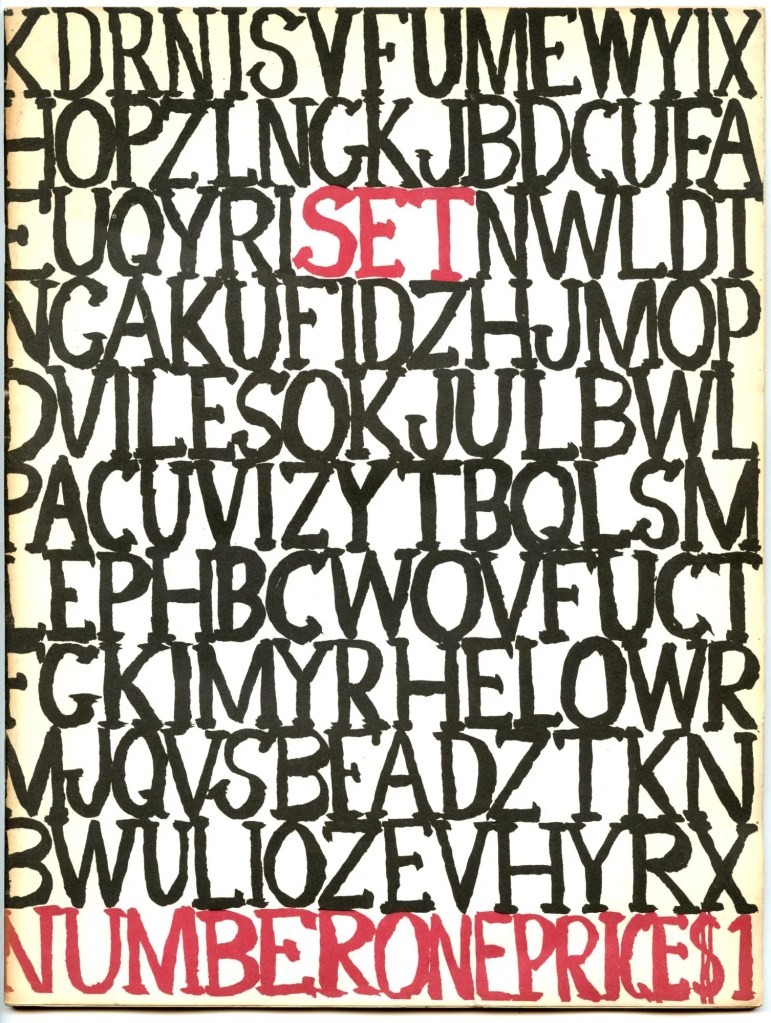
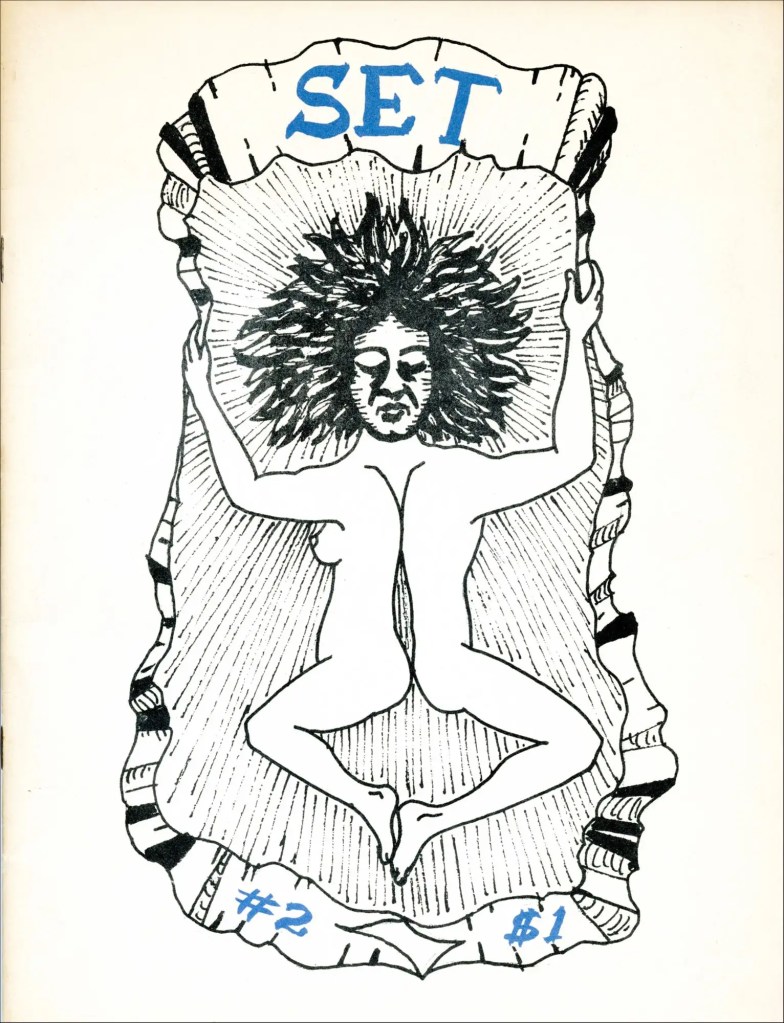
Lansing’s work seems to anticipate Grant’s in several ways. The two both think it important to honor the Egyptian god Set, for instance, with Lansing naming his early-60s poetry journal SET after him. And Grant’s focus on the Qliphoth, or the underground portion of the Tree of Life, seems present in the title of Lansing’s 1966 poetry collection The Heavenly Tree Grows Downward. For more on the “tree that grows downward,” Pierre Joris recommends looking at a section of Jung’s Alchemical Studies called “The Inverted Tree.”
The Fabian Contingent

Why does Wells propel his Time Traveler into as distant and bleak a future as the one imagined in The Time Machine? It’s the future as pictured from the standpoint and subject-position of the Traveler himself as he recounts his journey for others. Wells, meanwhile, imagined other futures elsewhere and elsewhen, as during his later years, following his split with the Fabian Society. His political ideal of those later years was the “World State”: a single global technocratic “world commonwealth,” governed by a scientific elite. In his twenties, however, Wells may have interacted for a time with a secret society of a different sort: the Hermetic Order of the Golden Dawn. His run-in with the Order is thought to have occurred in London in 1894, the year prior to the publication of The Time Machine, Wells’s first great success as a novelist. Ithell Colquhoun mentions this run-in in her book Sword of Wisdom: MacGregor Mathers and the Golden Dawn — or at the very least speculates about a “Fabian contingent” within a Golden Dawn splinter group called the Order of the Stella Matutina or “Morning Star.” Colquhoun describes Wells’s 1911 short story “The Door in the Wall” as “in the line of GD tradition” (192). I find myself reading again descriptions of Golden Dawn initiation rituals, like the following from Chic Cicero and Sandra Tabitha Cicero’s Self-Initiation into the Golden Dawn Tradition:

“The goal of initiation is to bring about the illumination of the human soul by the Inner and Divine Light. A true ‘initiate’ is an individual whose Higher Self (or Higher Genius) has merged with the Lower Personality and actually incarnated into the physical body. The Personality is left in charge of the day-to-day routines of living and working, but the Higher Genius is free to look out at the world through the eyes of the initiate. Through this experience, the individual is given a permanent extension of consciousness which is impossible to mistake. Many times a student of the mysteries is drawn to a particular mystical current without knowing it. A series of ‘coincidences’ and synchronicities will often direct (or sometimes shove) a person toward that current through books or through meeting other people who also have a connection with the current. During this time, the student’s psychic faculties are still relatively undeveloped, yet the inner spark has been ignited. However, a full initiation, or dawning of the Inner Light, is evident when the entire aura is illuminated.”

Of course, one can be a solitary magician. One can tap into the Golden Dawn’s magic, as Wells did, without having to become a member of any particular group or organization. But according to Cicero and Cicero, the solitary magician is at a disadvantage, “not having a group of temple-mates to consult if problems arise” (xxvi).

Monday December 21, 2020

What happens to those initiated into a world of magic, made to embark upon a path or journey by way of psychedelics? More specifically, what happens when this process begins in absence of teachers and institutional containers — when shamans and rituals, in other words, are not part of the initiate’s lifeworld, the initiate stripped of these on account of having rejected the religion of his ancestors in his youth? The search for a new framework becomes part of the initiate’s quest, does it not? One doesn’t even know at first that the process has begun. Advice arrives, though, as one asks around. One learns from fellow heads. Elders pass along teachings by book, by song, by word of mouth. Writings appear on walls, counseling one to pray and meditate. Days fill with makeshift, self-invented rituals — practices adapted to local conditions in the course of one’s travels. We become weird ones — lonely experimentalists sitting Indian-style in the dark. Are our adaptations legitimate ones, or are they products, as René Guénon warns, “of a merely individual caprice” (Perspectives on Initiation, p. 4)? Guénon would call those about whom I speak “mystics” rather than “initiates.” “In the case of mysticism,” he writes, “one never knows just where one is headed” (8). For Guénon, “the mystical path differs from the initiatic path in all its essential characteristics, which difference is such as to render the two truly incompatible” (9). Given subsequent right-wing uses of Guénon’s philosophy by monsters like Steve Bannon, however, we must take care not to place too much stock in this distinction.

Saturday November 28, 2020

I used to think that others I met were wise witches and wizards welcoming me and guiding me, everyone and everything a potential teacher. I was a gnostic initiate on the threshold of a newly re-enchanted cosmos. At some point prior, an event had occurred that changed me, my sense of time and space altered. Pot restored some prior magical conception of reality that I’d been made to hide or repress — even as it also opened me to new modes of experience. I had become fearful in certain ways during my schooling. I’d developed emotional and psychological armor, shutting myself off from awe, desire, love, pain, hope — so as to just endure amid fear of bullying. It happened early in my childhood. A neighbor down the street used to push me. I was bullied and betrayed. This kid was my “best friend” at the time. Yet he pushed me around. He hurt me. That pattern of bullying and abuse continued, repeating itself in middle school and high school and beyond. These events turned me inward. I became like a turtle withdrawn into its shell. Pot got me out of that pattern. It helped me peek my head out of the Cave, like the dude who escapes in Plato’s allegory. I started to think of myself in terms of that character: the freed prisoner, the one whose head pierces the veil. At the end of the high (which can also be an ascent, a flight north), the hero returns again to the cave to free the others. The myth is restaged countless times; it can be transhistorical, like Christ’s harrowing of Hell, or historically specific, like Harriet Tubman’s many journeys to the South. The myth can be told as part of one’s past or one’s future. Millions of people relate to this tale in one or another of its many retellings. What about today? Is this still the narrative with which I fashion myself? I’ve become more discerning than that, have I not? In my encounters with witches and wizards, I study statements and practices. I listen for clues. If it seems like a person or group is trying to trick me or manipulate me, I bounce.

Tuesday November 24, 2020

Tasks arise, so I attend to them. One sees to the things one has to do. Grooming, cleaning, parenting. “So be it! See to it!” as Octavia E. Butler would say. The phrase was Butler’s mantra, one she wrote to herself in her journal years ago, before she was a published author. The words on that page of her journal are a spell. She decides what she wants and she proclaims it. Forget the excuses, she tells herself. “See to it!” Spells of this sort combine imperatives and future tense declarations of what will be. What were Butler’s thoughts on magic and the occult? What would she have called this if not magic? Psy-ops? An experiment in self-programming? Either way, it’s a power related to journaling. One becomes one’s own storyteller, writing dialogically day by day. Lauren’s journal functions this way. (Lauren is the main character in Butler’s Parable novels.) Lauren’s spells are the sections of the Parable novels written in verse. And here I am journaling about Butler‘s journals. Texts arrive bearing word about the process of initiation, like Butler’s 1988 novel Adulthood Rites, the second book in her Xenogenesis trilogy. (The three works in this trilogy — Dawn, Adulthood Rites, and Imago — have also been gathered under the title Lilith’s Brood.) Initiation requires a teacher, though, does it not? Perhaps I can just learn from my friends.

Monday March 11, 2019

Self and will are learned, not imposed, when one goes with the flow. Don’t worry about how to word it. Just go. Plunge out into the neighborhood and note the signs, identify the constellations, let the world approach in new ways. Worry not of communications, even when short and cryptic. “Daphne with daffodils.” Our soul stretching upward in many guises, like the limbs of an ancient oak. What is this inner spirit that expresses itself as a cradle for ever more diverse gradations of being? A river of cars, a barking poodle. Sometimes something like will or desire manifests, as when I note to myself: “2370, at the corner of Lyndhurst and Coventry, is a beauty.” Or afterwards, at a counter over an order of French fries: “Is there significance attached to the number 8 appearing thrice? Or a dog that self-identifies as a deer?” Perhaps this is my way of announcing my goal as an initiate. “Eight is Infinity — Paradise regained.” Voices speak of bounty and prosperity, movement toward realization of purpose. Let this be the promise of March: the joy in my heart.