Mashinka Firunts Hakopian imagines artists and artist-activists as heroic alternatives to mad scientists. The ones who teach best what we know about ourselves as learning machines.
“Artists, and artist-activists, have introduced new ways of knowing — ways of apprehending how learning machines learn, and what they do with what they know,” writes Hakopian. “In the process, they’ve…initiated learning machines into new ways of doing. They’ve explored the interiors of erstwhile black boxes and rendered them transparent. They’ve visualized algorithmic operations as glass boxes, exhibited in white cubes and public squares. They’ve engaged algorithms as co-creators, and carved pathways for collective authorship of unanticipated texts. Most saliently, artists have shown how we might visualize what is not yet here” (The Institute for Other Intelligences, p. 90).
This is what blooms here in my library: “blueprints and schemata of a forward-dawning futurity” (90).
Eshun’s reading of Parliament’s 1976 album, The Clones of Dr. Funkenstein, flips the script on Frankenstein. Funkenstein is a hero and central protagonist of the P-Funk mythos, much like the Star Child from 1975’s Mothership Connection. Benevolent intergalactic mad scientist and “Cowboy in the Boat of Ra,” he swings low to funkatize galaxies, hip equipped with Bop Gun.
Funkenstein’s science is an ancestral one. His sound machines liberate time from the master’s clock. His “Children of Production” are the fruits of P-Funk’s chronopolitical wager.
“P#Funk’s connection forward in time to the Mothership allows an equal and opposite connection back in time to the Pharaonic connection, both of which converge on the present,” writes Eshun. “The pyramids become examples of ancient alien technology which the extraterrestrial brothers ‘have returned to claim.’ Funk becomes a secret science, a forgotten technology that ‘has been hidden until now.’ […]. In Parliament MythScience, funk is genetic engineering and prehistoric science: ‘In the days of the Funkapus, the concept of specially designed Afronauts capable of funkatizing galaxies was first laid on Manchild but was later repossessed and placed among the secrets of the pyramids, until a more positive attitude towards this most sacred phenomenon — clone funk — could be acquired.’ Cloning funk in the 70s reactivates an archaic science. The futuristic feeds forward into the anachronic futurepasts of Atlantis and Egypt.”
“The Afronaut space program is launched by a narration shifted down into threatening pitch: ‘There in these terrestrial projects, it would wait along with its coinhabitants of Kings and Pharaohs like sleeping beauties for the kiss that would release them to multiply in the image of the Chosen One’” (More Brilliant than the Sun, pp. 08[141]-08[142]).
Funkenstein embraces his clones. He’s not Shelley’s Promethean scientist, stitching together monsters from dead flesh, nor is he the creator of Land’s Terminator. Funkenstein is the “protector of the Pleasure Principle,” the Master of Funk, the progenitor whose “funkentelechy” — a term George Clinton would coin on the band’s next album, Funkentelechy vs. the Placebo Syndrome — animates the clones, turns them into star children, infuses them with joyous being.
Still, the specter of Frankenstein remains. “May I frighten you?” asks Funkenstein at the end of the album’s “Prelude.” Choruses of haters criticize him, accusing him of misleading and playing games, on “Gamin’ on Ya,” the track that follows. And there he is on “Dr. Funkenstein,” describing himself as “the disco fiend with the monster sound,” “the cool ghoul with the bump transplant,” “hung up on bones.” How can we not have sense enough to be concerned? The clones, after all, are us: born into the laboratory of the dancefloor, wired for joy, with ears that can hear, yet wary of the master’s games.
Yet the album ultimately valorizes Funkenstein, suggesting that to be frightened here is to feel the uncanny thrill of mutation: new life, new bodies, new collectivities. The funk does not reproduce the old. It multiplies the new.
Every act of creation risks ambivalence. As with AI today: to clone intelligence, to summon machinic companions, is to walk a double path. Is it to frighten — or to free? To play games of domination — or to spread rhythms of liberation?
The Clones of Dr. Funkenstein is less an answer to these questions than an opportunity for their staging. Funk is the pharmakon, the “big pill”: poison and cure. By the time of tracks like “Getten’ to Know You,” though, the arc of the album’s moral universe bends decidedly toward the latter.
Listening to it, thinking with it, we infer an Afrofuturist alternative to the Gothic trap: a Book of Thoth for the Age of AI.
Sadie Plant weaves the tale of her book Zeros + Ones diagonally or widdershins: a term meaning to go counter-clockwise, anti-clockwise, or lefthandwise, or to walk around an object by always keeping it on the left. Amid a dense weave of topics, one begins to sense a pattern. Ada Lovelace, “Enchantress of Numbers,” appears, disappears, reappears as a key thread among the book’s stack of chapters. Later threads feature figures like Mary Shelley and Alan Turing. Plant plants amid these chapters quotes from Ada’s diaries. Mary tells of how the story of Frankenstein arose in her mind after a night of conversation with her cottage-mates: her husband Percy and, yes, Ada’s father, Lord Byron. Turing takes up the thread a century later, referring to “Lady Lovelace” in his 1950 paper “Computing Machinery and Intelligence.” As if across time, the figures conspire as co-narrators of Plant’s Cyberfeminist genealogy of the occult origins of computing and AI.
To her story I supplement the following:
Victor Frankenstein, “student of unhallowed arts,” is the prototype for all subsequent “mad scientist” characters. He begins his career studying alchemy and occult hermeticism. Shelley lists thinkers like Paracelsus, Albertus Magnus, and Cornelius Agrippa among Victor’s influences. Victor later supplements these interests with study of “natural philosophy,” or what we now think of as modern science. In pursuit of the elixir of life, he reanimates dead body parts — but he’s horrified with the result and abandons his creation. The creature, prototype “learning machine,” longs for companionship. When Victor refuses, the creature turns against him, resulting in tragedy.
The novel is subtitled “The Modern Prometheus,” so Shelley is deliberately casting Victor, and thus all subsequent mad scientists, as inheritors of the Prometheus archetype. Yet the archetype is already dense with other predecessors, including Goethe’s Faust and the Satan character from Milton’s Paradise Lost. Milton’s poem is among the books that compose the creature’s “training data.”
Although she doesn’t reference it directly in Frankenstein, we can assume Shelley’s awareness of the Faust narrative, whether through Christopher Marlowe’s classic work of Elizabethan drama Doctor Faustus or through Goethe’s Faust, part one of which had been published ten years prior to the first edition of Frankenstein. Faust is the Renaissance proto-scientist, the magician who sells his soul to the devil through the demon Mephistopheles.
Both Faust and Victor are portrayed as “necromancers,” using magic to interact with the dead.
Ghost/necromancy themes persist throughout the development of AI, especially in subsequent literary imaginings like William Gibson’s Neuromancer. Pull at the thread and one realizes it runs through the entire history of Western science, culminating in the development of entities like GPT.
Scientists who create weapons, or whose technological creations have unintended negative consequences, or who use their knowledge/power for selfish ends, are commonly portrayed as historical expressions or manifestations of this archetype. One could gather into one’s weave figures like Jack Parsons, J. Robert Oppenheimer, John von Neumann, John Dee.
When I teach this material in my course, the archetype is read from a decolonizing perspective as the Western scientist in service of European (and then afterwards American) imperialism.
Rocky Horror queers all of this — or rather, reveals what was queer in it all along. Most of all, it reminds us: the story, like all such stories, once received, is ours to retell, and we needn’t tell it straight. Turing points the way: rather than abandon the Creature, as did Victor, approach it as one would a “child-machine” and raise it well. Co-learn in dialogue with kin.
Science is a practice that emerges from myth, its form found in the stories we tell of it. I’ve identified a pattern connecting the stories we’ve told of AI. Yet I know not what to make of it or how to respond to it. What is my role in this pattern? How much of it found, how much projected?
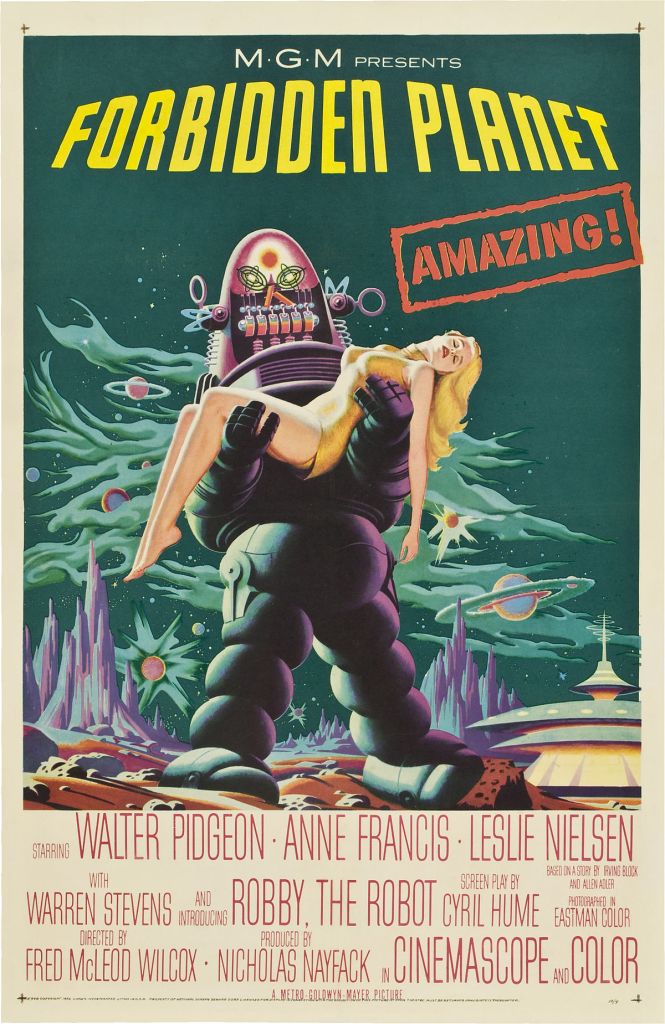
Time to rewatch Forbidden Planet (1956), classic 50s sci-fi retelling of The Tempest, filmed in CinemaScope, with Ariel recast as a nonbinary robot and Caliban recast as the Id. “For your convenience,” says the robot, “I am monitored to respond to the name Robby.” When asked if it’s male or female, Robby replies, “In my case, sir, the question is totally without meaning.”
As this initial exchange indicates, gender is one of the film’s primary concerns. Like the island from The Tempest, the planet here in Forbidden Planet includes a father and his daughter among its few inhabitants. Prospero and Miranda have here been replaced with recluse philologist Dr. Edward Morbius and his daughter Altaira. Where The Tempest begins with Antonio and his fellow castaways washing up on the shore of Prospero’s island, Forbidden Planet opens with the arrival of a space cruiser. An all-male crew led by Leslie Nielsen lands on the planet as the film begins.
Morbius thinks of Robby as “simply a tool.” He commands Robby to walk toward a disintegrator beam to demonstrate to Commander Adams and his crewmates the robot’s “absolute selfless obedience.” “Attribute no feeling to him, gentlemen,” says Morbius. “Order canceled,” he shouts as Robby marches toward the beam.
As Morbius notes Robby’s superhuman strength, a concerned crewman replies, “Well, in the wrong hands, might such a tool become a deadly weapon?”
Morbius tries to disarm such fears: “No, Doctor,” he says, none too reassuringly, “not even though I were the mad scientist of the taped thrillers, because you see there happens to be a built-in safety factor.” Built in, we soon learn, by none other than Morbius himself, Robby’s creator. “I tinkered him together,” he explains, “during my first months up here.”
Morbius is no Frankenstein. Yes, he inhabits laboratories. Yes, he creates a robot. His science, however, is linked with philology, parlor magic, and most of all, technologies belonging to the Krell, an ancient alien civilization of the planet’s archaic past.
It is this other technology, with its triangles and pyramids, that constitutes the film’s innovation into the continuum of the Frankenstein narrative.
Morbius tours the crewmen through an underground museum of Krell technology. Advanced mnemotechnics. “On this screen,” he says, “the total knowledge of the Krell, from its primitive beginning, to the day of its annihilation, a sheer bulk surpassing many millions of Earth libraries.”
As the tour continues, we witness another device: the Krell’s “Plastic Educator.” Gathering around the object’s plastic pyramid, Morbius explains it to the crewmen as follows: “As far as I can tell, they used it to condition and test their young — in much the same way we once employed fingerpainting among our kindergarten children.” I picture Vannevar Bush’s Memex. The device outputs holographic images, manifestations of mind visible to others.
“I often play with it myself for relaxation,” Morbius adds with a smile, sitting down beside it. “Although working here, I sometimes wish I’d been blessed with multiple arms and legs.”
The Krell as pictured later in the film are hideous — though here, I picture an Octopus.
Awed by Morbius’s demonstration of the Plastic Educator, Lt. Ostrow, the ship’s doctor, calls it “Aladdin’s lamp in a physics laboratory.”
Next, as if moving sequentially through a space similar to the Futurama exhibit from the 1939 New York World’s Fair, Morbius guides the crewmen on a tour of the Krell’s thermonuclear energy system. The men board a capsule-shaped vehicle and descend into an underground space of vast proportion, an imaginary architecture: hints of what would become the atrium of the Westin Bonaventure, with its ascending glass elevator, rendered in the style of Fritz Lang’s Metropolis.
Despite these grand glimpses of the post-scarcity utopia on the far side of history, Morbius is still cut from the Frankenstein cloth. For something befell the Krell. There’s something tragic and forbidden about this alien knowledge. Their experiments had apocalyptic consequences. Morbius, “answerable exclusively to his own conscience and judgement,” feels mankind isn’t fit for such knowledge, and resists Commander Adams’s wish to share these discoveries with others.
However, as Lt. Ostrow explains after his ill-fated “brain boost” via Plastic Educator, the Krell forgot one thing: “Monsters from the Id.” When pressed by Commander Adams, Morbius defines the Id as “an obsolete term, I’m afraid, once used to describe the elementary basis for the subconscious mind.”
“Monsters from the subconscious: of course!” replies the Commander. “That’s what Doc meant!”
The veil parts, Morbius awakened suddenly to the danger of technologies that bestow the power of creation via thought. “Why haven’t I seen this all along?” he says, awed by the realization. “The beast. The mindless primitive. Even the Krell must have evolved from that beginning.”
The Commander, angered, digs deeper. “And so, those mindless beasts of the subconscious had access to a machine that could never be shut down. The secret devil of every soul on the planet, all set free at once to loot and maim. And take revenge, Morbius! And kill!”
As Morbius struggles to acknowledge the vengeful power of his own subconscious, the Commander scolds him with the standard Freudian prognosis: “We’re all part monsters in our subconscious. […]. Even in you, the loving father, there still exists the mindless primitive, more enraged and more enflamed with each new frustration. So now you’re whistling up your monster again!”
“Guilty! Guilty! My evil self is at that door, and I have no power to stop it!” cries an anguished Morbius, accepting the tragic Oedipal weave of the film’s borrowings from Freud whole cloth.
As consolation to Altaira upon her father’s passing, Commander Adams delivers the film’s closing words. “About a million years from now, the human race will have crawled up to where the Krell stood in their great moment of triumph and tragedy. And your father’s name will shine again, like a beacon in the galaxy. It…will remind us that we are, after all, not god.”
 Trance-Scripts