A cat has been sitting on a chair on our deck these last few days, napping midday. I like having it around. Deck chair cat. Classes are going well. After a full day of teaching (a pretty magical performance, I must say), I hang out with colleagues at a department party. Once home again, I splash water under my arms and rinse my feet. I spent the day talking with students, dialoguing about Plato’s Allegory of the Cave, where the freed prisoner ascends toward sight of the sun, much as the philosopher ascends toward knowledge of the good, and by evening, I’m attending a show by the band Sunwatchers. Life assembles into these weird coincidences, these synchronicities. I share Gabriel Marcel’s view: “Hope is a memory of the future.” As Sam Keen and Anne Valley-Fox note, “Memories of primal pleasure are alive and well in the unconscious; all we need to do is call them forth.”
Tag: music
Wednesday September 4, 2019
Constellations of thought rotate around like the cover of Led Zeppelin III or the wheel of a rotary telephone, an object common to domestic space during the era of my childhood, replaced over time by cellphones. Thinking of the Led Zeppelin album, I kneel beside my unalphabetized, unsystematized wall of vinyl whispering, “Come out, come out, wherever you are!”
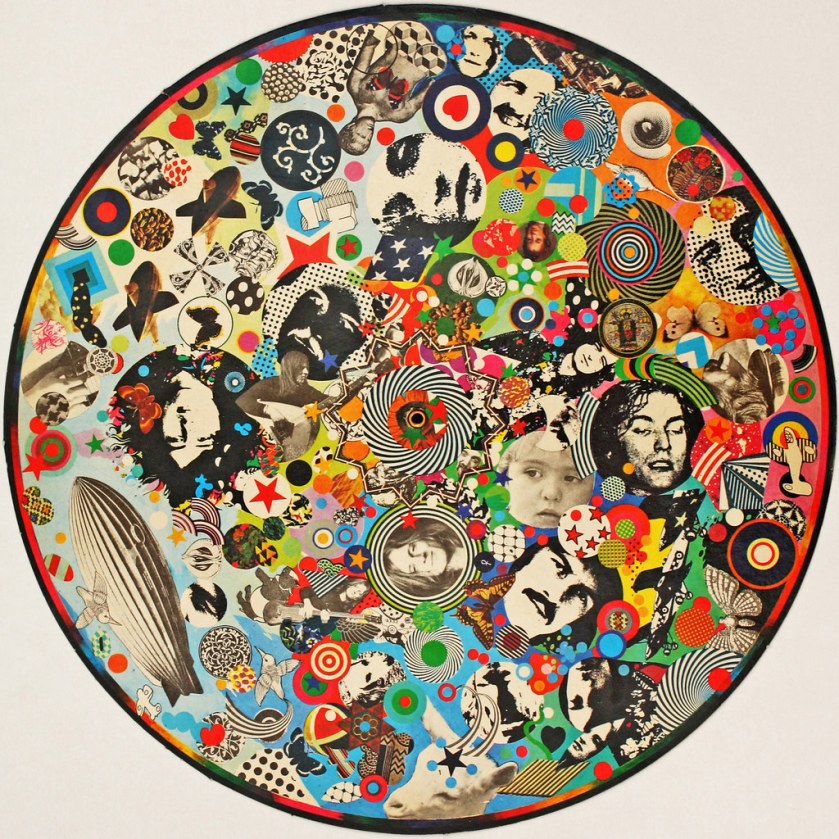
There it is, a psychedelic thing of beauty. “Visual Creations by Zacron,” reads the circular stamp beside the credits on the inner sleeve. I guess this device I’m imagining is a volvelle, a wheel chart featuring concentric circles with pointers. Volvelles were used in medieval Europe to calculate the phases of the sun and moon. “While at the Royal Academy Schools,” I learn, “Zacron produced a rotating book” called One Line and a Box.

Users could ask the book “questions about their interaction with the environment,” as they might using devices like the Tarot or the I Ching. From this earlier work, Zacron derived the idea for the design of Led Zeppelin III. My courses begin to shape up into elaborate nested allegories.
Thursday August 29, 2019
I listen excitedly, hands tapping thighs, to HausLive 1: Sunwatchers at Cafe Mustache 4/13/2019 after an afternoon at the pool, swimming, reading Kiese Laymon’s Heavy.
Laymon’s prose remedies with its tender heavy murmur. He writes as a son addressing a letter to his mother. It’s a book that hits hard. Subtitled “An American Memoir,” the book allows personal and familial history to tell as well the story of the harm done by the country to black bodies: the weight of antiblackness those bodies are made to bear. His mother’s withering appraisal of Dukes of Hazzard when he was a kid forces me to reflect with disappointment upon my own upbringing. My parents thought it appropriate to dress me in a pair of Dukes of Hazzard pajamas at one point when I was a toddler. It is my duty to confront that past and live differently.
Wednesday August 28, 2019
Returned from a successful day of teaching, I dance around the house, my hand out in front of me swimming like a fish as I listen to Patrick Cowley’s “The Runner” from his album Afternooners.
Students seem cool: joyful, inquisitive minds. I think they dig the way I talk. I think they dig the way I walk. Like I’m shaking bells and a tambourine, our conversations a kind of dance. Cue Young-Holt Unlimited’s “Dig Her Walk,” take it for a spin. Then find a quieter place. Sit back, relax.
Thursday August 22, 2019
Tap on Relatively Clean Rivers. Flash that archetypal Dayglo river-road landscape on the album cover, hint of the mid-1970s privately pressed Marin County-rooted psychedelic folk-rock contained therein. The record includes odd instrumental hollows, exudes a sweet blend of joy and melancholy: “weight off one’s mind,” as the band sings on “Hello Sunshine.”
To encounter it is to encounter a psychedelic beacon, the acid equivalent of the holy spirit, beaming a signal to fellow heads across time. What is it that we’re trying to tell one another, I hear myself asking, we who have had psychedelic experiences? Where did we find ourselves before, in the midst of, and after? The lyrical persona in “A Thousand Years” speaks as one frustrated by subjecthood and identity, disappointed to find itself left again with a face—but the voice persists in its attempt to communicate. It’s an Orphic persona: one who attempts to realize and comprehend the totality, one who bears news from the other side. The news seems to be that all that is Good is trying to win us to its side. Songs are credited to band member Phil Pearlman, a name that recalls past parables as well as poems from the beginnings of English literature. Pearlman’s two incarnations prior to Relatively Clean Rivers were called The Electronic Hole and The Beat of the Earth. After a conversion of sorts involving a bible on a beach, however, Pearlman changed his name to Seth Philip Gadahn. Quite a story there, for those who wish to look.
Monday August 19, 2019
I establish as part of the “setting” of my “set and setting” the Visible Cloaks mix, A Young Person’s Guide to Unseen Worlds.
The mix forms a semi-stable backdrop as I sit with Eroding Witness, an early collection of poems by Nathaniel Mackey. He’s performing with the Our True Day Begun Soon Come Qu’ahttet on campus this semester, and I hope to read and discuss some of his work with students in advance of that performance. Horns echo and cascade across space. This work is challenging. One has to lift up one’s arms and breathe, like the colophons for Verso and City Lights. Sarah arranges for us an online baby registry containing beautiful friendly objects, many of them with faces. I read about the Ghede, a family of Haitian Loa said to embody the powers of death and fertility. Those who are “mounted” by these deities launch stinging critiques of bosses and elites. I note down Mackey’s “Song of the Andoumboulou: 6” as a work I might include in my course.
Sunday August 18, 2019
Do words play some role in helping us assemble? Can we with them raise consciousness, as does the hornplay of Ornette Coleman’s “Beauty Is a Rare Thing”? Sit back, I tell myself. Close eyes, listen to the mad scramble of “Kaleidoscope,” and then scramble downstairs, assemble and play drums. Repair what needs repairing, tune what needs tuning.
After performing these tasks, I return to my office and read a weird tale from Gerald Heard’s AE: The Open Persuader, the final part of the book, when AE leads L to a “Fulfiller Dome” in Antarctica, home to reindeer and a Baleen whale. Through AE, Heard gives voice to a radical cultural pessimism, wearied to the point of despair. Another voice intervenes, however, with news of a “psychic ‘thaw out'” made possible by “Polar radiation” (258-259). Under the glare of the latter, “ideological-conditioned fanatic ideologies, defrosted, fall off” (259). The voice warns, though, of a further false step along the ladder of enlightenment, the retreat inward to escape suffering, claiming that “the greatest brains in the world” have fallen prey to this error. As example, the voice points to what it calls “those stupendous body-mind hypertrophies, the Baleens,” the voice regarding these large-brained creatures as “living specimens of the utmost terminal state of false samadhi” (261). By this point I’m out of my element, exhausted by the book’s elaborate eccentricity, as well as the occasional cruelty of its worldview. One way to approach the book would be to read it in light of José Esteban Muñoz’s ideas about “queer futurity.” Ideas from Lee Edelman’s book No Future: Queer Theory and the Death Drive also seem relevant and applicable.
Saturday August 17, 2019
I listen to recordings from several weeks ago of friends and I jamming with guitars, laptops, effects pedals, and modular synths. Amazing how it all comes together into a synchronous spontaneous composition. Noise band as groupuscule, noise band as psychedelic assemblage. Isn’t that what John Sinclair had in mind? “A rock & roll band,” he wrote, “is a working model of the post-revolutionary production unit. The members of a rock & roll family or tribe are totally interdependent and totally committed to the same end — they produce their music collectively, sharing both the responsibility and the benefits of their work equally. […]. It’s time to turn on tune in and take over! Up against the ceiling, motherfucker!” Will Alexander helps in this regard, reminding me of exercises for “turning on,” like the ones specified in Edward de Bono’s book Lateral Thinking. Most importantly, he reminds me, “Leaps can be made.” Alexander calls the technique “flexible ambulation through one’s mental catacombs” (Singing in Magnetic Hoofbeat, p. 13). Through him I learn about the Cuban painter Wilfredo Lam, influenced by his godmother, Matonica Wilson, a Santeria priestess, healer, and sorceress who performed rites dedicated to African orishas. One drifts a bit, breathing, open to new experience. Voices respond by firmly chanting, “Aye!” as they do in the Supergrass song, “Coffee in the Pot.”
Let us try to see as others see. Try, try! Unforeseen outlooks, hidden powers, power on. Let us become creative in our capacity to heal. Bruce Mau’s advice also seems applicable here: “Take field trips. The bandwidth of the world is greater than that of your TV set, or the Internet, or even a totally immersive, interactive, dynamically rendered, object-oriented, real-time, computer graphic-simulated environment.”
Friday August 16, 2019
“Spiral Dynamics” comes to mind as I listen to “Beautiful Crystals” by Sunwatchers.
The band takes its name from a song by Albert Ayler. Guitars interplay with horns, drums, and synths to form complex patterns. Concentrating on the band’s epic prog-psychedelic freak-outs, consciousness can float around a bit in a wild, hypnotic trance-state, reflections on sound and language intersecting to form brief synesthetic plateau-experiences. Life is mysterious, a bubbly, frothy, rococo garden of love, as one listens. Ever-changing, too—in constant surplus of itself. The band operates in a variety of modes: cosmic-archetypal in their aspirations one minute, urgently political the next. I look forward to seeing them when they play in town next month. Spiral Dynamics, meanwhile, seems to be some sort of West Coast “theory of everything,” popularized by the consciousness theorist Ken Wilber. Abraham Maslow fits in there somewhere in the movement’s origins, his “Hierarchy of Needs” adapted into a full-blown “tiered,” “evolutionary” theory of consciousness. It hasn’t been clear to me upon initial perusal whether or not this theory proposes a corollary ethics or practice, though I assume so. At times it sounds hyper control-oriented and egoic, encouraging practitioners to “sweep away objects” and focus on a prior “I Am,” consciousness in its most abstract and deracinated form—an ever-present, transhistorical “One,” divorced from the particulars of any thought, emotion, or object. Within short order, one finds oneself wondering, “Where is the Other in this model?” Reduced, it seems, to pure Becoming, known only through its momentary modifications, ripples, and arisings. The Other is that which encircles “I Am” as the latter spirals through states of distraction and re-cognition.
Tuesday August 6, 2019
Re-reading humanistic psychologist Abraham Maslow, I find much to like: his re-imagining of well-being in terms of individual and collective “self-actualization,” fulfillment occurring in and through a eupsychian network of co-evolving communities, including communes and growth centers like Esalen. But there are also some terrifying, instrumentalist defenses of “Science,” as when, in the preface to the first edition of Toward a Psychology of Being, he writes, “Science is the only way we have of shoving truth down the reluctant throat. Only science can overcome characterological differences in seeing and believing. Only science can progress” (viii). There’s a lot of genuflecting before terms like “empirical” and “raw facts.” Yet there remains a saving desire for integrated knowledge, knowledge that admits humanity’s creaturely actuality, as well as its god-like potential. Maslow characterizes this latter, “vertical” facet of human personality as a future dynamically active in the present, an absent cause prompting our becoming in a serendipitous manner, as if unplanned. We and the reality around us change subtly day by day.
Out comes Oneida’s Anthem of the Moon, released again into consciousness by the appearance of the band’s logo on an old t-shirt I pull from my dresser and refold while trying to de-clutter my house using the “KonMari Method.” The moon appears again later in the day in the lyrics to a Silver Apples song called “I Have Known Love.” The song is sad and tragic, as if sung by a psychedelic fallen angel, an Icarus or a Prometheus, chastened, having burned his fingers on the sun.
 Trance-Scripts