The Book of Thoth

Reed places at the center of his novel a Text over which opposing parties struggle. Around novel’s midway, we learn that this Text is called the Book of Thoth (94). Reed refers to it again later as “the 1st anthology written by the 1st choreographer” (164). Nor is he the first to imagine such a text. Drawing from references found in ancient Egyptian mythology, thinkers across the ages have written works alleging to be Books of Thoth. In some iterations, it’s a magic book, often containing two spells: one allowing understanding of the speech of animals, and another allowing perception of the gods. Lacking access to it themselves, mythographers of the West eye the suppressed original with a mixture of fear and desire. It is, in at least some of their accounts, a dangerous book, containing knowledge humans aren’t meant to possess.

As readers read Reed’s novel, they’re made to wonder: Why is Jes Grew searching for its “Text”? And why is this text the Book of Thoth?

“Someone once said,” writes Reed, “that beneath or behind all political and cultural warfare lies a struggle between secret societies. Another author suggested that the Nursery Rhyme and the book of Science Fiction might be more revolutionary than any number of tracts, pamphlets, manifestoes of the political realm” (18).

Perhaps Thoth’s Book, this “1st anthology,” is an anthology like the Bible, or indeed like Mumbo Jumbo itself. Each one revolutionary in kind, each a set of Nursery Rhymes and books of Science Fiction.

Let’s pursue this suggestion, shall we? How do works of literature aid revolution? Are poets the unacknowledged legislators of the world, as Percy Bysshe Shelley claimed in his 1821 essay, “A Defense of Poetry”?

The Atonists, we learn, have suppressed the ideas of their opponents: censoring, prohibiting, causing a deflation of consciousness, a mass forgetting across history.

“PaPa LaBas knew the fate of those who threatened the Atonist Path,” writes Reed. “Their writings were banished, added to the Index of Forbidden Books or sprinkled with typos as a way of undermining their credibility […]. An establishment which had been in operation for 2,000 years had developed some pretty clever techniques. Their enemies, apostates and heretics were placed in dungeons, hanged or exiled or ostracized occasionally by their own people who, due to the domination of their senses by Atonism, were robbed of any concerns other than mundane ones” (47).

Healing from the traumas inflicted by the Atonists requires an act of remembering. A process of anamnesis.

As I read Mumbo Jumbo, I’m reminded of Frederick Douglass’s autobiography and the importance granted by Douglass to acquisition of literacy. The written word comes to function for Douglass as the key enabling him to unlock the door of his prison. Literacy becomes the sign of difference distinguishing the ignorant from the knowledgeable, categories that under slavery were racialized, mapped onto the enslaved and the free. Douglass doesn’t do much to question these distinctions. Orality gives way to literacy, and thus slavery gives way to freedom.

Yet Jes Grew spreads the same way black folktales spread — through oral transmission, supported by music and dance. This transmission persists despite vast slaveowner efforts to separate captured Africans from their native tongue, forcing them to communicate in the master’s tongue. As Samuel R. Delany notes, “When…we say that this country was founded on slavery, we must remember that we mean, specifically, that it was founded on the systematic, conscientious, and massive destruction of African cultural remnants” (as quoted in Dery, “Black to the Future,” pp. 190-191). Captors hoarded access to writing skills, with slaves actively denied opportunity to make use of this form of techne.

Poet Audre Lorde famously warned, “The Master’s Tools Will Never Dismantle the Master’s House.” I read Reed’s work in dialogue with Lorde’s. Both weigh in, decades in advance, on what Marxists like Nick Dyer-Witheford would later call “the reconfiguration debate.” (For more on the latter, see Dyer-Witheford et al.’s Inhuman Power: Artificial Intelligence and the Future of Capitalism, pp. 147-149.) Writing Mumbo Jumbo in the years prior to Lorde’s warning, Reed doesn’t shy away from handling the Master’s tools. Science fiction, detective fiction: these are, after all, Western languages, technologies, genres, cultural forms. Like the jazz musicians who populate his novel, Reed’s handling of such tools transforms them into instruments of play. And while his performances may not yet have brought down the House, they do go some way toward dismantling it.

His suggestion is that the opposition between the oral and the written is based on a misconception. “For what good is a liturgy,” he asks,” without a text?” (6).
Saturday January 9, 2021

Octavia Butler’s Kindred is a time travel novel worth noting in light of work by contemporary Afrofuturists. The book’s protagonist, a 26-year-old African-American temp agent named Dana, finds herself suddenly and inexplicably transported from her home in present-day California (or the present day of 1979, the year the book was published) to a plantation in the Antebellum South. History kidnaps her, we might say. She doesn’t travel willingly. And when it occurs for her, travel is always to a painful and traumatic past. The book stages for readers an encounter with ancestors, leaving unventured the world of tomorrow. Kindred differs from conventional time travel narratives in other ways as well. Usually, time travel narratives feature white male protagonists who can travel to almost any period in history without sacrificing their privileged social status and position of dominance. These conventional white male protagonists can “pass” as ordinary figures from the period, while often using their knowledge of the future in order to gain power over others. For these characters, time travel is basically an exotic form of tourism, like a safari (as is explicitly the case in Ray Bradbury’s classic 1952 short story “A Sound of Thunder”). Meanwhile Dana’s appearance as a liberated black woman (in terms of clothing, skin color, manner of speech, etc) immediately places her in danger of rape and enslavement as soon as she arrives to the past.

Wednesday September 2, 2020

Despite the abolition of chattel slavery, other forms of slavery abound. Wage slavery, sex slavery, debt slavery. Plus that form of labor permitted in the language of the thirteenth amendment, which forbids slavery and involuntary servitude “except as punishment for crime”: i.e., prison labor. Prisoners who refuse to comply are placed in solitary confinement. American capitalism is a legal-political-economic construct built atop these various slaveries. White workers organized after the Civil War. Blacks were often excluded from these organizations and fraternities. Mike Davis tells part of that history in his classic study Prisoners of the American Dream. The story also receives treatment in Robin Blackburn’s An Unfinished Revolution. The latter includes a series of letters exchanged between Karl Marx and Abraham Lincoln at the end of the Civil War. Against those wishing to maintain racially segregated workplaces stood the International Working Men’s Association, a group that sought to unite “black and white, men and women, native and foreign-born.” The IWA may never have acquired more than a few thousand supporters in its day. What interests me now, though, is not organization so much as abolitionism and antifascism, rebellion and revolt.

Sunday August 30, 2020

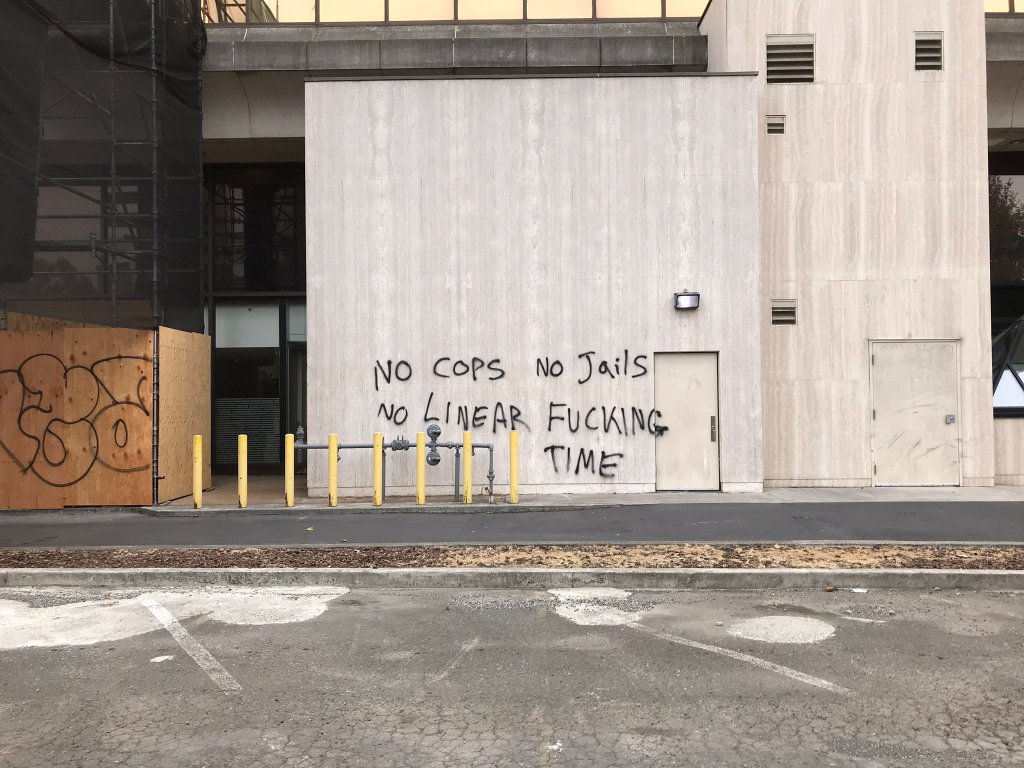
Upon finding employment on his third day in the Northern city of New Bedford, Frederick Douglass declares himself his own master. “I was now my own master,” he writes. This is a “happy moment” — one of the few such moments in Douglass’s narrative. Its rapture can be understood, he says, “only by those who have been slaves” (78). The scene leaves me wondering: at what point is there no longer someone robbing us of the rewards of our work? The employment Douglass has found is a form of wage slavery, is it not? Is the reward not taken in the setting of the wage by the capitalist? Are Marx and Engels wrong? In what sense is the wage relation not a form of slavery? Labor hours remain at the command of external masters under capitalism. The economy one faces is manufactured by the State, and the State is a mere police-backed conspiracy of land developers and financiers. All of us are in some way or another pressed into its service. Those of us in entertainment and education — those of us manning the ISAs, as Louis Althusser would say — we’re the functional equivalent of PsyOps officers. Yet we can always rebel — and many of us do. Wizards needn’t always be their wizards. There are fugitive histories to be learned, memories of fugitive ancestors awaiting remembrance through fugitive study. Because if the past isn’t past, as Faulkner wrote, and the demand on the streets is “NO COPS / NO JAILS / NO LINEAR FUCKING TIME,” then abolitionists are among us today, their cause as just as it was a century and a half ago.

Wednesday August 12, 2020

In fugitive slave narratives of the nineteenth century, and continuing in neo-fugitive works like Octavia E. Butler’s Parable of the Sower, freedom requires migration north on foot, master and his minions often in hot pursuit, as in the story of Harriet Tubman. It also involves extrication out from under the master’s religion, imposed over the course of the slave’s upbringing. Divinity has to be understood and believed in by the slave as something other than the wretched white tyrant who runs the farm. This understanding emerges surreptitiously, through what Fred Moten calls “fugitive study.”

Monday June 29, 2020

How might we characterize Frederick Douglass’s views regarding religion? Douglass tries to forestall misunderstanding about his views in the appendix to his autobiography. He doesn’t want his readers to suppose him “an opponent of all religion” (107). “What I have said respecting and against religion,” he writes, “I mean strictly to apply to the slaveholding religion of this land, and with no possible reference to Christianity proper; for, between the Christianity of this land, and the Christianity of Christ, I recognize the widest possible difference — so wide, that to receive the one as good, pure, and holy, is of necessity to reject the other as bad, corrupt, and wicked. […]. I love the pure, peaceable, and impartial Christianity of Christ: I therefore hate the corrupt, slaveholding, women-whipping, cradle-plundering, partial and hypocritical Christianity of this land” (107). Why is religion the terrain of appeal here at book’s end? Religion has been a tool of indoctrination, a violently imposed ideology, a “crown of thorns”-style cognitive map and/or map of the cosmos imposed upon slaves. Douglass shows that the crown can be seized and repurposed. The slave arrives into Logos, reclaims “Scripture,” and sits in judgment upon the master. Douglass’s religious views also manifest in his several attestations about “divine providence,” and his claims regarding the latter’s influence over key events in the course of his narrative.

Sunday June 28, 2020

“Chapter XI,” the final chapter of Douglass’s Narrative but for a brief appendix, is where the author describes how he “planned and finally succeeded in making” his escape from slavery (94). How does Douglass escape, and what role does literacy play in his plan? Does he, in effect, write his way to freedom? Or is writing but a small part? One arrives to the chapter excited to read further. But Douglass tells us immediately that he’ll have to withhold some of the facts of the escape. Too much of the particular, and others might come to harm. Because of slavery’s persistence as a system, he must deprive himself of the pleasure to speak freely the facts of the matter; otherwise, he would run the hazard of closing doors of use to those still enslaved. Means of flight must be kept secret. At most, no more than hinted at. Of the slaveholder, from whom knowledge of this sort must be kept, Douglass says, “Let him be left to feel his way in the dark; let darkness commensurate with his crime hover over him” (95).

Wednesday June 24, 2020

Octavia E. Butler’s inclusion of a neo-slave narrative at the heart of her book Parable of the Talents leads me to Narrative of the Life of Frederick Douglass, An American Slave. A butterfly greets me at my window as I read, then floats off on its way. In a children’s book, we might follow the butterfly. But when the baby naps, we must reckon with Douglass. Born into slavery, he becomes a fugitive at twenty. Seven years later, in 1845, he authors his narrative.

Thursday March 5, 2020

At a desk covered in objects — stacks of papers and books; horizontal arrays of napkins, paper clips, highlighters markers and pens — I sit and work: teach, meet, read, write, converse with students. Around and behind me, dense stacks of books and records, artifacts that store and transmit stories and histories, recordings of events, theories, philosophies. From these, I build my teachings, dialogical investigations of life through study of literature. The America revealed in this literature is a place filled with stories of injustice and resistance. Conquest, slavery, wage slavery. And like a thread run through it, the revolution, the ongoing one, the perennial one, the fights for freedom, equality, love among all persons and joy to the world. The works we read and discuss implicate us — as victims, as perpetrators, oftentimes as both — in a violent, fascist, capitalist-imperialist, patriarchal settler-colonialist system of domination — a system radically at odds with the future integrity of Earth as biosphere.