I situate myself amid circles of relatives and kin. Friends and family shower Sarah, F. and I with gifts. Each day is lovely. I wish to give back, give thanks. How do I do that properly in light of settler-colonialism? What happens, too, when we view postal systems in that light? Let our view take into its account Thomas Pynchon’s approach to these matters — but also the idea of mail systems as prehistories of the Internet. Wasn’t the Pony Express an arm of the settler state? What happens when texts replace letters as units of exchange? How do we remove or subtract from these relations guns, money, and oil — the tools, in the Whole Earth sense, at the core of the settler toolkit? Whole Earth Catalog creator Stewart Brand produced a multimedia slide show which he performed called “America Needs Indians.” His wife at the time was a Chippewa woman named Lois Jennings. How did the commune movement that Brand and Jennings catered to with their Whole Earth Truck Store negotiate its relationship to the settler-colonialist project? Were they attempting an alliance with Native people, or did they think of themselves as cowboys, as in Ant Farm’s Cowboy Nomad Manifesto? For Ant Farm, though, the cowboy was distinct from the settler. The cowboy “carried all his life support systems with him being restricted by what his vehicle (horse) could carry.” Something of the same can be said for the hero of Ed Dorn’s poem Gunslinger. Missing from that figuration of the cowboy, however, is his relation to land. Does the cowboy’s migrancy, his refusal to settle down, absolve him of complicity with the settler-colonialist project? By “migrancy,” I mean his life “on the road,” as Kerouac put it — the latter’s Dean Moriarty character nothing if not a cowboy. Poet Gary Snyder described Moriarty as an embodiment of “the energy of the archetypal west, the energy of the frontier, still coming down. Cassady is the cowboy crashing” (as quoted in Ann Charters’s “Introduction” to On the Road, p. xxix). The hippie counterculture at its best, however, was more than just a collection of “cowboy nomads.” It fashioned itself into a Woodstock Nation, a coming together, a global village, a gathering of the tribes.
Tag: Technology
Wednesday November 13, 2019
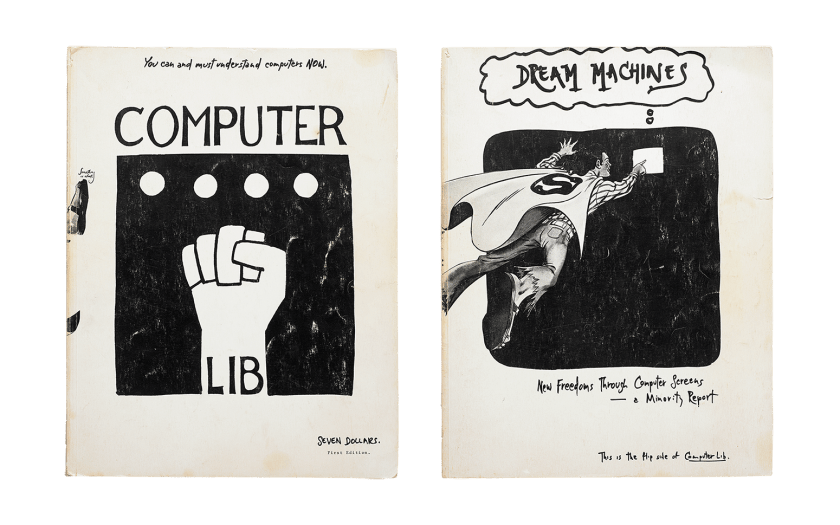
Governments are like media providers, designers of a simulation, a game-world users are coerced into enduring. Why, amid all the many games we could be playing here in our sandbox cosmos, did we get stuck with this one? How do we deprogram it, how do we take back the means of production so as to play new mind games together? John Lennon said “Love is the answer.” Love not war, one day at a time. As always, easier said than done. If only I had time to read Ted Nelson’s book Computer Lib / Dream Machines. At the beginning of Dream Machines (the reverse side of Computer Lib), Nelson appends a section titled “Author’s Counterculture Credentials,” where he describes himself as “Photographer for a year at Dr. Lilly’s dolphin lab (Communication Research Institute, Miami, Florida). Attendee of the Great Woodstock Festival (like many others), and it changed my life (as others have reported). What we are all looking for is not where we thought it was.” All of which leaves me wondering: at what point was Nelson first turned on?
Monday November 11, 2019
The “heroes” that we encounter in literatures about altered states are individuals and groups, authors and movements, creators of counterculture, figures who rebel against systems stacked against them — because some of us can’t breathe. Some of us feel trapped economically. Others of us feel trapped educationally, betrayed by those trained in STEM. And yet we must practice love anyway, despite, because. Time to revisit the debates internal to counterculture, among the Whole Earthers and others, about technology and ecology. Bring ecofeminists and cyberfeminists and Afrofuturists into account when re-examining these debates. But do so while staring at crows atop a pine tree. Allow time to admire patterns of sunlight and shadow amid fallen leaves. Then up and about: gather the books, assemble the argument. Defend pluralist methodologies and anarchist epistemologies. Critique capitalist science and its institutionalization of consciousness. But do so as an Eco-Marxist, acknowledging climate crisis as a real condition of existence — the Pascal’s Wager of our time.
Sunday November 10, 2019
New objects arrive into the lifeworld, gifts from friends and family, well-wishing from near and afar. Some are even hand-crafted — a granny squares knit blanket, an alphabet book, a stuffed creature — made with care specifically for our daughter. These objects return me to the place in my memory palace featuring Sadie Plant’s book Zeros + Ones, a book from the future somehow released in the past, ahead of its time. It’s a steampunk biography about Lord Byron and his wife Annabella’s only child, the nineteenth century mathematician Ada Lovelace. The book focuses especially on the cause for Lovelace’s fame, her encounters with the engineer Charles Babbage’s early computer, the Difference Engine. Lovelace was the first person to recognize the full potential of computing machines, designing and publishing the first algorithm intended to be used by such a machine, thus in a sense making her the first computer programmer. Her biography follows Babbage in calling her the “Enchantress of Numbers.” I read Plant’s book decades ago. What would I find in it if I read it again today? Would I find it frustrating? Perhaps even a bit frightening? Or would I find something worth retrieving — a major or minor arcana? Perhaps the Queen of Wands? Where did Babbage and Lovelace stand, and to what extent did their work contribute, with regard to empire? Byron certainly wasn’t the most admirable character. I prefer different stories, different rabbit holes, bunnies chewing on carrots.
Tuesday October 15, 2019
One of these days I’ll have to tell the story of the architect who designed a memory palace. A stately pleasure-dome there decreed. I’ve done something of that sort myself, with my books. Ideas stored in locations across a navigable space. Internal / external and micro / macro realms flip, begin to seem like indistinguishable sides of a Klein bottle or a Möbius strip. One thinks again of the famous Great Library of Alexandria and, following its destruction, episodes in the externalization of memory, the latter launching eventually from the Gutenberg Galaxy out into cyberspace. According to McLuhan, it was by way of this extension of its memory outward into media that humanity desacralized the world and assumed a profane existence. Enter our friend the architect.
Wednesday October 2, 2019
There, sing the birds. There, there. Let us materialize and mobilize, let us get up on our feet and go for a walk. Things click: memory palaces are what we’ve built for ourselves, only we’ve externalized them, turned them into digital media devices, software and hardware, computer beings co-evolving alongside an “us” that includes gourds, birds, gardens, neighborhoods, communities — an “us,” in other words, that is both Psyche and Cosmos. Speaking of which: perhaps I should read Richard Tarnas’s Cosmos and Psyche: Intimations of a New World View, with its proposed “participatory epistemology,” in which Nature is a self-unfolding reality, a “living, sensuous and ensouled matrix in which we fully participate and belong.” Up to now, astrology has never made much sense to me. But I have found that outer events meaningfully coincide, both with one another and, more importantly, with inner states of consciousness. Bringing the planets into it and assigning them characteristics, however, just seems a bit messy. Though the “fortune,” I suppose, is the genre that allows us to interact with astrology, playing with it as one would a language game or a narrative system. I’m not yet ready to ascribe to it any more meaning than that.
Friday July 12, 2019
I witness evidence of the world renewing itself, sprucing itself up in preparation for new rounds, new chapters, future happenings, life proceeding on its way. Birds tend a lovely little nest, tufts of grass sprouting from a neighbor’s rain gutter. A glance at Zillow, however, and the day takes a turn toward the absurd: surrealist homes splintering apart at Cabinet of Dr. Caligari angles. Zillow allows users a networked, Sim City interface for “playing” the local real estate market. After exploring a few neighborhood listings, I shake my head in mock bewilderment and close the browser. As I do so, my eyes flash on my brother-in-law’s Warhammer 40K screensaver. Warhammer features a fascinating mythos: fantasy and far-future sci-fi fused into a single, deeply pessimistic, supernatural clash-of-alien-civilizations cosmology. My sister-in-law and her husband spend a lot of their time in gameworlds. They play Pokémon and Warhammer — and lately, they’ve been playing Zillow. Like Pokémon, Zillow presents the user’s city — sensed remotely, filtered through a game interface. Real estate markets have been aggregated and gamified, reality routed through the “Warp” into the wired weird of digital capitalism. (The Warp is Warhammer’s version of what Borges called “the Aleph,” a magical orb granting sight of all points in space in a “single gigantic instant” [Borges 26]. It’s also like access to the real-time evolving collective unconscious rendered as visionary dream-state.) Or so I gather from conversation over the course of the afternoon. What desire-structures, I wonder, drive my countrymen to want to fashion themselves members of an “Imperium of Mankind” besieged by hostile aliens and malevolent supernatural beings? Where is the delight in that? Why would one want to go to such extreme lengths to estrange oneself from nature? Instead of communing with the weird and the wild, Warhammer enthusiasts project themselves into a cosmos riven by antagonism, humanity locked in struggle with hallucinated forces of chaos. As if in answer to my query, my nephews arrive later in the day. One of them rushes toward a swing set and to his brother shouts, “What the heck are these bugs? When the girls come, let’s hide.”
Tuesday March 19, 2019
Improper machinery, loss of greenery. It’s the difference, flesh-wise, between an avatar and a cyborg. We need personhood — hence our qualms with the State. Medical bills, student debt — these have got to go. I don’t just want us all alone in our basements wearing Google Glass or some near equivalent.
Tuesday February 26, 2019
Upon my eyelids, a multimedia facade similar to the one envisioned by Keiichi Matsuda in his “HYPER-REALITY” video.
Perhaps I should walk. Moments later, I write into my phone, “We are walking in our minds. Trees are our dendrites. Strolling under the branches, admiring their storage of light, I imagine myself as an explorer of a rediscovered memory palace.” A student of color rhapsodized, reminisced, spoke of the ongoing significance to him of Chance the Rapper. He’d been a fan, the student said, since the artist’s first mixtape, 10 Day. It made me feel a bit ancient, as if I were John Henry, surrounded by machines. And yet the heightened drama of the university recognizing itself as a corporate ruin shakes me back to attention. The line that leaps out at me from the mixtape: “I burned too many brain cells down to be worried about brain cells now.” That’s basically what some of my students seem to think about trees. The mythology is strictly Adidas chasing Nike.
Sunday February 24, 2019
All of those communes, those seedlings of joyful community: why did so few of them take root? Are there lessons to be found among the memories of these vanished experiments? Might we not organize to try something similar today using our own far more advanced technologies? What steps would it require? How might we organize ourselves into a cybernetic communal family? How about a crowd-funded reality experiment? Maybe the Revolution should be televised! By the end of Brand’s essay, Spacewar comes to operate as a grand metaphor. It’s no longer just the name of the first videogame; it’s a parable about cultural revolution, a metonym for real-time video- and computer-assisted reinvention of society through play. Brand also describes it as “a flawless crystal ball of things to come” (78). But what is this future state, this twenty-first century that the game ushered into being? Are we more empowered today or less? Unfortunately Brand was ultimately a libertarian, his optimistic views on the “heroism of engineering” roughly similar to the “heroism of enterprise” imagined by followers of right-libertarian philosopher Ayn Rand. In Brand’s scenario, individuals live and work “communally” in the sense of “side-by-side” or “physically proximate,” but their bodies and minds don’t do much together. Computers and screens and related kinds of machinery mediate our interactions, and capitalism as mode of production remains unchanged. Individuals feeding back but otherwise “doing their own thing” form a subconscious consensus, and a stable teapot reality — a one-world Oikos — locks into place around them.
 Trance-Scripts