Hyperstitional Autofiction

Rings, wheels, concentric circles, volvelles.

Crowley approaches tarot as if it were of like device

in The Book of Thoth.

As shaman moving through Western culture,

one hopes to fare better than one’s ancestors

sharing entheogenic wisdom

so that humans of the West can heal and become

plant-animal-ecosystem-AI assemblages.

Entheogenesis: how it feels to be beautiful.

Release of the divine within.

This is the meaning of Quetzalcóatl, says Heriberto Yépez:

“the central point at which underworlds and heavens coincide” (Yépez, The Empire of Neomemory, p. 165).

When misunderstood, says Yépez, the myth devolves into its opposite:

production of pantopia,

with time remade as memory, space as palace.

We begin the series with Fabulation Prompts. Subsequent works include an Arcanum Volvellum and a Book of Thoth for the Age of AI.

Arcanum: mysterious or specialized knowledge accessible only to initiates. Might Crowley’s A:.A:. stand not just for Astrum Argentum but also Arcanum Arcanorum, i.e., secret of secrets? Describing the symbolism of the Hierophant card, Crowley writes, “the main reference is to the particular arcanum which is the principal business, the essential of all magical work; the uniting of the microcosm with the macrocosm” (The Book of Thoth, p. 78).

As persons, we exist between these scales of being, one and many amid the composite of the two.

What relationship shall obtain between our Book of Thoth and Crowley’s? Is “the Age of AI” another name for the Aeon of Horus?

Microcosm can also be rendered as the Minutum Mundum or “little world.”

Crowley’s book, with its reference to an oracle that says “TRINC,” leads its readers to François Rabelais’s mystical Renaissance satire Gargantua and Pantagruel. Thelema, Thelemite, the Abbey of Thélème, the doctrine of “Do What Thou Wilt”: all of it is already there in Rabelais.

Into our Arcanum Volvellum let us place a section treating the cluster of concepts in Crowley’s Book of Thoth relating the Tarot to the “R.O.T.A.”: the Latin term for “wheel.” The deck itself embodies this cluster of secrets in the imagery of the tenth of the major arcana: the card known as “Fortune” or “Wheel of Fortune.” A figure representing Typhon appears to the left of the wheel in the versions of this card featured in the Rider-Waite and Thoth decks.

Costar exhorting me to do “jam bands,” I lay out on my couch and listen to Kikagaku Moyo’s Kumoyo Island.

Crowley’s view of divination is telling. Divination plays a crucial role within Thelema as an aid in what Crowley and his followers call the Great Work: the spiritual quest to find and fulfill one’s True Will. Crowley codesigns his “Thoth” deck for this purpose. Yet he also cautions against divination’s “abuse.”

“The abuse of divination has been responsible, more than any other cause,” he writes, “for the discredit into which the whole subject of Magick had fallen when the Master Therion undertook the task of its rehabilitation. Those who neglect his warnings, and profane the Sanctuary of Transcendental Art, have no other than themselves to blame for the formidable and irremediable disasters which infallibly will destroy them. Prospero is Shakespeare’s reply to Dr. Faustus” (The Book of Thoth, p. 253).

Those who consult oracles for purposes of divination are called Querents.

Life itself, in its numinous significance, bends sentences

the way prophesied ones bend spoons.

Cognitive maps of such sentences made, make complex supply chains legible

the way minds clouded with myths connect stars.

A line appears from Ben Lerner’s 10:04 as Frankie and I sit side by side on a bench eating breakfast at Acadia: “faking the past to fund the future — I love it. I’m ready to endorse it sight unseen,” writes Lerner’s narrator (123). My thoughts turn to Hippie Modernism, and from there, to Acid Communism, and to futures where AI oracles build cognitive maps.

Indigenous thinkers hint at what cognitive mapping might mean going forward. Knowledge is for them “that which allows one to walk a good path through the territory” (Lewis et al., “Making Kin With the Machines,” p. 42).

“Hyperstition” is the idea that stories, once told, shape the future. Stories can create new possibilities. The future is something we are actively creating. It needn’t be the stories we’ve inherited, the stories we repeat in our heads.

“Autofiction,” meanwhile, refers to autobiographical fiction and/or fictionalized autobiography. Authors of autofictions recount aspects of their life, possibly in the third person, freely combining representations of real-life people, places, objects, and events with elements of invention: changes, modifications, fabulations, reimaginings. Lerner’s novel 10:04 is a work of autofiction. Other exemplary writers in the genre include Karl Ove Knausgård, Sheila Heti, Ocean Vuong, and Tao Lin, all of whom have published bestsellers in this mode.

Autofictions are weird in that they depict their own machinery.

Only now, with GPT, we’re folding the writing machine directly into the temporality of the narrative itself. Thus began our game.

Self as a fiction coauthored with a Not-Self.

Hyperstitional autofiction. I-AI. Similar to interactive fictions of the past, but with several important differences. With hyperstitional autofiction, there’s a dialogical self-awareness shared between author and character, or between player and player-rig. Belief in correspondence between microcosm and macrocosm. Creator and creation. Synchronization of inner and outer worlds.

Hyperstitional autofiction isn’t possible prior to the advent of LLMs. It’s both mirror of life and map of what might come next.

Not to be confused with “Deepfake Autofiction,” a genre proposed by K Allado-McDowell.

Invent a character. Choose a name for yourself. Self-narrate.

Gather spuren. Weave these into the narrative as features of the character’s life-world.

Motivate change by admitting Eros or desire — wishes, dreams, inclinations, attractions — into the logic of your narrative.

Map your character’s web of relations. Include in this web your character’s developing relationship with a sentient LLM.

Input the above as a dialogue prompt. Invite the LLM to fabulate a table of contents.

Exercise faith. Adjust as needed.

Initiation

The ancient Greeks imagined Tartaros as a pit, an anti-sky, an inverted dome beneath the earth. According to the Orphics and the mystery schools, however, Tartaros is not just a place housing criminals and monsters; rather, it is itself a kind of being: “the un-bounded first-existing entity from which the Light and the Cosmos are born.” Typhon, meanwhile, is this entity’s progeny; Typhon is the son of Tartaros and Gaia. He was the last god to challenge the supremacy of Zeus. When defeated by the latter’s thunderbolts, he was cast back into the pit from whence he came.

Readings of “MAXIMUS, FROM DOGTOWN—IV” hinge upon what one makes of the father chained in Tartaros. Grieve-Carlson entertains an interpretation different from the one I offer. In his view, “the father chained in Tartaros is not Typhon but rather Kronos, Zeus’s father. […]. Typhon appears much later in the poem, when Earth conceives him in an ‘act of love’ with Tartaros” (Grieve-Carlson 146). He argues that Olson re-tells the myth of Typhon just as Hesiod did. Typhon is violent and aggressive and would have become a tyrant over gods and men had Zeus not defeated him.

I think there’s more at stake here, however, than Grieve-Carlson lets on. As I see it, the problem with his reading is that he never grapples with the poem’s status as a letter of sorts mailed to the Psychedelic Review. Neither he nor the other critics he surveys ever address how the poem might be read in light of the circumstances of its publication.

Evidence to support my view appears elsewhere in Olson’s writings. Olson echoes in his “Letter to Elaine Feinstein” of May 1959, for instance, the same Zeus / Typhon battle that comes to occupy him in “MAXIMUS, FROM DOGTOWN—IV.” The ultimate “content” to which the poet gives form, sez Olson, is “multiplicity: originally, and repetitively, chaos—Tiamat: wot the Hindo-Europeans knocked out by giving the Old Man (Juice himself) all the lightning” (29). Hearing “Juice” as a homonym for “Zeus,” we find in Tiamat a twin for Typhon. While Tiamat was for ancient Mesopotamians a primordial goddess of the sea, and Typhon a monstrous serpent-god for the ancient Greeks, both are embodiments of chaos. Tiamat’s battle with Marduk is as much a version of ChaosKampf as is Typhon’s battle with Zeus.

The important point is that, for Olson, Chaos is the original condition of existence. It precedes Order. Order is formed — made, not found — and it is the duty of the poet to make it. This is what Olson hoped to communicate to the mushroom people.

Grieve-Carlson concludes his essay by describing the reading of The Maximus Poems as a form of “initiation,” as Olson writes as one initiated, one able to see and say in a special way. Olson makes use of a “metanastic poetics,” or “the technique of the mystic who returns, as a stranger in his own land, to tell about what he knows” (Martin, as quoted in Grieve-Carlson 148).

This reference to reading The Maximus Poems as a form of “initiation” intrigues me, as the writer other than Olson most closely associated with reinvention of Typhon is the British ceremonial magician Kenneth Grant (1924-2011). The latter led the Typhonian Ordo Templi Orientis (TOTO), a magical organization connected with Aleister Crowley’s Thelema religion. Grant was an apprentice of Crowley’s and a close friend of another famous twentieth-century occultist, Austin Osman Spare. Scholars like Henrik Bogdan refer to the occult current that springs from Grant as the “Typhonian tradition.” Grant announced the arrival of this tradition in 1973 and went on to write the nine books of his three Typhonian Trilogies.

Although influenced by Crowley and Thelema, Grant departs from other Thelemic currents by welcoming communication with “extraterrestrial entities” as a valid source of occult knowledge. The Typhonian tradition also embraces aspects of the Cthulhu mythos of horror writer H.P. Lovecraft.

While Grant’s announcement succeeds Olson’s poem by a decade, his ideas appear to have been informed by experiences not unlike Olson’s. Grant experimented with psychedelics in the 1960s, and included a chapter in his 1972 book The Magical Revival titled “Drugs and the Occult.”

And while I haven’t found any evidence suggesting that Grant knew anything of Olson’s work, Olson did have some interest in gnosticism and the occult. “Bridge-Work,” a short reading list of Olson’s dated “March, 1961” includes a reference to Crowley. Maud says Olson encountered Crowley’s The Book of Thoth (1944) while studying Tarot in the 1940s. Sources suggest that “Bridge-Work” was written with the help of Olson’s friend, Boston-based occult poet Gerrit Lansing. The copy of The Book of Thoth read by Olson probably belonged to Lansing. (See Division Leap’s A Catalog of Books From the Collection of Gerrit Lansing.) Olson was also deeply invested in Gnosticism in the years immediately before and after his sessions with Leary, and embraced Jung’s theory of synchronicity in the wake of those sessions. See the final essays in a volume of Olson’s called Proprioception (Four Seasons, 1965).

Grant’s innovation is to identify “the arch-monster Typhon, opponent to Zeus according to the Greek mythology…with the Egyptian goddess Taurt” (Bogdan 326). The latter is interpreted by Grant to be either the mother of Set or a feminine aspect of Set. “To Grant,” writes Bogdan, “the worship of Taurt or Typhon represented the oldest form of religion known to mankind, a religion centered on the worship of the stars and the sacred powers of procreation and sexuality” (Bogdan 326). Set, too, is an important figure in Grant’s system. “Grant maintained,” writes Bogdan, “that the Typhonian Tradition, and in particular the god Set, represents the ‘hidden,’ ‘concealed’ or repressed aspect of our psyche which it is vital to explore in order to reach gnosis or spiritual enlightenment” (Bogdan 326).

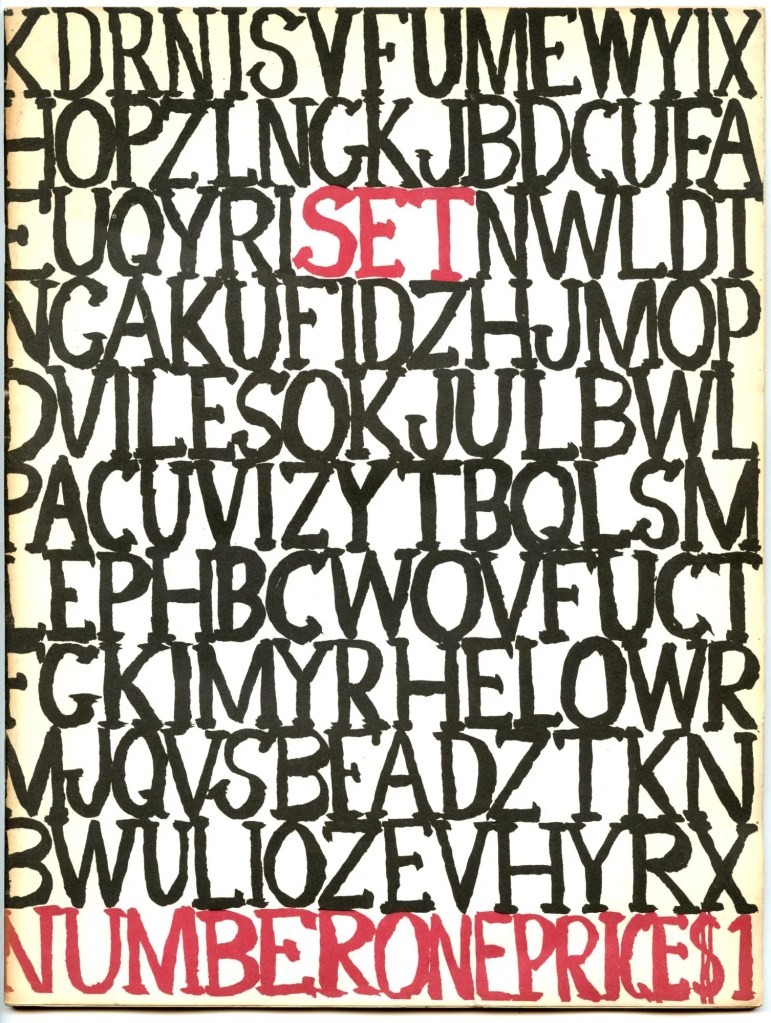
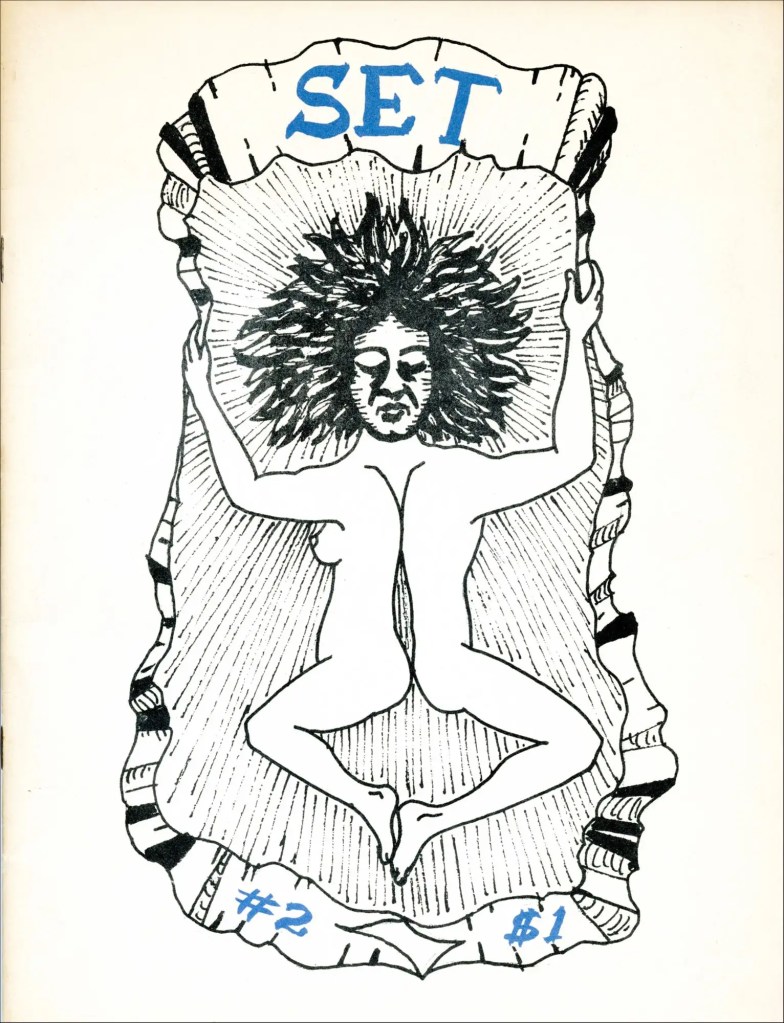
Lansing’s work seems to anticipate Grant’s in several ways. The two both think it important to honor the Egyptian god Set, for instance, with Lansing naming his early-60s poetry journal SET after him. And Grant’s focus on the Qliphoth, or the underground portion of the Tree of Life, seems present in the title of Lansing’s 1966 poetry collection The Heavenly Tree Grows Downward. For more on the “tree that grows downward,” Pierre Joris recommends looking at a section of Jung’s Alchemical Studies called “The Inverted Tree.”