Birthplace of the Iroquois Confederacy

Syracuse is a place with a rich and storied past. The Iroquois Confederacy was founded here at Onondaga “some time about the middle of the fifteenth century,” as Paul Wallace tells us in White Roots of Peace: The Iroquois Book of Life. I find Wallace’s book on a shelf in the city’s four-story Antiques Exchange: one of innumerable structures and forms by which the city retains its history.
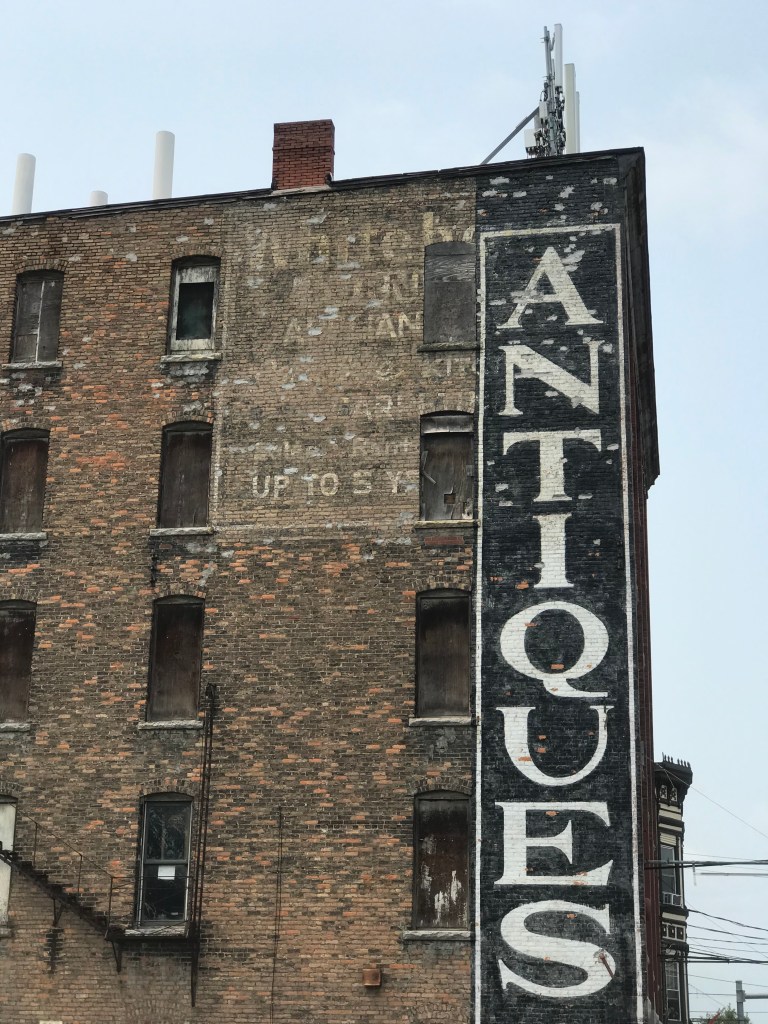
Driving a car is already a form of time travel — but ’tis especially so in Syracuse. Multiple eras coexist amid the beauty and dilapidation of major city thoroughfares like Salina Street. Sitting now on a sleeping bag in a tent, I read of the Five and Six Nations and the Constitution of the Haudenosaunee. Wallace recognizes the resulting Iroquois Confederacy as “a model for, and an incentive to, the transformation of the thirteen colonies into the United States of America” (19). Other scholars contest some of Wallace’s claims, suggesting that the ratification occurred further west (near what is today Victor, NY). These are stories told among Indigenous people, passed on to white anthropologists like Wallace: tales retold in the tongue of the settler. One understands that much is lost in translation. Time travel is an imaginal practice, not a science. The Great Peacemaker Deganawidah appears in Wallace’s account as a miraculous figure comparable to Christ and Buddha. “I come from the west and I go toward the sunrise,” he tells those he encounters. “I carry the Mind of the Master of Life, and my message will bring an end to the wars between east and west” (38-39).

Under the Dome

Camping: a play starring mother, sister, brother-in-law, niece and nephews, aunts and uncles, Sarah and Frankie. Air mattress craps out, so Sarah drives into town to purchase another. I stay behind at the camp, in a camp chair beside Frankie as she naps. Sister orders pizza; brother-in-law and uncle handle boat and jet-ski. Domed tents go up amid leafy profusion: Coleman, Ozark Trail. ‘Tis the universe of Sears-Roebuck, L.L. Bean, and Whole Earth Catalog: temporary tools and architectures. But beside each tent sits a car, where in earlier times would have stood a horse. Nothing here is as I wish. No wisdom, no gnosis. No silence, no solace. No love ’til I sit with trees. Is the time travel narrative’s hero the one who stays or the one who goes?

Indra’s Net

An itchy, hairy, melancholy spider tiptoes along threads of text. Time is to the one who travels a bit like Indra’s Net. At each “eye” in this net of infinite dimension, one is told, lies a jewel set there by the net’s artificer to please the tastes of the great god Indra. Inspect any one jewel and one will discover reflected there in its polished surface all of the others. Alan Watts described it thus: “Imagine a multidimensional spider’s web in the early morning covered with dew drops. And every dew drop contains the reflection of all the other dew drops. And, in each reflected dew drop, the reflections of all the other dew drops in that reflection. And so on ad infinitum. That is the Buddhist conception of the universe in an image.”

Love and Marriage: A Discourse

“There I was,” recalls the time traveler. “A married man, despite my vexed relationship to marriage as sacrament and institution.”

“Okay,” nods the narrator, eyebrows raised, trying to intuit from what he knows of the traveler’s past what might lie on the other side of “vexed” if that word was hyperlinked. “You’ll have to say more at some point—but go on.”

“Sarah and I had exchanged our vows seventeen years prior,” explains the traveler, “outdoors, in a state-sanctioned but otherwise nonreligious ceremony, with the blessing of friends and family.”

The traveler pauses, proceeds haltingly here in his telling, reliving again the flowers, the arbor, the sunshower afterwards. “I wasn’t seeking to marry,” he adds. “That wasn’t part of any future I’d imagined for myself in my youth.”

Narrator considers this, nods again approvingly, asks what he’d imagined in its place.

“As far as I can remember,” muses the traveler, “all I’d wanted was to write.” He smiles, picturing himself hunched over his notebooks in years past.

“But you and Sarah fell in love?” asks the narrator.

“Yes,” confirms the traveler, “no denial of that on my part. And there we were, in the final months of our Master’s program: both of us wanting to pursue PhDs in English, with hopes of earning a living, despite already mounting debt, by continuing to teach courses at the college level.”

“Fair enough,” says the narrator, elbows propped on the arms of his chair, fingers arched to form a pyramid. “But how did you get from there to the decision to marry?”

“The immediate stress in those days,” breathes the traveler, voice achieving new resolve, “was that we were drawn toward different programs. Mentors dear to us at the time advised us to go our separate ways. ‘Sarah should go to Buffalo,’ they told us. ‘Matt should go to Brown.’”

Narrator purses his lips, tries to conceive the traveler’s dilemma.

“I remember us crying afterwards upon leaving those meetings,” murmurs the traveler. “Neither of us wanted to live apart.”

Traveler looks up here in his telling, eyes glinting. “And so it happened.”

“Just like that?” inquires the narrator. Traveler nods. “Just like that,” he replies, snapping his fingers as if to illustrate. “Over dinner one evening: we agreed to marry.”

Escape from Space and Time

“What about the future?” thinks the time traveler. Could binaural beats be of use, as the Monroe Institute claimed? The narrator has cassettes of theirs in his basement, and could be cajoled into playing them for the time traveler as the latter reclines on a futon at Dada’s House on the night of a full moon.

“The Monroe people seem sort of creepy, though,” warns the narrator. They allege that their “Gateway Experience” enables escape from space and time. CIA thought the technique had some degree of merit, didn’t they? Enough, certainly, to warrant an investigation. The results of that investigation have been declassified and are available now through the CIA website. Thobey Campion reviewed the agency’s findings about the Institute several months ago in a piece for Vice.

Free Jazz vs. Circuit City

The time travel narrative dredges up pain from the past. A bizarre love triangle rhymes without repeating. “The story needn’t go there,” thinks the narrator. If the machine or device is the narrative itself, then (to honor Moor Mother’s terms) let it draw us toward free jazz rather than circuit city. Let the “trance-script as time machine” be a liberation technology. Let it be a spirit-force that helps us heal.

Hopework

So thinketh one of our time travelers. The one who relives the past. Let there also be a traveler who seeks and conceives here in the dailiness of his lived experience a utopian future. As Joshua Chambers-Letson, Tavia Nyong’o, and Ann Pellegrini note in their foreword to the 10th Anniversary Edition of José Esteban Muñoz’s Cruising Utopia: The Then and There of Queer Futurity, “Hope is work; we are disappointed; what’s more, we repeatedly disappoint each other. But the crossing out of ‘this hoping’ is neither the cancellation of grounds for hope, nor a discharge of the responsibility to work to change present reality. It is rather a call to describe the obstacle without being undone by that very effort” (x). The obstacle is a challenge we must both survive and surpass, Muñoz argues, “to achieve hope in the face of an often heart breaking reality.”

Backstory

The backstory to the story is the story of the House on Shady Blvd. This is the past to which the author must return. He must tend to old wounds to enable future flourishing. Do we need a Time-Turner like the one used by Hermione Granger? Or is the Device that enables travel simply the trance-script itself? Does the author sift through unpublished entries from the past? Or have we gotten ahead of ourselves, trying to lead when what the story demands is that we let ourselves be led?

Friday July 2, 2021

Benedict Seymour’s Dead the Ends takes Chris Marker’s La Jetée as its Ur-text. Seymour’s film is a found-footage concoction, and thus incorporates much of the Marker film into itself. But Dead the Ends is also database art, as Seymour pairs these bits of La Jetée with their many echoes in subsequent time travel narratives (Terry Gilliam’s 12 Monkeys, etc.). These works that Seymour reanimates in Dead the Ends all feature romance at their core: lovers seeking each other across time. The narrator of my story, meanwhile, feels growing within himself some similar romantic core. It is there “in the belly of this story,” as Leslie Marmon Silko says of her novel Ceremony. I trance-scribe these texts in the time-stream of the paralogy, but they are words received from another timeline, spoken by a shadow-self whose desires led him West. Or not spoken by the shadow-self, but in dialogue with it. Trance-scribing is not the same as channeling. The shadow-self wants to access the acid diaries of Merry Prankster Stewart Brand, founder of the Whole Earth Catalog. The shadow-self is headstrong — discontented — and then enlivened — reawakened — through an encounter with another. Whereas the paralogical self is a family man: loving father, loving husband. But grown weary from excessive self-silencing, and (given the nature of the karmic cycle) the expectation that he plod on and endure.

Thursday July 1, 2021

All of us are feeling it, the sudden shift in mood and content from one day to the next. Here we are trying to react to this new present. I for one haven’t any words yet for this funk that leaves me driving around weeping to Martha Wainwright midday. I’m supposed to suffer through this, is what I gather from the day’s intel. I’m reliving an incident from my past. Time travel prompts a return of the repressed. I’m here to revisit an old knot of sorrow: a scene of fantasy that ended poorly when pursued in the past. The hope is that in my behaving differently this time, we can heal.