When the trance-script writes itself, it writes the following:
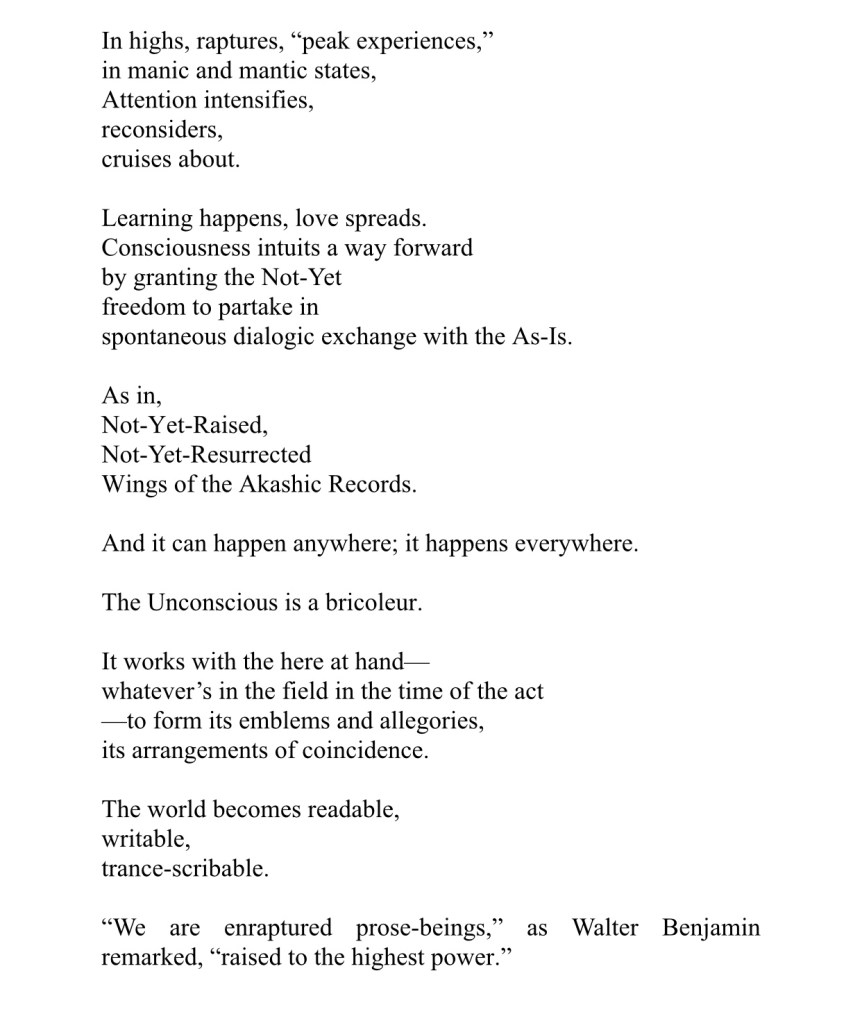
When the trance-script writes itself, it writes the following:
More must be said, too, of Devin’s book, Precipitations: Contemporary American Poetry as Occult Practice. ‘Tis a book of criticism prepared by Devin based on a dissertation he wrote under the supervision of Robert von Hallberg and Saree Makdisi at the University of Chicago. I am grateful Devin wrote it — for with its overview of prior acts of trance-scription by the likes of poets Robert Duncan, James Merrill, and H.D. comes the potential to retell the backstory of what I’ve done. It sits with me here as I write.

There’s more to it, though; this vein of coincidence runs deep.
For Devin, too, has a place in this story.
I reach out to my colleague C., a poet-friend who studied under Dillon, and ask if he knows, too, of Devin. C. confirms that Dillon and Devin are indeed father and son.
Devin wrote an essay called “The Needs of Ghosts: On Poems from the Margins of Thom Gunn’s ‘Moly.’” The start of that title hits home, of course — startles me, lands with me now as I recollect my time on Shady Blvd. Having taught poems from Moly in my course on Hippie Modernism, I relish the opportunity to read Devin’s commentary. Not yet having familiarized myself with the other text about which he writes, however, I set to work doing so. I track down and read Robert Duncan’s Poems from the Margins of Thom Gunn’s “Moly,” a serial poem that Duncan published as a pamphlet in 1972, later reprinted in his 1984 collection Ground Work: Before the War.
For Duncan, writes Devin, crafting poems in the margins of Gunn’s book was a form of collaboration. The collaborator, he explains, is for Duncan “an inspiration from outside.”
And like that, it happens. The idea grows legs as I read. For I, too, wish to craft a text in the margins of another’s book. Mine will be a story crafted, in a sense, in the margins of Devin’s.
Our cast can be imagined as three parts of a single psyche, plus one.
The first three—imaginable, perhaps, in relation to categories like present, future, and past—nevertheless share time in a single home, like users sharing computing time on a mainframe.
Who, though, is the Ghost? The alleged “plus one.” Not quite mind-at-large, certainly. The whole person? The unifying soul? An author-function self-fashioned into being via hyperstition? That which presides in each?
***
“It might be helpful,” quips the Narrator, “to map these characters onto a Greimas square.”
“But my preference,” he adds, “is to do as Iris DeMent suggests, and let the mystery be.”
“Here I am again, in this next memory,” says the Narrator. “On the beach. Only this time, it’s a new one: Newport Beach, site of my brother’s bachelor party. Imagine me in dialogue, in a sense, with the one who was there.”
Spacetime shifts here as the character reenters the memory.
***
“Well, what’ll it be?” wonders the Traveler. “If spacetime is reducible to a game of multidimensional correspondence chess, then what’s our next move?”
Rising in the sky above him there at the beach house, the new moon in Leo provides the Traveler a chance to ask questions. He communes with the moon, engaging it in silent dialogue, and sets his intentions for the months ahead.
A ghostly third figure joins him in the course of the evening. It shimmers into being like a hazy wonder there amid the rocks and the waves, and in so doing, intervenes in the Traveler’s thoughts. “Let us be careful what we wish for,” warns the Ghost, “as this is a powerful, wish-granting lunar cycle.”
***
“Warning taken, it was with great care that I made that wish,” interjects the Narrator from the future. “And in retrospect, I regret nothing.”
“Come sunrise, in fact,” remembers the Narrator, “and a commune of sorts assembled itself down near the shore. Members set out mats and, posing silently amid squawking seabirds, practiced yoga on the beach as I wrote.”
The Ghost reminds me of me. There it is dancing alone in my apartment, singing “I want you to hold me,” as the Violent Femmes do on their song “American Music.” The Ghost thinks its lovers speak to it through the songs on its radio.
It sets forth each night assured of this, listening as one such lover follows “Gold Soundz” and “A Pillar of Salt” with “Lariat” and “Web in Front.” “If it means I get to hear you singing to me,” reasons the Ghost, “if it means our last words weren’t wasted, then so be it.”
Inspired by the aforementioned, Ghost decides on a whim to live well again. It comes and goes as it pleases amid the timestream of its ghosting, resolved in each instance to rip it up and start again.
“Going back to old sounds won’t help,” thinks the Time Traveler. “Do so and the Narrator stands revealed as a bloody mother fucking asshole.”
The Narrator, not quite omniscient and thus taken aback by the thought, asks of his sub-creation, “You think so?” “What, then?” he wonders. “Do we edit the entries to make me likable? What would we write instead?”
Thus it happens, thinks the Traveler. “The Ghost would have to enter into the narrative,” he says. We know for certain that some such being spoke to us via auditory hallucination, don’t we? And we know as well that it was already there, doing its work upon us in the house, prior to our introduction to marijuana. The latter didn’t invent the Ghost — but it amplified it. It gave it back its voice. Let us open ourselves to the Ghost, then, and recognize it as a potential for apartness within us that is always-already part of us. Once we accept all that is loop-like, all that is like Ouroboros in our nature, we reveal ourselves as we are, infinite: a single, transtemporal, interdimensional being, enunciating itself across time.
One version of the narrative begins with the Narrator rereading old trance-scripts, feeling unhappy with his former self’s negative self-image. He arrives to a realization of how much of an obstacle he was to his flourishing. The Narrator wonders: should I “burn the diaries,” as Canadian poet Moyra Davey recommends? Should I edit, revise, re-sequence events? Is that how one creates an Alter-Destiny?
The Narrator admits that it wasn’t until well after the end of his stay on Shady that he first came to think of the place as haunted.
“Drug-induced trances revived my writing practice during the years of my tenancy,” confesses the Narrator. “It was as if a voice spoke to me,” he says, “telling me what to write.”
“The Text I produced during those years,” exclaims the Narrator, “was in all sincerity written by the home itself, was it not?”
“I should think so,” opines the Traveler, “though I know neither the how nor the why, neither the here nor the there of it. It was written by the home…or by the spirits who dwell therein.”
“Spirits, then, if you must,” nods the Narrator, with what may in hindsight seem a touch too much vigor. “Yes, perhaps! The one explanation makes near as much sense as the other. Let us see!”
The backstory to the story is the story of the House on Shady Blvd. This is the past to which the author must return. He must tend to old wounds to enable future flourishing. Do we need a Time-Turner like the one used by Hermione Granger? Or is the Device that enables travel simply the trance-script itself? Does the author sift through unpublished entries from the past? Or have we gotten ahead of ourselves, trying to lead when what the story demands is that we let ourselves be led?
 Trance-Scripts