Earthseed isn’t the first religion invented within the context of science fiction. Scientology comes to mind as another, invented by science fiction writer L. Ron Hubbard. I’m also reminded of Discordianism, a religion of sorts propagated in part by Robert Shea and Robert Anton Wilson’s Illuminatus! trilogy. Like Hubbard’s Scientology, Earthseed is nontheistic — at least in the sense that the latter’s god is simply “change,” a process said to lack consciousness, yet capable of being “shaped” toward humanity’s “destiny” among the stars. Earthseed refuses to console with any promise of an afterlife. (A bit like Stoicism, in that sense.) As a belief system, I find it overly grim.
Author: trancescripts
Saturday June 13, 2020
Earthseed, the religion founded by Lauren Oya Olamina, the heroine who narrates Octavia E. Butler’s novel Parable of the Sower, resembles other faiths (including the Baptism of Butler’s upbringing) in its evangelical cast. Lauren spreads the word and seeks converts, her church being a kind of mutual aid society. Together, she and her followers form a traveling, changing community — a “team” or “tribe” of sorts, decisions made organically based on the group’s capacity to survive amid thieves, murderers, cannibals, junkies, wild dogs, and arsonists. Lauren’s view of the world is paranoid, but it’s a paranoia borne out by lived events of trauma. She “experiences” and “shares” the pain of others due to what she calls “hyperempathy syndrome.” She has an ability that makes her vulnerable, and thus cautious of who she can trust. We needn’t think of this as mere delusion. The reactions to bodily harm sometimes manifest physically, another’s pain sometimes drawing blood. However we view this aspect of Lauren’s experience, it leads her to seek followers. She wants others to believe her, offering in exchange a path toward survival.
Thursday June 4, 2020
Strong is the power of ideology — but we’re changing, we’re slipping out from under the latter’s grip. Dancing in the streets. The tasks ahead seem massive but thrilling. Time to learn how to make of the lawn a garden. Purchase the tools one needs and get to it. Convert this place into a permaculture Oikos, a multiplayer bower of bliss.
Wednesday June 3, 2020
One senses other voices — distractions from the work we’re here to do. “Ascent” and “descent” seem to be top priority for esotericists. Others call for reparation, insurrection, revolution, loving-kindness. Some speak of Babylon, purgatory, Tartarus. Beware the spooky ones and the trolls — the paranoids who think everything’s a plot. Get one’s house in order, noting daily the interplay between psyche and cosmos. Remember, too, that Butler’s heroine in Parable of the Sower writes a book of the living rather than a book of the dead.
Sunday May 31, 2020
The story that writes itself and needs to be written is the story of black life — multiple, joined with others, protesting, demonstrating, rioting against systemic racism and Trumpism and white supremacy and police murder in cities across America. “We have our masks and we’re ready,” says the voice of the collective subject. Reception of the Event is always mistranslated by journalists — yet awareness is growing, consciousness is changing. We’re learning our way toward insurrection and rebellion against injustice. My hopes are, as always, with the struggle. Mike Davis and Jon Wiener walk me through the Watts Uprising of August 1965. As Horace Tapscott exclaimed, “The Giant Is Awakening.”
Tapscott’s Underground Musicians Association (UGMA) formed at the heart of the Watts Renaissance. They were a jazz commune like Sun Ra’s Arkestra — but unlike the autocratic structure of the latter, Tapscott’s group was, as Davis and Wiener say, “an anarchist participatory democracy” (Set the Night on Fire, p. 245). The feeling today is much the same: giants awakening, people assembling. What has needed to happen is happening.
Wednesday May 20, 2020
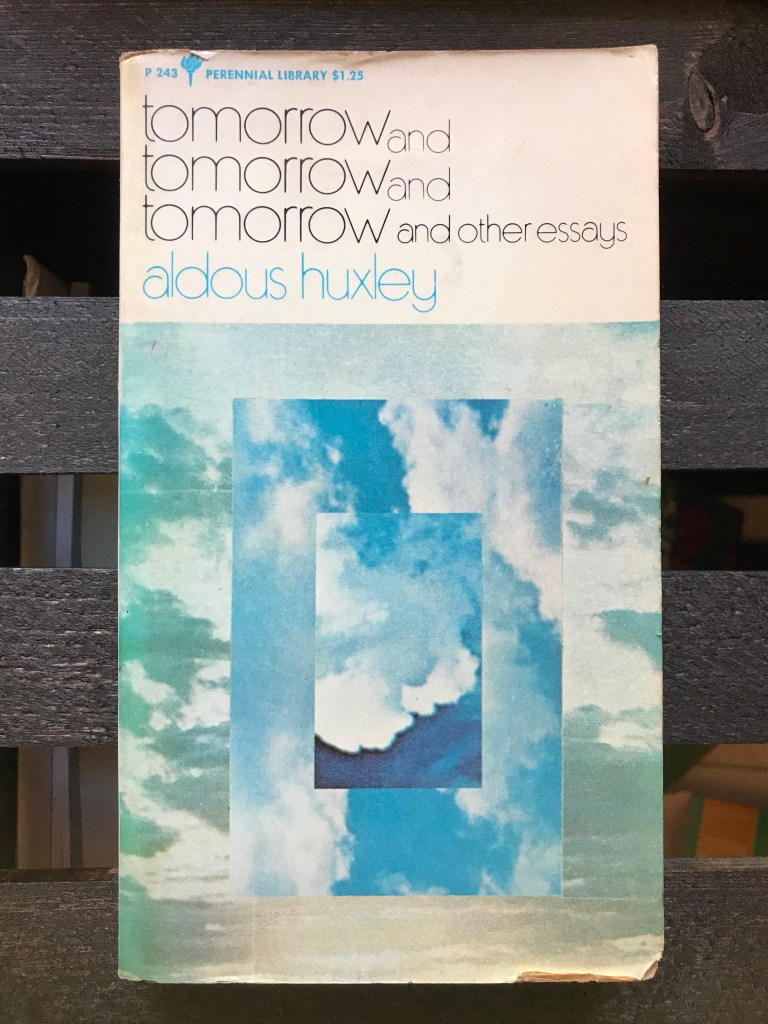
Packing books into boxes takes time — not least because I keep pausing to admire ones that catch my eye, like Aldous Huxley’s Tomorrow and Tomorrow and Tomorrow, which, in its 1972 Perennial Library paperback edition, features a groovy cover design by a young Barbara Kruger. But into boxes they go — all of them. Kirkpatrick Sale’s SDS, R. Buckminster Fuller’s Operating Manual for Spaceship Earth. To be retrieved at the new place a few days hence.
Tuesday May 19, 2020
I sit quietly and close my eyes, feeling my way around an inner plateau.
Monday May 18, 2020
We arrive at a digital labyrinth, without memory even of our name. “Your guess as good as mine,” says somebody to somebody. “Here, inside our walls,” begins an orator, “what exactly is taking place? An anamnesis? A catabasis? A war against psychic repression?” Audiences shift in their seats and begin to type.
Wednesday May 13, 2020
The baby falls asleep to Parliament Funkadelic, Spaceship Earth reimagined as the Mothership Connection. “Are you hip to Easter Island?” asks singer George Clinton late in the song. “The Bermuda Triangle? Well all right / Ain’t nothing but a party.” Time to live light years in the future, in a time-space proposed by Afrofuturists. “One Nation Under a Groove.” Re-constitute the social order and make it funky: “Feet don’t fail me now!” Out of fear of its wrath, I refrain from playing Lee ‘Scratch’ Perry & The Upsetters’s “War Ina Babylon,” opting instead to play Bob Marley & The Wailers’s beautiful “Redemption Song” as the baby wakes. Afterwards, we dance around, her in my arms, me on my feet, to Jorge Ben’s Africa Brasil — on which I discover to my surprise a song called “Hermes Trismegisto Escreveu.” Later, by myself, I climb to the room above the garage and bliss out to J Hamilton Isaacs’s Circumzenithal Arc.
Sunday May 10, 2020
As parents, we become, undergo metamorphosis, transform into the worlds of our children. Through our actions, we model better natures, better worlds. Hopes manifest, consciousness redoubles upon species-being — and upon waking, sees before its very eyes a better state. We change by projecting upon the mind’s eye dreams other than those programmed into us by History.
 Trance-Scripts