“Against work, for utopia,” announces a podcast I’ve listened to of late. Give it a try: sex worker Conner Habib, the show’s host, interviews Marxist-feminist Kathi Weeks, author of The Problem with Work. Weeks is an investigator of “Antiwork Politics” and “Postwork Imaginaries.” See especially her book’s fifth chapter, “The Future Is Now: Utopian Demands and the Temporalities of Hope,” where Weeks proposes “a utopianism without apology” (175). To defend the latter, Weeks draws upon the ideas of the great German Marxist “philosopher of hope” Ernst Bloch. Her account of Cold War anti-utopianism covers ground I covered in my dissertation: Karl Popper, Francis Fukuyama. All of it now dust in the wind. Let Utopia rise again from the sea of the possible as it did for More.
Category: Uncategorized
Saturday April 3, 2021
There were deer in the yard when I arrived home from “the Teet.” And a stinkbug that needed rescue, and a toilet that whines and may need a new valve. Tomorrow, weather permitting, I’ll mow the lawn and grade. In the days ahead, we hope to build our garden. As Roy Morrison said of the Mondragon cooperatives: “We Build the Road as We Travel.” Let these trance-scripts be spaces of hope. Signposts to an alternative modernity, like the one reported from firsthand by Richard Fairfield, reports gathered in his book The Modern Utopian: Alternative Communities of the ’60s and ’70s. If I could time-travel, the countercultural communes would be a destination to which I would journey. Let us be drawn toward collective living, enriched by conversation with others. We can begin by taking Fisher’s course on Postcapitalist Desire. Read the assigned readings, including work by Ellen Willis. Fisher gets his assessment of the reasons for the failure of the communes from Willis. Fellow ’60s rock critic Richard Goldstein included Willis among Emma Goldman and Abbie Hoffman as members of a lost tradition of “radicals of desire.” Somewhere in my basement is a collection of Willis’s writing on rock music, Out of the Vinyl Deeps. Also the book with the material Fisher assigned: Beginning to See the Light.
Thursday April 1, 2021
We rejoice upon word of the rapid, successful birth of our niece. My sister FaceTimes with us: she and baby are well. We care for her boys until her return, while teaching and caring for each other. The boys are into lightsabers and Fortnite. I race after them, pushing Frankie in a stroller, as they bike to the neighborhood park on the bay. They request “Lava Monster,” where I roar and give chase.
Tuesday March 30, 2021
Laws are changing in both the state of my birth and my current state of residence. The states that house most of my lived experience. Decriminalization of marijuana where I reside, and legalization up north for the people of New York. Think of it as “tools returned to the people,” “medicine for the people,” people able now to receive plant wisdom without fear of persecution. In some locations, these projects have been “articulated,” in Laclau and Mouffe’s sense, with police abolitionism and reparations for communities of color.
Saturday March 27, 2021
Some of my students are writing brilliant papers. Let us celebrate. Ice cream truck: jingle jingle, dream big. The world is always-already enchanted, slips the confines of the automatized western. One is not at the end of history but rather its beginning, says Going In, a Brooklyn-based sub-label dedicated to long-form musical compositions geared towards meditation, psychedelic ceremonies, yoga, [and] massage.” The part of me that wants to write wants to listen. Entering the moment means watching The Croods, or staring at stars, or seeking copies of Verdant Gnosis.
Thursday March 25, 2021
Time: an odd phenomenon in light of the way it communicates, deposits emblems, plays hide-and-seek with consciousness. “Let Your Dreams Set Sail” says one such emblem, printed on the wall above the bed in which I’ve slept of late. A box on the ground displays the Paramount logo, a mountain pointed toward an outer sphere, like a Bucky dome lined with stars. Outside the sphere pokes SpongeBob SquarePants: the Flammarion engraving rejoined or reversed.
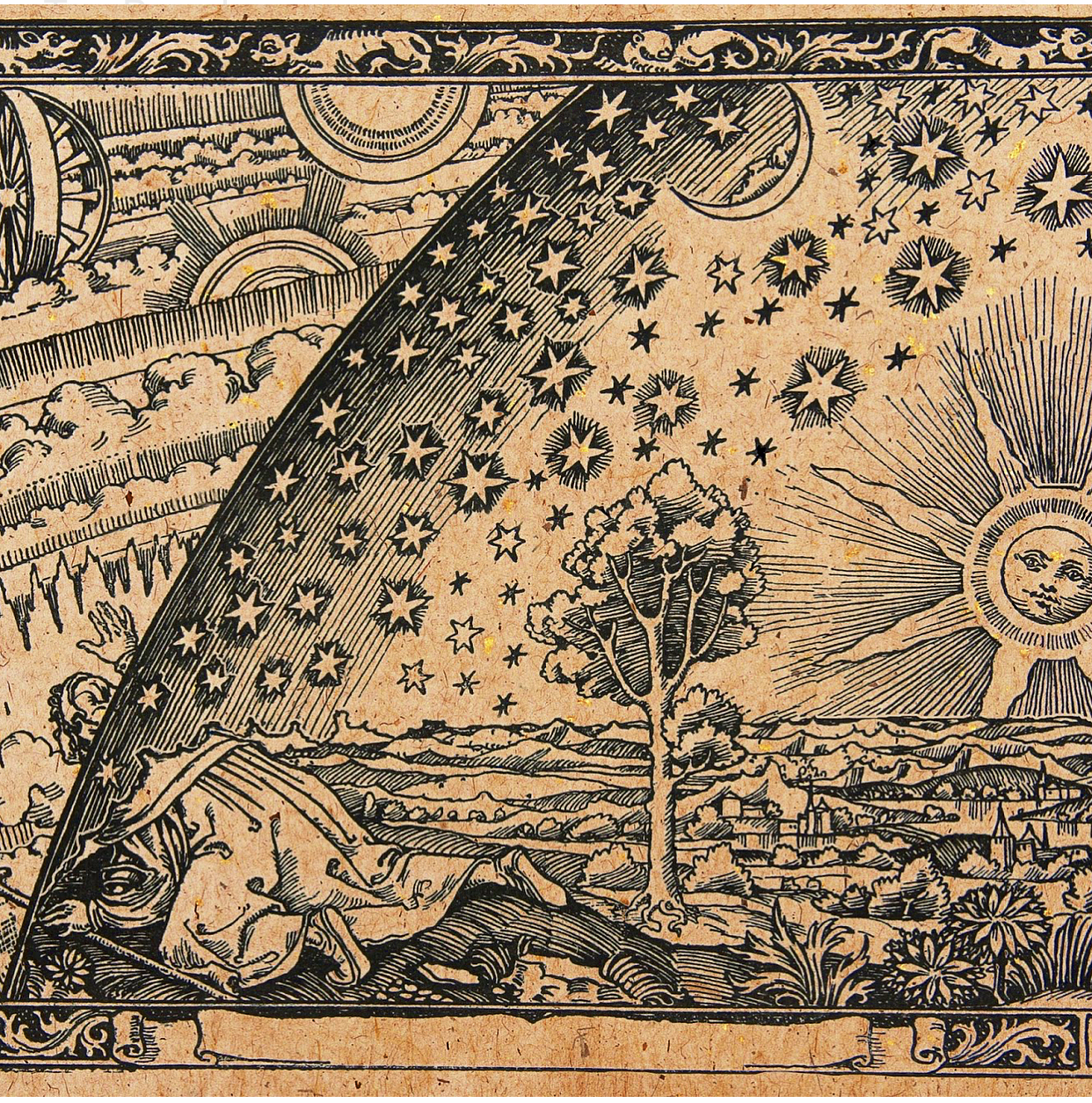

SpongeBob disrupts the first sphere’s fourth wall, smiles at consciousness, injects among solemnity a spirit of mirth set free to roam the cosmos. He, too, partakes of the image’s directionality, the vertical ascent narrative involving spaceships: the thing toward which the parts of the emblem incline. Let us imagine among these ships of possibility that which is prophecied in the mythology of the Dog Star — black anti-slave ships, lines of flight like Marcus Garvey’s Black Star Line. Nathaniel Mackey fuses these symbolisms in his poem “Dogon Eclipse.” The poem ends “as if by then I’d / been thru / Hell / and back.” As if the “I” of the poem were Orpheus, the poet of ancient Greece, founder of the Orphic mysteries. Orphics revered Dionysus. He, too, is said to have descended into the underworld and to have returned. Through his poem, Mackey initiates those who read. So sayeth Michael S. Harper in his preface to Eroding Witness: “These poems are about prophecy and initiation.” Poems like “Dogon Eclipse” hint at mysteries; they transmit a secret knowledge. Other poems in the collection conjure loas from Voodoo and Vodou. Loas are the “mystères,” “the invisibles.” They act as intermediaries between worlds.
Tuesday March 23, 2021
Kids and I play in my brother-in-law’s back yard.
Geese swim up and greet Frankie and I on the canal, splashing, squawking loudly.
I build the kids a fort.
I drive my nephew to preschool.
Sarah and I see his brothers to the bus stop, send them to school.
It’s a day of many moving parts.
Sicilian pizza for lunch from my favorite pizzeria.
I return home with slices for Sarah and Frankie.
L. attends the same preschool I attended forty years ago.
Clear skies, sunlit afternoon.
I man the grill and prepare dinner.
A day of actions rather than words.
Sunday March 21, 2021
We rearrange ourselves beside a canal among people with good stories. A seal docked beside me with a smiley face sticker atop its face prompts me to imagine the addition of hieroglyphs to the text message emoji/emoticon lexicon. Mermaids hover to my left, and to my right a friend’s new romance novel: Joanna Lowell’s The Duke Undone. A trip down memory lane. “Down By the Bay” theme song performed on ukulele. I eye the book’s prologue and note its relationship to another of the friend’s novels. Female protagonist. Third-person subjective narration. Yet there the similarities end. Or so I imagine.
Thursday March 18, 2021
Step into “Jam On It,” members of Newcleus rocking the mic, beat is fresh. Then read Lennon Remembers, a two-part interview with John Lennon conducted by Jann Wenner for the December 1970 and January 1971 issues of Rolling Stone. Lennon begins the interview a bit rancorous and sour grapes. The Beatles had broken up eight months prior, and Lennon seems convinced that the 1960s cultural revolution failed to produce real change. “Nothing happened except that we all dressed up,” he says. “The same bastards are in control, the same people are runnin’ everything, it’s exactly the same. […]. We’ve grown up a little, all of us, and there has been a change and we are a bit freer and all that, but it’s the same game” (12). The band’s final years were in Lennon’s view humiliating and awful. People were thrust on them and would touch them. To recover, he made his first solo album, John Lennon/Plastic Ono Band, released the same month as the interview. The album cover features John and Yoko relaxing under a tree beside a lake at Lennon’s Tittenhurst Park estate. A church bell rings in the opening seconds of “Mother,” the first track on Side A.
By the time of “Working Class Hero,” my thoughts are of primal scream therapy and psychic restitution. That’s what one seeks through psychotherapy, is it not? “Psychic restitution”? It all seems a bit too rooted in the past. It is time instead to re-read Eroding Witness by Nathaniel Mackey.
Wednesday March 17, 2021
The “new” look of psychedelic art and design of the 1960s was, as a recent Vox video shows, about recooking the past. “Art Nouveau on acid.” For Huxley, meanwhile, the psychedelic experience is about Moksha, a concept from Eastern spiritual traditions involving freedom from samsara, or access to a truth or a reality beyond the cycle of suffering and rebirth. I find myself returning to Huxley’s book The Perennial Philosophy, published in 1945, immediately after WWII. The book assembles passages from the writings of saints and prophets from traditions of Eastern and Western mysticism. The German philosopher Gottfried Leibniz is the one who named this strain of esoteric wisdom “the perennial philosophy.” There’s a universalizing bent to perennialism, arguing as it does that all religions, despite their differences, point to the same truth: “That Art Thou,” or “Thou Art That,” “the immanent and transcendent Ground of all being” (Huxley, The Perennial Philosophy, p. vii). There is an eternal Self in the depths of each person. Or as Marcus Aurelius claimed, “the universe is a single living organism possessed of one substance and one soul, holding all things suspended in a single consciousness and creating all things with a single purpose that they might work together spinning and weaving and knotting whatever comes to pass.”
 Trance-Scripts