Some car drama this afternoon — but we take care of it, we swap out the flat tire, replace it with the spare, drive it over to the auto shop for repair. I remember the last time I changed a tire: the flush afterwards, the sense of accomplishment. Upon discovering today’s flat, I responded initially with flashes of anger and resentment. These, however, I channeled, transmuted into energy that I made work for me as I performed the physicality of what the circumstance of the day demanded: a series of arm wrestles with lug nuts and tires. Afterwards my shoulders went numb a bit as after an intense session of weightlifting. Yet there’s work to be done, so I do it. Up next in the course, Ginsberg and Di Prima.
Sunday September 20, 2020
Here I am once again reading Allen Ginsberg’s “A Supermarket in California,” a poem I’ve been reading for most of my adulthood. Today, though, is the first time I see the supermarket through which the poet wanders as both sacred and profane: a supermarket of neon and concrete, certainly, but also a supermarket of the spirit. Ginsberg wanders amid Whitman’s “enumerations” and “penumbras,” the catalogued universe of American consumerism — but he dwells there with his ancestors, in an afterlife like the one imagined by the ancient Greeks. Whitman is addressed and invoked throughout the poem. Ginsberg questions him as if Whitman were an American Virgil leading Ginsberg through the inferno of the American Century. The poem travels from the bright light of the new postwar supermarket to a lonely American night. The Spanish poet Federico García Lorca shops here, too, apparently. Ginsberg wonders what Lorca was doing there “down by the watermelons.” Lorca was executed by fascists during the Spanish Civil War. Ginsberg follows these figures, though he also imagines in a somewhat paranoid manner that he himself is being followed or trailed by “the store detective,” as if the poet were a character in one of the era’s films noir. All of this thinking occurs on the night of a full moon. It’s a “weird” poem, is it not? Weird as in the way Erik Davis uses the term in his book High Weirdness. The supermarket is as much in Hades as it is in California. I read it now while tending a small fire in a fire-pit in my backyard. Whitman seems dismayed by the country’s development in the half-century since his passing. The “lonely old grubber,” who always said he was immortal, appears in the poem eyeing and questioning the grocery boys. “Who killed the pork chops?” he asks. “What price bananas? Are you my Angel?” The questions suggest confusion, suspicion, bewilderment, and indignation. Why do we find ourselves in this world, he seems to be asking, rather than “the lost America of love,” the one we dream? Why, though, does the poem end beside the waters of Lethe? Perhaps that is where the poet locates America spiritually and psychogeographically.
Tuesday September 15, 2020
Gnosticism is a theology with which I was already grappling before I’d heard the term — for there was a “gnostic current” in the culture of my youth. One receives gnostic teachings, for instance, in the works of Philip K. Dick, Thomas Pynchon, and Jean Baudrillard. Similar teachings appear in the “edge-of-the-construct” films of the late 1990s — movies like The Matrix and The Truman Show. These works spoke from a period of political paranoia — the Cold War and its immediate aftermath, with widespread fears of conspiracy around the turn of the millennium mixed with anxieties about technological transformations, “New Economy” dot-com bubble newly burst. Computers were suddenly “virtual places” to which many of us migrated for many hours each day. Computers housed places we showed up to for work and play. And of course, all of this seemed interlinked with prior screen cultures like TV and cinema. One spent a lot of one’s time in what Situationist Guy Debord called “The Society of the Spectacle.” It’s not a fun place to be. The Spectacle intervenes in one’s relationship to one’s body. Marxism says all of this is happening within an economy. Workers must unite and seize control of the means of production, wrest them from the clutches of the capitalists. And so I believed — as I do today. But Eric Voegelin reminds us that Marxism is itself a brand of Gnosticism. One can’t escape one’s latin roots.
Saturday September 12, 2020
I sort through boxes of books, selecting several a day to add to shelves of bookcases around the house. Each room with its books operates thus around me as ever-expanding memory palace and cognitive map. The angel of the library arrives, or as Erik Davis says in an interview for a recent episode of Michael Taft’s Deconstructing Yourself podcast, “The archive wakes up and starts to show you patterns.” I’ve experienced and continue to experience “visits” from these “intelligences from the other side.” These are for the most part joyful occasions — growth games. One feels sized-up like Mario under the influence of flower power. Imbued with a kind of grace.
Friday September 11, 2020
What happens when we enter the imaginative space of Walt Whitman’s America? The country widens. Through it strides the Spirit of Hope — “in the Mannahatta and in every city of these States inland and seaboard…Without edifices or rules or trustees or any argument, / The institution of the dear love of comrades” (128). But Whitman’s also a poet of settler-colonial Westward expansion, is he not? Rather than referring to indigenous people as “Indians,” Whitman called them “the red aborigines.” They appear in Leaves of Grass only as people who have “vanished” — as if there was no violence involved in this “melting” and “departing.” In “Starting From Paumanok,” they’re mentioned in a single stanza, remembered only for “charging the water and the land with names” (26). Whitman’s epic whitewashes American history. During the years of Whitman’s production of Leaves of Grass, Indian Wars were fought by the United States government everywhere west of the Mississippi. The first edition appeared in the wake of the Trail of Tears. The Wounded Knee Massacre occurred at the end of 1890, the year before Whitman’s death. Whitman seems to have thought little about his complicity with the evils of a government that wages war on Indians. This despite the fact that he spent the year of 1865 working in the Indian Bureau of the Department of the Interior. So, it wasn’t like he was unaware of indigenous people — he just regarded them as “savages,” doomed to demise by the settler-state’s imagined “manifest destiny.” Beyond just casually dismissing indigenous struggles, however, Whitman was also an appropriationist, his English decorated with words poached from native languages, particularly names of tribes and names of places. How do we make Whitman and the past he represents “useful,” as Frederick Douglass said, “to the present and the future”?
Wednesday September 2, 2020
Despite the abolition of chattel slavery, other forms of slavery abound. Wage slavery, sex slavery, debt slavery. Plus that form of labor permitted in the language of the thirteenth amendment, which forbids slavery and involuntary servitude “except as punishment for crime”: i.e., prison labor. Prisoners who refuse to comply are placed in solitary confinement. American capitalism is a legal-political-economic construct built atop these various slaveries. White workers organized after the Civil War. Blacks were often excluded from these organizations and fraternities. Mike Davis tells part of that history in his classic study Prisoners of the American Dream. The story also receives treatment in Robin Blackburn’s An Unfinished Revolution. The latter includes a series of letters exchanged between Karl Marx and Abraham Lincoln at the end of the Civil War. Against those wishing to maintain racially segregated workplaces stood the International Working Men’s Association, a group that sought to unite “black and white, men and women, native and foreign-born.” The IWA may never have acquired more than a few thousand supporters in its day. What interests me now, though, is not organization so much as abolitionism and antifascism, rebellion and revolt.
Sunday August 30, 2020
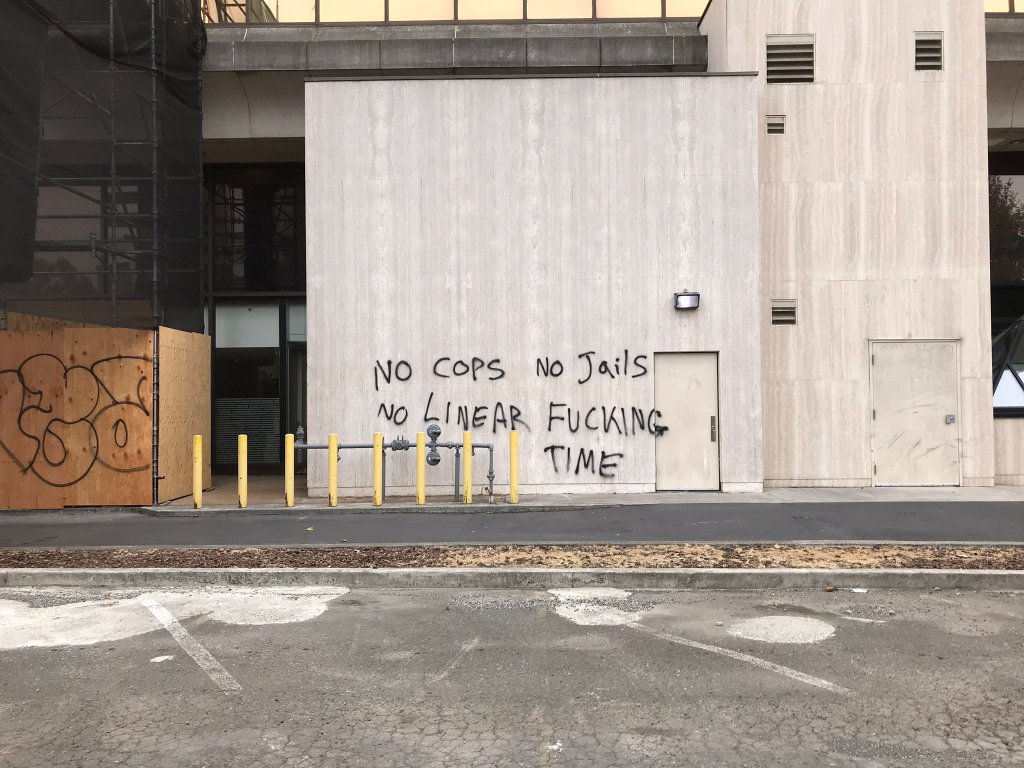
Upon finding employment on his third day in the Northern city of New Bedford, Frederick Douglass declares himself his own master. “I was now my own master,” he writes. This is a “happy moment” — one of the few such moments in Douglass’s narrative. Its rapture can be understood, he says, “only by those who have been slaves” (78). The scene leaves me wondering: at what point is there no longer someone robbing us of the rewards of our work? The employment Douglass has found is a form of wage slavery, is it not? Is the reward not taken in the setting of the wage by the capitalist? Are Marx and Engels wrong? In what sense is the wage relation not a form of slavery? Labor hours remain at the command of external masters under capitalism. The economy one faces is manufactured by the State, and the State is a mere police-backed conspiracy of land developers and financiers. All of us are in some way or another pressed into its service. Those of us in entertainment and education — those of us manning the ISAs, as Louis Althusser would say — we’re the functional equivalent of PsyOps officers. Yet we can always rebel — and many of us do. Wizards needn’t always be their wizards. There are fugitive histories to be learned, memories of fugitive ancestors awaiting remembrance through fugitive study. Because if the past isn’t past, as Faulkner wrote, and the demand on the streets is “NO COPS / NO JAILS / NO LINEAR FUCKING TIME,” then abolitionists are among us today, their cause as just as it was a century and a half ago.
Saturday August 29, 2020
Due to health problems, Ada Lovelace started using opium “systematically,” as her biographer notes, from 1841 onward. Her mentor and collaborator Charles Babbage is an interesting figure, too, the author of both “On the Economy of Machinery and Manufactures” as well as the Ninth Bridgewater Treatise, a work on natural theology. The fourth chapter of the latter work is titled “On the Account of the Creation in the First Chapter of Genesis.” Scanning the chapter’s opening pages, one discovers references to geology. Most mysterious of all, though: Ada’s letters to Babbage contain references to a “lady-fairy” and “Fairy-Guidance.” Babbage’s nickname for Ada was “Enchantress of Number.” Her hope, apparently, was to “bequeath to the generations a Calculus of the Nervous System.” As her health declined in the 1850s to the point where opium no longer controlled her pain, she began to experiment with cannabis. Ada was largely forgotten after her death until her rediscovery by figures like Alan Turing nearly 100 years later in the 1940s and 1950s. The key to all of this magic, I think, is what Ada called “cycles” and “cycles of cycles,” or loops and nested loops.
Friday August 28, 2020
Algorithms: what are they? When do they enter the history of ideas? What are their presumptions? Ada Lovelace had something to do with it, did she not? Cyberfeminist Sadie Plant explored parts of this history in her book Zeroes & Ones. Lovelace also appears with her partner-in-crime Charles Babbage in William Gibson and Bruce Sterling’s The Difference Engine. The latter novel founded an entire subgenre of science fiction known as “steampunk”: works set in an alternate-Victorian past. In the case of The Difference Engine, the world is one where Lovelace, the daughter of the Romantic poet Lord Byron, succeeds not just in theorizing but in building the world’s first computer. Calculating machines: what are they? What are the consequences of these devices? Where do they lead? Part of me would love to write an occult conspiracy thriller amid such a milieu — though I wouldn’t want it to skew toward horror, as in Alan Moore’s From Hell. More in the direction, rather, of utopian fantasy, with Acid Communism and Red Nation arriving more than a century earlier than planned. That would be a fun book. Where would one posit the “point of divergence”? Where would history happen other than as one was taught? Therein lies the nature of Myth. Yet that’s the point. Rebellion occurs there or not at all. Maybe this is a bit like my once-imagined novel on Project Cybersyn, but “woven” now, in the style of Foucault’s Pendulum, with secret societies and esoteric traditions. Then again, maybe my novel should just zero in on one of the details from The Difference Engine: the scenario, in other words, where Marx and Engels move to America and ally communism with the Iroquois Confederacy. Either way, the time has come for me to reread Plant’s Zeroes & Ones.
Friday August 14, 2020
Ishmael Reed may have been present at the founding of the East Village Other — indeed, he seems to have been the one who gave the paper its name! — but many of his poems of the 1960s, the ones gathered in Conjure: Selected Poems, 1963-1970, are quite scornful in their assessment of the counterculture. In his “Neo-HooDoo Manifesto,” for instance, Reed calls out Theodore Roszak, noting that in the latter’s famous book The Making of a Counter Culture, “there is barely any mention of the Black influence on this culture even though its members dress like Blacks talk like Blacks walk like Blacks, gesture like Blacks wear Afros and indulge in Black music and dance” (20-21). Speaking of neglected black influences upon the counterculture, why am I only just now learning that the acid trip sequence in Easy Rider was shot at or near Voodoo priestess Marie Laveau’s tomb in St. Louis Cemetery No. 1? Hopper and Fonda filmed the sequence guerrilla-style, without permission … while tripping on acid. Reed’s collection also includes a poem called “catechism of d neoamerican hoodoo church” — a self-conscious response of sorts, I imagine, to Millbrook resident Art Kleps’s Boo Hoo Bible: The Neo-American Church Catechism and Handbook. Several of Reed’s associates were participants in the psychedelic revolution — including East Village Other co-founder and publisher Walter Bowart. Bowart’s second wife was Peggy Hitchcock, the director of Leary and Alpert’s International Federation for Internal Freedom (IFIF). Peggy’s brother Billy is the one who arranged for the Leary crew to live on the Hitchcock Estate in Millbrook. Bowart went on to publish an important book on MK-Ultra in 1978 called Operation Mind Control.

