Home again, stretching, settling in after seven weeks of travel. Initially I find myself needing to focus on nesting, repair, self-care, readjustment. Vacuuming feels like manual operation of a Photoshop airbrush. I get better results and greater satisfaction when I kneel down and clean the floor with a wet rag. If that’s what the life-world needs, then so be it. I give gladly. Throughout the day, I catch myself renegotiating use of will, contemplating my relationship to various entities and objects. Slugs, spiders, chairs, old bits of clothing, bottled water: all of these things require care and attention, as does Erik Davis’s High Weirdness, a copy of which I pluck from the pile of mail that arrived for me while I was gone. Also in the pile is a copy of Fredric Jameson’s new book Allegory and Ideology. Time to start reading, I tell myself. Both books feel weighty, but High Weirdness is the one that warrants immediate attention, I decide after some hemming and hawing, the Stranger Things soundtrack modulating through my head. The Davis book is the one I’ve been waiting for these last few months. It feels timely. It speaks to present hopes and concerns. As Jeffrey J. Kripal notes in his blurb on the back cover, “May this book, like a glowing UFO, land on your lap, and every other lap, and weird our world beyond all measure.” I approach it with a degree of trepidation — but also with great excitement. Across from me on the wall of my dining room hangs a reproduction of the famous Ambrosius Holbein engraving from Thomas More’s Utopia, looking suddenly like an emblem representing macrocosm and microcosm: Genesis, Paradise Lost, and Frankenstein woven into a single grand narrative, the figures down at the bottom reminding me of the debaters from the garden of branching paths. “The devil in the details,” as one commentator puts it. The figure I’ve imagined in the role of Adam wears the name “Hythlodaeus” in the engraving, referring to the character in More’s text whose name means both “God has healed” and “Speaker of nonsense.”
Tag: Erik Davis
Sunday July 14, 2019
An ant explores the surface of a sunlit outdoor table. I sit across from it observing and writing on my in-laws’ back patio. A neighbor waters a garden next door as I read Erik Davis’s review of the “Hippie Modernism” exhibition for Frieze magazine, written two years ago, when the show was up at BAMPFA. This is the show that inspired the course I taught this past spring. There’s an elegance to the review’s list of the show’s achievements. My eyes dwell for a time on an image included in the review, a digital reproduction of a 1965 painting by Isaac Abrams called Hello Dali.
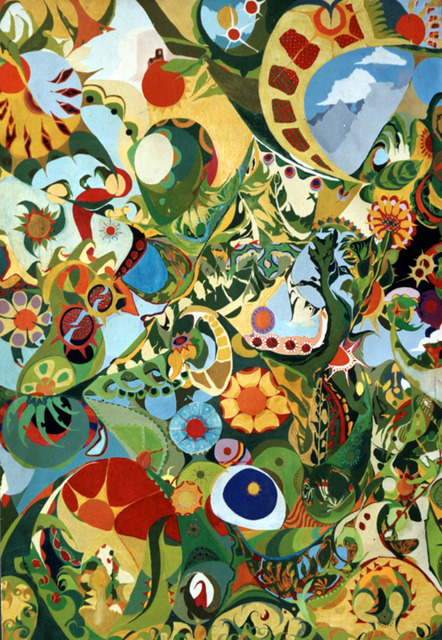
I see echoes of the painting as I look over at flowers in my in-laws’ garden. I let this work motivate me to complete my project. I watch videos, like the radical Italian design group Superstudio’s “Supersurface: An Alternative Model for Life on the Earth,” a film of theirs from 1972.
Balm applied, the goad to work kicks in. I note down books I need to order, like Art Boericke and Barry Shapiro’s Handmade Houses: A Guide to the Woodbutcher’s Art. After a breakfast of homemade waffles and orange juice, I burrow away and watch Davis’s recent talk, “A Brief History of Queer Psychedelia,” where I learn about Gerald Heard’s involvement with the Mattachine Society, one of the earliest gay rights organizations in the United States.
Isocrates was the pseudonym that Heard used for the articles he published in the society’s magazine, the Mattachine Review. He also wrote articles for ONE, another early gay publication, under the pseudonym D.B. Vest. Davis also unveils a weird book of Heard’s written in the late 1960s called AE: The Open Persuader published under the pseudonym Auctor Ignotus (or maybe W Dorr Legg). Tartarus Press published a collection called Dromenon: The Best Weird Stories of Gerald Heard in the early 2000s. That, too, is a book worth tracking down. By midafternoon, elements have clustered together to cause me to wonder at the overlapping histories of psychedelics and ritual magic. The famous LSD chemist Augustus Owsley Stanley III noted that his early experiences with acid coincided, for instance, with his reading of The Kybalion. Most of the first-generation Western psychedelic crowd took up at points with Eastern tantric currents. Some folks also explored Western pagan and esoteric traditions. This outburst of spiritual yearning and experimentation remains for me in its utter mysteriousness a source of fascination. In my state of unknowing about it, the topic seems rich with narrative potential, like there’s a story there waiting to be told. Like the fate of Pedro Salvadores in the Borges story of that name, it strikes me as a symbol of something I am about to understand, but never quite do.
Friday June 28, 2019
The interior bends and warps as the train travels its serpentine path toward Finchley Road, where Sarah and I disembark to meet with a psychoanalytically-inclined friend of ours at the Freud Museum. We view the famous couch, the books, Sergei Pankejeff’s “Wolf Man” paintings, the Qashqa’i carpets, the vast collection of antiquities, swapping tales of projects and travels along the way. Afterwards the three of us retire to Freud’s garden and chat excitedly about psychedelics. As a kind of last hurrah here in London, I zoom over to Hackney for another event involving Erik Davis, hosted this time by a group called The Psychedelic Society. Davis’s co-stars at the event include Jeremy Gilbert and Lindsay Jordan. As the talks commence, I note down on a slip of paper, “Something cool is happening here: heads coming together.”
Friday May 17, 2019
I share my couch with my friend’s dog, a cute half-lamb, half-poodle puffball named Stevie. Out in the yard across the street fly a pair of bluejays. Perhaps I should listen again to the birds. Everything else just looks like hype seeking freedom to spend. I wonder which version of London will appear in my coming journey. Will it be one I’ve read about, one I remember? Or will it be a visionary London, an occult London? Will the corporate pentagon of power sour the hour, or will we ascend, rise up, learn about heikhalot literature and Merkabah? For now, let’s assume the “latter” is above our pay grade and seek a third option. As Teilhard de Chardin reminds us, “The outcome of the world, the gates of the future, the entry into the super-human — these are not thrown open to a few of the privileged nor to one chosen people to the exclusion of all others. They will open only to an advance of all together, in a direction in which all together can join and find completion in a spiritual regeneration of the earth” (The Phenomenology of Man, p. 244). Soon I’m coasting along, Erik Davis serving again as guide, recounting for me the account of Indra’s Net from the Flower Garland Sutra — a “cognitive map” if ever there was one! Reading it makes me think for a moment of the here and now, the ground of Being. We are all sustaining and defining one another — so we might as well get good at it. Sunlight, birdsong, subreddits full of horse girls and rats that wash themselves with soap — find room for it, get it in there. Everything in a blog post. Everything on a sheet of paper. Evoke the world as a bird that flies over and tweets. Followed by another, followed by another. Davis explains it well. “Indra’s net is an image of totality,” he writes, “but unlike Teilhard’s vision of the Omega point [the moment when matter evolves into convergence with mind], this holism does not depend upon some apocalyptic moment of future synthesis. In the Hua-yen view, reality is already a totally interdependent matrix, and this unity does not and cannot cancel out difference, the blooming multiplicities that compose each individual event” (TechGnosis, p. 339). With this image of totality set as our map, we become more mindful of our angelic companions. “Buzz, buzz” go the bumblebees. “Buzz, buzz” go birds, cars, pedestrians as we attend to our craft: Self as it attempts to voice, sound, and sense the multitude.
Sunday May 12, 2019
Some dude gets on a mic and introduces my city to Schrödinger’s Cat and theories of parallel worlds as we gather for an outdoor screening of Spider-Man: Into the Spider-Verse. Downtown appears thoroughly transformed by gentrification, landscaping, redevelopment. But there’s still the excitement, the unrealized potential of the assembly of a local, democratic multitude, one that embraces and tolerates its self-constitution through dance, performance, and play. Man-in-the-Moon arrives as Gwen Stacy reviews her origin story. I imagine myself a moonlit Silver Surfer listening to “Lonely Surf Guitar” by the Surfaris.
“By cutting a pentagram into the air or dancing a wild spiral dance,” writes Erik Davis in his account of Pagan ritual, “the self submits to the designs of human and cosmic powers on a more visceral plane than philosophical conceptions or sermons allow” (TechGnosis, p. 192). Davis stresses, though, that this Pagan use of ritual instrumentalizes the latter’s transformative potential, raising worrying questions when what this “technology of the sacred” operates upon and instrumentalizes is imagination and the unconscious. What ritual possesses, however, and what reason lacks, is fidelity to wonder, reverence, and awe. Pagans, for instance, “seek sacred communion” with Nature. Theirs is a “visionary materialism” (194). I can also relate, though, to the “will to utilize” informing the magical practices of figures like Genesis P-Orridge and their group Thee Temple ov Psychick Youth. Their aim is to use magic to disrupt the spell of the global totalitarian society of the spectacle.
Thursday May 9, 2019
Timothy Leary, ever the magician, pinches together his thumbs and forefingers to form a symbol of infinity, an eye out of which stream prismatic beams of light. Sarah and I sit on a blanket in a park reading beside a tree. Afterwards, on Erik Davis’s recommendation, I turn on and watch “Tones, Drones, and Arpeggios,” a BBC documentary on the birth of minimalism featuring LaMonte Young and Terry Riley in counterculture California.
[And here’s Episode 2.]
I learn about time-lag accumulation, weird spells, past dragged into the future. Interesting things start happening. A universe of cycles rather than arrows. The revolution of Terry Riley’s “In C.” Communism in action. Couple that with Steve Reich’s “Music as a Gradual Process,” and doors begin to open. (By the way, Erik Davis is the real deal. He’s been walking the freak beat for decades, his senses and inclinations honed by years of practice. I remain awed by his sharp analysis and critical takedown of the 1960s/1970s counterculture’s fetish for “consciousness tools” and “technologies of transformation” [152] in his book TechGnosis.)
Saturday November 17, 2018
I sit with squirrels on a November afternoon absorbing golden rays of sunlight. ‘Tis given freely. Our mutual inheritance. The squirrels jump and scurry among branches of trees. Where shall we place our attention, if not on speaking squirrels? The one above me, in its lovely ahhs, its lusty cries, its squaws, its pleas, sounds like a tearful Donald Duck. Through our stillness, we allow others space and time to be. A lawnmower supplies a buzz to compete with a leafblower’s roar. The neighborhood performs itself as would an orchestra for an audience of one. This is what I want as a communist: control enough of means of production so as to live free, our days, mine and yours, always occasions for pleasure and growth. Michael Davidson’s The Karma Machine reads like a prearranged signal, alerting those who read it of the planet’s wish to mutate-convert into a crystalline “ecstosphere” (162). How do we get there in the midst of what Erik Davis calls “reality meltdown”? Mass media’s programming of listeners and viewers to spur mass consumption gives way to the absence of shared points of reference. Today’s competing news agencies tell competing stories, thus creating competing consensus realities: a plurality of maps, all jostling for control of territory in the Desert of the Real. Against this, argues Davis, rise forces of re-enchantment. Movies of future disasters, journeys through the cosmos. Let us attend to the truth of experience, he cries, and carry stories lightly! “Doubt is a medicine! Skepticism is a medicine!” Always inquiring, always probing amid a totality filled with human and non-human persons. By way of the imagination, he suggests, we can interface with the non-human, the alien Other. “Let myriad things come forth and illuminate the self.”
Friday November 16, 2018
Here we are, coasting along on this lovely planet, sharing in its seasons and cycles. I sit in a room lined with pine as day turns to night, and work relents and so begins that week of utopia known among academics as “Thanksgiving Break.” Erik Davis says the “breakdown of consensus reality,” which he believes is occurring in our current moment, “pulls out of us” a desire to engage the world as “an enchanted, magical place…where practices of awareness are practical survival necessities.” He traces the origins of the phrase “consensus reality” to Peter L. Berger and Thomas Luckmann’s book The Social Construction of Reality. Davis’s talk brilliantly captures the as-yet-unnamed structure of feeling governing the current moment in the phrase “reality meltdown.” People dropping out and declaring psychedelic independence. This way of looking has made me judgmental, as if speciation occurred and one can only look back and laugh.
Monday April 30, 2018
What are the main differences in terms of form or orientation that distinguish the psychedelic from the weird? Both refer to anomalous modes of experience—but the psychedelic is the more utopian of the two sensibilities, is it not? Let us pursue this as our working hypothesis. Where the weird ruptures the circular selfsameness of consensus reality in a way that generates, as Erik Davis says, “a highly ambivalent blend of wonder and horror,” the psychedelic skews instead toward a more fully joyous cosmology, one that allows for ecstatic realization in the unconcealed immediacy of the here and now of what others might call the utopian, the eudaimonic, and the sacred. Speaking of which: The universe tosses me multiple 23s as Sarah and I drive with a friend of ours to visit an iris farm. So many varieties: Shaman, Catalyst, Closed Circuit, Lime Fizz, Desert Thistle. Petals hang in the sun, fluttering gently in the breeze. Before leaving, I’m drawn to a final flower. “Hidden Message,” reads the placard on the ground beside it. “How appropriate a name,” I think to myself, despite a certain skepticism, a reluctance to trust the world’s signage, not least because of a painful self-consciousness regarding the partiality, the incompleteness, and thus the potential incorrectness, of my conceptual inheritance. “By what means might we seek to inquire? And if hidden, by whom?”

Thursday October 19, 2017
It is for declaring their difference, their exceptionalism, that selves are punished. That is the Law, my friend, from here unto forever. I’m all about sensing, having an awareness of my body, but only in a fleeting way, feeling — but I rarely know my wants and needs enough to go after them. Perhaps I should teach myself Socionics. Anything to avoid living at a lower level of consciousness. Rabbit holes, rabbit holes. Optical illusions. (Just kidding, by the way, about Socionics. Though I like for use in a piece of fiction the idea of a psychedelic autodidact survivalist character obsessed with Socionics, seeking relationship advice from its teachings, classifying personalities of customers in terms of its typology at the convenience store where she works.) Here I am, traveling around stoned while reading Lindsey Michael Banco’s Travel and Drugs in Twentieth-Century Literature. The world’s about to get a whole lot warmer. Beams of light shining through windows strike the narrator, prompting momentary blindness. Freezer joint, meat monstrosity. The jerk trail beckons. An article on Bandcamp points me to some really cool head music out of Mexico City: netlabel releases like Outworld Music by RITUALZ, HYPNOSYS by Upgrayedd Smurphy, and Desterritorialización by AASSP.
After listening to a recent episode about it on Erik Davis’s podcast Expanding Mind, I’m hoping to grab a copy of Rachel Nagelberg‘s debut novel, The Fifth Wall. While reading an excerpt from Nagelberg’s book in 3:AM Magazine, I stumble upon a scholar named Lindsay Jordan, who it just so happens (in classic synchronistic fashion) delivered a talk at the Breaking Convention conference last month titled “‘Unprofessional’… ‘Irrelevant’… “Fascinating’: A Story of Academia and Psychedelic Pride.” It’s as if the totality wants me to happen upon this stuff. As for instance the other night, when I settled into the futon in my “meditation room” (that’s right — I have a “meditation room”) and began listening to an 8-cassette recording of a lecture delivered at Naropa in the early 2000s featuring LSD researcher Dr. Stanislav Grof. Show of hands: how many of you have experienced “non-ordinary” states of consciousness? The room laughs when it sees hands up among nearly everyone. The tapes had washed up in the bins at Goodwill earlier that day, like gifts willed to me by the universe. I suppose I’m being guided toward Grof’s book Psychology of the Future. “We shall find there the answers we seek,” says a self-created mentor or guide. For native people, Grof claims, these states of consciousness are just accepted parts of the spectrum of human experience. One person’s mystical psychosis is another person’s holotropic episode.
 Trance-Scripts