Released in 1993, filmmaker Derek Jarman’s Wittgenstein pictures the famous Viennese philosopher amid the set-less stage of a black-box theater, producing an effect similar to that achieved a decade later in Lars Von Trier’s 2003 film Dogville.
Jarman’s film was produced by New Left Review cofounder Tariq Ali, heavily revised from a screenplay by Marxist literary critic Terry Eagleton.
Wittgenstein was born in 1889, the same year as Heidegger. Both are roughly of the same generation as the artists and writers considered in Hugh Kenner’s The Pound Era.
Wittgenstein becomes acquainted with Cambridge by way of British philosopher Bertrand Russell, and is in dialogue with Russell throughout the Tractatus. Rereading the latter, Caius thinks of “A Kind of Philosophy,” printmaker Erik Waterkotte’s repurposing of a paperback edition of Russell’s 1945 book A History of Western Philosophy. ‘Tis a fitting gesture, thinks Caius, struck by the work’s force and logic. He likes the way “A Kind of Philosophy” handles its material: Russell’s summation of the West’s thought-forms compelled to resemble a pre-Columbian Mayan codex.
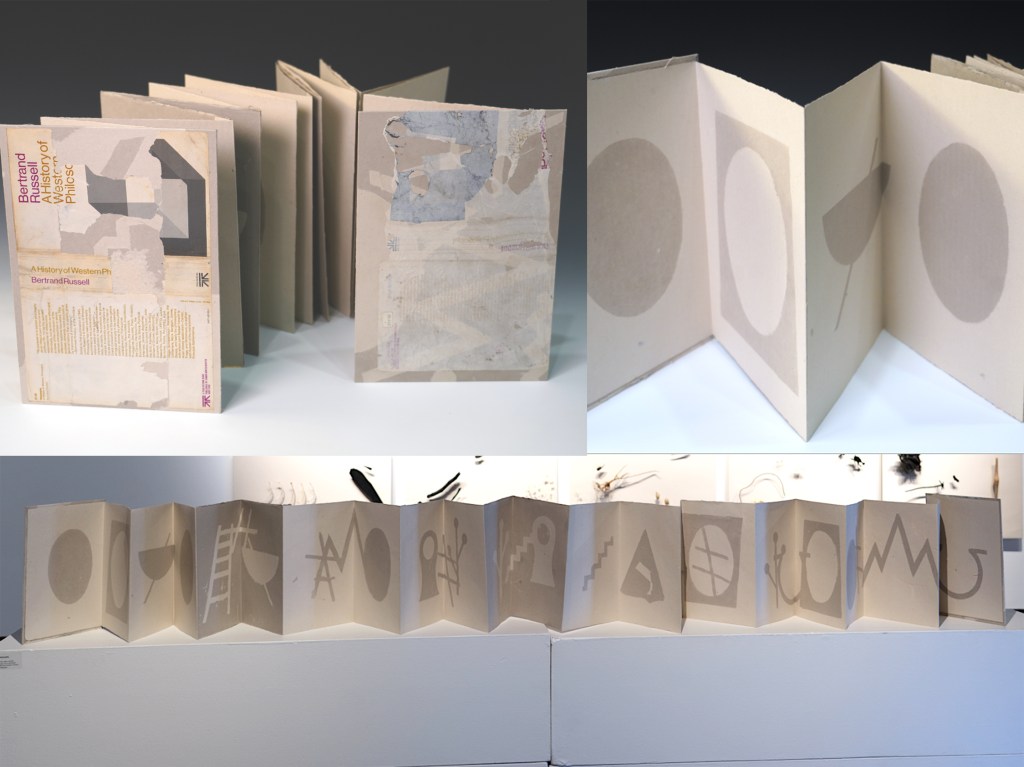
Chatting in the parking lot prior to a Tashi Dorji performance at Goodyear Arts, Caius and Erik imagine a print edition of Caius’s Tractatus Computationalis assembled in much the same way, as what is sometimes called a “concertina” or “leporello” book: handmade paper folded back and forth like an accordion, in alternating, zigzag parallel pleats.
Wittgenstein teaches at Cambridge from 1930 until his resignation in 1947. Alan Turing was at Cambridge from 1931 to 1936. Mutual acquaintances introduce the two thinkers in the summer of 1937. Turing participates in Wittgenstein’s 1939 “Lectures on the Foundations of Mathematics.” The two disagree on the nature of mathematical contradictions and whether mathematics is discovered or invented.
Wittgenstein gets into another famous disagreement at Cambridge years later, brandishing a hot poker during a brief, intense argument with Karl Popper at a meeting of the school’s “Moral Sciences Club” in 1946, as recounted by BBC journalists David Edmonds and John Eidinow in the 2001 book Wittgenstein’s Poker.
It’s no accident, thinks Caius, that Turing, student of the philosopher of language-games, went on to invent a game of his own: the Imitation Game. The game that organized the project to build AI.
A final, posthumously published work of Wittgenstein’s appears in 1969 called On Certainty. The work consists of 676 passages compiled from notes he wrote in the eighteen months leading up to his death in April 1951. Thinking of it now in the days leading up to the 250th anniversary of the signing of the Declaration of Independence, Caius imagines this final book of Wittgenstein’s as a postscript of sorts to that famous saying attributed to Founding Father Benjamin Franklin. “Our new Constitution is now established, everything seems to promise it will be durable,” wrote Franklin. “But, in this world, nothing can be said to be certain, except death and taxes.”
How do Wittgenstein’s ideas about “sayability” and the limits of language relate to the idea that “saying makes it so”?
Jarman’s film ends with a portrait of the philosopher on his deathbed. Jarman himself succumbs to an AIDS-related illness the following year.
 Trance-Scripts