What happens when we enter the imaginative space of Walt Whitman’s America? The country widens. Through it strides the Spirit of Hope — “in the Mannahatta and in every city of these States inland and seaboard…Without edifices or rules or trustees or any argument, / The institution of the dear love of comrades” (128). But Whitman’s also a poet of settler-colonial Westward expansion, is he not? Rather than referring to indigenous people as “Indians,” Whitman called them “the red aborigines.” They appear in Leaves of Grass only as people who have “vanished” — as if there was no violence involved in this “melting” and “departing.” In “Starting From Paumanok,” they’re mentioned in a single stanza, remembered only for “charging the water and the land with names” (26). Whitman’s epic whitewashes American history. During the years of Whitman’s production of Leaves of Grass, Indian Wars were fought by the United States government everywhere west of the Mississippi. The first edition appeared in the wake of the Trail of Tears. The Wounded Knee Massacre occurred at the end of 1890, the year before Whitman’s death. Whitman seems to have thought little about his complicity with the evils of a government that wages war on Indians. This despite the fact that he spent the year of 1865 working in the Indian Bureau of the Department of the Interior. So, it wasn’t like he was unaware of indigenous people — he just regarded them as “savages,” doomed to demise by the settler-state’s imagined “manifest destiny.” Beyond just casually dismissing indigenous struggles, however, Whitman was also an appropriationist, his English decorated with words poached from native languages, particularly names of tribes and names of places. How do we make Whitman and the past he represents “useful,” as Frederick Douglass said, “to the present and the future”?
Tag: Literature
Sunday August 30, 2020
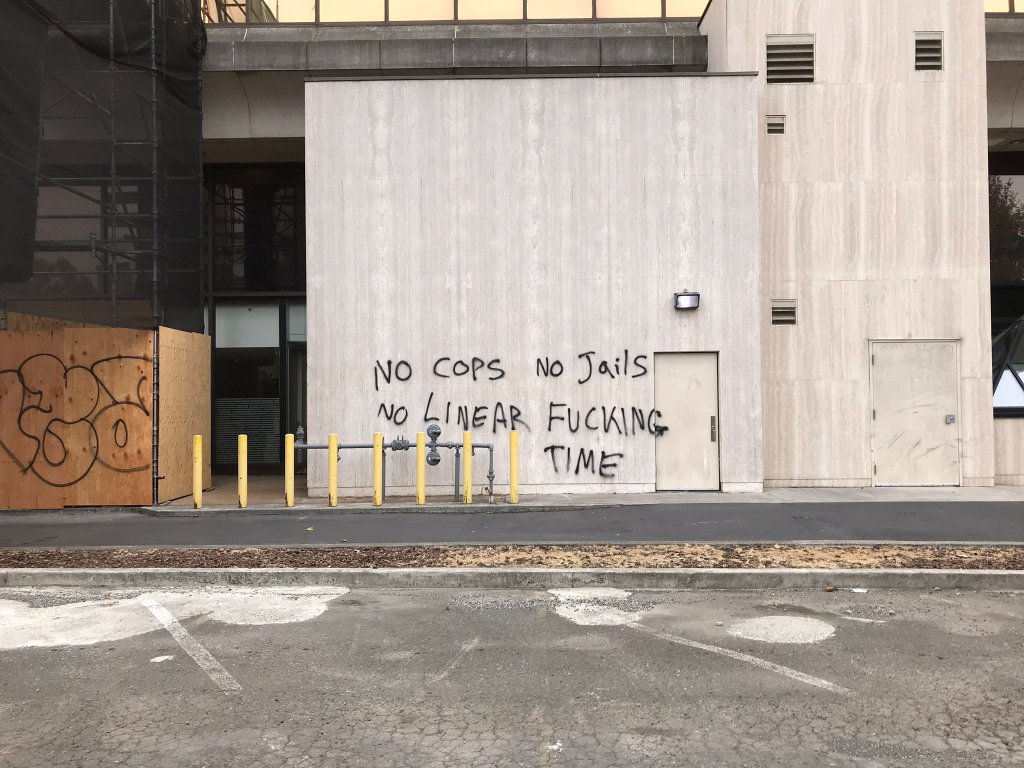
Upon finding employment on his third day in the Northern city of New Bedford, Frederick Douglass declares himself his own master. “I was now my own master,” he writes. This is a “happy moment” — one of the few such moments in Douglass’s narrative. Its rapture can be understood, he says, “only by those who have been slaves” (78). The scene leaves me wondering: at what point is there no longer someone robbing us of the rewards of our work? The employment Douglass has found is a form of wage slavery, is it not? Is the reward not taken in the setting of the wage by the capitalist? Are Marx and Engels wrong? In what sense is the wage relation not a form of slavery? Labor hours remain at the command of external masters under capitalism. The economy one faces is manufactured by the State, and the State is a mere police-backed conspiracy of land developers and financiers. All of us are in some way or another pressed into its service. Those of us in entertainment and education — those of us manning the ISAs, as Louis Althusser would say — we’re the functional equivalent of PsyOps officers. Yet we can always rebel — and many of us do. Wizards needn’t always be their wizards. There are fugitive histories to be learned, memories of fugitive ancestors awaiting remembrance through fugitive study. Because if the past isn’t past, as Faulkner wrote, and the demand on the streets is “NO COPS / NO JAILS / NO LINEAR FUCKING TIME,” then abolitionists are among us today, their cause as just as it was a century and a half ago.
Friday August 14, 2020
Ishmael Reed may have been present at the founding of the East Village Other — indeed, he seems to have been the one who gave the paper its name! — but many of his poems of the 1960s, the ones gathered in Conjure: Selected Poems, 1963-1970, are quite scornful in their assessment of the counterculture. In his “Neo-HooDoo Manifesto,” for instance, Reed calls out Theodore Roszak, noting that in the latter’s famous book The Making of a Counter Culture, “there is barely any mention of the Black influence on this culture even though its members dress like Blacks talk like Blacks walk like Blacks, gesture like Blacks wear Afros and indulge in Black music and dance” (20-21). Speaking of neglected black influences upon the counterculture, why am I only just now learning that the acid trip sequence in Easy Rider was shot at or near Voodoo priestess Marie Laveau’s tomb in St. Louis Cemetery No. 1? Hopper and Fonda filmed the sequence guerrilla-style, without permission … while tripping on acid. Reed’s collection also includes a poem called “catechism of d neoamerican hoodoo church” — a self-conscious response of sorts, I imagine, to Millbrook resident Art Kleps’s Boo Hoo Bible: The Neo-American Church Catechism and Handbook. Several of Reed’s associates were participants in the psychedelic revolution — including East Village Other co-founder and publisher Walter Bowart. Bowart’s second wife was Peggy Hitchcock, the director of Leary and Alpert’s International Federation for Internal Freedom (IFIF). Peggy’s brother Billy is the one who arranged for the Leary crew to live on the Hitchcock Estate in Millbrook. Bowart went on to publish an important book on MK-Ultra in 1978 called Operation Mind Control.
Wednesday August 12, 2020
In fugitive slave narratives of the nineteenth century, and continuing in neo-fugitive works like Octavia E. Butler’s Parable of the Sower, freedom requires migration north on foot, master and his minions often in hot pursuit, as in the story of Harriet Tubman. It also involves extrication out from under the master’s religion, imposed over the course of the slave’s upbringing. Divinity has to be understood and believed in by the slave as something other than the wretched white tyrant who runs the farm. This understanding emerges surreptitiously, through what Fred Moten calls “fugitive study.”
Friday August 7, 2020
Literary critic Henry Louis Gates Jr. appears as himself in the recent Watchmen series on HBO. Ishmael Reed’s Mumbo Jumbo figures prominently as a primary object of study in Gates’s groundbreaking book The Signifying Monkey. Watchmen is a work of alternate history, as is Mumbo Jumbo. Both works help us remember our history, parts of which have been buried in the white political unconscious. The Tulsa Massacre, for instance, is an event dramatically reenacted in Watchmen‘s opening episode, and the US invasion and occupation of Haiti reappears to consciousness in much the same way as one reads Mumbo Jumbo. The two works rhyme with each other — “repeat with a difference,” as Gates would say — in other ways as well. Reed’s secret, conspiratorial white-supremacist Atonist Order finds its correlate, its contemporary near-equivalent, in Watchmen‘s secret “Cyclops” conspiracy. Each work also features as its hero a black detective: PaPa LaBas in Mumbo Jumbo, and Det. Angela Abar, aka Sister Night in Watchmen. Yet there are differences. As Mark Twain is reputed to have said, “History doesn’t repeat itself, but it rhymes.” Attribution of that saying to Twain appears in print in 1970, as in “A Said Poem” by Canadian artist John Robert Colombo. But Twain’s actual words appear in The Gilded Age, a novel Twain co-wrote with his neighbor Charles Dudley Warner: “History never repeats itself, but the Kaleidoscopic combinations of the pictured present often seem to be constructed out of the broken fragments of antique legends.” The old legends and their systems of order are in pieces due to migration, diaspora, forced separation of people from the lands of their ancestors. The crack in the cosmic egg. With these multicultural fragments let us assemble a mosaic — something colorful, like the drawing by Cuban-born artist Alberto del Pozo on the cover of The Signifying Monkey.
Thursday August 6, 2020
Di Prima was born in Brooklyn, NY in 1934. Her maternal grandfather was an active anarchist — a friend and confidant, in fact, of another author I’m teaching this semester, Emma Goldman. Like her fellow Beat writer Allen Ginsberg, Di Prima grew and evolved over the course of her long career alongside the leading countercultural movements of her time. She protested the Vietnam War; she experimented with free love and lived communally with others; she promoted mind expansion through use of psychedelics. After editing a newsletter called The Floating Bear with Amiri Baraka (LeRoi Jones), Di Prima spent much of 1966 with Timothy Leary’s crew of utopian psychonauts and psychedelic spiritualists at Millbrook. Her Poets Press published the first two editions of Leary’s Psychedelic Prayers in Spring 1966.
Wednesday August 5, 2020
I’m planning to teach Diane Di Prima’s Revolutionary Letters (or excerpts therefrom, not the book in its entirety) in my course this fall. The work is a serial poem begun by Di Prima in 1968. It was published as part of the famed Pocket Poets Series from City Lights Books — the same series that released the original iconic edition of Allen Ginsberg’s Howl and Other Poems a decade earlier. Di Prima lived for much of 1966 with Timothy Leary’s crew in upstate New York on the Hitchcock estate in Millbrook.
Monday August 3, 2020
Leslie Marmon Silko published a critique of Gary Snyder’s Turtle Island in a 1977 issue of the Yardbird Reader. 1977 is the year she published her first novel Ceremony. And Yardbird Reader was a literary journal founded in 1972 by Ishmael Reed — a yearly anthology featuring writing by contemporary authors of color. Several of the writers I’m teaching this semester, in other words, wrote in dialogue with one another over the course of the 1970s. Silko titled her critique of Snyder “An Old-Time Indian Attack Conducted in Two Parts.”
Saturday August 1, 2020
If I had a library, I’d visit it mornings, evenings, I’d look for books by David Henderson, co-founder of the Umbra writer’s workshop, a group that met on the Lower East Side of Manhattan in the early 1960s. At one point Henderson was married to the black feminist scholar Barbara Christian. I have a book of his on Jimi Hendrix somewhere in my basement. By the 1980s, though, Henderson started publishing with North Atlantic Books, a press founded by Miranda July’s father, the writer Richard Grossinger. I retrieved a book of Grossinger’s from my basement earlier this week. He seems to be quite a character — a magician of sorts who apprenticed under Robert Kelly. At some point I should also look for work by Calvin Hernton, another of the writers associated with the Umbra group. Hernton studied with R.D. Laing, participating in the Institute of Phenomenological Studies and the Antiuniversity of London before returning to the US in 1970. Ishmael Reed once described him as “a modern-day warlock…the man faltering governments keep their eye on. The native who has his own cabala.”
Monday July 20, 2020
What happens when Ishmael Reed’s Mumbo Jumbo is read alongside Leslie Marmon Silko’s Ceremony? Both texts mingle mythoi and logoi. They tell tales and give accounts. Healers figure centrally in each novel. In Ceremony, we encounter medicine men like Betonie; in Mumbo Jumbo, we encounter PaPa LaBas, the novel’s “HooDoo psychiatrist” protagonist. Both characters rebel against Western teachings. Their cognitive maps are anti-colonial assemblages containing ancient wisdoms retained by their people — tools used to survive and resist in the age of Empire. Armed with these maps, protagonists interpret America as the work of evil magicians operating in secret across hundreds or even thousands of years. Healing requires use of sacred practice: a counter-magic of indigenous rites and ceremonies, story and dance.

