Note how Leslie Marmon Silko situates the writing of her novel Ceremony in a particular place. The book conjures the Laguna Pueblo in New Mexico, though it was written, as Silko states in the book’s preface, “750 miles north of Seattle” in Ketchikan, Alaska. Silko moved to Ketchikan “from Chinle, Arizona in late spring of 1973” (xi). Silko describes for us the room where she wrote the book so that, when we read the poem “Ceremony” that opens the novel, it is her that we recognize as the creation-figure “Ts’its’tsi’nako, Thought-Woman” (1). It is she who, with her sisters “Nau’ts’ity’i and I’tcts’ity’i,” “created the Universe / this world / and the four worlds below” (1). So begins the ceremony of Ceremony. Silko is a writer of mixed ancestry — a borderlands figure stuck between cultures, as the Chicana cultural theorist Gloria Anzaldúa would say. See Anzaldúa’s famous book Borderlands/La Frontera: The New Mestiza — a work that, like Ceremony, mixes poetry and prose. Ceremony‘s protagonist Tayo is another such figure. Raised on the reservation but of mixed ancestry.
Tag: Literature
Friday October 23, 2020
Books can present themselves as sacred works: “received word.” They can also serve as ceremonial objects containing the teachings of ancestors. Authors share mythoi and logoi. Exchanges occur cross-culturally. Histories are understood to unfold within and share the form of religious myths. History is the latter’s translation and dissemination across space-time. These myths and histories can be mixed and sampled, played with a difference by the storyteller, as they are by Ishmael Reed in Mumbo Jumbo. Stories can be intercut with myths as the two rhyme across time. Stories become circles within circles, as in Leslie Marmon Silko’s Ceremony.
Monday October 19, 2020
I listened to an hour-long podcast on Welsh author Arthur Machen this afternoon, and not once was there mention of Machen’s membership in the Hermetic Order of the Golden Dawn. “An odd and unfortunate omission,” I think — though I concede that the podcast was otherwise quite informative. Why should it matter? Omissions of this sort are perhaps how the occult stays occult. I wonder, too, about Ishmael Reed, who includes Golden Dawn member Aleister Crowley’s The Book of Thoth in the multi-page “Partial Bibliography” at the end of his 1972 novel Mumbo Jumbo. Crowley’s book is a study of the Tarot. Reed mentions neither Crowley nor the Tarot elsewhere in Mumbo Jumbo. Yet The Book of Thoth — the mythic one, the one alleged to have been written by Thoth himself — is the “Text” sought by the warring secret societies in Reed’s novel. This is but one of many aspects of Mumbo Jumbo deserving further study. I wonder, too, for instance, about the novel’s critique of Sigmund Freud and the references to Freud’s protégé and rival, Carl Jung. Freud is said to have fainted on two occasions — and Jung was present both times. On the first occasion, Jung “spoke about being fascinated by some recent discoveries of ‘peat-bog corpses.'” Jung’s interest in the subject of mummies and corpses “got on Freud’s nerves,” causing the latter to faint in the midst of dinner. On the second occasion, Freud fainted during a discussion of a Karl Abraham paper, an Oedipal reading of the Egyptian pharaoh Akhenaten. (See Nausicaa Renner’s essay, “Freud Fainting.”) Reed focuses, though, not on the fainting but on Freud and Jung’s reactions to America. For Freud, the place was “a big mistake” — part of some monstrous “Black Tide of Mud.” Reed suggests that Freud was an Atonist. Jung, meanwhile, was more ambivalent about America. Like Freud, however, he viewed America as a place where Europeans would have to undergo a transformation to survive — a process Jung called “going Black” (Reed 209). Reed takes the additional step of celebrating this process, granting it agency and giving it the name “Jes Grew.”
Friday October 16, 2020
There’s a story here to be told. Let there be magic. Note the power that Ishmael Reed grants to “Rev. Jefferson,” father of “Woodrow Wilson Jefferson” in Reed’s novel Mumbo Jumbo. Can I find my Text and become articulate? When asked to justify his power, Rev. Jefferson cites John 2:14. Christ booted the businessmen from the Temple. Let’s give Trump the boot. Fredric Jameson observed a use of pastiche in art and fiction produced under “postmodernity.” Postmodernism is a “cultural logic,” a “condition” felt and lived in our current historical period, the era of “late capitalism.” Pastiche is a style or mode adopted by artists in this period — a kind of “blank parody.” Reed’s novel, however, is satire of a critical bent. The book is a pointed, powerful criticism of Western civilization. Jameson included in his essay on “Postmodernism” a famous phenomenological description of his experience of a hotel in Los Angeles. Reed lived in Oakland, taught at Berkeley — lived the historical moment differently, constructs a rich elaborate allegory of the Nixon years. Reed decolonizes consciousness across millennia. Western ways of thinking are shown to be products of a racial policing of consciousness. It is a product of a certain kind of schooling, a cultural, religious, elite-controlled linguistic system. Reed turns economic events, depressions and the like (period markers for Marxists like Jameson) into signs of Voodoo Warfare, spells cast upon the Atonist imperium. Colonized people continue to wage war because the opponent, the white-supremacist adversary, poses a threat to survival, making it difficult to breathe. The latter group’s rituals of capitalist development and production are destroying the planet. Money is the Atonist order’s currency — the god to be worshiped above all others. The thing that money’s chasing, however, the thing it’s trying to “bop” or “co-opt” is an “anti-plague,” a source of cultural vitality and invention imagined to be “carried” by people of color (but capable of spread to others). The “contagion” metaphor that fuels Atonist thought, the white racist fear of a spreading blackness, the fear of becoming a “white minority”: this entire style of thought is absorbed into Reed’s novel. The result, though, is not “pastiche” or “blank parody.” Reed “signifies with a difference,” as Henry Louis Gates Jr. argues. Contagion is blanked of its negative connotations, as what spreads is what saves. “Jes Grew” is the spirit of Osiris seeking to reassemble the pre-Atonist ancient Egyptian past. People “catch the spirit”; they’re moved by it. They’re lifted up, buoyed by the likes of Bobby McFerrin. “Don’t Worry Be Happy” is the letter sent, the message received. So I think as I ponder the day.
Thursday October 8, 2020
Ishmael Reed begins his novel Mumbo Jumbo with a dictionary definition of the title phrase. He does so to demonstrate that White Americans have appropriated this phrase. They use it ignorantly, disrespectfully, forgetful of its origins. The term derives from the Mandingo ma-ma-gyo-mbo, meaning “a magician who makes the troubled spirits of ancestors go away” (7). Mandingo or Mandinko is a language spoken in West Africa (Guinea-Bissau, The Gambia, and Senegal). Reed tells us with his title that his book is the work of such a magician. How would that work? Who are these “ancestors”? Are they black? Are they white? Why are they “troubled”? Where is “away”? I flip through old journals reading trance-scripts from the dawn of the Trump era (just after the election but prior to the inauguration). How was I able to write like that? Is it because consciousness is able to be in two or more places at once? Or is it on account of them loas? Nina Simone recorded three tracks based on originals by Bahamian artist Exuma: “Obeah Woman,” “Dambala,” and “22nd Century.”
I wrote about the latter song four years ago. Exuma called himself “the Obeah man.” The cover of his first album bore the message, “the future is freedom, the past a chain / the present, anybody’s game.” PaPa LaBas is described as an “obeah-man” (45) in Mumbo Jumbo.
Wednesday October 7, 2020
Ishmael Reed’s depiction of race in his novel Mumbo Jumbo avoids essentialism by emphasizing culture and religion as collectively authored, orally-transmitted utterances — sayings that can be played with, jazzed with, riffed upon. Figures like Papa LaBas and Black Herman exist eternally, as do the novel’s Knights Templar characters. They possess a magical capacity, remaining of fixed age, archetypal, unchanging across the ages, as joyous people, the Jes Grews, battle the forces of repression, the monotheists, the Atonists.
Sunday October 4, 2020
I prepare a series of video mini-lectures on Diane Di Prima’s Revolutionary Letters, Julius Lester’s telling of “Stagolee,” and Ishmael Reed’s Mumbo Jumbo. Along the way I glimpse the famous white patron of the Harlem Renaissance, Carl Van Vechen, as depicted by the Jazz Age artist Florine Stettheimer in her 1920 painting Asbury Park South.
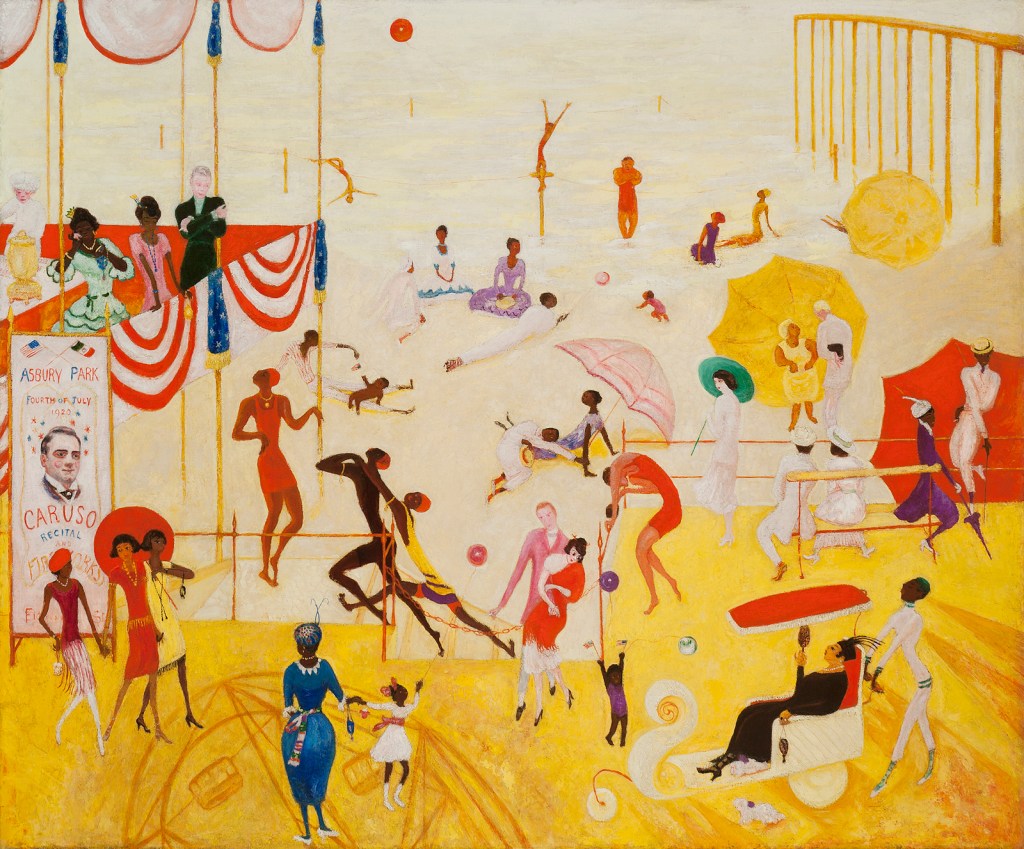
Van Vechen remains a controversial figure, in part due to his 1926 novel, the title of which I don’t wish to repeat (though it appears that Langston Hughes was one of the book’s defenders). Countee Cullen and W.E.B. Du Bois regarded it as an “affront to the hospitality of black folks.” Ralph Ellison condemned Van Vechen — as did Reed, given that he modeled Mumbo Jumbo‘s villain Hinckle Von Vampton after him.
Saturday October 3, 2020
We gathered in a circle, some of us in chairs, others of us on blankets, on a sunny afternoon, celebrating a friend’s 40th birthday. It’s a lovely day — quality time with friends, all of us pleased to be together, laughing, telling stories, sharing observations and enthusiasms. Afterwards, I reflect upon Allen Ginsberg’s centering of Carrie Nation in the midst of the vortex in his antiwar poem “Wichita Vortex Sutra.” Nation was a temperance zealot. She ran around cities like Wichita attacking alcohol-serving establishments with a hatchet in the decades prior to Prohibition. I recall there being a straightedge band named after her in the 1990s, as well as a fictional band in Russ Meyer’s 1970 film Beyond the Valley of the Dolls. Is Ginsberg suggesting that Prohibition birthed Vietnam? What is a vortex? In his 1914 essay “Vortex,” modernist poet Ezra Pound described the latter as “the point of maximum energy.” But of course, Pound was a fascist. Is his essay one we need to read to understand Ginsberg? It’s a modernist manifesto, one that launched the short-lived movement known as Vorticism. (British fascist Wyndham Lewis is the other major figure linked with the movement.) Pound was obsessed with “race” and “race-memory” and attacked hedonism. Yet he’s widely considered one of the most influential poets of the twentieth century. The “Vortex” essay ends with a quote from Pound’s lover and contemporary, the modernist poet H.D. The latter is a curious figure, for sure. H.D. experienced “visions,” sought treatment from Sigmund Freud, and dabbled in the occult. For further discussion of H.D.’s interest in the latter, see Matte Robinson’s book The Astral H.D.: Occult and Religious Sources and Contexts for H.D.’s Poetry and Prose.
Monday September 28, 2020
Drafting a series of notes on Julius Lester’s telling of the “Stagolee” narrative, I ask myself: What can we say of the tale’s protagonist? Is Stagolee a hero, a superhero, a deity, an antihero, a villain? In what way is he a “rebel”? He’s not just a murderer. He’s a community hero. He cares for his victim’s wife and kids. Others love him and celebrate him at his funeral. He is what I think Ishmael Reed would call an “Osiris” figure, given his magical capacity for self-resurrection. Osiris both is and is not the same as Christ. He likes to party and dance and have a good time. He shares his love with others. Cecil Brown, however, recognizes in Stagolee Shango, the Yoruba god of thunder (Brown 3). He claims that there were field hollers and field blues that predate the 1895 shooting of William Lyons by Lee Shelton. The songs precede, foretell — prophetically conjure into being, we might say — the characters in the newspapers. The vibrational form of the song dreams the world into being. Religion is once again the site of battle. It is against one religion, a certain kind of Christianity, and in practice of another that Stagolee’s rebellion is staged. He rejects all higher authority, including that of the Lord of what Frederick Douglass called “the slaveholder’s religion.” Stagolee is a man who can say, as Douglass did, that he is his own master.
Sunday September 20, 2020
Here I am once again reading Allen Ginsberg’s “A Supermarket in California,” a poem I’ve been reading for most of my adulthood. Today, though, is the first time I see the supermarket through which the poet wanders as both sacred and profane: a supermarket of neon and concrete, certainly, but also a supermarket of the spirit. Ginsberg wanders amid Whitman’s “enumerations” and “penumbras,” the catalogued universe of American consumerism — but he dwells there with his ancestors, in an afterlife like the one imagined by the ancient Greeks. Whitman is addressed and invoked throughout the poem. Ginsberg questions him as if Whitman were an American Virgil leading Ginsberg through the inferno of the American Century. The poem travels from the bright light of the new postwar supermarket to a lonely American night. The Spanish poet Federico García Lorca shops here, too, apparently. Ginsberg wonders what Lorca was doing there “down by the watermelons.” Lorca was executed by fascists during the Spanish Civil War. Ginsberg follows these figures, though he also imagines in a somewhat paranoid manner that he himself is being followed or trailed by “the store detective,” as if the poet were a character in one of the era’s films noir. All of this thinking occurs on the night of a full moon. It’s a “weird” poem, is it not? Weird as in the way Erik Davis uses the term in his book High Weirdness. The supermarket is as much in Hades as it is in California. I read it now while tending a small fire in a fire-pit in my backyard. Whitman seems dismayed by the country’s development in the half-century since his passing. The “lonely old grubber,” who always said he was immortal, appears in the poem eyeing and questioning the grocery boys. “Who killed the pork chops?” he asks. “What price bananas? Are you my Angel?” The questions suggest confusion, suspicion, bewilderment, and indignation. Why do we find ourselves in this world, he seems to be asking, rather than “the lost America of love,” the one we dream? Why, though, does the poem end beside the waters of Lethe? Perhaps that is where the poet locates America spiritually and psychogeographically.

