Among the more fearsome of the precursors to what follows is John Dee, the great Renaissance spymaster, court magician and inventor of the British Empire. Filmmaker Derek Jarman is just one of several artists to have made much of Dee in recent decades. In fact, Dee appears repeatedly throughout Jarman’s oeuvre. We first meet Dee, for instance, in Jarman’s 1978 film Jubilee, where he operates as a kind of early-modern Doc Brown. At Her Majesty’s behest, the Dee of that film works up a spell that sends Queen Elizabeth I 400 years into the future–i.e., to London in the age of punk. And what begins in Jubilee continues in the films that follow, with Dee cropping up again the very next year by way of Shakespeare’s famous magician character Prospero. The latter wields a wand modeled upon Dee’s Monas Hieroglyphica in Jarman’s adaptation of The Tempest (1979). Nor is this the last of Dee’s appearances in Jarman’s catalog. He also turns up as muse, for example, in a film named after Dee and Kelley’s famous scrying experiments, The Angelic Conversation (1987). Nor was Jarman alone in thinking highly of Dee. The latter captured the imaginations of several of Jarman’s contemporaries. To mention just two examples: Dee appears as a character in Michael Moorcock’s Gloriana, or The Unfulfill’d Queen; and comics artist Alan Moore wrote a libretto about him. For Jarman’s own reflections on his interest in Dee and in related topics like alchemy, see his memoir Dancing Ledge.
Tag: Magic
Sunday June 27, 2021
The day is a difficult yoga session writ large. I hold poses through tasks required of me: grocery shopping, lawn mowing, parenting. When time allows, I sit eyes closed and meditate. There is an alchemy in this working-through, this processing of desire. The day is the site where one practices care for an absent other. Come afternoon and suddenly it’s a pool day, world redeemed by popsicles and coconut bars. I rise up onto the surface of the pool and float there, big happy smile on my face as I imagine the act shared with another. My friend at The Alchemist’s Studio reminds me of a saying attributed to Vincent Van Gogh: “Yellow is capable of charming God.” The charm of that rhymes later in the day with “Charm (Over ‘Burundi Cloud’),” the 21:24 B-side to Jon Hassell and Brian Eno’s Fourth World Vol. 1: Possible Musics.
Hassell passed away yesterday at the age of 84. After listening and giving thanks, I receive J.R.R. Tolkien’s St. Andrews lecture, “On Fairy-Stories.” For this is what we wish to write, is it not? A story about Faerie, “the realm or state in which fairies have their being.” As Tolkien emphasizes early on, “Faerie contains many things besides elves and fays, and besides dwarfs, witches, trolls, giants, or dragons: it holds the seas, the sun, the moon, the sky; and the earth, and all things that are in it: tree and bird, water and stone, wine and bread, and ourselves, mortal men, when we are enchanted.” Tolkien also calls Faerie “the Perilous Realm” — the source of peril, I presume, having something to do with the realm’s magic. Faerie’s virtue lies in its capacity to satisfy various desires: “to survey the depths of space and time,” for instance, and “to hold communion with other living things.”
Thursday June 24, 2021
What are we talking about when we talk about “political theology”? It’s a rejection of the secularization thesis. Religion never goes away; theological notions haunt the structures and discourses of capitalist modernity. I think of the lyrics to Buffy Sainte-Marie’s song “God Is Alive, Magic Is Afoot.” The song’s title is a line from a poem in Leonard Cohen’s 1966 novel Beautiful Losers. “I propped two pages of his book up on a music stand,” she recalled when asked about the song in an interview, “and I just sang it out, ad-libbing the melody and guitar music together as I went along.” Who is it that tells us “mind itself is magic coursing through the flesh / And flesh itself is magic dancing on a clock / And time itself, the magic length of God”? Is it Sainte-Marie, or is it Catherine Tekakwitha, the 17th century Mohawk saint worshipped by the narrator of Cohen’s novel?
Wednesday June 2, 2021
Kim Stanley Robinson has written far too many books of a similar nature to be of much interest to me here in 2021, I think to myself as I survey the many books of his that I’ve purchased and read these last twenty years. I read Red Mars in a graduate seminar in the first years of the new millennium. His Mars trilogy was the focus of the final chapter of my dissertation. Is there a way to salvage that older project? Could I write a preface introducing it as a document retrieved from a time capsule? The author-self writing in 2021 is “a person of the future” compared to the version of me who wrote the dissertation. I live amid the time about which he wrote, in a world other than the ones he and others imagined. And Robinson, meanwhile, has only grown in the time since more boosterish and grotesque in his optimism about science and technology. His commitment to “science fiction” leaves his imagination bereft of magic.
Wednesday May 26, 2021
“For my next act” I think as I stare at trees, their upper branches bathed in the orange light of the setting sun. I feel like a magician having built boxes, four wooden raised beds, conjured them in the midst of a field of clover here in the yard behind our home. In these beds, we’ll plant our garden. Yet the utopian in me (or the Faust in me? the Gnostic in me? the “slow sick sucking part of me”? same difference?) is already restless, ready to set sail (as per Wilde), ready to walk away (as per Le Guin), wishing for something other than what is here, wanting in its stead some other bower of bliss (this not that): a vertical garden, say, in the midst of a food forest.
Sunday May 23, 2021
While in no way meant as a comment upon yesterday’s chapbooks, which were indeed a pleasure to read, horror nevertheless continues to trouble me, remaining for the most part a genre I hold in low regard. Horror disappoints — depresses and deflates the spirit, if such a thing can be said, i.e., assuming we have a theory of spirit. The conventionality of its unhappy endings reads like a failure of nerve. If one is to allow magic back into the cosmos, let it be a positive magic like the magic of love. So I think as I trade yesterday’s diet for today’s: Joanna Lowell’s The Duke Undone.
Saturday May 22, 2021
A package arrives from my friends at Theurgical Studies Press containing two chapbooks, the press’s first releases: Benjamin Gardner’s “Incident at Funk’s Grove” and Erik Waterkotte’s “Inside the Found Photograph.” Along with the chapbooks, Gardner also included his read-along book The Cabin. These are beautiful small-press objects made by writers who are also talented printmakers and painters. Gardner and Waterkotte work adeptly wherever they try their hand. They present themselves as theorgoi, who, as the Chaldean Oracles report, “do not fall under the fate-governed hand.” Theurgy was a form of magic performed by Neoplatonists. Theorgoi, then, are those who practice this magic: figures who invoke deities through ritual. Horror is generally not my cup of tea, and Theurgical Studies Press is at least in part a publisher of horror. “What is the nature of the horror to which my friends are drawn?” I hear myself wondering. But “Incident at Funk’s Grove” is a delight. Entry into the story’s grove functions as would passage through a portal. One crosses the magic circle that bounds contemporary realism so as to access the world of the weird.
Friday April 23, 2021
Sarah and I celebrate her birthday by beginning A Discovery of Witches, a British television series based on the first book in author Deborah Harkness’s “All Souls” trilogy. It’s a fantasy series, magic a central facet of its world.
Sunday February 21, 2021
Rereading Freud’s Civilization and Its Discontents, the parent in me wants instantly to refute it. I want for my daughter something other than the Oedipus complex. I imagine a succession of heroines and goddesses. Why among all the characters of mythology does Freud opt for Oedipus and Electra? The latter, of course, has been reinvented in our time as a Marvel superhero. No longer daughter of Agamemnon and Clytemnestra, she wields a pair of sai. Electras loom large in the minds of at least two hideous men: Freud and Frank Miller. What if instead we imagine Oedipa Mass, the heroine in Thomas Pynchon’s novel The Crying of Lot 49? While imagining Oedipa, imagine too the women in “Bordando el Manto Terrestre (“Embroided Earth’s Mantle”),” the Remedios Varo painting (middle part of a triptych, in fact) viewed by Oedipa at a key point in the novel.
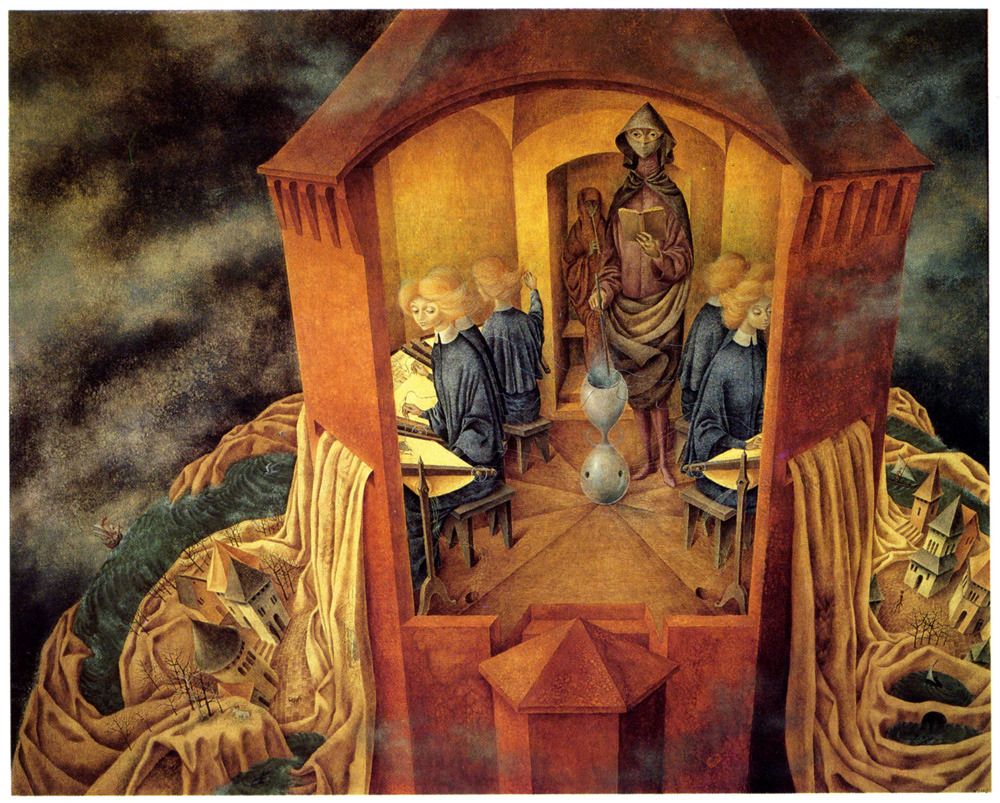
The figures in each case are all still figures trapped in another’s tapestry. “Such a captive maiden,” writes Pynchon, “having plenty of time to think, soon realizes that her tower, its height and architecture, are like her ego only incidental: that what really keeps her where she is is magic, anonymous and malignant, visited on her from outside and for no reason at all. Having no apparatus except gut fear and female cunning to examine this formless magic, to understand how it works, how to measure its field strength, count its lines of force, she may fall back on superstition, or take up a useful hobby like embroidery, or go mad, or marry a disk jockey. If the tower is everywhere and the knight of deliverance no proof against its magic, what else?” This, too, is the dilemma faced by Melba Zuzzo, the heroine of Joanna Ruocco’s novel Dan. Next thing I know, I’m sending myself “Playing the Post Card: On Pynchon’s The Crying of Lot 49“ while scanning my shelves for H.D.’s book Tribute to Freud. Having seen the Varo painting in an exhibit a year prior to writing the novel, Pynchon recalls it from memory. Oedipa sees in the painting what Pynchon wants her to see. If she’d looked closely, she’d have seen “La Huida (The Escape),” the third part of the triptych, where the girl and her lover flee to the mountains.
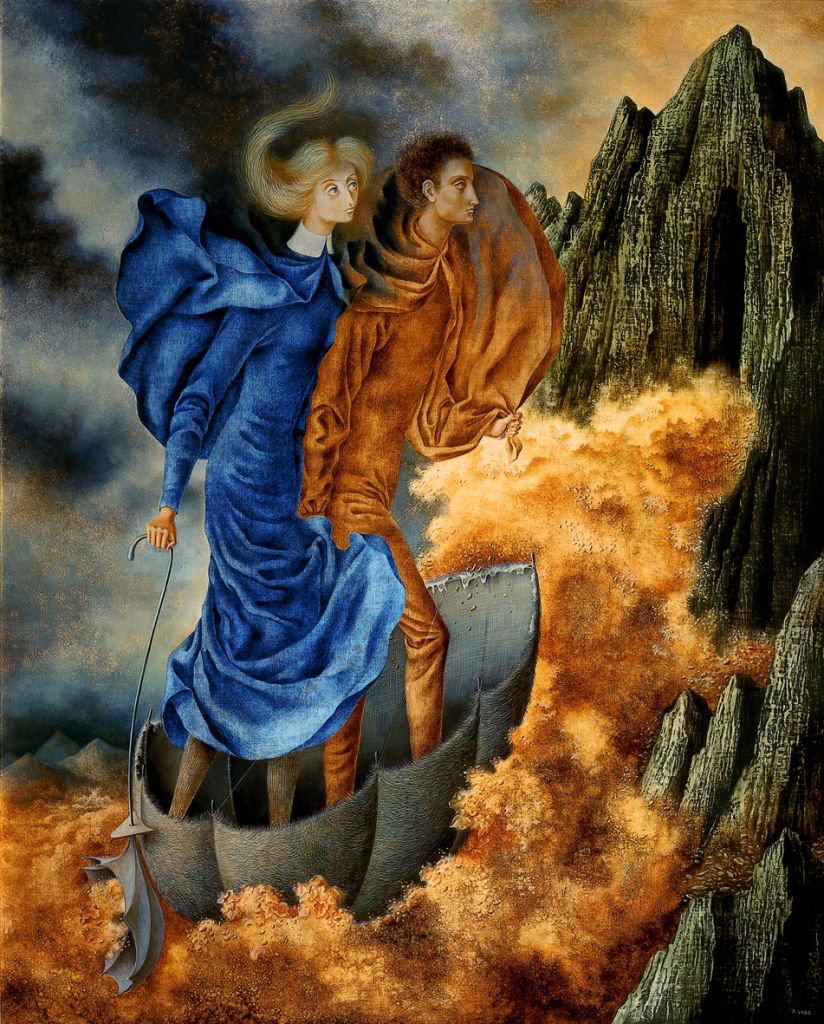
And at the center of the triptych, reading from a spell book and stirring a cauldron, a sorceress. Such figures of power and liberation are occulted by Pynchon’s imagining of a feminized Oedipus — a character “hailed,” “interpellated” as Althusser would say, in the novel’s opening sentence when named executor of the estate of her former lover, Pierce Inverarity. Principle among the items of Pierce’s estate is a stamp collection. LSD is a plot point in Pynchon’s novel. Perhaps we could read Pierce’s stamp collection as the equivalent of “blotter art.” It’s described as containing “thousands of little colored windows into deep vistas of space and time,” and is delivered to Oedipa by “somebody named Metzger.” Readers might be forgiven for confusing “Metzger” with “Metzner,” as in the logic of a dream. As in “Ralph Metzner,” editor of Psychedelic Review and co-author, along with Timothy Leary and Richard Alpert, of The Psychedelic Experience.
Questions for a Gathering
Dear Muses, friends, and fellow members of the hive, I ask this kindly of thee:
“Wherein lies the difference, if any, between an algorithm and a spell?“
[…] “Both consist of textual operations, written procedures to be followed,” texts a friend.
“Yes, yes, y’all,” we reply: “In the beginning was the word.”
[…] “Correct me if I’m wrong, but what is a code if not a kind of spell?” adds another. “The command line works as does a wand.”
Let us begin there. Let our partner in this beginning be Freud’s Unconscious, or what French philosophers Gilles Deleuze and Félix Guattari call “the body without organs” and its many “desiring-machines.”
Having established these initial similarities between codes and spells, let us attend as well to ways in which they differ.
“Spells enliven,” we venture; “whereas programming produces robots and drones.”
Twenty years ago, I and others assembled and performed under the name i,apparatus. Our approach involved spontaneous group play akin to Kerouac’s “Spontaneous Prose” and (tho perhaps without fully knowing so at the time) Mekas’s “Spontaneous Cinema”: egos seeking fusion on the fly through low-tech, sonic squall.
“Might we gather today, or in the days ahead?” asks wonderingly one who types, longing again for union with others. “Under what name, or by way of what method, and for what purpose?”
“For purposes of spontaneity in the realization of desire!” sings a chorus in reply. Spontaneity is the crux of the matter, even as we allow ourselves room to correct.
 Trance-Scripts