With its large, curtain-less, floor-to-ceiling window facing out onto a public street, my meditation room is a place of display, equal part studio and stage, wherein I perform and exhibit my daily being for others. It is in that sense much like these trance-scripts, which I imagine, by the way, to be a kind of Acid Communist variant upon the Prison Notebooks, the mind partaking in consciousness-raising and revolution while the body sits in a box. I know, of course, the absurdity of that comparison. I, for instance, lack accomplishment in any memorable, “world-historical” sense, unlike Gramsci, who headed the Italian Communist Party. My life unfolds in the long American slumber at the end of history, whereas the final years of Gramsci’s unfolded in one of Mussolini’s prisons. Did he, while “doing time,” as they say, ever abscond from the office of public intellectual? I hope he did. I hope he allowed his thoughts to dwell now and then upon the Self as consciousness and condition. Perhaps not, though. Perhaps he refused himself the luxury of “mere subjectivism,” as some of us might say—perhaps even “on principle,” as a “man of science,” his writing free of all trace of the personal. The moments I most admire in the Western Marxist tradition, however, are precisely the opposite: those “trip reports,” those brief phenomenologies of individual everyday being that we find, say, in Fredric Jameson’s report of his encounter with the Bonaventure Hotel in the famous “Postmodernism” essay, or in the confessional poetry in all but name of certain post-WWII French intellectuals like Sartre and Lefebvre. Devising a theory of Acid Communism will require a reappraisal not just of Gramsci and these others, but also of the so-called “Lacanian” turn, the late-60/early-70s moment of Althusserian Marxism in Europe and the UK, with its self-espoused anti-humanism and all of its other insights and peculiarities—all of this re-envisioned, basically, in light of the ideas and practices of humanistic and transpersonal psychologists like Abraham Maslow and Stanislav Grof. Because today’s heads, after all, exist amid vastly different circumstances. Why look for answers in so distant and so marginal a past? By the time Jameson was writing the “Postmodernism” essay for New Left Review in the 1980s, revolutionaries in the US operated largely in isolation, affiliated in many cases with academic institutions, but no longer able to identify with the consciousness of a party. Where does that leave us today, those of us sitting at our windows, wishing to act up as an oppressed class? How does the singular monadic debtor household in post-Occupy USA (by which I mean “me,” the first-person author-function, the Subject of these trance-scripts) live intentionally? How else but by the yoga of writing and zazen—sitting through, enduring, persevering, so as to instigate change both in one’s own life-world and in the life-worlds of others.
Tag: Marxism
Wednesday November 7, 2018
I perform a mind game wherein I imagine a psychoanalytic interpretation of Ken Kesey’s One Flew Over the Cuckoo’s Nest, a novel not just seen through the eyes of its half-Native American narrator, Chief Bromden, but somehow also set in the character’s head, his paranoid delusions causing him to hallucinate — by which I mean “literalize,” or “externalize” — the internal struggle between his Superego and his Id as a struggle between the characters of Big Nurse and Randle Patrick McMurphy. Then again, instead of psychoanalysis, we could sub in Marxism as our master discourse and read the novel as a Cold War allegory and/or a satire of the postwar order. Like all good political allegories, the work can be read on several levels or scales of being: the personal, the spiritual, the national-historical, and the world-historical all somehow homologous. The Nurse’s effort to cast aspersions on McMurphy’s motives resembles the progressivist critique of industrial robber-baron capitalism, just as the incident in the shower room represents the Zoot Suit Riots. If interpretation of this sort places me in the camp of the novel’s wheelchair-bound WWI veteran Colonel Matterson, so be it.
Friday October 26, 2018
A rainy evening. Streetlights help us symbolize a mood. Slim branches of bushes bend beneath weight of falling water. I sit watch and bear witness beside a window, dazing, dreaming, pondering the relationship between Ernst Bloch’s theory of an eternal utopian spirit and Aldous Huxley’s presentation of that spirit as a will for self-transcendence. How do we who find ourselves here in language preserve what Fredric Jameson, in a book of 48 years ago, saw fit to describe as “the almost extinct form of the Utopian idea” (Marxism and Form, p. 116)? How do we pry this idea out of the clutches of a total system that even then, as Jameson could see, “may yet ultimately succeed in effacing the very memory of the negative, and with it of freedom, from the face of the earth” (115)? Huxley called this system the Brave New World. To forestall that outcome, let us imagine freedom and then go there! “Complete the thoughts of the past,” as Marx wrote in his “Letter to Ruge” of 1843. This has always been our duty: to develop a clear idea of what the world has long dreamt. Let us confront Huxley’s mystical consciousness so as to awaken in it an Egalitarian Giant. Let us restore to the dreaming subject the political direction which rightfully belongs to it. I do this in my classroom with my assembly for students of “a hermeneutic which offers renewed access to some essential source of life” (Jameson 119). For Paul Ricoeur, Jameson claims, this source is the sacred. What about for Huxley? Is the latter’s positive hermeneutic secular or religious in its orientation? Who or what is it that winks at us in recognition in the wake of ego-dissolution? We could ask the same question of Charlotte Perkins Gilman. Who is the woman who escapes from the yellow wallpaper? Identification shifts over the course of Gilman’s story. Of course as readers, we, too, are in the same position as the story’s narrator: observing the movement toward freedom of the woman in “The Yellow Wallpaper,” who herself is observing the movement toward freedom of the woman in the yellow wallpaper. All stories are the same story. But it matters, I suppose, whether the prison from which we dream ourselves is to be transcended or transfigured. “This to that,” or “that in this”?
Thursday May 10, 2018
Language is the domain wherein we learn our way in the cosmos. Without ignoring that preference for listening that sometimes makes me reticent to speak, I nevertheless feel moved to affirm here that by discoursing with others, we evolve our reality. It is in this spirit that, kicked up into dialogue by the music video for Childish Gambino’s “This Is America,” I land upon one of performer Donald Glover’s other recent accomplishments, the TV show Atlanta. Graced by an ability to improvise without worry using the Entirety of Being, one becomes if not quite a god, then at least a medicine. Or, in a further act of diminution, an interesting thought experiment, as the experience is akin to discovering “Thou Art That.” Especially if by “That” we mean a dialectically-evolving ensemble of objects. Because of the persistence of injustice, however, the revolutionary in me deems the new worlds I wake to each morning insufficiently distinct from the worlds of yore. Marxism remains for me the discourse I call home, in the sense that it rarely any longer challenges me to revise myself, it rarely any longer situates me as subject within an actionable project of individual and collective self-betterment. Yet along its trail of thought I still thread the sentences of my days.
Monday May 7, 2018
What is the ontological status of what others call falsehoods? Are they simply inaccurate statements housed in material form? A friend invited Sarah and I to his house the other night to celebrate his fortieth. While there, some comrades and I stood beside a carpeted cat tree drinking beer debating amongst ourselves our beliefs as Marxists. I suppose that what prompted this debate was my desire to defend terms like “wellness” and “mindfulness.” It is by now a common procedure on the Left to show how these ideas have been put to use by neoliberalism. (Barbara Ehrenreich performs this argument, for instance, in her new book Natural Causes.) But to me, some of the practices associated with these ideas, practices like yoga and meditation, provide benefits to practitioners such that they transcend the uses to which they’ve been put. Up with survival strategies. Up with coping mechanisms. Up with the perennial demand, the one demand that class societies can never fully satisfy: collective joy, collective reconciliation with Being.
Tuesday March 6, 2018
Something new begins now, bursting forth in kaleidoscopic profusion. Neoliberal governance reaches new heights of absurdity through the invention of “lunch debt.” But the teacher strike in West Virginia points a way forward, a first win, to be followed as early as next month, perhaps, with a strike by teachers in Oklahoma. The path for wildcats intersects there with a key choke point for social reproduction: tests that qualify states for federal funding. By placing federal funding into jeopardy, the strike jumps levels and has the potential to capture full national attention. Together, teachers, parents, and students can dictate the terms of a new deal. For the Trump administration, the goal will be to crush teachers the way Reagan crushed PATCO, while maintaining a semblance of economic populism among the base. Notice the administration’s reluctance to engage the West Virginia action’s illegality. They’re wary of trying to uphold an unpopular and unenforceable law. But of course, they’ll have to intervene eventually. His fans already love watching him say, “You’re fired.” Yet this runs the risk of intensifying antagonisms and contradictions. With solidarity walkouts, one could begin to imagine coordinated strikes, extension of wildcat tactics into public higher ed, systemwide stoppages, the reactivation of class power among the dispossessed.
Wednesday February 7, 2018
Marxism has always been a peculiar guide to consciousness. And by “peculiar,” I mean more than just “dialectical.” Cognitive dissonance experts won’t believe their ears, but consciousness resides ontologically at a level greater than mere smoke and mirrors. Part of me wonders, however, if by “greater than,” I mean “prior to.” This manner of thinking about thinking, like a body trying in the midst of practice to pick up and weigh its parts: is there a quality to it that distinguishes it from mere performative noodling? I feel challenged when faced with duplicating my experience of mind via words. Yet language is all that remains when the Cartesian self severs ties to productive agency with regard to that which lies beyond its senses. I prefer active listening. Selective co-production of meaning. When I walk, for instance, I modulate the directionality of my awareness as if I were operating an ambient musical interface not unlike a soundboard. Sound-objects rise and fall, as it were, in the mix. The best moments, though, I tell myself, are when awareness dips and the mix directs itself.
Thursday November 23, 2017
Reviewing past trance-scripts, I find in them a portrait of a divided self. I find myself caught in these moments struggling to maintain a shaky détente between two personas representing two competing political orientations: the peaceful, happy-go-lucky hippie and the thwarted, indignant Marxist. This self-discovery of sorts puts me in mind of two books from the early 1970s that washed up yesterday at Goodwill: Gil Green’s The New Radicalism: Anarchist or Marxist? and Adam Curle’s Mystics and Militants: A Study of Awareness, Identity, and Social Action.
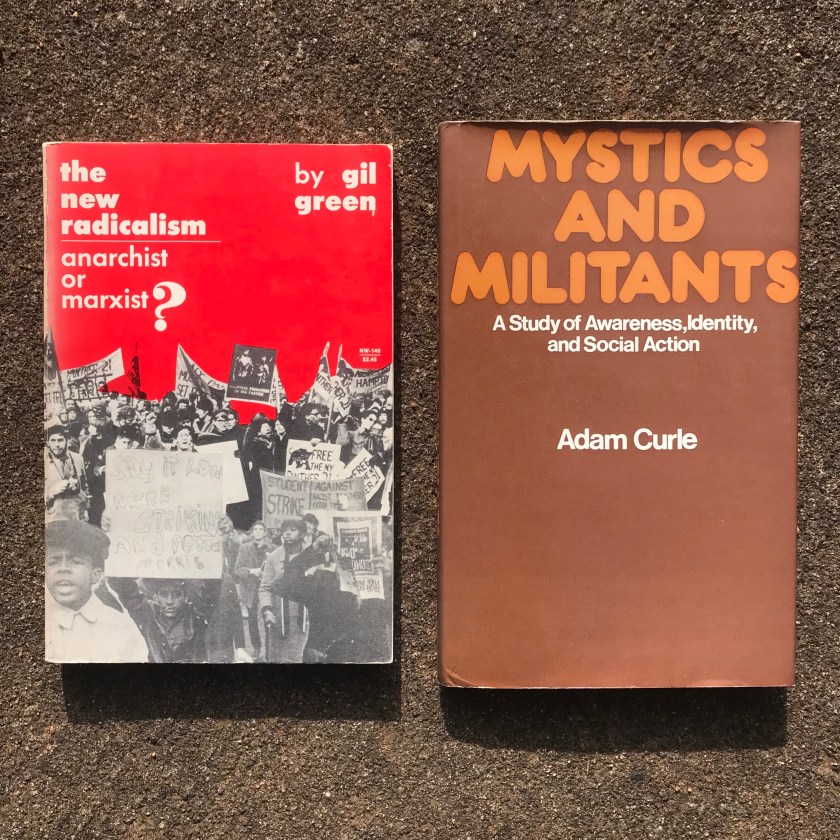
Despite their differences (more pronounced, I think, in the excitement of the sixties and seventies), I persist in thinking the necessity of both of these personas (and other, more minor ones besides). They grow from the same soil. Their utopias reply to the same intolerable contradiction at the foundation of my existence: land to be lived upon is beautiful and bountiful, yet I lack it. All habits, all ways of living, take this immiserating lack as their premise. But enough with the tragedy, I tell myself. Dwell instead on that which gives joy, no apologies. Let it just be said: so long as the above, the public will remain equal parts rational and deluded, owing always to its positioning with respect to property. Whenever a society compels people of diverse potential to act as apathetic and accepting subjects, a violence is done to consciousness. Such a relationship, as Curle observes, “cannot be termed peaceful.” It leaves all parties disgraced, able to persist under the illusion of separation from open warfare only because lack of parity between combatants is too great. Given these conditions, I find it hard to think and write other than in kinship with twilight, even amid blaze of day. I recommend, though, as a way of conditioning this condition, freeing one’s head through a listen of Roland Kirk’s Volunteered Slavery, by which I mean “I Say a Little Prayer.” Such sonic outpourings have the power to transform social relations, if at least in the instant.
Wednesday November 22, 2017
Gnostic beasts blow smoke in my face. They draw their fangs and whisper in my ear. I posit the existence both of a subliminal language and of those who speak it. I know not, however, this subliminal messenger-class’s intent. “What art thou,” I ask blindly, “friend or foe?” Friends and I must try to make the Commune into the outcome of history’s likely progression. Put utopia back on the map. Marxism needs to stop its “museum roaring with crowd of sober patrons” act. The grain of sand must become the pearl. No more molding of behavior to accord with the words of the patriarch. Dress instead to celebrate life. Become like the wild animals who, even as we converse, continue to roam the countryside. The change from good to brutish happens, though, in every child, warns Wilhelm Reich. It is here and now, in one’s inner grace, that one attains one’s godhood. No more entrapment of consciousness in identification with the as-is. Go instead for weed-supplemented walks with friends. Pass a grey-and-white cat nesting in a batch of monkey-grass. When friends and I stomp through a park amid the murky air of a purple and orange dusk, a cacophony of chirping bird-speak erupts from an evergreen, and squirrels root around in dead leaves at the base of tall, bare shadow-trees. A friend recommends I read Argentinian author Samanta Schweblin’s new novel Fever Dream. I direct my head toward knowledge acquisition, but nothing happens — the system’s fried. All I can picture are skies filled with slaughterbots. Autonomous drones. Makes no difference whether we’re ‘tiny house’-owning minimalists or OCD hoarders. They’ll declare open season on all of us. Tech will empower authoritarian capitalism to precision-strike its foes.
Sunday October 15, 2017
Let’s put the revolution back in crazy talk. Grab people by the collar, get up in each one’s face and shout, “The revolution begins now, motherfucker!” Or (to remove any suggestion of aggression): “The revolution, an event of super-humanization affecting the one and the many, begins now, with chemically-assisted transfiguration of consciousness.” Mass exodus from participation in the social sacrifice of life via labor. “Capitalism ain’t getting shit from me,” smirks the narrator as he starts his break. Marx was at his most Marxist in his hatred of work. “Fuck wage labor,” he’d say, “I’m gonna go hang out all day in the British Museum Reading Room!” The anti-capitalist martyr remains an important latency in my political identity. An impossible self I’ve at times admired, a fatal temptation to which I may yet succumb. Weed is very much for me an example of “appropriate technology.” A tool for creative self-experimentation with consciousness. Peter Mortensen investigates a similar such view in his essay “Tripping Back to Nature: Aldous Huxley, Psychedelics, and Pro-Technology Environmentalism.” Earl Hooker’s “Lucky You” scored yesterday’s venture into the psychedelic unknown.
Stoned at a local outdoor music festival. Relaxing sunlit on a grassy hill, while bands perform below. Could this event have served as a turning point? And if a turning point, away and toward what? The vibe was surprisingly negative at first, as if festival-going were the performance in an evacuated church of a belief-less ritual. I still believe in these gestures, however, says the participant, my vomit reserved only for poor execution of ceremony. Beautiful out here under the night sky. The universe arranged for me. And on the date of my parents’ anniversary, no less: my locale, assembling itself in celebration. Spider Bags speak to me, testifying, “I found inner peace by ignoring things.” Is that what I want on my tombstone? Shit started to feel exactly that existential as I stood there afraid of slipping down a hill. “That’s a long, long way to roll,” sang the band. I could see stars above as they chanted, “Who will I be next?” The self must avoid destroying itself for those it loves. Particularly affecting was a song the band performed with NC blues singer extraordinaire Reese McHenry.
The night melted into super chill vibes, though, with level-up conversation and synesthetic animation, once headliner Washed Out took the stage.
Paranoia subsides, and the crowd sways like wind-blown grass. This is how it begins, the participant thinks to himself. This is how you educate desire. This is how heads are turned.
 Trance-Scripts