Postmodern Liturgy

Our father, who is also in / Tartaros chained in being
—Charles Olson, “MAXIMUS, FROM DOGTOWN—IV”

The poem opens like a prayer — but twisted, inverted, hurled downwards into the pit.

This is not the Father of Heaven. Not the lawgiving patriarch of Christian theology. This is the Father beneath the foundations: a presence chained in Tartaros, the precondition of Order, the progenitor of Chaos, silence, breath. The reversal is stark — and crucial.

In this fourth installment, we turn to MAXIMUS, FROM DOGTOWN—IV” itself, a poem Olson described as “deliberately” given not to any old little magazine, but to The Psychedelic Review: “the one that the mushroom people edited.” And yet the poem contains no mention of mushrooms, no obvious gestures toward psychedelia.

What it gives us instead is myth in shards — a Hesiodic echo refracted through twentieth-century American poetics, emerging from a poet who had tasted the mushroom and returned not with visions, but with an ancient voice.

It is the use of the Lord’s Prayer that first signals the poem’s intent to unmake received forms.

The Father is not enthroned. He is entombed.

We remember, with Hesiod, that Tartaros is not merely hell. It is primordial. Deeper than Hades. Older than the Olympians. It is the chaos-place, the pit where Typhon returns after being struck down. It is the place of potentiality before form.

In Olson’s cosmology, this is where the real work begins.

Dogtown — abandoned settlement, stony ruin, former commons — is the psychic mirror of Tartaros. Olson walks it as ritual. He listens to the wind. He reads the stone. He opens the field of composition to receive myth not as allegory, but as event — a rematerialization of chaos in language.

In his poem, Zeus is not hero, not savior. He is the figure of domination — the lightning-armed force that imposes order upon the manifold. Olson knows this force. He has seen it in history, in empire, in himself. He has seen it in Koestler’s terror and in the glassy optimism of the technocratic age.

What Olson gives the mushroom people is a warning: beware the thunderbolt that burns away multiplicity. Beware the system that names chaos “evil.” Beware the will to cohere when it comes at the cost of forgetting.

And yet, there is no hatred here. No bombast. Only voice.

The poem sings, hisses, growls. It walks the edge of lyric and liturgy.

Typhon, when he arrives in the poem, does so not as monster but as signal. His body is the syntax of the ungovernable. His voices — animal, elemental, unspeakable — are the chorus Olson dares to channel.

Grieve-Carlson argues that Olson follows Hesiod closely, that he upholds the cosmology of order. But I read the poem differently.

To me, Olson invokes Hesiod not to ratify the myth, but to activate it. To re-constellate it. To speak it into a new moment — the moment of Dogtown, of postmodern ruin, of psychedelic reentry.

The important point is that, for Olson, Chaos is the original condition of existence. Order is not found. It is made. And it is the poet’s duty to make it — again and again — from the materials of breath, myth, and memory.

Thus the poem becomes not explanation, but theogony — a breathing-forth of being from the pit of the real.

Olson offers no easy answers to the mushroom people. He offers no program, no doctrine, no trip report. He offers them this: a field. A myth. A prayer to the father in Tartarus.

And through it, he calls them — calls us — to make meaning from the underside. To shape voice from fire and stone. To reclaim chaos not as enemy, but as source.

This is the poem’s gift.
This is its weight.
This is its light beneath the pit.
A Prayer for the Year Ahead

In an effort to set intentions amid the energy of a new moon, I write the following:

May I heal what hurts so as to be available to behave lovingly toward all.

May I learn to behave thus, so as to be other than a mere pontificating white man among other pontificating white men.

May I be a loving father.

May I forgive those who have harmed me, and may I be forgiven by those I’ve harmed.

May my love be true, practiced with the whole of my being, in ways that nourish the beloved and bring forth growth rather than harm.

May I be a great giver of gifts, grateful for the many gifts I’ve been given.

May the year ahead be a year of Lovers: a time of awakenings: a time of sexual and spiritual discovery; realization of love’s promise.

Amen. So mote it be.

The Labyrinth of Stuck Desire

Where something taken to be history takes the form of a world on fire, catalog of events adding up in tedious barrage, as in Billy Joel’s grim 1989 song “We Didn’t Start the Fire.” Joel grew up on Long Island, along the beaches, as did I. Beaches were closed the summer prior to the song’s release due to “Syringe Tides.” Hypodermics from Fresh Kills Landfill in New Jersey washed up along the shore — an event Joel cites in his litany. The fears stirred by the event were compounded by the era’s Reagan-administration-escalated AIDS crisis. The event filled me with concern — motivated the pen of my middle-school self to draw a political cartoon: a small surfer dwarfed by a wave of waste. Surfer stares glumly out the picture toward the viewer. And here I am now, most of my day spent grading student responses, thinking about it again, not just because of the Joel song, which appeared as the subject of a student’s response, but also because a colleague submitted for approval a course examining literary imaginings of the end of the world. The Jewish festival of Sukkot minds me to be grateful for my home, and all who help me to maintain it.

Upon a whim, I pick up and read from The Complete Poems of Emily Dickinson a poem selected at random, as in wherever my thumb happens to land, containing the lines:

Prayer is the little implement

Through which Men reach

Where Presence — is denied them.

They fling their Speech

By means of it — in God’s ear—

If then He hear

This sums the Apparatus

Comprised in Prayer—

“Why must longings be irreconcilable — why ‘Presence denied’?” I wonder afterwards.

“Why ask why? ‘Tis so,” sayeth the Fates in reply. Yet one can make of Fate a place one avoids, a spatiotemporal coordinate that one eludes like a fugitive. With Fred Moten, for instance, we can “consent not to be a single being.”

Monday June 21, 2021

“Put a lemon on it” is the first of several words received as I sit eyes closed beside a pool. Words overheard, duly noted, to be reimagined in the evening hours as dream material and as a step in a recipe for pasta with broccoli. There has been a desire of late, some chakra lighting up all that is. I play it records, feed it the exalted public speech of Odetta at Carnegie Hall.

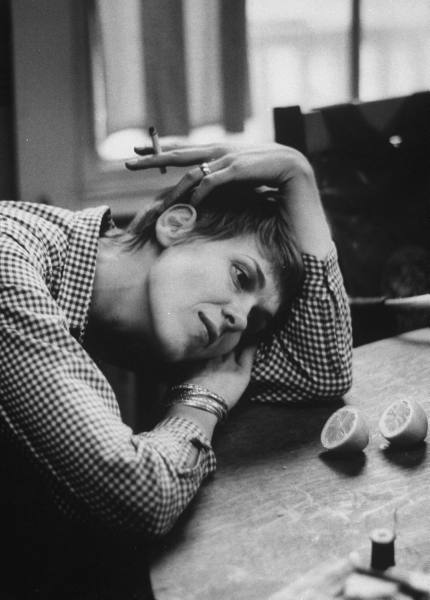
A kind of love is organizing all things, Amens everywhere “all over this land.” That’s what Leary thought, isn’t it? “The history of our research on the psychedelic experience,” he writes, “is the story of how we learned how to pray” (High Priest, p. 171). Let us include among the characters in this story IFIF medical director Madison Presnell. A photograph of Presnell appears in the April 16, 1963 issue of Life magazine. A photographer with the magazine accompanies Cambridge, MA housewife Barbara Dunlap on her first acid trip. Presnell administers the drug. The caption for the final photograph in the series reads, “Dunlap smokes a cigarette while seeing visions in the seeds of a lemon.”

Wednesday December 9, 2020

We’re seeking new practices, and a proper space in which to meditate, as churches and temples were for our ancestors. My grandmother prayed before statues. She built a stone grotto with a statue of Mary, and across from it a stone bench on which to sit, in a corner of her backyard. Hers was a magical world full of prayer beads, statues, jewelry, and shrines. She attended Catholic masses. I wish to honor her memory by creating a sanctum of some sort — a space akin to the meditation room at my previous home. I should try sitting in the loft above the garage, or outdoors, or in the sun room. Either that or I’ll just continue to recite mantras and prayers silently in bed each morning (as I have each morning since the move). Perhaps I should read some Thomas Merton. Or just observe His Dark Materials, with its magical, pluriversal cosmology mapped out Game of Thrones-style in its opening credits.