Sunday October 4, 2020

I prepare a series of video mini-lectures on Diane Di Prima’s Revolutionary Letters, Julius Lester’s telling of “Stagolee,” and Ishmael Reed’s Mumbo Jumbo. Along the way I glimpse the famous white patron of the Harlem Renaissance, Carl Van Vechen, as depicted by the Jazz Age artist Florine Stettheimer in her 1920 painting Asbury Park South.
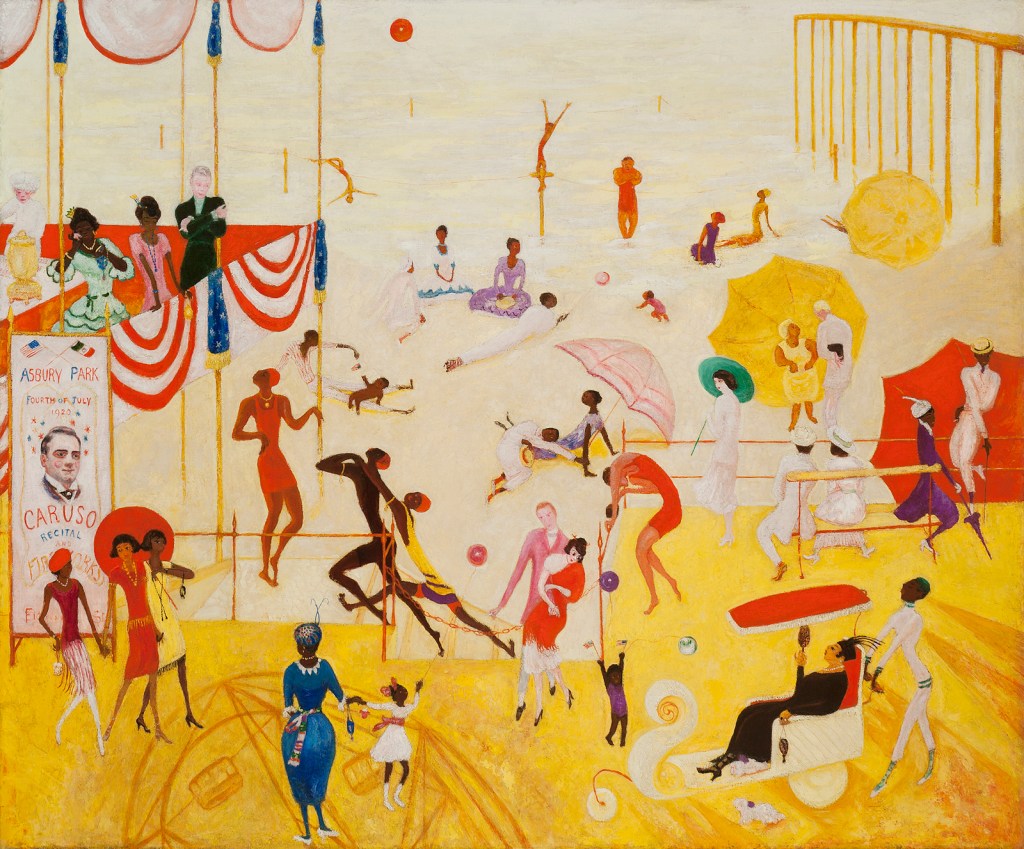
Van Vechen remains a controversial figure, in part due to his 1926 novel, the title of which I don’t wish to repeat (though it appears that Langston Hughes was one of the book’s defenders). Countee Cullen and W.E.B. Du Bois regarded it as an “affront to the hospitality of black folks.” Ralph Ellison condemned Van Vechen — as did Reed, given that he modeled Mumbo Jumbo‘s villain Hinckle Von Vampton after him.

Friday September 25, 2020

Students in my classes produced presentations on Beats, Hippies, and Millbrook. The third class was more comprehensive in its coverage — though none of the groups mentioned the new religions and religious organizations formed at Millbrook: the Neo-American Church, for instance, and the League for Spiritual Discovery. Practitioners of religion were targeted by government. These were utopian communities of love and peace: open, welcoming communities founded not through settlement but through sacramental use of psychoactive substances. They modeled for the civilization the Alternative, the solution to the economic and environmental crises. They also modeled, however imperfectly, an attempt at alliance with anti-racist, anti-colonial groups like the Black Panther Party and the American Indian Movement — a point neglected in the histories presented by my students. Is there more I could say to help them vote? Or is the action we must take vaster than that? Let us trust that the texts will lead the way, permitting us to say what needs saying.

Wednesday August 5, 2020

I’m planning to teach Diane Di Prima’s Revolutionary Letters (or excerpts therefrom, not the book in its entirety) in my course this fall. The work is a serial poem begun by Di Prima in 1968. It was published as part of the famed Pocket Poets Series from City Lights Books — the same series that released the original iconic edition of Allen Ginsberg’s Howl and Other Poems a decade earlier. Di Prima lived for much of 1966 with Timothy Leary’s crew in upstate New York on the Hitchcock estate in Millbrook.

Monday August 3, 2020

Leslie Marmon Silko published a critique of Gary Snyder’s Turtle Island in a 1977 issue of the Yardbird Reader. 1977 is the year she published her first novel Ceremony. And Yardbird Reader was a literary journal founded in 1972 by Ishmael Reed — a yearly anthology featuring writing by contemporary authors of color. Several of the writers I’m teaching this semester, in other words, wrote in dialogue with one another over the course of the 1970s. Silko titled her critique of Snyder “An Old-Time Indian Attack Conducted in Two Parts.”

Monday July 6, 2020

Some of these recent trance-scripts have been addressing and will continue to address for the remainder of the summer the course I’m planning to teach this fall. The idea is to sit with texts and think with them. Texts belonging to a rebellious current — particular expressions that leap across time, appearing throughout American history in the nation’s literature. Placed in dialogue, these texts reveal the Empire, the settler-colony in its pattern of continuous struggle with the land and its people. Rebellion occurs in these texts in open opposition to settler histories, settler temporalities, settler cosmologies. This course, of course, is a work in progress — and also a critique of progress. Yet here I am also learning to make pizza, dough and all. Or so was my hope before the baby woke. Sarah and I collaborate on a pair of dueling Sicilians.

Wednesday July 1, 2020

A friend and I chat about Octavia E. Butler’s Parable of the Talents. It was a good conversation — so I think. A substantive, earnest thinking-through together. There is agreement that this could become a “reading group” of sorts. We’ve at least agreed to read another book together. But perhaps I should refocus my energies elsewhere. Grow vegetables. Tend the land. On my shelf sits Leaves of Grass. Beside it sit other books relevant to my work as a teacher: Leslie Marmon Silko’s Almanac of the Dead and Thoreau’s Walden and Resistance to Civil Government. Time to clean up and make good. At some point I also ought to read Ernst Bloch’s The Spirit of Utopia. Sarah urges me to rethink. The book I need to read at present, she reminds me, is Leslie Marmon Silko’s Ceremony.

Tuesday March 31, 2020

Sustainability depends upon acts of reparation. Property needs to be redistributed. Families are struggling. Digital communication penetrates the life-world with anxiety. Demand a general strike. Or just slog through, do one’s best, whatever that means each day. Behave joyously. Memes have me wanting to re-watch The Big Lebowski. But when is there time? Hop in, do what is necessary, step out. Thus I scramble through the work-life balance complexities of remote teaching and parenting amid shelter-in-place. (While also trying to buy a home.) Seated, arms up across the top of a bench like a slouched cowboy, the protagonist eyes the room. Tips an imaginary hat in greeting. “In Dorn’s allegorical scheme,” writes Marjorie Perloff in her introduction to Ed Dorn’s poem Gunslinger, “characters exist, not as particular individuals but as functions of a larger mechanism, relational properties that take on meaning only in their interaction” (viii).

Sunday March 29, 2020

She’s growing quickly. She’s active, inquisitive, communicative, discerning. We hang out. We go for walks. We return home to home cooking and mother’s breast. The household looms large around the edges of each day. I come home from walks eyes heavy with pollen. Allergy season. I’m interested to see what students do with this week’s readings: texts by Abbie Hoffman and John Sinclair. I dig in and learn about Abbie’s friendship with Allen Ginsberg. The two writers admired each other’s work. Ginsberg influenced Yippie politics and Hoffman’s brand of revolutionary political theater through a piece he wrote called “Demonstration or Spectacle as Example, As Communication.” (Abbie’s archives are available, by the way, at University of Texas at Austin.)

Friday March 20, 2020

What does it mean to convert teaching into assembly of discussion forums plus creation and delivery of content within these forums within a piece of university-administered “classroom management” software? When do we get back to in-person gatherings of students and teachers? How under such circumstances does one practice a pedagogy of hope? Do we become video friends? Do we record little lectures, each of us seated before the camera-eye atop our laptops and smart phones, prisoners in a new kind of panopticon prison? But who knows? With a little practice, we can launch a jailbreak, a prison strike, a riot. Unless perhaps we use this as a moment to build ourselves up. I suppose it’s fitting that I started my career as a teacher, back all those years ago during training, with a short videotaped lecture on the panopticon. For that is what they’ve built around us with the camera atop the devices from which we work, now that our teaching is to be done online. These conditions have been imposed by fiat down a command chain, regional accrediting bodies the ones cracking the whip. Time to get to it.

Tuesday March 17, 2020

Time to head back to work, where remote / distance pedagogy is the new condition, the newly imposed norm, “until further notice.” A friend’s QuickTime lecture, “hot off the press,” as they used to say, sets me thinking about Queer responses to the AIDS crisis, that part of history surfacing again into consciousness. Another friend’s course description evokes Hurricane Katrina and the flooding of New Orleans. Mine, meanwhile, traces a “path of resistance” in American history as manifested in literatures of rebellion across the centuries. Even as we remember trauma, let us remain champions of hope. Think of it in terms of genre. Some raise consciousness; others deflate it. Inboxes can be filled with event cancellations or broadcasts from radio outlaws. Joe Strummer broadcasting from Radio Clash, Felix Guattari broadcasting from Radio Alice in the red Bologna of 1976. Sit outside in early evening, an hour or two before sunset, though, and it’s the same old birdsong, beautiful as ever, cars well in the distance. Do we scale up from this afterwards into tribes? An owl hoots; dogs bark; crows caw; two squirrels work cooperatively in a tree, plucking tufts of evergreen for a nest. Doom is not my thing.